Wajima Lacquer Ware

  • Overview
  • Production
  • Interviews

Wajima Lacquer Ware

The production of a piece of lacquer ware generally involves four main stages. First comes the making of the wooden carcass or core made of hard, durable woods. The skill of the craftsman is crucial at this stage as the wood must be properly seasoned to prevent bending or cracking, and the carcass needs to be finished to precise dimensions.
Before the carcass can be coated with lacquer, however, it must be filled and primed. The importance of this stage of the work cannot be underestimated as the quality of this preparatory work influences the durability of the piece and the quality of the finishing coats of lacquer.
With the priming complete, the actually application of the lacquer can now begin. It is the start of a process of repeated application and rubbing down of several layers of lacquer starting with the undercoat, and moving on to a middle coat and top coat. Humid conditions induce the lacquer to "dry", although strictly speaking it "hardens" rather than dries.
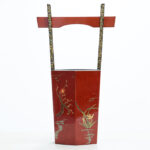
Everyday pieces of lacquer ware are mostly finished with a top coat only, although some pieces are decorated. This, too, is the domain of a specialist. There are a number of techniques in his repertoire. First there is the maki-e technique using gold and silver powders sprinkled onto wet lacquer. Then there is a chasing technique involving the applications of a special lacquer which is then incised with lines. A design then appears as these lines are filled with gold leaf. One other technique is mother-of-pearl work using patterns cut from thin pieces of iridescent shell.
Now let us look at some of the main stages of production.

Stage 1

Woodwork: There are actually four different types of cores or carcasses, which are made by specialist woodworkers. Turned items include soup bowls, bowls, plates and other such articles, which can be turned from wood on a lathe. Woods such as zelkova and a type of birch called mizume-zakura are used. The turner works with a lathe and chisels and gouges, which he makes himself.

Small pieces of joinery are mostly made from Hiba Arbor-vitae and include stacking boxes, inkstone boxes, and various kinds of trays. Besides hand tools such as saws, planes, chisels and pattern devices, automatic planes are now often used.

Some bentwood work is also made. Thin boards of wood are immersed in water to soften them before being bent into shape to make round or horseshoe shaped trays, and lunch boxes. Quarter sawn Hiba Arbor-vitae is the preferred wood. A number of power tools are used alongside such hand tools as saws, planes, small hatches, and the inevitable jigs in which the wood is bent.

The making of complex pieces of joinery are handled by yet another specialist craftsman using such woods as cucumber tree, katsura, and Hiba Arbor-vitae to make such small items of furniture as low tables, shelving and plant stands. Beside a number of power tools, such hand tools as saws, planes, chisels, craft knives, cramps and formers are mainly used, although small planes are very often used in the shaping of complex forms with curved surfaces.

Stage 2

Filling, Priming: Work at this stage involves filling any joins or junctions in the wood, strengthening any weak points, and the making of a strong, close applied surface. Apart from a working bench, the tools used are such things as a spatula, craft knives and planes. Use is made of a polishing turntable for rubbing down surfaces using a whetstone. The forming of a ground includes the use of three grades of powdered, burned earth that make this ware particularly robust.

Stage 3

Top Coat: Using a good quality lacquer, a number of layers of a top coat lacquer are applied separately with a brush. Having removed any dust with a special brush, another special brush is used to roughly apply an appropriate quantity of lacquer, after which yet another special brush is employed to apply the finishing coat. Any specks of dust or dirt that may fall on the wet lacquer are meticulously removed using a feather quill or fine maki-e brush. The piece is then placed in a revolving drying chamber to stop the lacquer from running, and occasionally turned over on a vertical axis, too.

Click on the picture for QuickTime Movie

Stage 4

Decoration: Various forms of decoration are employed. A lacquer containing no oil is used to work up a high gloss by repeatedly wiping on layers of lacquer, which are then dried and burnished to produce a mirror-like, transparent gloss. It is most delicate work which finally involves polishing the surfaces with the fingers and soft areas of the hands until not even the faintest of hairline scratches remains.

Maki-e work is another form of decoration. A sketch made on paper is transferred onto the piece and the outline of the design is painted in lacquer. Powders of gold and silver are then sprinkled on the wet lacquer. When this is dry further applications of lacquer are made and allowed to harden before being rubbed down to bring up the luster of the precious metals. Various forms of this technique are used including the basic or "flat" form of maki-e work, the "polished-out" form called togidashi-maki-e, and the relief form of this decorative technique called taka-maki-e.

Chasing is also employed. Working from a sketch, which is transferred to the piece, the design is incised into the lacquer using a number of different gravers. Lacquer is then lightly brushed into the engraved marks and any excess on the surface is wiped off with a handmade Japanese paper. After gold and silver leaf or powders have been applied to the incised design and fixed, excess material is wiped away to reveal the glowing decorative effects.

Click on the picture for QuickTime Movie

Page Top