Wood

Enjoyed by (Almost) All

Enjoyment of wood and wood grain seems to be a universal human pleasure. The Japanese are no different from other people in their enjoyment of the patterns of a wooden surface and of the texture of wood as a material. Yet, in the traditional Japanese house, there seems to be more bare wooden surface than is found in the architecture of many other parts of the world. This fact was brought home at the end of World War II, when the U.S. forces requisitioned many Japanese houses for personnel and, in a spasm of cultural assertion, proceeded to cover all uncoated wood surfaces with layers of paint. When the houses in question reverted to their owners, the paint was painstakingly removed and the wood returned to its uncoated purity. (The Occupation forces also painted the crumbly tuffaceous stone surfaces of F. L. Wright's Imperial Hotel.)

Ancient Origins

With three-fourths of the land area mountains, Japan was and is a land of deep forests and rich timber resources, both soft and hard woods. The excavation in 1996 of the Sannai-Maruyama site revealed a structure utilizing massive tree trunks as pillars, and changed the entire picture of the architecture and society of Neolithic (Jomon culture) Japan. It is now clear that sophisticated architecture (not just little huts) was being built at least as early as 4500 b.c., utilizing the wood of the land.

While Japan's pottery has one of the world's longest histories, everyday food vessels and containers used by the common people were mainly plain and sometimes lacquered wood until well into the 17th century. Wood in just about every form was almost synonymous with life itself. It is no wonder there are so many woodworking techniques and crafts and disciplines in Japan.

Dependent on Steel

The quality of a country's woodwork is directly dependent on the quality of the blade tools available, which, in turn is determined by the quality of metallurgy. Since Japan's carbon steel blade tools were developed to a high level at an early date, woodwork as well was highly advanced. Whether it be a farmer using an adze to gouge out a wooden bowl for his own use or a professional craftsman wielding tiny chisels to carve intricate transoms, the tools used were the best.*

Aristocratic Taste

Most of the folkcraft in wood has disappeared. The woodcraft industries and techniques remaining today are of the architectural or fine art persuasions. As mentioned briefly in the Buddhist Altars page, these are fine joinery, cabinetry, carving, latticework, lathework, bentwood, cooperage (including wooden bathtubs), and various kinds of carpentry.

*A visit to the splendid little Takenaka Carpentry Tools Museum in Kobe is rewarding for those interested in such things.

Joinery

Japanese joinery shares with its Chinese and Korean counterparts a delight in perfection. In architecture, structures were made by mortise and tenon, without use of pegs or nails. Architectural joinery is highly developed and has come up with various interesting developments, including ways to increase the length of a beam without sacrificing strength. The complex, puzzle-like joints of temples and pagodas never cease to fascinate and bewilder. Such joinery is why the "shrine carpenter" (miya daiku) is a profession separate from conventional house carpenter.

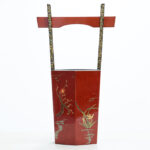
The joinery (sashimono) of fine cabinetry and of furniture are also separate professions. A compelling and technically precise subcategory is the joinery used to make small objects destined to be lacquered. This is known as honokiya and is quite different from conventional joinery, because the way the wood expands and contracts beneath the lacquer coatings demands special joint construction.

Round Things

Round and curved objects can be made by turning on a lathe, cooperage, and bentwood work. The first has a long and fascinating history in Japan; wooden eating vessels and bowls were made by itinerant turners or bowl bodgers, who traveled the country with a lathe on their backs making and selling their wares.

Cooper's work is particularly important in Japan, because one branch of the craft made the wonderful cypress and cedar bathtubs, which now are mostly a thing of the past. Whereas most households once had such a tub (unless the public bath house was a daily pilgrimage), fiberglass has taken center stage, and cypress tubs are made by only a few elderly craftsmen and are very much a luxury item.

Japan is one of the few countries in which bentwood work is still alive, though it once was worldwide. Coniferous wood is soaked then tied around a template, dried, and the ends fastened with bark strips. Scandinavia still makes some bentwood; South and Southeast Asian work uses bamboo rather than wood.

Intricate Detail

Woodcarving of all kinds still has vigor. The most spectacular objects are the transom carvings (ranma). The strength of simple statement was somewhat lost in this craft during the "bubble economy" years, when new money sought complex and overintricate detail to advertise personal wealth. Carvers are now attempting to rectify this and to create new markets for apartment dwellers and interior-conscious home owners by a return to simplicity and creation of new types of room dividers. The woodcarving craft of Inami city, Toyama Prefecture, has a program of inviting wood sculptors from various countries for a residence of two weeks to create a work in woods such as chestnut, beech, and camphor. Sculptors from Columbia, the Czech Republic, Russia, India, Hungary, New Zealand, Denmark, and Indonesia have participated in this vigorous exchange of ideas program.

Page Top