KURUME Kasuri (Ikat)

Fukuoka Prefecture

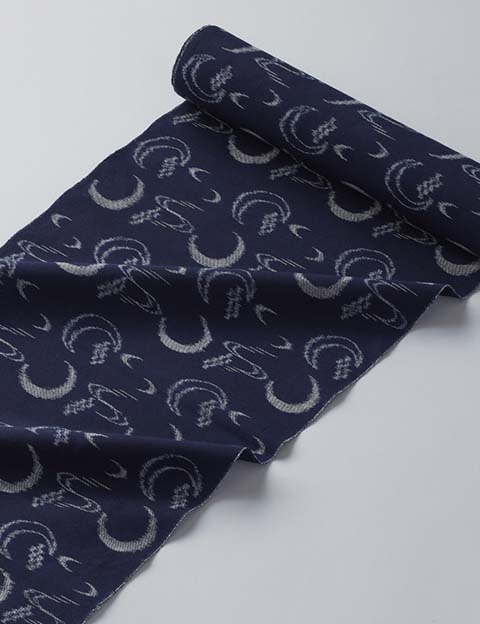
It was started in the early 19th century by a 12-year-old girl, inspired by a faded thread from an old piece of cotton cloth.
Subsequently, KURUME Kasuri (Ikat) developed as a cotton ikat production area with unique and distinctive techniques, including large and small patterned ikat, thanks to the encouragement of the industry by the Kurume Domain, which is located in the southwestern part of present-day Fukuoka Prefecture, and improvements such as the pictorial ikat technique and the small ikat technique.

  • Technology/techniques/raw materials

    Technology/techniques

    1. The fabric must be a kasuri textile woven using one of the following techniques or methods.
    (1) The fabric shall be plain weave with pre-dyed yarn.
    (2) Kasuri thread shall be used for warp and weft threads or as weft threads.
    (3) For inserting the weft threads, use a "hand-thrown shuttle" or a "flying shuttle with a footrest."

    2. The dyeing method for ikat threads shall be by "tying" or "weaving."
     

    raw materials

    The yarn used should be cotton.

  • Work scene

    Let's take a look at how KURUME Kasuri (Ikat) is made.

    Step 1: Pattern creation (design)

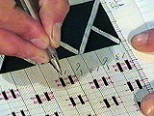
    We create the design while sketching out the image of the ikat pattern. This is an important production process that requires experience and skill.

    Step 2: Picture paper

    Based on the design, determine the distribution of warp and weft (vertical and horizontal), and then fill in the dimensions and number of feathers. Sometimes, this is done while simultaneously creating a preliminary sketch.

    Step 3: Making the length ruler

    Based on the picture paper, a bamboo stick 5-6 mm wide is marked with ink to create a vertical ruler (tatejaku). Each ruler is made to match the pattern and used accordingly.

    Step 4: Sketch

    The ikat pattern is redrawn, taking into account the shrinkage of the weft fibers, to match the paper.

    Step 5: Drawing the design with thread

    Based on a preliminary drawing that calculates the shrinkage rate of the weft thread, a guide thread is created to assist in tying the weft thread.

    画像をクリックすると動画が再生されます

    Step 6: Warp preparation

    The number of warp threads (ikat threads) and ground threads is determined according to the pattern, and then wound onto a large frame.

    Step 7: Weft preparation

    The weft threads are arranged in units of 20, according to the number of pattern elements within the length of the warp threads.

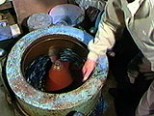
    Step 8: Thread boiling (scouring)

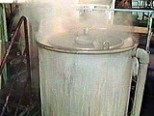
    To strengthen the thread and remove impurities, the thread is placed in a container and boiled.

    Step 9: Bleaching

    The yarn is bleached with a solution made by adding sodium bicarbonate to the supernatant liquid of bleaching powder.

    Step 10: Applying glue

    To prevent the threads from becoming tangled, a thin layer of wheat starch is applied and the fabric is dried in the sun.

    Step 11: Hand tying

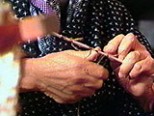
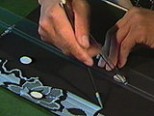
    The warp threads, divided into sections for the ikat pattern, are stretched evenly. A warp ruler is placed against these warp threads, ink is applied to the part to be tied, and it is tied with coarse hemp. The weft threads are prepared together with the pattern threads, so the marked parts of the pattern threads are tied in the same way as the warp threads. Subtle movements affect the finished product, so it requires great skill.

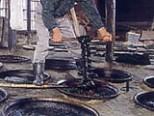
    Process 12: Indigo dyeing

    We use high-quality indigo from Tokushima and ferment it (indigo dyeing) for 7 to 10 days.

    Step 13: Indigo dyeing

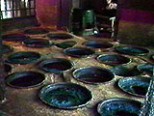
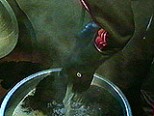
    There are 8 to 12 indigo vats lined up, and when dyeing, the yarn is dyed sequentially from the lowest concentration of under-indigo to the medium-indigo and then the highest concentration of under-indigo. After each dyeing, the skeins of yarn are squeezed and beaten thoroughly. This is done to allow the yarn to expand and come into contact with the air, which helps the indigo to oxidize, ensuring that the edges of the yarn are dyed well.

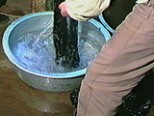
    Step 14: Rinse with water

    The yarn is washed with water to remove impurities and excess tannins during the indigo dyeing process.

    Step 15: Unraveling the Kasuri (ikat) fabric

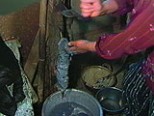
    After the dyed threads are rinsed with water, the coarse hemp fibers are quickly unraveled before the threads dry.

    Step 16: Wash and bleach

    After unraveling the ikat weave, soak the fabric in water for about 24 hours.

    Step 17: Gluing and drying

    To prevent the yarn from fraying or becoming unruly, apply a thin layer of starch, then dry it in the sun.

    Step 18: Vertical splitting (pattern matching)

    Each strand of thread is bundled together, aligning them with the pattern.

    Step 19: Gluing and drying

    Apply starch, drain the water, and quickly stretch the threads while they are still warm to dry. This prevents fuzzing of the threads, disruption of the ikat pattern, and tangled threads, as well as making weaving easier.

    Step 20: Insertion and reed threading

    The ikat threads and ground threads are arranged according to the number of threads determined by the pattern threads. The arranged threads are then passed through the reed (osaba) two at a time, leaving one reed open at a time from one side.

    Step 21: Vertical winding

    The winding box for the warp threads is fixed to the winding stand, and the ends of the warp threads are tied to create a beautiful ikat pattern.

    Step 22: Rib tying (Heddle threading)

    After the warp threads are wound onto a winding box, each thread is removed from the reed and threaded through the upper and lower heddles, one thread at a time.

    Process 23: Setting up the machine

    The threads, threaded through the heddles and reed, are set up in the hand in preparation for hand weaving.

    Process 24: Weft splitting

    Remove the embroidery thread and split it into strands of 20.

    Step 25: Frame lifting

    The threads, divided into groups of 20, are wound onto a weft frame.

    Process 26: Tube winding

    The thread is wound from the weft frame onto a bamboo tube that goes into the shuttle.

    Step 27: Hand weaving

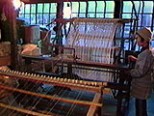
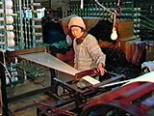
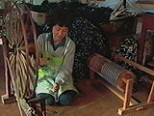
    A type of loom called a shuttle loom is used. The weft thread is passed through with the shuttle, aligned with the pattern of the warp threads, and the reed is beaten down. The quality of the finished product depends on the height of the heddles, the pressure applied by the foot pedals, and the way the reed is beaten, so hand weaving requires considerable experience.

    画像をクリックすると動画が再生されます

    工程28: 乾燥

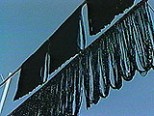
    The finished fabric is blanched in hot water and then hung on a pole to dry in the shade.

    Step 29: Fabric preparation

    While checking the width and finished size, cut to the specified length and fold into quarters.

    Process 30: Inspection

    The finished products are inspected by KURUME Kasuri (Ikat) Cooperative Association, and the producers attach a certificate of responsibility to the end of the fabric.


  • Close-up

    KURUME Kasuri (Ikat) breathes gently.

    The charm of KURUME Kasuri (Ikat) lies in its texture, exuding a simple yet warm feel through the meticulously woven patterns and carefully dyed indigo blue. The techniques and beauty, refined and passed down over approximately 200 years, seem to teach busy modern people the importance of taking a deep breath.


    Inoue Den, the creator of KURUME Kasuri (Ikat) (a type of ikat weaving)

    KURUME Kasuri (Ikat) was invented around 1800, at the end of the Kansei era, by a woman named Inoue Den (1788-1869), who grew up as the daughter of a rice merchant in Kurume. One day, Den noticed white spots on her clothes that had faded after being washed several times. Fascinated by the rough beauty of these spots, Den could not contain her inquisitive spirit. She quickly untied the clothes and tied them with white thread, following the black and white of the original threads. Then she dyed it with indigo dye and dried it, and then untied the threads. When she placed it on a loom, hundreds of white spots appeared on the surface of the fabric, and a new textile with a mysterious charm was born. Because this textile appeared faded in places, it was named "Kasuri." This was the beginning of KURUME Kasuri (Ikat).
    The techniques of hand-tying, indigo dyeing, and hand-weaving spread throughout the Chikugo region, and continued to develop even after the death of the original master. In 1957, it was designated as a National Important Intangible Cultural Property.
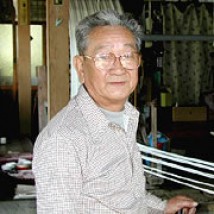
    We spoke with Shigetoshi Fukamachi, a traditional craftsman who continues to steadfastly uphold the 200-year-old tradition of KURUME Kasuri (Ikat) weaving through the "kukuri" (tying) process.

    Shigetoshi Fukamachi, a veteran craftsman with 50 years of experience in this field.

    KURUME Kasuri (Ikat) is a harmony woven by humans, machines, and thread.

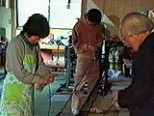
    On a warm spring day, Shigetoshi Fukamachi was working diligently in his workshop. Despite being busy, he stopped his work and told me various stories. Mr. Fukamachi was born in 1930, meaning he has been involved with KURUME Kasuri (Ikat) for nearly 50 years. In fact, he had graduated from a local industrial school and was scheduled to work for a shipbuilding company in Nagasaki, but his uncle half-forcibly dragged him in, saying, "Why do you have to go all the way to Nagasaki to collect your salary? You should work with KURUME Kasuri (Ikat), a local industry." So he became an apprentice to his uncle. At that time, the "tying machines" were not powered by electricity, but by human power. It was extremely hard work, having to keep stepping on the "tying machine" from morning till night.
    "On top of that, even when I turned 19, I didn't get a salary. Well, I did get a small amount of pocket money," Fukamachi says with a laugh. "In the case of this 'tying' technique, other craftsmen don't know about it, but each step is complex and difficult, and my uncle taught me carefully, step by step. However, if I wasn't a quick learner, he'd immediately give me a knuckle sandwich. I think I had about four years of apprenticeship like that. I've always liked machines, so I've never really thought this job was hard. But sometimes, even now, the thread just won't cooperate. Those times are tough. No matter how many times I try, it doesn't work the way I want, and I think, 'Oh man, this is so frustrating!' But machines and threads are living things, so they can't always be in a good mood. Kasuri weaving is a job where the 'machine,' 'thread,' and 'human being' have to work in harmony," Mr. Fukamachi said, smiling affectionately as he looked at the tying machine that has been running for nearly 30 years. Perhaps the simplicity of KURUME Kasuri (Ikat) is a reflection of the feelings of people like Ms. Fukamachi, who have a deep love for machines and threads.

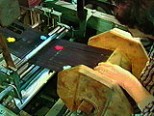
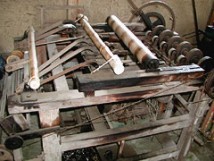
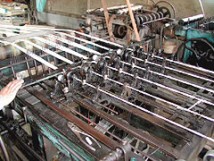
    When weaving complex and intricate patterns, the "manual binding machine" is still in use today.

    "A craftsman's honor is probably in being known as someone people can trust, someone they can rely on to make a good job."

    Even though Mr. Fukamachi is over 70, he is still very active. He is still extremely busy, from designing patterns to tying the fabric. Mr. Fukamachi proudly told us: "A craftsman's honor isn't about money. When the people who give us work, that is, the weavers, say, 'If we ask him, we can be sure it will be good,' it makes us really happy. Especially this tying work, it's the foundation of KURUME Kasuri (Ikat), so we take pride in it. When a weaver says, 'This job is difficult, so we want Fukamachi to do the tying,' it's not about the money anymore. It makes us feel motivated and say, 'Alright, leave it to me.'"
    During a trip to Kanazawa, she happened to meet a woman wearing a KURUME Kasuri (Ikat) kimono that she had designed and tied the threads herself. At the time, she was surprised, but also felt as if she were seeing a daughter she had given up to marry. She doesn't know how her meticulously crafted Kasuri kimono ended up in Kanazawa, but it was being cherished and worn by a complete stranger. "I was so happy then," Ms. Fukamachi said with a beaming smile. Perhaps it was a special kind of emotion that only someone who has poured their love into creating something can feel, an experience that is simply impossible to have in modern society.
    "But, you know, it's a sad state of affairs because there's a lack of successors. If you'd like, I'd be happy to teach you any technique. My dream is to carry on KURUME Kasuri (Ikat) into the 21st and 22nd centuries. I love Kurume, and of course I consider the traditional Kasuri to be a source of pride for my hometown, so I intend to continue working until the day I die."

    The "binding machine" continued to operate without taking a break even during the interview.

    The azaleas were in full bloom in the garden of Mr. Fukamachi's home. The azalea is the official flower of Kurume City. The traditional craftsman of KURUME Kasuri (Ikat) was a man who loved his hometown, loved his hometown's crafts, and loved his hometown's flower.

    Craftsman Profile

    Shigetō Fukamachi

    KURUME Kasuri (Ikat) pattern designer and traditional craftsman specializing in tie-dyeing. Born in 1930, he is a veteran craftsman with 50 years of experience dedicated to this craft.

    Anecdotes

    The history of the creation of KURUME Kasuri (Ikat)

    The birth of Den Inoue
    On December 29, 1788, a girl was born in the castle town of Kurume Domain. This was Inoue Den, who would later become the founder of KURUME Kasuri (Ikat) (a type of ikat weaving). Her father ran a rice shop. From a young age, Den loved weaving, and by the time she was 12 or 13, she had become skilled and was selling her textiles in the castle town.

    The creation of KURUME Kasuri (Ikat)
    Around this time (1800), there was an old indigo-dyed kimono that had been washed many times. In some places the dye had faded, leaving white spots, which puzzled Den. What was the structure of each individual thread? Not ignoring this question, Den actually unraveled the threads of the kimono, which became the impetus for the creation of KURUME Kasuri (Ikat). Den tied new threads in various places with other threads, just like the white areas that appeared on individual threads, so that those parts would not be dyed with indigo, and then dyed the fabric. When he wove the fabric with these threads, the surface of the cloth exhibited a unique texture. This was the beginning of KURUME Kasuri (Ikat).
    Because of his good reputation, Den began selling this textile in the castle town, branding it as "Kasuri." By the time he was 15, more than 20 people had gathered to learn from him. He married at the age of 21, but even after marriage, he continued to instruct his apprentices, selling his textiles with a certificate of authenticity that read "Kurumehara Koga Textile Shop Oden's Grand Premium Custom Made."
    In 1813, Den struggled to weave pictorial patterns into ikat fabrics, which could only produce mottled designs at the time. He consulted Tanaka Hisashige, who was then known as Giemon. At the age of 15, Hisashige perfected a method of assembling pictorial patterns and a machine that could be considered a board-clamping technique for ikat. This Tanaka Hisashige was known as "Karakuri Giemon" (Giemon the Karakuri) from a young age. He later moved to Osaka and Kyoto and became a famous figure who made many groundbreaking inventions, including the "Perpetual Clock" which is now on display at the National Museum of Nature and Science. He then moved to Tokyo and manufactured telegraph machines at a factory in Ginza, and also prototyped telephones. After his death, his successor, the second Hisashige, established the Tanaka Manufacturing Plant in Shiba, Tokyo, which later became the predecessor of "Toshiba."
    When Den was around 27 years old, her husband died of illness, leaving behind three young children. Den took her three children and moved into a small house diagonally across from her birthplace, where she continued to instruct her disciples.

    The establishment of KURUME Kasuri (Ikat) industry
    By 1827, when Den was 40 years old, he had as many as 1,000 apprentices, about 400 of whom scattered throughout the country and started their own weaving businesses. At this point, the production of KURUME Kasuri (Ikat) had moved from being a personal hobby to a group of self-employed individuals engaged in manufacturing and sales, in other words, the status of the "KURUME Kasuri (Ikat) industry" was established, and we can see here the founding of KURUME Kasuri (Ikat) industry (production area).
    In 1857, when Den was 70 years old, some volunteers from what is now Daizenji-machi in Kurume City asked him to teach their wives and daughters how to weave ikat textiles. As transportation was not as convenient as it is today, and it was too far to commute, they hesitated to leave their children with Den alone and requested that he come to teach them. Although Den was already elderly, he went to the area and stayed for a while to teach them. He also received a similar request from the headman of what is now Tachiarai-machi in Mii-gun and taught dozens of his daughters. It is said that he was no longer able to give hands-on weaving instruction, so he brought his granddaughter Tomo along to demonstrate.
    Thus, even in his later years, Den continued to teach ikat weaving techniques, and it is said that thousands of people received his instruction. As a result, it is said that there was no place in the Kurume domain (present-day Kurume City, Ogori City, Yame City, Chikugo City, Okawa City, Mitsui District, Mizuma District, and Ukiha District) where the sound of weaving could not be heard.

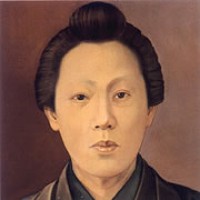
    • Portrait of Inoue KURUME Kasuri (Ikat), the creator of Kurume Kasuri (1788-1869)


overview

Craft item name KURUME Kasuri (Ikat)
Reading Curling
Classification of crafts fabric
Main Products Kimono fabrics, Western clothing, interior goods
Main manufacturing area Kurume City, Yame City, Chikugo City, Okawa City, Ukiha City, Hirokawa Town (Yame District), Oki Town (Mizuma District)
Designated date June 2, 1976

contact address

■ Production area association

KURUME Kasuri (Ikat) Cooperative Association
839-0809
5-8-5 Higashiaikawa, Kurume City, Fukuoka Prefecture
Inside the Kurume Regional Local Industry Promotion Center
TEL: 0942-44-3701
FAX: 0942-44-3705

Features

Kasuri is a type of pre-dyed textile. Because the ikat threads are created by tying them together and then dyed before weaving, the designs have a rich depth. This simple textile is widely used for kimonos, accessories, interior goods, and more.

How to make it

The process involves creating an ikat pattern, then preparing the warp and weft threads separately, tying the ikat patterns, and tightening the weave. Using these dyed ikat threads, the fabric is woven by hand, carefully matching the ikat design.

Please see here for information on traditional craftspeople.

Japanese traditional craftsman
top