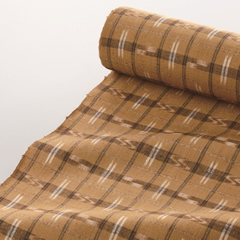
KUMEJIMA Tsumugi (Pongee)

Okinawa Prefecture

Around the 14th century, weaving techniques originating in India were introduced through trade with the South.
Furthermore, it is said that the island's weaving tradition began when sericulture techniques were learned from China and taught to the islanders, making it the birthplace of Japanese pongee silk. From the early Edo period to the latter half of the Meiji era, pongee silk was used as payment for the poll tax.

  • Technology/techniques/raw materials

    Technology/techniques

    1. The fabric must be a kasuri textile woven using one of the following techniques or methods.
    (1) The fabric shall be plain weave with pre-dyed yarn.
    (2) The warp threads shall be made of raw silk, and the weft threads shall be made of hand-spun raw silk.
    (3) A hand-thrown shuttle is used to insert the weft threads.

    2. The dyeing method for ikat yarn shall be by "hand-tying". In this case, the dye shall be a plant-based dye made from Smilax china, Rhaphiolepis indica, etc., and the mordant shall be mud or alum.
     

    raw materials

    The yarn used must be raw silk or hand-spun silk floss.

  • Work scene

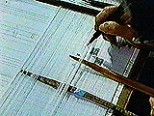
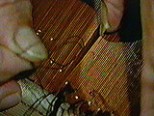
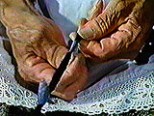
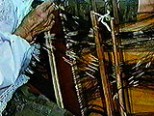
    KUMEJIMA Tsumugi (Pongee) is handwoven using natural dyes. The process involves spinning the yarn, tying the ikat patterns, dyeing, and weaving. It is a painstaking series of tasks, and the process before weaving can begin takes several months. In addition to mud dyeing, the final "kinuta-uchi" (beating with a wooden mallet) is another characteristic of KUMEJIMA Tsumugi (Pongee). Beating the fabric with a wooden mallet gives it a supple texture and a lustrous sheen.

    Step 1: Spinning the yarn

    warp threads
    The cocoons are boiled to soften them, the ends of the threads are pulled out, and the required number of threads are gathered to make a single thread. Using a reeling machine, the thread is wound while twisting, resulting in a high-quality thread with a round cross-section. The thread is wound onto bobbins. The bobbins are lined up and rotated while being unraveled vertically and twisted.
    weft
    After refining the cocoons in boiling water, float the softened cocoons in lukewarm water. Make a hole in the top of the cocoon, turn it inside out, and place it over your hand. Once it reaches a suitable thickness, put it on a silk floss rack to make square silk floss. Loosen the floss and pull out the threads, feeding them out while evening out the thickness with your fingers. Lightly twist the threads and wind them onto a bobbin.

    画像をクリックすると動画が再生されます

    Step 2: Design

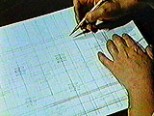
    Next, we choose the pattern. The patterns on Tsumugi silk fabrics are traditional and drawn from nature, plants and animals, and everyday life.

    Step 3: Kasuri tying

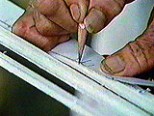
    The warp threads, which have been glued with potato starch called umukuji, are reeled in. The ikat threads are warped and stretched to obtain the required length and number. The ikat areas are marked using an ikat ruler. The fabric is wrapped in multiple layers of plastic and then tied with damp cotton thread. If the tying is too loose, the dye will seep in and the ikat pattern will lose its clarity. If it is too tight, the boundary between the ikat and the background will be too sharp, and the softness of the ikat pattern will be lost.

    Step 4: Seed thread preparation

    The weft threads are tied according to the diagram. The diagram and the diagram stand are fixed in place, and the starched white cotton threads are placed on the diagram stand. The seed threads are carefully marked with ink using a brush according to the diagram. After winding the weft threads, they are warped to the length of the seed threads. The seed threads are stretched along the weft threads, and the marked areas are tied.

    工程5: 染色

    The dyes are made using plant dyes native to the island. These include plants such as Rhaphiolepis indica, Myrica rubra, Smilax china root, and Citrus hibiscus. The dyeing process is carried out during a time when the humidity is low and the yarn dries quickly.
    In the case of mud dyeing
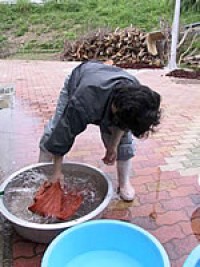
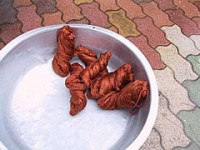
    Boil the finely chopped ghoul for 2-3 hours. Soak the yarn in the hot dye solution for about 30 minutes, then hang it to dry in a sunny place. Turn it over constantly while drying to prevent uneven dyeing. Repeat this 4-5 times a day for 10 days. Allow the yarn to dry completely to bring out the bleeding effect of the ikat pattern.
    The yarn that has been dyed with goo dye is now dyed with tekachi. This is repeated 6 or 7 times a day for about 14 days.
    Next, we dye it with mud. After soaking it in mud, we leave it to dry and then rinse it with water. We do this about seven times a day. Once that's done, we dye it again with tekachi dye. We repeat the mud dyeing and tekachi dyeing until we get the desired dark brown color.

    画像をクリックすると動画が再生されます

    Step 6: Temporary reed threading and winding

    The ground threads are starched and wound. The warp threads are prepared by gathering the required length and number of threads. Two ground threads are passed through the temporary reed at each stitch according to the design. The warp threads are stretched taut, combed, and wound up while maintaining a constant tension.

    Step 7: Unraveling the Kasuri (ikat) pattern

    The tied cotton threads are untied, starched, and stretched. The ikat pattern is aligned, starched, and pulled taut. The weft threads are untied in the same way as the warp threads. Each thread is wound up and separated into smaller portions. They are wound onto bobbins and set up on the loom.

    Step 8: Weaving

    The warp threads are arranged between the ground threads that have been passed through the temporary reed. The arranged warp threads are placed on the loom and passed through each of the two heddles, one thread at a time. Then they are passed through the reed and weaving begins. It takes about a month to weave one bolt of fabric.

    Step 9: pounding the cloth

    The folded bolt of fabric is wrapped in cotton cloth and beaten with a wooden mallet. This softens the cloth, gives it a sheen, and creates the unique texture KUMEJIMA Tsumugi (Pongee). After this, it is steamed and pressed, and then it is finished.


  • Close-up

    The mud-dyeing technique that has been passed down through generations in the Tsumugi region.

    Kumejima is said to be the birthplace of Tsumugi silk. Having learned sericulture from China, the foundations of weaving were established in the first half of the 17th century. We spoke with Yoshiko Momohara, who is trying to pass on the techniques inherited from her grandmother and mother to younger generations.


    KUMEJIMA Tsumugi (Pongee) features a glossy black background adorned with striking brown and yellow ikat patterns. The black base color used in this representative color scheme is achieved through mud dyeing. Achieving a deep, beautiful black that is neither reddish-brown nor brownish is difficult, and the dyeing process is repeated for a full month.
    I learned the general procedure from Yoshiko Momohara. Simply putting the yarn in mud won't make it black. Before that, you have to dye it 80 times with a plant dye, either Tekachi (Rhaphiolepis indica) or Guru (Smilax china). Because you have to dye and dry it repeatedly, this alone takes 25 days.
    Once the threads have turned brown, it's time for mud dyeing. The grandmothers of Kumejima get up at 3 a.m. to start the work. They put mud collected from the mountains into a large plastic bucket, soak the threads in it, and leave them for two hours. They wash the threads and soak them again, repeating this process about seven times a day.
    The next day, it's dyed with tekachi again. Then, after two or three days, it's dyed with mud, then tekachi again... and so on. The mud itself is grayish in color, not jet black. Yet, it dyes black because the iron in the mud reacts with the tannins in the tekachi.
    On the island, the month from the end of October is the mud-dyeing season, during which a year's supply of yarn is dyed. It's a very difficult task to do alone, so neighbors gather together and help each other out, a practice called "yuimaru." During that time, you can see yarn drying in the yards of houses everywhere.

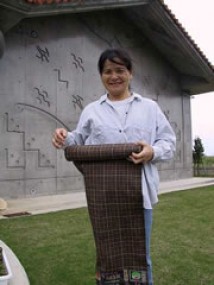
    Momohara Teiko's expression as she spreads out her artwork is bright.

    Kumejima is an island of silk weaving. You can hear the sound of looms as you walk through the villages. When Ms. Momohara was a child, she would wake up to the sound of her mother's loom. She started helping out when she was in junior high school. After graduating from high school, she worked in Gifu, but soon returned to Okinawa and studied dyeing and weaving at the prefectural crafts training center. For the past 24 years, she has continued to weave KUMEJIMA Tsumugi (Pongee), and her works have received high praise, including being selected for exhibitions.
    "The quality of the fabric is mostly determined by the tying and dyeing process," says Momohara. Tying involves wrapping the parts of the yarn that you don't want dyed with string before dyeing to prevent the dye from penetrating. It takes two to four weeks to tie four bolts of yarn, so the thread can cut the skin on your hands. Despite mentioning how hard it is, Momohara seems to be enjoying the process very much.
    "I love the preparation process. I really enjoy putting the yarn on the loom and starting to weave, and watching the pattern emerge. I could even give away the finished product," she laughs.
    From spinning the silk floss into yarn, designing the pattern, tying it, and dyeing it—all of this takes months, so weaving must feel like the finish line. It's easy to imagine the joy of seeing the perfectly calculated ikat pattern appear before your eyes.
    "I've been working with it since I was little, so I didn't have any trouble learning it, but as I continued, I came to understand how truly difficult it is. I haven't made a piece I'm completely satisfied with yet. There's always something I'm not happy with, like the colors not coming out well, or the thread being too thick."
    Ms. Momohara is currently trying to recreate the colors and patterns of the past. These are from the "Oezucho," a collection of designs sent by the Ryukyu Kingdom government in the 17th century to women on KUMEJIMA Tsumugi (Pongee) as tribute.
    "The colors were more abundant in the past. The craftsmanship was more elaborate, and the patterns were more complex than they are now. It's fascinating."
    His enthusiasm for his next project was so strong that he seemed unfazed by any hardships.

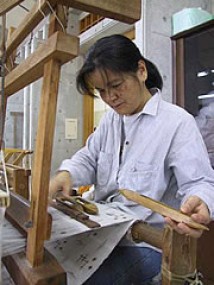
    • She becomes completely focused as soon as she starts weaving. Her movements are fast.

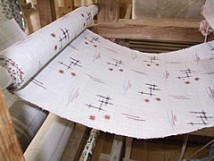
    • We are restoring each design from the illustrated atlas one by one.

    Craftsman Profile

    Teiko Toubaru

    Born in 1954. His works have been selected for exhibitions such as the Okinawa Prefectural Craft Exhibition. He is also active as an instructor.

    Anecdotes

    The joy of being able to do it all by yourself from start to finish.


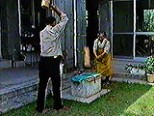
    • The one on the left in the foreground is a ghoul, and the one on the right is Tekachi.

    • Dyeing and weaving is physically demanding work.


overview

Craft item name KUMEJIMA Tsumugi (Pongee)
Reading Kumejima Tsumugi
Classification of crafts fabric
Main Products Kimono fabric, Western clothing, obi sashes, tablecloths, noren curtains, small accessories
Main manufacturing area Kumejima Town, Shimajiri District
Designated date February 17, 1975

contact address

■ Production area association

KUMEJIMA Tsumugi (Pongee) Business Cooperative
〒901-3104
1878-1 Majya, Kumejima-cho, Shimajiri-gun, Okinawa Prefecture
Tsumugi no Sato Yuimaru Hall
TEL: 098-985-8333
FAX: 098-985-8970

https://www.kume-tumugi.com/

Features

Because of its subdued base color, this garment can be worn by two or even three generations of a family simply by changing the obi (sash). Currently, summer Kumejima weaving is also available as a product. The supple texture of the spun yarn and the deep dark brown color achieved through plant dyes and mud dyeing gently envelop the wearer's body, making their skin appear fairer.

How to make it

The yarn is spun from silk floss obtained from silkworms, and the dyes are made using plants, tekachi, gouru, and Ryukyu persimmon. Everything is done by hand, and it is hand-woven. Because it is hand-woven with a hand-thrown shuttle, each thread is carefully aligned by moving two treadles up and down, creating a unique ikat pattern.

top