YUNTANZA Hana-ui (Flower Patterned Textiles)

Okinawa Prefecture

Based on the unique designs of Hanaori weaving, it is believed to have originated in the south, but the exact time of its arrival is unknown.
However, records indicate that it was produced in the 15th century, as it was given as a gift to Korea and from Java to the Ryukyu Kingdom. At that time, it is said that it was an official cloth for the Ryukyu Kingdom and could not be worn by ordinary people other than the residents of Yomitan.

  • Technology/techniques/raw materials

    Technology/techniques

    1. The fabric must be a patterned fabric woven using the following techniques or methods.
    (1) The fabric shall be plain weave with pre-dyed yarn.
    (2) A hand-thrown shuttle is used to insert the weft threads.
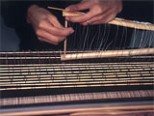
    (3) The crest shall be drawn using a "flower heddle" or a "sewn shuttle".

    2. When using ikat yarn, the dyeing method for the ikat yarn shall be "hand-tying".


    raw materials

    The yarn used must be raw silk or cotton yarn.

  • Work scene

    YUNTANZA Hana-ui (Flower Patterned Textiles) is a type of patterned weaving. Flowers and other patterns are woven in a way that makes them stand out. Unlike ordinary plain weave, which uses two heddles, this weave uses 8 to 11 heddles. These are called flower heddles. There is also a technique called hand-flowering (ti-bana) where colored threads are inserted using a bamboo spatula during the plain weave process. Both techniques are used in combination with ikat and stripes.

    Step 1: Design

    I draw the designs on graph paper with colored pencils. The basics are three floral patterns: Jinbana (coin flower), Kajimaya (windmill), and Ojibana (fan flower). I then create patterns by combining these with over 30 geometric patterns, ikat, and stripes.

    Step 2: Kasuri tying

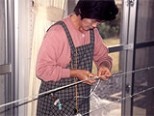
    Silk threads are stretched horizontally, and the parts that you don't want to dye are tied with cotton threads. Cotton tightens when it absorbs moisture, making it difficult for the dye to penetrate. The threads are tied at equal intervals, with widths of 8 mm, 6 mm, and 1 cm. Once tied, the fabric is dyed. Dyes used include Fukugi, Tekachi (Rhaphiolepis indica), Guru (Smilax china), Shiitake, and Ryukyu indigo.

    Step 3: Winding the thread

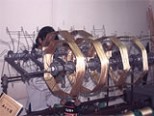
    To make the thread easier to use, it is wound into skeins and then onto bobbins.

    工程4: 整経

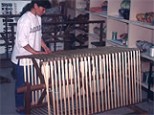
    This is the process of adjusting the weaving width and the length of the garment. The number and length of the warp threads are aligned. In the case of garment fabric, there are 28 threads per centimeter width.

    Step 5: Temporary reed threading

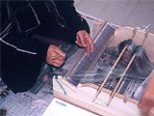
    The warped threads are passed through a reed of the desired width. The upper and lower threads are paired together and passed through the holes of the reed. For a 40cm wide piece of fabric, 1120 threads are passed through.

    Step 6: Vertical winding

    Pull and straighten the thread that has passed through the reed, then begin winding it. Take care to ensure that the tension is even.

    Step 7: Threading the heddles

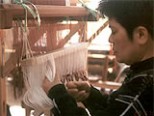
    Remove the reed and thread it through the heddles. Thread the threads one by one, separating them into front and back. This ensures the weft threads are neatly positioned between the warp threads.

    Step 8: Attaching the heddles to the flowers

    The threads are passed through the heddles. This is where the pattern of the floral weave is determined. There are usually 8 to 11 heddles.

    Step 9: Separating the Kasuri pattern

    The ikat weft threads are unraveled and wound onto a bobbin. This is then placed into the shuttle.

    Process 10: Weaving

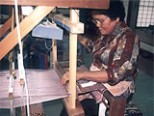
    The weaver raises and lowers the heddles using a foot pedal while weaving. Typically, they weave about 40 centimeters a day, and one bolt of fabric takes about two months to complete.


  • Close-up

    A delicate flower guar woven with a serene heart

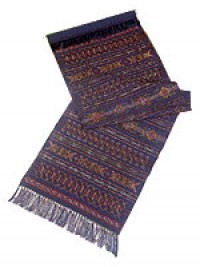
    Hanaori, as its name suggests, is a lovely fabric woven with floral patterns. Traditionally, it features red and yellow dots on a dark blue background. Because the flowers are represented by tiny square dots, it looks like intricate embroidery.


    The legendary textile has been brought back to life.

    The floral patterns, locally known as "Hanagua," have three basic designs: Jinbana (money flower), Kajimaya (windmill), and Ojibana (fan flower), which are used by arranging their size and combinations. Adding ikat and stripes to these creates a three-dimensional effect on the fabric.
    During the Ryukyu Kingdom era, Yomitan flourished as a trading hub with China and Southeast Asia. Amidst the influx of foreign cultures, Hanaori weaving took root locally around the 15th century. Designated as an official fabric and protected by the royal government, it declined from the mid-Meiji period after the abolition of the feudal domains and the establishment of prefectures, eventually becoming a legendary, almost mythical, textile. In 1964, thanks to the efforts of Sada Yonamine, who later became a Living National Treasure, Hanaori weaving was revived. With the village's support, the number of weavers gradually increased.

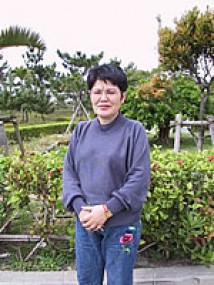
    Sumiko Aragaki is a brisk and energetic person.

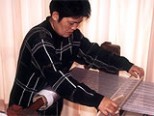
    Weaving involves using your hands, feet, and your whole body.

    Sumiko Arakaki started weaving 20 years ago at the suggestion of her husband, Takashi, who works in dyeing. While some weaving is relatively easy once you start weaving, even though preparing the yarn is difficult, with Hanaori weaving, the hard work continues even after you begin weaving.
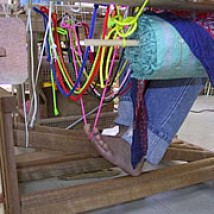
    In ordinary plain weave, the weft thread is passed through a gap between the upper and lower threads, so the weaver alternately pulls down two heddles with their feet. In floral weave, however, there are as many as 10 heddles (floral heddles). The weaver pulls the 10 strings hanging from the heddles in sequence with their feet while weaving. It's like an acrobatics act. The more heddles there are, the more complex the floral pattern becomes.
    "I easily use 15 to 20 pieces. Since I design them myself, I know which ones to pick. I weave while moving my whole body, both my hands and feet. Weaving is a battle against time, and a battle against myself. If I don't do it, it won't become cloth."

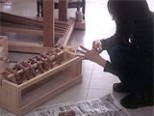
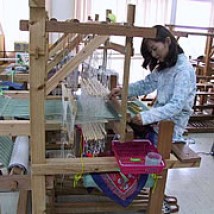
    The flower heddles are arranged in a row in the center of the trainee's loom.

    I can always immediately recognize things I've created, no matter how many years pass.

    The most important thing is to approach it with a calm mind. "When you're irritated and in a bad mood, you're bound to make mistakes. It takes a whole day to fix them. I stopped arguing with my husband 20 years ago. If you can't control yourself, then don't work that day."
    In the future, I want to create things that no one else can imitate. I want to incorporate a sense of the seasons and design colors and patterns that I myself would want to wear.
    "I'd love to meet someone wearing something I made. You can tell right away if it's 20 years old because I don't make the same things as everyone else. I can also tell immediately whether the dyeing is done by me or someone else."
    My husband, who is also in the same profession, is my closest critic.
    "I've never been praised even once. I've come here mainly because I wanted to be praised. I wonder how many more years it will take before I get praised."
    It seems I won't be able to leave Kaori anytime soon.

    Weaving by pulling the string with your feet

    Craftsman Profile

    Sumiko Shingaki

    Born in 1949, he has received numerous awards and is also involved in mentoring successors.

    Anecdotes

    A teaser expressing feelings for a loved one.

    In Yomitan, tenugui (Japanese hand towels) are called tisajji (hand towels). Hanaori tisajji have long been used as gifts. According to Takashi Arakaki, chairman of the YUNTANZA Hana-ui (Flower Patterned Textiles) Business Cooperative, "This is called tiibana, a technique often used for obi (kimono sashes). It is the most primitive technique among patterned weaving methods. It is not difficult, but it is time-consuming. Because the threads are inserted by hand, various patterns can be created as the weaving progresses."
    In the past, women would weave elaborate patterns and present them to the men they loved. These were called "umui (feelings) tisaj." It seems that women competed with each other, thinking, "If she weaves something of that caliber, I'll weave something even better," so no two designs are the same. "Uminai (prayer) tisaj" were woven to pray for the safety of those traveling to China or mainland Japan. A journey to China was called "tōtabi" and was undertaken with the understanding that one might lose their life. The word "tōtabi" is now used to mean that someone has died and is buried in a grave. Women wove tisaj with all their hearts for their family and loved ones, praying for their safe passage on such a dangerous journey.

    • Tissage woven with individual designs


overview

Craft item name YUNTANZA Hana-ui (Flower Patterned Textiles)
Reading Yuntanzahanaui
Classification of crafts fabric
Main Products Kimono fabric, table runner, obi
Main manufacturing area Yomitan Village, Nakagami District
Designated date June 2, 1976

contact address

■ Production area association

YUNTANZA Hana-ui (Flower Patterned Textiles) Business Cooperative
〒904-0301
2974-2 Zakimi, Yomitan Village, Nakagami District, Okinawa Prefecture
TEL: 098-958-4674
FAX: 098-958-4674

http://www.yomitanhanaori.com/

Features

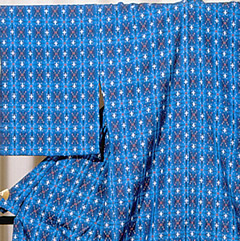
This textile exudes a tropical charm, featuring delicate and intricate floral patterns created with colored threads, enhanced with the texture of ikat weaving. The patterns include heddle flowers, hand-painted flowers, and ikat, and the combination varies depending on the product; for example, the bolt of fabric may feature heddle flowers and ikat, while the obi fabric and hand towels may feature heddle flowers, hand-painted flowers, and ikat.

How to make it

A hand-thrown shuttle is used to insert the weft threads, while a floral heddle or embroidery shuttle is used for patterned weaving. Ikat threads are tied by hand, and plant dyes such as Ryukyu indigo, Rhaphiolepis indica, Garcinia subelliptica, Smilax china, and Citrus aurantium are used for dyeing. The ground warp threads and warp ikat threads are set up on the loom, and floral heddles are attached, and the fabric is woven on a high loom.
top