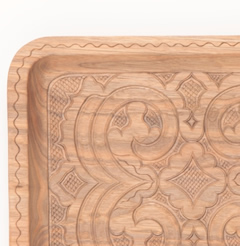
NIBUTANI Ita (Wood Trays)

NIBUTANI Ita (Wood Trays) has been passed down for over a hundred years by the Ainu people and others living in the Saru River basin. Records show that half-moon trays and round trays were presented as tribute from this region in the mid-19th century.

  • Technology/techniques/raw materials

    Technology/techniques

    1. Carving on the wood surface shall be carried out using the following techniques or methods:

    (1) To carve Ainu patterns such as Moreunoka, Aiusinoka, and Shikunoka into the wood.

    (2) Filling the spaces between patterns with ramramnoka (scale-shaped) carving is called "scale carving".
     

    raw materials

    The wood used for the base shall be walnut, katsura, or a material of equivalent quality.

overview

Craft item name NIBUTANI Ita (Wood Trays)
Reading Nibutani
Classification of crafts Woodwork/bamboo products
Main Products Trays, small items
Main manufacturing area Biratori Town, Saru District
Designated date March 8, 2013

contact address

■ Production area association

Nibutani Folk Craft Association
〒055-0101
77-14 Nibutani, Biratori-cho, Saru-gun, Hokkaido
Biratori Ureshipa, a general incorporated association
TEL: 01457-3-7501
FAX: 01457-3-7502

Features

This shallow, flat wooden tray is a practical item that can be used for a long time in daily life, but it is also a beautiful craft item that is adorned with Ainu patterns such as Moreunoka (spiral shape), Aiushunoka (spike shape), and Shikunoka (eye shape), as well as scale carvings called Ramramnoka (scale shape).

*In Ainu script, the "shi" in "aiusinoka," the "ku" in "shikunoka," and the "mu" in "ramramunoka" are written in lowercase.

How to make it

① The logs are sawn into planks and air-dried for 3-4 years. ② Plank cutting (the surface of the planks is flattened and cut to the desired size). ③ Shaping (rough cutting is done, and the bottom and corners are shaped). ④ Pattern carving (a preliminary drawing is made, and lines are carved along the drawing. Indentations are carved to deepen the shading of the patterns, and double lines are drawn around the main patterns to enrich the carving's expression). ⑤ Scale carving (scales are carved into a grid pattern and then carved out).

Please see here for information on traditional craftspeople.

Japanese traditional craftsman
top