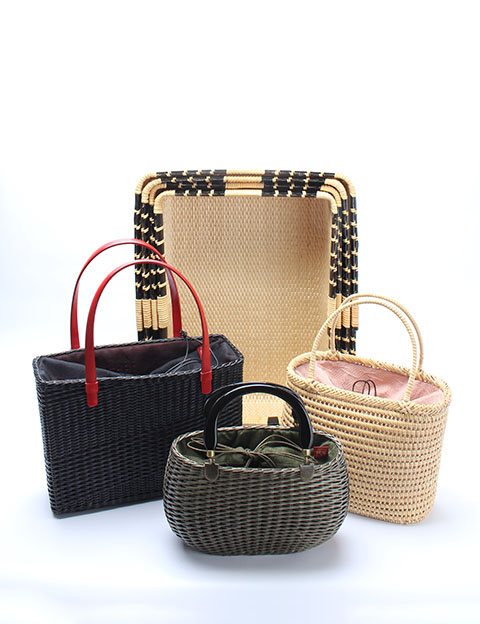
TOYOOKA Kiryuu Zaiku (Willow Basketry)

Hyogo Prefecture

The origins of willow weaving date back to the beginning of the 1st century, and a "willow box made in Tajima Province" still remains among the treasures of the Nara Shosoin.
Willow weaving, which began with weaving baskets from willows growing in the wasteland along the Maruyama River, took shape as an industry when Toyooka became a castle town.
During the Edo period, the feudal lord protected and encouraged willow weaving and established a monopoly system, which led to Toyooka products becoming known to the world.

  • Technology/techniques/raw materials

    Technology/techniques

    1. In the case of willow baskets, the following techniques or methods shall be used:
    (1) To soak in water.
    (2) A bamboo bow should be used for the bow string.
    (3) "Sashi" is performed by fixing the bow string to the wooden support.
    (4) The weaving should be done while holding the material in place with a pressing block.
    (5) To "add a grandchild" to the family.
    (6) For "raising the mountain," use a wooden mallet and a wooden hammer.
    (7) Use the word "toji" for "edge wrapping".

    2. For small trunks, the following techniques or methods shall be used:
    (1) To soak in water.
    (2) A bamboo bow should be used for the bow string.
    (3) The knitting shall be done while the material is fixed with a presser foot. In this case, the knitting shall consist of flat knitting and mountain knitting.
    (4) Use "toji" for "edge wrapping".

    3. Willow baskets and rattan baskets shall be made using the following techniques or methods:
    (1) When performing "willow splitting," use "splitting boards."
    (2) When performing "chamfering," use "width determination."
    (3) Soaking in water.
    (4) The "bottom weave" shall be made by "split cross bottom weave", "cross bottom weave", "well frame bottom weave", "rice grain bottom weave", "oval bottom weave", "square bottom weave", or "common bottom weave".
    (5) If you do not perform the "common base weaving" method, perform the "vertical core bending" method first, and then perform the "rope weaving" method.
    (6) The "side weave" shall be made using the "regular weave," "rope weave," "fly weave," or "variation weave."
    (7) The "marriage" shall be by "mutual marriage" or "circular marriage".
    (8) When using the "lid weave," use the "regular weave," "rope weave," or "fly weave."
     

    raw materials

    1. The main material shall be willow or rattan.

    2. The bamboo used shall be Madake, Moso bamboo, or a material of equivalent quality.

    3. The yarn used shall be made of hemp or a material of equivalent quality.

    4. The side reinforcement material to be used shall be canvas or a material of equivalent quality, or leather.


  • Work scene

    TOYOOKA Kiryuu Zaiku (Willow Basketry) is famous for its willow baskets and rice containers, but here let's take a look at the manufacturing process using baskets as an example.

    Step 1: Knitting the base

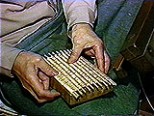
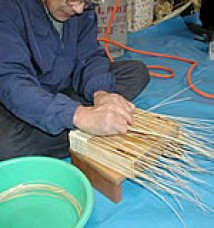
    First, we begin weaving the base, arranging thick willow logs that will serve as the "vertical supports" for the weaving process. Then, we weave the thinner willow logs, which will serve as the "weaving threads," perpendicular to the vertical supports. The finished product will vary depending on how tightly the weaving threads are pulled. Weave carefully, making sure that the dimensions are correct.

    Step 2: Weaving the lid

    Next, we weave the lid, using more vertical threads than the base. For the weaving thread, use thin, aesthetically pleasing willow. Once woven, adjust it to match the curve of the lid.

    Step 3: Secure the base to the bottom of the wooden mold and insert the vertical supports.

    Checking the marks for the vertical positions, make holes between the marks using a flat stitch. Insert the vertical pieces into the holes with the cut ends facing downwards. Then, bend the vertical pieces and secure them with a cable braid. Braid around twice and add reinforcing cores to both sides of the vertical pieces.

    Step 4: Side knitting

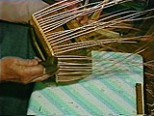
    After braiding ropes with three logs, the process gradually ascends using over 20 different techniques, including "straight braid," "skipping braid," "shrike braid," and "armor braid." Once the braiding is complete to the required extent, the wooden mold is removed and the "edge braiding" is done. A technique called "prayer edge" is used to ensure that the lid fits snugly. Finally, when only two vertical beams remain, the beams are threaded through each section using binding tools and braided. Finally, any excess willow is trimmed with a knife to shape the body, completing the main body.

    画像をクリックすると動画が再生されます

    Step 5: Weaving the top lid

    Just like with the base, knit it in the same way, following the pattern.

    画像をクリックすると動画が再生されます

    Step 6: Make the handle

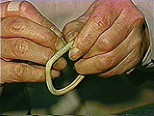
    A ring of rattan is used as the core, and thin strips of willow are wrapped around it to create the handle.

    Step 7: Attach the handle and lid.

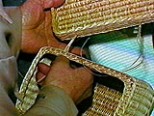
    Thread the braided willow cord through the body and attach it to the lid. That's it!

  • Close-up

    TOYOOKA Kiryuu Zaiku (Willow Basketry) Reborn

    Willow baskets (yanagigori) were once a common sight in the closets of almost every home. They were indispensable for moving or traveling. Rice baskets (meshigori) were also highly valued as lunch boxes. These willow crafts from Toyooka, once immensely popular, are now in danger of being forgotten. What does the future hold for them? We asked a traditional craftsman with 40 years of experience.


    The softness and strength of the willow

    "It looks very soft, which is probably what attracts people to it. But the material itself is very hard and strong," says Masao Yagita, a traditional craftsman. Indeed, it looks soft, glossy, and sometimes gives a feeling of coolness, but when you touch it, it is solidly made. Yagita says, "The quality of the material is the charm of willow crafts." But what exactly is willow? Willow is the "Koriyanagi" tree, a member of the Salix genus in the Salicaceae family. Unlike ordinary willows with drooping branches, it is a deciduous shrub that grows near water. It has the characteristics of being highly hygroscopic and resistant to insects. For this reason, it has been used as a material for clothing boxes and lunch boxes. When dry it is very hard, but when it absorbs moisture it becomes soft and easy to process.

    Knitting work scene

    Time-consuming cultivation and peeling

    When demand was high, raw materials were gathered in Toyooka from all over the country, and there was no shortage of raw materials. However, now they cultivate the amount they need for their own production. They plant them in the fields, harvest them every autumn, let them overwinter, and then in the spring, they plant two or three stalks at a time in the rice paddies. New shoots emerge, and sap flows between the bark and the stem, making it easier to peel. "This is the only time it peels easily. This is when we peel the bark," Yagita explains, describing the delicate timing. After peeling, they wash the bark thoroughly in the river to remove the slime, and then dry it in the shade before using it after the summer solstice. They prepare the raw materials in various forms, from thick pieces to thin strips. When making the crafts, they keep the materials wet, but since they harden when dry and become difficult to work with, they often work without air conditioning, even in the summer. It is a very laborious job, but that is what makes willow weaving so profound.

    The flow of time

    Even after the war, they were busy producing shopping baskets and baskets, and demand did not drop even during the 1973 oil crisis. However, when large quantities of products were imported from China around 1977-1978, demand plummeted. "It was really tough back then. In some cases, we even processed semi-finished products from China in Toyooka. Cheaper products, even if they were of poor quality, were more popular," recalls Mr. Yagita, reflecting on that time.

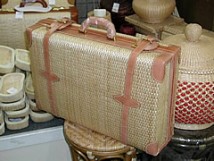
    Willow weaving attaché case

    Traditions passed down

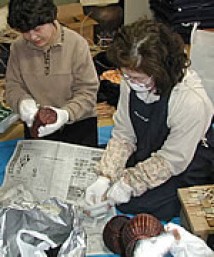
    The decline in demand has forced a change in its raison d'être. In other words, it has shifted from a practical item to a craft. How can the inherent value of the willow's characteristics be conveyed? How can people be nurtured to carry on the tradition? Currently, Ms. Yagita teaches 30 people in the beginner's course and 11 in the specialist course. Two to three people advance from the beginner's course to the specialist course at any given time. Many new experiments are being conducted there, such as plant dyeing and lacquer dyeing. Plant dyeing uses butterbur, azalea, sow thistle, white oak, and kudzu as raw materials. For lacquer, cashew is now the main material. The shapes are also being arranged in a modern style, resulting in the creation of free and creative works. Many of the students are housewives, and the quality of the work is changing from that of a craftsman to that of a craftsman and artist. Traditional crafts are being reborn with new participation at the citizen level. They are breathing life into the world once again.

    Scenes from a specialist course training session.

    Craftsman Profile

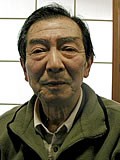
    Masao Yagita

    Born in 1926 (Taisho 15).
    A traditional craftsman with over 40 years of experience in willow weaving. She also worked for many years at the prefectural crafts instruction center. Her love and passion for teaching are evident.

    Anecdotes

    Escaping from a precarious situation


    • Willow crafts in the shape of animals

    • Chairman Eiichi Tanaka


overview

Craft item name TOYOOKA Kiryuu Zaiku (Willow Basketry)
Reading Toyooka Kiryuzaiku
Classification of crafts Woodwork/bamboo products
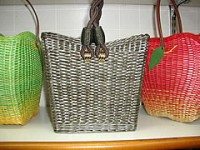
Main Products Willow baskets, baskets
Main manufacturing area Toyooka City, Yabu City, Kami Town, Mikata District
Designated date October 8, 1992

contact address

■ Production area association

Hyogo Prefecture Willow Products Cooperative Association
668-0801
1362 Akaishi, Toyooka City, Hyogo Prefecture
TEL: 0796-23-3821
FAX: 0796-24-0913

Features

The basket weaving techniques, which utilize the natural beauty, strength, flexibility, softness, and resilience of wood, involve weaving each basket by hand. These techniques include 6 types of rope weaving, 33 types of side weaving, and 18 types of edging, resulting in a variety of works depending on the intentions of the craftsman.

How to make it

Willow weaving utilizes the properties of willow and rattan, which soften when soaked in water and harden when dry. Baskets are woven using willow and hemp thread, and then finished with a rim. Baskets are woven from the base, attached to a wooden mold, bent into vertical cores, secured with rope weaving, woven on the sides, and then the mold is removed and the rim is assembled to finish the piece. Various techniques are used at each stage to complete the work.

top