ECHIZEN Uchihamono (Forged Blades)

Fukui Prefecture

It is said that the origin of this craft began in the early Muromachi period when a swordsmith from Kyoto came to this area in search of land suitable for sword making, and started making sickles for nearby farmers.
During the Edo period, thanks to the protection of the Fukui domain, these products began to be sold throughout Japan. In 1979, the region became the first to be designated as a traditional craft for cutlery production.

  • Technology/techniques/raw materials

    Technology/techniques

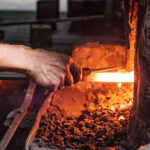
    1. The shaping process involves heating the blade steel in a furnace and then hammering and widening it.

    2. The "spreading" of a double-edged knife should be done by stacking two blades together.

    3. Sickles and machetes shall be fitted with a "groove".

    4. For quenching, apply a "mud coating" and then rapidly cool.

    5. "Sharpening," "sharpening," and "finishing" must be done by hand.

    6. When finishing the knife, apply a "blurring" effect.
     

    raw materials

    1. The materials to be used shall be iron and carbon steel.

    2. The handle shall be made of wood.

  • Work scene

    ECHIZEN Uchihamono (Forged Blades) require numerous processes to complete, and are masterpieces that embody considerable physical and mental strength, as well as the fusion of forging and refinement. From the raw materials of base metal and steel, true works of art are born. Here, we will introduce the general process.

    Process 1: Steelmaking and base metalmaking

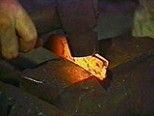
    The steel is heated to approximately 800 degrees Celsius and then forged to the desired size.

    Step 2: Interruption and boiling

    The base metal is split, grooves are made, steel is inserted, and then the steel and base metal are forge-welded together.

    Step 3: Preparation and trimmings

    Shape the flat part of the knife and cut it off to the length of one knife blade.

    画像をクリックすると動画が再生されます

    Step 4: Core removal

    We will now forge the part that goes inside the handle.

    Step 5: Spread out the two pieces

    Place two sheets of paper on top of each other and flatten them to the desired size.

    Spreading two pieces of a kitchen knife (kitchen knife)
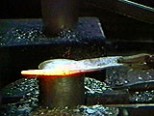
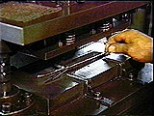
    This process involves quickly striking two stacked pieces of metal from both sides with a belt hammer (traditionally, this was done by two people using a large hammer and one using a small hammer) to ensure both pieces are flattened to an even thickness. This is because stacking the pieces doubles the thickness, allowing the belt hammer's compression force to work more effectively, and also helps maintain the temperature, resulting in less unevenness in the finished product. This is a characteristic of ECHIZEN Uchihamono (Forged Blades).

    Step 6: Annealing

    After heating to approximately 800 degrees Celsius, it is allowed to cool naturally in the air.

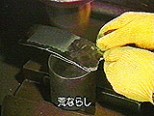
    Step 7: Removing mud and rough leveling

    Remove any attached debris and smooth the surface with a belt hammer.

    Step 8: Finishing and leveling

    Lightly tap it with a hammer to straighten it out and shape it.

    Step 9: Cutting and shaping

    Cut off any excess material to match the desired shape.

    Step 10: Heat treatment

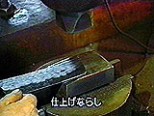
    After applying mud and heating to 800°C, it is quickly cooled in water and then baked.

    画像をクリックすると動画が再生されます

    Step 11: Tempering

    To give the steel toughness, it is heated to 150-220°C for about 30 minutes, and then gradually cooled in the air.

    Step 12: Rough grinding and medium grinding

    Use a coarse whetstone to create the basic shape, then use a finer whetstone to sharpen the edge horizontally to a fine point.

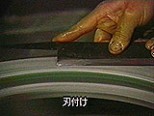
    Step 13: Sharpening the blade

    We carefully sharpen the blade.

    Step 14: Finishing sharpening

    The entire knife is polished until it shines, the sharpened edges are blended using a blending machine, and the secondary bevel is then aligned to complete the process.

    In the case of sickles and pruning shears, step 5 is "attaching the steel," and it will be as follows:

    The method of attaching steel, said to have been devised by Chiyozuru Kuniyasu, is called the Masaoki method for ECHIZEN Uchihamono (Forged Blades). After forge-welding the steel to the base metal, the entire piece of steel is flattened into a diamond shape starting from one corner. This allows the steel to be made thinner, making it easier to sharpen and resulting in a superior edge. This method, unique to ECHIZEN Uchihamono (Forged Blades), requires considerable skill in forging techniques compared to products made using the "Hiraoki method," which is commonly used in other production areas throughout Japan, and the resulting products are far superior.


  • Close-up

    700 years of tradition, refined craftsmanship. "ECHIZEN Uchihamono (Forged Blades)"

    Echizen City, a central city in Fukui Prefecture, is home to the renowned "ECHIZEN Uchihamono (Forged Blades)." Its exceptional sharpness and ease of use stem from the unwavering dedication and consistent passing down of authentic techniques.


    Passion and dedication. Unrelenting technological innovation has established the unique techniques ECHIZEN Uchihamono (Forged Blades)

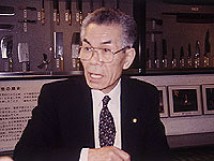
    The key question is why "ECHIZEN Uchihamono (Forged Blades)" has survived and been passed down for 700 years, and we asked Mr. Hiroshi Masutani, advisor to the "ECHIZEN Uchihamono (Forged Blades) Production Cooperative Federation," about this very issue.
    Mr. Masutani was instrumental in the establishment of the ECHIZEN Uchihamono (Forged Blades) Production Cooperative and the construction of ECHIZEN Uchihamono (Forged Blades) Hall. Although he speaks quietly, he is a person full of leadership qualities and a great idea man.
    "The defining characteristic of ECHIZEN Uchihamono (Forged Blades) is undoubtedly the strength and sharpness that comes from the various handcrafted processes. Almost all of the craftsmen here have spent many years undergoing rigorous training from a young age, constantly innovating and honing their skills. This skill cannot be acquired overnight. I'd say it takes at least 10 years to reach a certain stage."
    "And it's not just about skill. It's about the heart. In other words, you have to have the obsession, passion, and dedication to craftsmanship. Only when you have both of these can you make something truly great. That's why ECHIZEN Uchihamono (Forged Blades) are meant to last a lifetime; you can keep sharpening the blade and use it forever, even when it gets smaller. That's what makes them genuine."
    The foundation of their business has always been not just technical skill, but also a passion for craftsmanship. This is what produces wonderful works that are supported by people. This positive cycle may be the biggest reason why they have been able to continue to this day.

    Works by traditional craftspeople displayed on the second floor of ECHIZEN Uchihamono (Forged Blades) Museum

    The climate and history that nurtured this exceptional product.

    It is said that "ECHIZEN Uchihamono (Forged Blades)" originated in 1337 (during the Nanboku-cho period) when Chiyozuru Kuniyasu, a swordsmith from Kyoto, came to Fuchu (present-day Echizen City) in search of a suitable place for sword making, and while there, he began making sickles for the farmers of the surrounding area.
    However, in reality, blacksmiths were already active in Takefu at that time. In other words, it was because Echizen had a foundation as a cultural sphere with advanced blacksmithing that the advice of master craftsman Chiyozuru Kuniyasu proved useful. Later, during the Edo period, thanks to the protection policies of the Fukui domain, guilds were organized, and sales channels spread throughout the country. Initially, it started with lacquer tappers selling knives alongside their work.

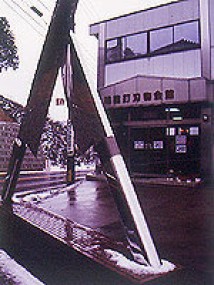
    A large knife monument displayed in front of the hall.

    We want to preserve Japan's ancient fire-forging techniques and hand-finishing methods.

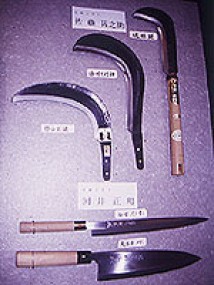
    Currently, the main products are kitchen knives, sickles, machetes, and pruning shears. In 1979, it was the first cutlery production area in Japan to be designated as a traditional craft. However, demand for specialized products such as sickles and machetes has decreased, and there are currently no successors. Like many other industries, the problem of finding successors is a major concern here as well.
    Because it's a traditional technique, it's not easy to master, requiring rigorous training that involves learning through physical experience, and it also has to adapt to societal changes. Apparently, the chairman's sons have taken over the business. Of course, he himself is still very much active...
    "But there are still steps in the process that I absolutely won't let my son do. He hasn't had enough training yet. Making something authentic isn't easy. If you want to get even one step closer to the real thing, you have to go through that process of effort, and only then can you create something good. That's what gives us craftsmen our pride."
    "These are tough times, but good things will endure. We must preserve them. My role is to take action to ensure that," Masutani said, his smile reflecting a belief he had cultivated throughout his life.

    • Inside the hall, a wide array of craftsman's works are on display, all boasting the finest sharpness.

    • "A knife is a tool for pulling. Insert it from the base of the blade and pull it towards you. Don't hit it, pull it; use the entire blade from back to front," Mr. Masutani explained, sharing his technique.

    Anecdotes

    I want to keep taking on new challenges in this new era.


overview

Craft item name ECHIZEN Uchihamono (Forged Blades)
Reading Echizen Uchihamono
Classification of crafts Metalwork
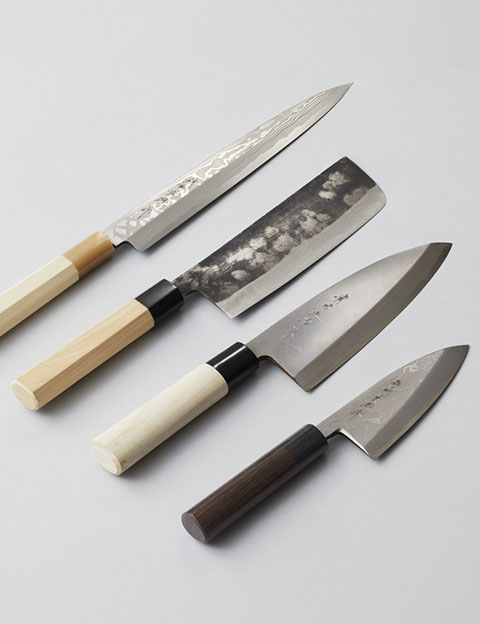
Main Products Sickle, hatchet, scissors, kitchen knife
Main manufacturing area Echizen City
Designated date January 12, 1979

contact address

■ Production area association

ECHIZEN Uchihamono (Forged Blades) Production Cooperative Association
〒915-0873
49-1-3 Ikenoue-cho, Echizen City, Fukui Prefecture
TEL: 0778-24-1200
FAX: 0778-67-2070

http://www.echizenuchihamono.com/

■ Related facilities
ECHIZEN Uchihamono (Forged Blades) Promotion Facility

https://www.hamononosato.com/

Features

Our main products are sickles, knives, and other items, primarily using traditional Japanese fire-forging techniques and hand-finishing.

How to make it

There are techniques such as "rotating steel attachment," where the entire piece of steel is flattened diagonally into a diamond shape starting from one corner, and "two-piece widening," where two blades are stacked together and hammered from both sides, working quickly to flatten both blades to an even thickness.

Please see here for information on traditional craftspeople.

Japanese traditional craftsman
top