OITAMA Tsumugi (Pongee)

Yamagata Prefecture

The origins of OITAMA Tsumugi (Pongee) date back to the early 8th century. In the early Edo period, the system for its production was established when the local lord, Uesugi Kagekatsu, encouraged its production.
Traditional and simple techniques are used to produce Shirataka Itajime Kogasuri, Yoneryu Itajime Kogasuri, weft-dyed ikat, combined ikat, and plant-dyed pongee using safflower and other dyes. In recent years, consumers have been rediscovering the value of handmade products.

  • Technology/techniques/raw materials

    Technology/techniques

    1. In the case of American Ryukyuan board-dyed ikat, the ikat fabric shall be woven using the following techniques or methods:
    (1) The fabric shall be plain weave with pre-dyed yarn.
    (2) The threads used for the warp and weft shall be "water twisted".
    (3) Kasuri thread shall be used for both the warp and weft threads.
    (4) The warp threads and weft threads are manually matched to create the ikat pattern.
    (5) The dyeing method for the ikat thread shall be "board-clamping".


    2. In the case of Shirataka Itajime Kokasuri, the ikat fabric shall be woven using the following techniques or methods.
    (1) The fabric shall be plain weave with pre-dyed yarn.
    (2) The threads used for the warp and weft shall be "water twisted".
    (3) The weft yarn used for the ground yarn should be "over-threaded".
    (4) Kasuri thread shall be used for both the warp and weft threads.
    (5) Matching the patterns of the warp threads and weft threads by hand to weave the ikat pattern.
    (6) The dyeing method for the ikat thread shall be "board-clamping".
    (7) The wrinkles should be formed by "hot water massage".


    3. In the case of weft ikat, the ikat fabric shall be woven using the following techniques or methods:
    (1) The fabric shall be plain weave with pre-dyed yarn.
    (2) The threads used for the warp and weft shall be "water twisted".
    (3) Kasuri thread should be used as the weft thread.
    (4) Matching the patterns of the ikat threads by hand to weave the ikat pattern.
    (5) The dyeing method for the ikat thread shall be by "hand tying," "hand printing," or "stencil dyeing."


    4. In the case of combined ikat fabrics, the ikat fabric shall be woven using the following techniques or methods:
    (1) The fabric shall be plain weave with pre-dyed yarn.
    (2) Kasuri thread shall be used for both warp and weft threads.
    (3) The warp threads and weft threads are manually matched to create the ikat pattern.
    (4) The dyeing method for the ikat thread shall be by "hand tying," "hand printing," or "stencil dyeing."


    5. In the case of plant-dyed pongee, it shall be a kasuri fabric, striped fabric, or similar fabric woven using the following techniques or methods:
    (1) The fabric shall be plain weave with pre-dyed yarn.
    (2) The yarns used for the warp and weft shall be dyed using plant-based dyes made from safflower, japonica, logwood, etc.
    (3) In the case of ikat textiles, the dyeing method for the ikat threads shall be by "hand-tying" or "hand-printing".
    (4) A hand-thrown shuttle or a pull shuttle shall be used to insert the weft threads.
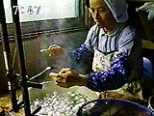
     

    raw materials

    The yarn used must be raw silk, spun silk, or floss silk.

  • Work scene

    OITAMA Tsumugi (Pongee) includes Yonezawa plant dyeing, Nagai Tsumugi with weft ikat and combined ikat, and Shirataka Tsumugi with Yonezawa board-dyeing and Shirataka board-dyeing small ikat, each with different processes. Here, we will introduce the plant dyeing process for Yonezawa Tsumugi and the board-dyeing process for Shirataka Tsumugi.

    Yonezawa Tsumugi silk / Natural dye "Safflower dye"

    Step 1: Picking safflower

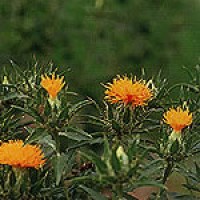
    It blooms with yellow flowers that resemble thistles during the hot summer months. The calyx develops thorns by midday, so pick them early in the morning.

    Step 2: Rinse and rub with water

    The flowers change color from yellow to orange when rubbed while exposed to water.

    Step 3: Fermentation

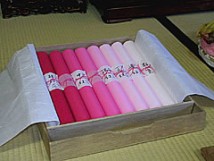
    Fermentation increases the amount of red pigment tenfold. Further pounding the fermented safflower increases the pigment content even more, resulting in a vibrant red color.

    Step 4: Making safflower cakes

    The safflower is rolled into small balls and dried. Making them into small balls makes them easier to transport and also makes it easier to adjust the amount of dye used during the dyeing process.

    Step 5: Dye elution and staining

    When safflower is soaked in lye (in this case, potassium carbonate solution), the pigment dissolves, allowing you to dye threads or fabrics. Afterwards, adding acid to neutralize it will fix the vibrant red color.

    Shirataka Tsumugi / Itajime Kasuri "Itajime Kasuri"

    Step 1: Threading

    After boiling the cocoons, the fibers are gradually extracted from them and spun into thread.
    By carefully rolling the yarn by hand, we can create a soft, natural texture.

    Step 2: Kasuri board rolling

    The warp and weft threads are wrapped around a stencil with an ikat pattern carved into it. This is a crucial step; if the threads are not tightened firmly, the ikat pattern will not come out properly.

    工程3: 染色

    Two stencil boards, each wrapped in thread, are placed on top of each other and tightly fastened together. Dye is then poured into the grooves between the boards, creating areas that are dyed and areas that are not. The quality of these areas determines the final result of the ikat weaving.


    工程4: 製織

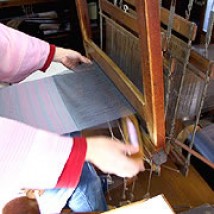
    Using a high loom and a shuttle, the warp and weft threads are carefully combined and woven together, resulting in vivid ikat patterns.

  • Close-up

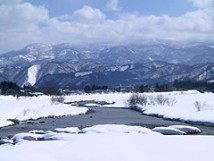
    A gentle crimson born from snow and cold: Oitama Tsumugi OITAMA Tsumugi (Pongee).

    OITAMA Tsumugi (Pongee), originating from the snowy and cold Okitama region, consists of Yonezawa Tsumugi, which is dyed with natural dyes such as safflower, Nagai Tsumugi, which is a weft-dyed ikat, and Shirataka Tsumugi, which is a board-clamped ikat. OITAMA Tsumugi (Pongee), which originated from Lord Uesugi Yozan's plan to rebuild the domain's administration, has been loved by ordinary people while adapting to the fashions of each era.


    Together with the renowned feudal lord, Lord Uesugi Yozan

    The production of Tsumugi silk in this region began at the command of Lord Uesugi Yozan, the lord of the Yonezawa domain, who is known for rebuilding the domain's finances by personally cultivating the fields. He invited weavers from Echigo and Kyoto, taught the techniques to the women in his household, and had farmers weave the cloth in Shirataka, where sericulture was originally thriving. As the technique of Tsumugi silk took root in the Okitama region, the domain's finances also recovered.
    Lord Takayama actively encouraged the planting of trees that could be used for dyeing. Fruit trees and nuts such as walnuts, chestnuts, plums, and pomegranates were used for natural dyeing in peacetime, and in years of poor harvests, they provided food to alleviate people's hunger.

    During the time of Lord Uesugi Yozan, both farmers and samurai wives wove silk.

    OITAMA Tsumugi (Pongee) Tsumugi silk

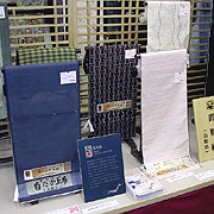
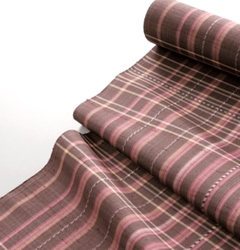
    OITAMA Tsumugi (Pongee) is a collective term for three types of silk fabrics that developed in slightly different regions. These include: Yonezawa Tsumugi, which is dyed using natural dyes from safflower, nuts, and tree bark; Nagai Tsumugi, which is a combination of weft-dyed ikat and warp-dyed ikat; and Shirataka Tsumugi, which is dyed using the board-clamping method and features intricately interwoven small ikat patterns such as tortoise shell, cross, and mosquito ikat. All of these silk fabrics are designated as traditional crafts OITAMA Tsumugi (Pongee) Okitama Tsumugi. All of them are labor-intensive silk fabrics, with the threads dyed beforehand and woven in a plain weave.

    Layering dyes with different properties

    At the workshop of Hideyuki Nitta, a dyer in Yonezawa City whom we interviewed, 20 artisans work. To become an artisan, one must first spend a year and a half learning dyeing, about a year learning hand-weaving patterns, and three years learning plain weaving. It takes at least five years just to acquire the basic techniques.
    "Even weavers must learn dyeing in order to acquire the ability to express colors." It seems that in order to create the desired patterns through weaving, one must be able to imagine the finished fabric from the stage when the threads are dyed.
    "Each dye has different properties. You have to remember those differences, learn the many dyeing techniques, and then layer the colors to express the desired shade." To produce purple, you dye with indigo first, then with safflower; to produce orange, you dye with yellow first, then with safflower. Subtle adjustments create an infinite range of colors.

    The vibrant crimson color is born from the climate and environment of this snowy region.

    The day I dyed crimson in the land of Okitama

    Safflower dyeing was long practiced only in Kyoto. However, with the introduction of chemical dyes, the demand for safflower decreased, and the technique fell into disuse. Safflower dyeing was revived in 1963 by Mr. Nitta's predecessor in Okitama, the birthplace of safflower.
    The best time for safflower dyeing is said to be "midnight in the coldest part of winter." Without the right amount of cold and good water, the delicate crimson of safflower won't come out. Behind the beauty of the crimson lies the work done in the bitter cold. Uncompromising dyeing techniques produce a lustrous crimson that cannot be found anywhere else.

    Colors that live in harmony with the wearer.

    "Colors are alive," she said, pulling out a vintage piece of fabric to show me. The crimson dyed long ago now had a soft, muted hue. "Over time, the dye gradually seeps into each individual fiber, and little by little, the excess is removed." The dazzling crimson that suited one's youth changes into a more subdued crimson as time passes, along with the wearer. The crimson worn at age 20 becomes a crimson that suits one's age by the time they turn 50. It's a crimson you can cherish for a lifetime.


    A workplace where the elderly are respected.

    While it's common for those working in companies to retire early as they get older, in this workshop, where novice craftsmen and masters with top-notch skills work together, the old-fashioned respect for elders is still alive. Craftsmen spend their entire lives honing their skills. Young people cannot easily match the skills of seasoned veterans. They work every day feeling firsthand the depth and flawlessness of the skills that only those who have lived through the years can possess. There is no obligation to show respect to elders here.

    The heart is revealed in the weaving.

    "I will continue weaving plain hakama for the rest of my life." He says there is nothing easier to weave than plain fabric, yet also more difficult. "With plain fabric, you can't hide imperfections or flaws. Your own heart is revealed in the weaving." As Mr. Nitta spoke by the hearth, I felt I could see the figure of someone who is earnestly pursuing their craft.

    Even with mastery, the weaving technique reveals one's emotions.

    Craftsman Profile

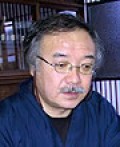
    Hideyuki Nitta

    Traditional craftsman (dyeer/weaver)
    "What I learned from my predecessor is that 'nature is unchanging.'" Whenever he's unsure about dyeing or weaving, he looks at nature and makes it his own.

    Anecdotes

    The path that safflower took to Kyoto

    Although safflower is now used to dye fabrics in its place of origin, Yamagata, during the Edo period, it was unthinkable for women in rural areas who picked the flowers to wear this vibrant red. The safflower was transported from the Mogami River to Kyoto by Kitamae ships and dyed by artisans in Kyoto. It was once such an expensive dye that it is said that "one monme of gold was exchanged for one monme of safflower."

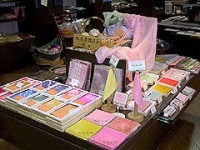
    • Dye it, let it dry, and dye it again. The more you repeat the process, the deeper the crimson becomes.
    • Safflower, whose thorns become erect during the day, should be picked in the early morning when it is foggy.
overview

Craft item name OITAMA Tsumugi (Pongee)
Reading Oitama Tsumugi
Classification of crafts fabric
Main Products Kimono fabric, hakama, obi, bags
Main manufacturing area Yonezawa City, Nagai City, Shirataka Town, Nishiokitama District
Designated date February 26, 1976

contact address

■ Production area association

OITAMA Tsumugi (Pongee) Traditional Textile Cooperative
〒992-0031
5-4-43 Omachi, Yonezawa City, Yamagata Prefecture
Inside "Kanno Dyeing Shop"
TEL: 0238-23-5044
FAX: 0238-23-5044

Features

OITAMA Tsumugi (Pongee) is the name given to all textiles produced in this region. There are six types: Yone-Ryu Itajime Ko-gasuri, Shirataka Itajime Ko-gasuri, Weft-Sō-gasuri, Combined-Gasuri, Plant-Dyed Tsumugi, and Benibana Tsumugi, but all are plain weave fabrics where the threads are dyed before weaving.

How to make it

Traditional textiles are produced in three areas of Yamagata Prefecture: Yonezawa City, Nagai City, and Shirataka Town. However, the manufacturing methods differ in each region. The traditional crafts of each region are as follows:
Plant-dyed fabrics are produced in Yonezawa City, weft-dyed and combined-dyed ikat fabrics are produced in Nagai City, and Yone-Ryukyu-style tie-dyed ikat and Shirataka-style tie-dyed ikat fabrics are produced in Shirataka Town.

Please see here for information on traditional craftspeople.

Japanese traditional craftsman
top