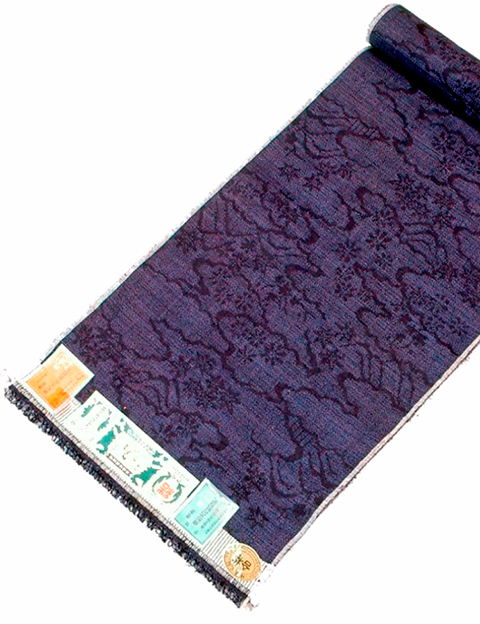
YUKI Tsumugi (Pongee)

Ibaraki Prefecture, Tochigi Prefecture

The Yuki region of Ibaraki Prefecture has a long history of sericulture, and during the off-season for farming, silk was produced as a by-product, and was already being supplied to the imperial court during the Nara period.
It is said that the name YUKI Tsumugi (Pongee) became established after the Yuki clan, who were the lords of this land during the Kamakura period, and who worked to protect and nurture this industry. In the early Edo period, Tadatsugu Ina, who became the local magistrate, introduced techniques from Shinshu and Kyoto, further enhancing the reputation of YUKI Tsumugi (Pongee). In modern times, the techniques have been improved, and in particular, advances in ikat weaving have led to the production of the highest quality Tsumugi silk.

  • Technology/techniques/raw materials

    Technology/techniques

    1. The textile must be woven using one of the following techniques or methods:
    (1) The fabric must be plain weave, either pre-dyed or pre-processed.
    (2) A "claw loom" shall be used for weaving.


    2. The dyeing method for ikat threads in ikat textiles is by "hand-tying".


    3. When removing wrinkles, the weft yarn used for the base yarn should be "curled" and "treated with hot water".
     

    raw materials

    The yarn to be used must be hand-spun silk floss yarn.

  • Work scene

    The production of authentic Yuki YUKI Tsumugi (Pongee) involves several steps. Let's take a look at the main steps.

    Step 1: Applying the silk floss

    Each cocoon, boiled in baking soda, is spread open by hand, and 5 to 6 layers are stacked to create a single bag-shaped floss. There is a demand for floss that can produce finer, stronger threads, and it takes experience to be able to make good floss, as the saying goes, "8 years of cotton handling, 3 years of spinning."

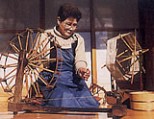
    Step 2: Spinning the yarn

    The silk floss is wrapped around a tool called a "tsukushi," and the thread is spun by hand and placed into a bucket called an "oboke." The warp and weft threads must be of different thicknesses, and the threads must be spun without any inconsistencies in thickness. While most threads, such as those called "Buddha threads," are strongly twisted to make them strong and reinforced, YUKI Tsumugi (Pongee) threads are unique in the world as untwisted threads. Mastering this technique requires several years of training. It takes two to three months to spin enough thread for one bolt of fabric.

    Step 3: Winding the pipes

    This is the process of winding Oboke spun yarn onto a bobbin using a spinning wheel. If you wind it too fast, the yarn inside will get tangled, and if you wind it too slowly, it will become slack, so you have to wind it at just the right speed.

    Step 4: Threading

    This is the process of winding yarn onto a skein to make it a consistent length. It is done to make the yarn easier to handle.

    Process 5: Machine laying

    Ten or so strands of thread are wound onto a weaving frame and trimmed to the length needed to weave one bolt of yarn. Some people do this for several bolts at once.

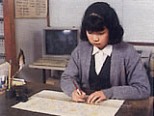
    Step 6: Design Creation

    During the Meiji era, YUKI Tsumugi (Pongee) featured stripes and simple vertical and horizontal ikat patterns, but in the Taisho era, pictorial ikat patterns using horizontal threads became popular. Then, in the early Showa period, "craft ikat" was devised, utilizing small ikat patterns such as tortoiseshell. Designs are drawn on special graph paper, and care is taken to create new designs that suit the times while preserving tradition.

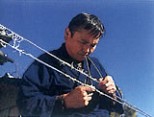
    Step 7: Kasuri tying

    To prevent the dye from seeping into the areas that will form the ikat pattern, the ikat threads are tied with cotton thread. There are four classes of fabric, with 80, 100, 160, and 200 tortoise shell patterns within the width of the bolt. In the simplest 80-tortoise shell pattern, 160 threads are tied in one width, and in the 200-tortoise shell pattern, as many as 400 threads are tied. Generally, the ikat tying alone takes about three months, and for more elaborate designs, it can take an unlimited amount of time.

    工程8: 染色

    The unique dyeing method for YUKI Tsumugi (Pongee) is called "tataki-zome" (beating dyeing). This method involves twisting the ikat-tied threads onto the end of a stick and beating them against a table to allow the dye to penetrate. Doing it too much can cause the dye to soak into the tied parts of the thread, while doing it too little can result in uneven dyeing. It is a tense process with no room for error.

    Step 9: Gluing

    Because spun yarn is cotton-like, it is starched to suppress fuzzing and to make it stiffer and easier to handle when weaving.

    Step 10: Reed threading

    The reed is comb-shaped, and two warp threads—the upper and lower threads—are inserted into its 680 teeth using a spatula called a yahaz. This is the process of loading the spun yarn onto the loom.

    Step 11: Winding the yarn onto the machine

    The warp threads, which have been passed through the reed, are wound onto a "thread winder" from the end they were passed through. This thread winder is then attached to the loom, and the weft threads are woven.

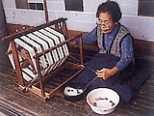
    Step 12: Weaving

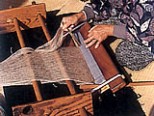
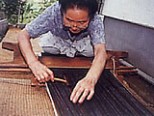
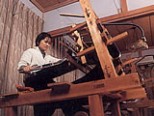
    YUKI Tsumugi (Pongee) is woven on a traditional loom called a "jibata," the most primitive type of loom. Amazingly, this method has remained unchanged for 1500 years. It's a laborious and time-consuming process, but the warp threads are tied to a waist support, allowing the elastic softness of the hand-spun yarn to be utilized without applying excessive tension during weaving. Meanwhile, the weft threads are beaten with a reed, and then further beaten with a shuttle made of oak, weighing 600 grams and measuring approximately 55 centimeters in length. This is how the unique texture YUKI Tsumugi (Pongee)—strong, light, and warm—is created. For a fast weaver, it can take about a month to weave one bolt, while high-quality Yuki Tsumugi can take over a year.

    Step 13: Shimaya (strip shop)

    Once the woven silk fabric is inspected and passes the inspection, it is brought to wholesalers in Yuki City, where it is traded for cash. These wholesalers are called "shimaya" (striped shops), a name derived from the fact that in the past, striped patterns were overwhelmingly common in YUKI Tsumugi (Pongee).

    Step 14: De-gluing

    Before tailoring the Tsumugi silk into a kimono, the final step is to pre-wash it. This process removes the starch applied before weaving, leaving a small amount in the core of the threads, resulting in a unique softness and texture. The subsequent washing and stretching further enhances the texture, and the color becomes more vibrant and the kimono conforms to the wearer's body with each wear.

     
  • Close-up

    Each and every thread embodies the deep love and unwavering dedication of the craftsman—YUKI Tsumugi (Pongee)

    The history of YUKI Tsumugi (Pongee) is ancient, dating back to the Nara period. "Ashiginu," a cloth presented to the imperial court as a specialty product of Hitachi Province, is considered the prototype of Tsumugi. Through the ingenuity and efforts of many people over many years, authentic YUKI Tsumugi (Pongee) has grown and been designated a "National Important Intangible Cultural Property" in 1956 (Showa 31) and a "Traditional Craft" in 1977 (Showa 52). Fukuichi Nomura, along with his wife Chiyoko and their four sons and their wives, are carrying on YUKI Tsumugi (Pongee).


    The rise of YUKI Tsumugi (Pongee)

    "Ashiginu" was later known as "Hitachi Tsumugi" during the Muromachi period when the Yuki clan was expanding its influence in Kitakanto. After being presented to the Muromachi Shogunate and the Kamakura Shogunate, it became a nationally renowned product, taking the name of the Yuki family as "YUKI Tsumugi (Pongee)." During the Edo period, Ina Bizen-no-kami Tadatsugu, the Shogunate's magistrate who governed the area, researched dyeing techniques and devised and improved patterns. In the Meiji era, it became popular and beloved among the general public. Then, at the end of the Taisho era, weft ikat was invented, and further, warp and weft ikat called "saiku ikat" was created, and sales channels gradually expanded. However, during the war, production was suspended except for a few skilled artisans. Throughout history, YUKI Tsumugi (Pongee) has grown and developed as a national strength. It was revived immediately after the end of the war, overcame numerous hardships, and continues to thrive to this day.

    • A typical YUKI Tsumugi (Pongee) in navy blue.
    • Fine patterns drawn on special graph paper; small ikat patterns such as tortoise shell designs developed from around the early Showa period.

    Theきっかけ (trigger/reason) for becoming a craftsman

    The Nomura couple started working with tsumugi silk because they naturally picked it up while watching their parents work. YUKI Tsumugi (Pongee) production was originally a side business for farmers, where the whole family would spin the thread, tie the ikat patterns, and weave the fabric. Mr. Nomura says he's been winding thread, which requires meticulous concentration, since elementary school. "It's less that I learned it from my father, and more that I grew up watching him." For tying the ikat patterns, you can tie them tightly by placing the thread between your back teeth. There are areas where you tie widely and areas where you tie tightly, but you have to tie them evenly with strong force. It's the most painstaking part of ikat making, a man's job. "You can't lose focus or change your hand," it says, requiring more concentration and unwavering effort than you might imagine. Chiyoko also says she learned it while playing around as a child. They've both been in this field for 50 years.

    • While matching it to the drawing, mark the parts to be tied with color.
    • Ms. Nomura is carefully tying the ikat fabric.

    Changes over 50 years

    The biggest change over the past 50 years is the colors. In the past, the fabric was navy blue with stripes, but now it's lighter, more refreshing colors, and the patterns have evolved with the times, from classic combinations to new designs. From around the mid-1940s, the patterns rapidly became more varied, with traditional patterns such as tortoiseshell, checkerboard, and Shippo (seven treasures) patterns becoming widespread. Before that, luxury was prohibited by the wartime "sumptuary laws." Under Mr. Nomura's leadership, the industry flourished simultaneously with the rapid economic growth. "Orders kept pouring in, so I didn't have time to think about taking on another job." Wholesalers would even wait by the looms while the weaving was finished. "It really sold well back then," says Mr. Nomura. Having experienced that glorious era where everything produced sold, Mr. Nomura believes that's why he has a successor. Considering his son, the successor, he believes that a direct flow from producer to consumer will be crucial going forward. While it's a long-standing practice for wholesalers to act as intermediaries, Nomura prioritizes sustainable collaboration with the wearers, considering what kind of partnerships are possible in the future. Creating a system where people who truly want to wear the clothes can buy them with confidence is also a challenge.

    Modern Yuki YUKI Tsumugi (Pongee) in soft colors

    As part of the future work of traditional craftspeople

    Ms. Nomura says that from now on, she wants to do more than just make and sell products; she wants to cherish the cultural aspects of YUKI Tsumugi (Pongee). She believes that conveying the culture of weaving is the key to fostering a desire to wear Tsumugi and cultivating a love for tradition. This kind of exchange activity as a traditional craftsperson began with Ms. Nomura. Just recently, she went to Kumejima Island in Okinawa to teach and exchange about Kume Kasuri (ikat weaving). At the same time, she has also decided to open her home workshop as an open space and start weaving classes. Students can learn techniques from basic to advanced levels, and all materials and looms used are designated as important intangible cultural properties. The finished product becomes the student's own. Increasing the sense of accomplishment from creating will also be an opportunity to deepen the wearer's love for Tsumugi.

    Authentic YUKI Tsumugi (Pongee) trademark

    The more you wear it, the deeper the feeling becomes.

    YUKI Tsumugi (Pongee), when woven, are as soft as raw silk, and the handcrafted feel deepens with each wear. They are light, warm, and wrinkle-resistant. Those who love YUKI Tsumugi (Pongee) say that once they experience these functionalities, they can't let go of it. Ms. Nomura has devised a summer material with a crisp texture using hand-spun yarn and linen yarn. While creating works of YUKI Tsumugi (Pongee) designated as an Important Intangible Cultural Property that will be permanently preserved at the Tokyo National Museum, Ms. Nomura also hopes to hand over kimonos that convey the heart of the maker.

     
    • A summer material designed by Ms. Nomura. It looks sheer and cool.
    • The "Blue and Blue Wave and Pine Sail Pattern" is permanently preserved at the Tokyo National Museum.

    Craftsman Profile

    Fukuichi Nomura

    Born in Yuki City, Ibaraki Prefecture in 1933. A traditional craftsman and holder of an Important Intangible Cultural Property designation. He has been the chairman of the Ibaraki Prefecture Honba YUKI Tsumugi (Pongee) Association since 1994. He received the Director-General's Award from the Ministry of International Trade and Industry in 1996 and the Award for Outstanding Skills in 1997. His father, Hanpei, played a key role in the designation of YUKI Tsumugi (Pongee) as an Intangible Cultural Property in 1931.

    Fukuichi Nomura and his wife, Chiyoko

    Anecdotes

    YUKI Tsumugi (Pongee) and Yuki chest of drawers, exuding warmth.

    Similar to YUKI Tsumugi (Pongee), "Kiri Tansu" (paulownia wood chests) are known throughout Japan. Since Yuki became a castle town, paulownia wood has been used to make kosode tansu (clothing storage chests) instead of zelkova wood. Paulownia wood is fire-resistant and highly breathable, making it ideal for clothing storage. Currently, most of them are produced as wedding furnishings. In 1958, it was designated as a traditional craft of Ibaraki Prefecture. This is also a valuable traditional craft that protects the precious YUKI Tsumugi (Pongee).

    Paulownia wood clogs
    From the mid-Edo period onward, the current types of geta (wooden clogs) were established, and the production of Yuki paulownia wood geta became a specialized profession. Even in modern times, when shoes are the mainstream, there are many enthusiasts who appreciate the breathability and comfortable feel of Yuki paulownia wood geta, and demand remains strong. Like paulownia wood chests, these geta were designated as a traditional craft of Ibaraki Prefecture in 1958.

    • Currently, they produce approximately 2,000 paulownia wood chests of drawers per year.
    • These paulownia wood clogs offer exceptional comfort.
     

overview

Craft item name YUKI Tsumugi (Pongee)
Reading Yuki Tsumugi
Classification of crafts fabric
Main Products Kimono fabric, obi
Main manufacturing area Yuki City, Shimotsuma City, Chikusei City, Yachiyo Town (Yuki District) Tochigi Prefecture / Oyama City, Shimotsuke City, Kaminokawa Town (Kawachi District), Mooka City
Designated date March 30, 1977

contact address

■ Production area association

Ibaraki Prefecture Honba YUKI Tsumugi (Pongee) Textile Cooperative Association
307-0001
3018-1 Yuki, Yuki City, Ibaraki Prefecture
TEL: 0296-32-1108
FAX: 0296-32-1108

https://www.honba-yukitumugi.or.jp/

Tochigi Prefecture Honba YUKI Tsumugi (Pongee) Textile Cooperative Association
323-0155
2358 Fukura, Oyama City, Tochigi Prefecture
Inside the Tochigi Prefecture Tsumugi Textile Technology Support Center
TEL: 0285-49-2430
FAX: 0285-49-2430

■ Visits to production areas from overseas
image
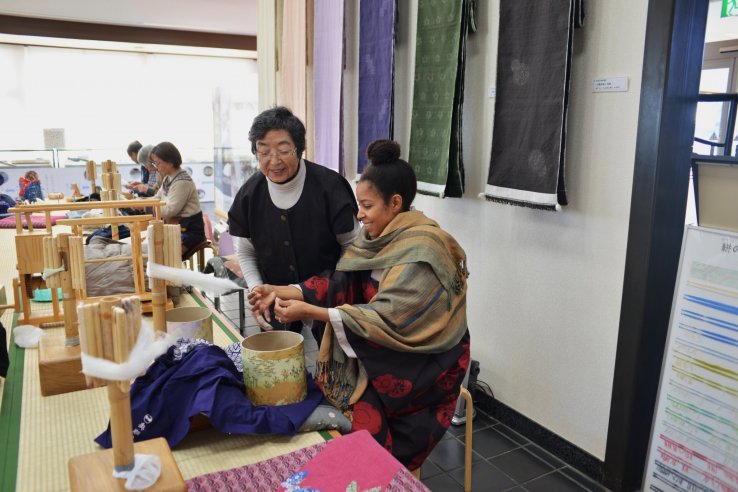
YUKI Tsumugi (Pongee)- A visit to the production area

Features

Because the threads are drawn by hand from raw silk, the hundreds of individual fibers of varying lengths simply intertwine, resulting in a voluminous, untwisted yarn. Therefore, it possesses a rustic, cotton-like quality despite being silk.

How to make it

The entire process is done by hand. The three processes of spinning yarn, tying ikat threads, and weaving on a handloom are designated as important intangible cultural properties. To make one kimono, approximately 30 km of yarn is spun by hand, and the weft threads are beaten more than 30,000 times with a large shuttle weighing 600 g. Ikat weaving is an extremely delicate process where even a 1 mm error is acceptable.

top