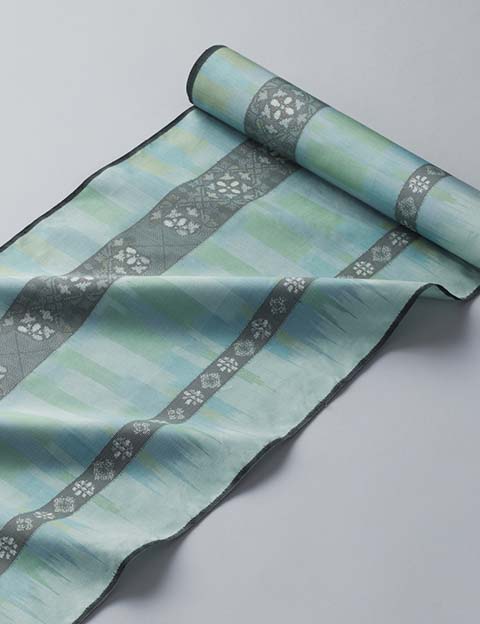
MURAYAMA OSHIMA Tsumugi (Pongee)

Tokyo

The origins of MURAYAMA OSHIMA Tsumugi (Pongee) are said to date back to the late Edo period.
Around 1920, two types of silk fabrics merged: "Murayama Konkasuri," a brocade fabric dyed with genuine indigo, and "Sunagawa Futori," a silk fabric made from double cocoons. This merged to create MURAYAMA OSHIMA Tsumugi (Pongee), a silk fabric that became the main focus of production. Its superb quality and durability were highly praised, and it was recognized as a Tokyo Metropolitan Government-designated Intangible Cultural Property.

  • Technology/techniques/raw materials

    Technology/techniques

    1. The fabric must be a kasuri textile woven using one of the following techniques or methods.
    (1) The fabric shall be plain weave with pre-dyed yarn.
    (2) Kasuri thread shall be used for both the warp and weft threads.
    (3) The warp threads and weft threads are manually matched to create the ikat pattern.


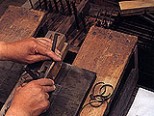
    2. The dyeing method for the ikat threads shall be "board-clamping".
     

    raw materials

    The thread used must be raw silk.

  • Work scene

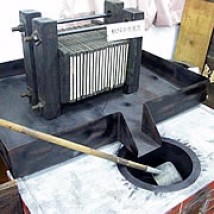
    A distinctive feature of MURAYAMA OSHIMA Tsumugi (Pongee) is its dyeing technique using board clamping. From the way the grooves are carved into the board to the way the threads are wound and arranged, this highly skilled technique, requiring experience and expertise, results in intricate and sophisticated ikat patterns.

    Process 1: Kasuri board production

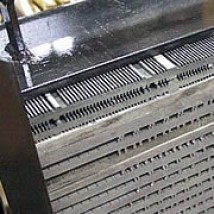
    The ikat boards used in the board-clamping injection dyeing method are needed for each different pattern of ikat threads, and the number of boards required increases with the size of the pattern, but generally, about 150 boards are used for one pattern, including both warp and weft. Grooves are carved into the ikat boards based on the board design. When the boards are stacked and clamped together, the dye is poured only into the valleys, leaving the peaks undyed. The raw material for the ikat boards is the giant Mizume cherry trees, which are 70 to 100 years old or older.

    Step 2: Refining

    This process improves the luster and texture of the raw silk. The silk is boiled in a pot, stirring constantly to remove impurities. After thorough washing and drying, it becomes soft, lustrous silk.

    Step 3: Dyeing the base

    The base yarn is dyed with plant-based dyes such as hematin. To ensure even color development and to further enhance the depth of the color, it is soaked in the dye for a long time before being rinsed with water.

    工程4: 整経

    The warp and weft threads are aligned. The length of the weft threads varies depending on the size of the pattern, so they are adjusted to the required length and number according to the pattern.

    Step 5: Rolling and stacking of boards

    This is the preliminary step before board-clamping dyeing. The warp threads are wound around each individual ikat board. The threads are wound at a consistent width, ensuring there are no gaps and that the threads do not overlap. The boards, once wound, are stacked with interlocking boards in between. The weft threads are laid flat, alternating between the boards. The key to achieving a beautiful dye is how evenly the threads are laid.

    画像をクリックすると動画が再生されます

    Step 6: Board-clamping dyeing

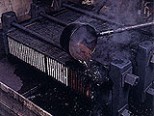
    Both the warp and weft threads are attached to boards with ikat patterns, which are then fastened together with bolts at a pressure of 10-15 t/m2. These boards are then laid on a basin called a "boat" to facilitate dye penetration, and hot water is poured over them with a ladle to prevent uneven dyeing.

    Step 7: Printing

    In the board-clamping injection dyeing method, only one color is applied. If a different color is needed locally depending on the design, the "rubbing and printing" technique is used. The dyed ikat threads are stretched out in a long bundle, and tied in places with string to prevent the ikat pattern from falling apart. The tip of a bamboo or wooden spatula is dipped in dye solution, and the bundle of threads is placed between two spatulas to rub the color into the fabric.

    Step 8: Machine winding

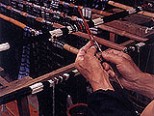
    The process involves assembling the patterns of dyed ikat threads. This is divided into many steps, including picking up threads, creating the heads, dividing the heads, spacing the threads, threading the reeds, and winding the threads. Matching the patterns is truly a battle with the threads, as even a single wrong thread can cause the pattern to fall apart. Precisely aligning the patterns that are lined up horizontally is also crucial.

    画像をクリックすると動画が再生されます

    工程9: 製織

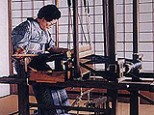
    Each warp thread and weft thread is precisely aligned to create the intricate ikat pattern. It takes a skilled weaver about 7 to 10 days to complete one ensemble. The finished fabric undergoes a rigorous quality inspection.


  • Close-up

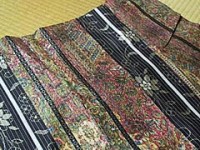
    Exquisite ikat textiles created using a unique board-clamping dyeing technique.

    "Murayama Oshima Tsumugi" is a silk fabric that evolved from "Murayama Konkasuri," a cotton fabric dyed with indigo that developed during the Edo period, and "MURAYAMA OSHIMA Tsumugi (Pongee)" a silk fabric. Over time, it further evolved into a silk fabric with warp and weft ikat weaving. The board-clamping dyeing technique made it possible to create an exquisite fabric in which the warp and weft ikat threads are skillfully dyed separately.


    Adding the refined texture of silk to traditional ikat weaving.

    The ikat pattern embodies the spirit of Japan. The subtle misalignment of the warp and weft threads gives the geometric patterns a human warmth, and the simple, handmade texture creates a sense of peace. MURAYAMA OSHIMA Tsumugi (Pongee), which uses raw silk, incorporates not only this folk-art style but also a lustrous sheen and a sense of refinement. Its most distinctive feature is the use of board-clamping dyeing with ikat boards. Based on the design, grooves are carved into ikat boards made of Mizume cherry wood, the threads are placed between these boards and stacked, then bolted together, and the dye is poured in. The peaks of the grooves remain undyed, while only the valleys are dyed. The finished ikat threads must be rearranged according to the design. Every step of the process is a skilled, manual labor.

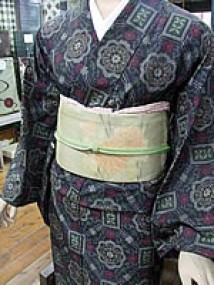
    The ikat patterns are beautiful. Men's garments with a fine tortoise shell pattern are also made.

    Hone your skills through experience and intuition.

    The peak of MURAYAMA OSHIMA Tsumugi (Pongee) production is said to have been around 1933-1934. It was around this time that Fukuo Harada began working at the weaving factory in earnest. As the third generation, Mr. Harada grew up surrounded by MURAYAMA OSHIMA Tsumugi (Pongee), as his workshop and home were in the same building at the time. He started his career as a craftsman at the age of 14, but it was a busy time, and he worked from early morning until late at night. "We would do morning work, finishing up some work before breakfast. The fabric that had been scouring and dyed in a vat the night before would be washed in the river the next morning, but in winter the river water would be frozen. We had to work while breaking the ice." It is a world of craftsmen where experience and intuition are paramount. With board-clamping dyeing, it is impossible to check the dyeing results with the naked eye. "Depending on how you clamp it, parts of the fabric that shouldn't be dyed can get dyed. Once it opens up, there is no going back, so it is indeed difficult." Because it requires patience and effort, there is great joy when the finished product turns out exactly as envisioned.

    The board-clamping process involves pouring dye at approximately 100°C using a ladle to prevent uneven dyeing.

    Development of new products

    In its heyday, the sound of weaving could be heard late into the night from any house with a woman in it. MURAYAMA OSHIMA Tsumugi (Pongee), which overcame the turmoil of the postwar period by striving to modernize its colors and patterns, saw a dramatic increase in demand when it was designated a national traditional craft in 1975, reaching its second peak. "No matter how much we made, the stock would disappear immediately. It was a situation where everything we made would sell." However, the weaver's skill is truly tested when sales slow down somewhat. "Once it becomes somewhat widespread, there is a demand for higher quality products. We can't sell the same thing anymore, so we have to think of new products." Until then, solid patterns such as fixed patterns were the mainstream, but from this time onwards, scattered patterns and open patterns began to be produced. "More complex techniques were required, such as dyeing without covering up the open areas. I was really happy when patterns that I thought were impossible in Murayama were successfully created and were recognized at exhibitions," Harada says. It was during this period that attempts were made to vary the base color of the fabric by using dyes made from locally grown Sayama tea.

    Approximately 150 ikat boards are used for one pattern.

    To keep the flame of tradition alive

    It is regrettable that the number of people wearing kimonos has clearly decreased in recent years, but it is precisely in these times that attention is being drawn to high-quality, excellent products. Murayama Oshima Tsumugi embodies the desire of the production area to "keep the flame of tradition alive, because it is not something that everyone can do," and this sentiment is embodied in every single thread. The producers will also need to make efforts to ensure that consumers recognize the value of their products. MURAYAMA OSHIMA Tsumugi (Pongee), the fourth-generation son of Mr. Harada, says, "From now on, we will focus on enjoying the process and carefully preserving the tradition without thinking too much about profit." The joy of creating something from nothing remains unchanged.

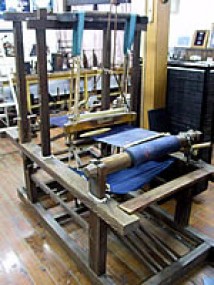
    A handloom that was used until the 1960s.

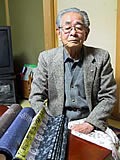
    Craftsman Profile

    Fukuo Harada

    Born in 1919.
    "The slight misalignment of the ikat pattern, which shows it was handmade, and its lightness and durability are what make MURAYAMA OSHIMA Tsumugi (Pongee) so appealing," she says.

    Anecdotes

    Develop new products with a rich imagination

    The patterns favored in kimonos change with the times. MURAYAMA OSHIMA Tsumugi (Pongee) silk has also evolved over time, with various colors and patterns being developed. Around 1937, the spread of stencil dyeing techniques led to the emergence of many new colors that had never been used before, greatly expanding the range of expression. Then, around 1985, MURAYAMA OSHIMA Tsumugi (Pongee) production area, striving to develop new products, embarked on a bold project: combining it with sarasa (chintz). The result is a magnificent fusion of weaving and dyeing. The piece pictured combines a sarasa komon (small patterned kimono) by "Second Generation Koshin" with Murayama Oshima MURAYAMA OSHIMA Tsumugi (Pongee) using threads dyed with Sayama tea. The beautiful finish brings out the best in each material, enhancing their individual presence. Even if you don't often wear kimonos, seeing such a wonderful piece might make you want to try it on!

    • A combination of Sarasa Komon and MURAYAMA OSHIMA Tsumugi (Pongee)


overview

Craft item name MURAYAMA OSHIMA Tsumugi (Pongee)
Reading Murayama Ooshima Tsumugi
Classification of crafts fabric
Main Products Kimono fabric
Main manufacturing area Tachikawa City, Ome City, Akishima City, Higashiyamato City, Musashimurayama City, and other cities in Saitama Prefecture / Hannō City and other cities
Designated date February 17, 1975

contact address

■ Production area association

Murayama Textile Cooperative
208-0004
2-2-1 Honcho, Musashimurayama City, Tokyo
TEL: 042-560-0031
FAX: 042-560-6252

Features

Lightweight and comfortable, Tsumugi silk has been passed down from grandmother to mother to daughter. Its deep, authentic tradition makes it a timeless fashion choice that resonates with people even today.

How to make it

Following the design, an ikat board is made, the threads assembled on the ikat board are tightly fastened with bolts, and then dye is applied to create the ikat pattern. The dyed ikat threads are laid out in long bundles, the board design is placed on top, and the pattern is rubbed in with a bamboo spatula. The ikat threads and plain warp threads are interwoven using a "mazaki-dai" (a type of loom), passed through a "maki-osa" (a type of reed), wound onto a "otoko-seki" (a type of reed winding), and woven while adjusting the ikat pattern.

Please see here for information on traditional craftspeople.

Japanese traditional craftsman
top