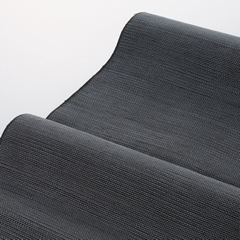
SHIOZAWA Tsumugi (Pongee)

Niigata Prefecture

The history of textiles in the Shiozawa region of Niigata Prefecture is long, and linen cloth from this area woven during the Nara period (present-day Echigo Jofu) is preserved in the Shosoin Treasure House in Nara.
SHIOZAWA Tsumugi (Pongee) is a type of silk fabric that incorporates the techniques of hemp weaving, and its weaving began during the Edo period.

  • Technology/techniques/raw materials

    Technology/techniques

    1. The fabric must be a kasuri textile woven using one of the following techniques or methods.
    (1) The fabric shall be plain weave with pre-dyed yarn.
    (2) The warp threads shall be made of raw silk or spun silk, and the weft threads shall be made of hand-spun raw silk.
    (3) A hand-thrown shuttle is used to insert the weft threads.


    2. The dyeing method for the ikat thread shall be by "hand tying," "hand rubbing," or "board clamping."

     

    raw materials

    The yarn used must be raw silk, spun silk, or hand-spun floss silk.

  • Work scene

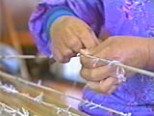
    The process of making SHIOZAWA Tsumugi (Pongee) is complex, but broadly speaking, it consists of pre-dyeing the warp and weft threads, creating the ikat patterns, weaving, and finishing. Tsumugi silk is woven after the threads have been pre-dyed to create the patterns. Raw silk or slub silk is used for the warp threads, and raw silk or hand-spun floss silk is used for the weft threads. The ground threads are dyed and the ikat threads that will form the patterns are created. Ikat patterns are created based on a drawing, an ikat ruler is made, and marks are made on the threads with ink along the ruler. This is done by "hand-tying," where cotton threads are tied to the marks, or by "hand-rubbing," where dye is rubbed in with a spatula. The dyed warp threads and ikat threads are combined and wound into a ball, which is then set on a loom, and weaving can finally begin. This process is meticulous, as each ikat thread is carefully aligned and woven. In the case of SHIOZAWA Tsumugi (Pongee), the use of different threads for the warp and weft creates a unique texture.

    Step 1: Design and Planning

    Based on the original design or sample, the pattern placement is determined on graph paper to create the ikat pattern, and the length of the threads and the exact positions of the ikat are meticulously designed. Then, the next work process begins based on that design.

    Step 2: Yarn making and twisting

    The weft yarn, hand-spun from raw silk, is made by carefully pulling out the raw silk with one hand while opening it with the other, resulting in an extremely fine thread. The thickness of the thread is determined by the amount of pressure applied when pulling it out. This technique has been passed down from the Echigo Jofu weaving tradition. In addition, the raw silk used is separated according to its intended use, such as warp and weft threads and warp and weft ikat threads, and twisted together according to specifications. This is done to ensure uniformity in thickness and strength.

    Step 3: Marking and shaping

    The weft threads are stretched onto the stretching stand, and ink marks are made on the pattern positions based on the ikat ruler created earlier. Next, the marked parts of the weft threads are tightly tied with cotton thread. This prevents the tied parts from being dyed. If the tying is not done tightly enough, the dye will seep into the tied parts and the ikat pattern will fall apart.

    Step 4: Rubbing

    Using a bamboo spatula, the dye is literally rubbed into the desired areas of the ink-marked weft threads. Afterwards, the fabric is placed in a steam chamber at around 100 degrees Celsius to fix the color.

    Step 5: Preparation for weaving, weaving

    For the warp threads, the ground threads are carefully wound onto bobbins, taking care to prevent the ikat pattern from shifting. These bobbins are then passed one by one through the heddles of the loom, and then two threads at a time are passed through the reed. By passing the warp threads through the heddles and reed of the loom, the threads are suspended up and down. The weft threads are then passed back and forth between the suspended threads using a boat-shaped device called a shuttle, and this is how SHIOZAWA Tsumugi (Pongee) is woven. The standard number of warp threads is about 1260. The ikat threads are prepared by raising the ikat pattern and then wound onto bobbins for weaving. The ground threads are wound onto bobbins separately for right-handed and left-handed twists. At this time, one side is marked to avoid mixing up left and right. The weaving is done using a loom called a takahata.

    画像をクリックすると動画が再生されます

    Process 6: Finishing, inspection

    After the weaving is complete, any dirt or starch is carefully removed, the fabric is trimmed to the specified width, and rolled up. Finally, it is inspected for any stains or weaving irregularities, and SHIOZAWA Tsumugi (Pongee) is finished.

    画像をクリックすると動画が再生されます


  • Close-up

    A finely woven fabric called SHIOZAWA Tsumugi (Pongee)

    According to the literary figure Suzuki Makino of Shiozawa, SHIOZAWA Tsumugi (Pongee) is "a famous product born from the interplay of snow, people, and spirit." Even in a changing world, it remains a vibrant and exquisite product imbued with reliable craftsmanship.


    Shiozawa, one of the three districts of Uonuma, a center of textile production.

    The "Engishiki," a detailed set of regulations for official ceremonies completed in 927 during the Heian period, already explicitly mentions "Echigo silk fabrics" and "Echigo hemp fabrics" in its section on chōyō (taxes and trade goods), indicating that Echigo textiles were highly regarded for their quality. Silk was also highly valued. This suggests that Shiozawa has been famous as a textile producing region since the Heian period. At the same time, it can be said that their weaving techniques were a source of livelihood for those born and raised in the SHIOZAWA Tsumugi (Pongee) cold and heavy snowfalls of the region. We spoke with Kiyoshi Nakajima, a traditional Shiozawa textile craftsman, about SHIOZAWA Tsumugi (Pongee), a textile that has been cultivated for generations.

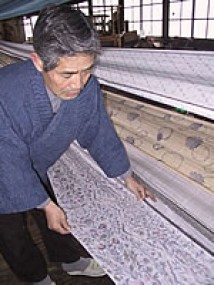
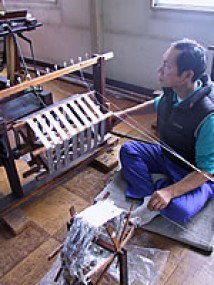
    Mr. Nakajima. He has been involved in this work for about half a century, having started when he was 15 years old.

    The unique texture of SHIOZAWA Tsumugi (Pongee)

    The unique texture of SHIOZAWA Tsumugi (Pongee) comes from its "raw materials first" philosophy. The weft threads are made of hand-spun raw silk. This utilizes the technique of Echigo Jofu called "oumi," which involved finely splitting ramie (called "choma") with fingernails to make thread. The hand-spun raw silk used for the weft threads of SHIOZAWA Tsumugi (Pongee) is produced by stretching the raw silk by hand to a uniform length, resulting in a fine, lustrous thread. It is an extremely painstaking process. Raw silk and spun silk are used for the warp threads. Because different threads are used for the warp and weft, a unique texture is created, and Mr. Nakajima says that customers who wear it comment on how well it drapes.

    SHIOZAWA Tsumugi (Pongee), with a warm ikat pattern.

    The intricately woven ikat patterns reveal their form.

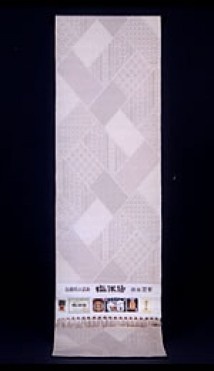
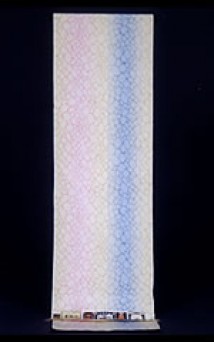
    This ikat weaving technique combines cross-shaped and tortoise-shell patterns, creating designs with a finer ikat pattern called mosquito ikat. The technique involves traditional hand-tying and hand-printing methods, carefully weaving each warp and weft ikat thread to form the pattern. The patterns incorporate a variety of designs, including floral patterns, arabesques, and geometric motifs. The ikat patterns, revealed by the delicate weaving of silk threads as thin as a strand of hair, are truly the epitome of luxury. The beauty of these patterns can perhaps be best appreciated by seeing them in person.

    Intricate patterns created using ikat weaving techniques.

    It has already been perfected over a long history.

    Regarding the tools used, they employ a type of loom called a "takahata." "It has been naturally improved, allowing us to weave without putting any strain on the threads." Those currently involved in SHIOZAWA Tsumugi (Pongee) have tried to make further improvements several times, but ultimately, they say that the loom they currently use allows them to weave with the least strain on the threads. The process of making SHIOZAWA Tsumugi (Pongee) involves the work of many people before the threads are placed on the loom. "It's not something I do alone. I make things with the next person in mind, thinking about how to make the work easier for them." Even the weaving itself requires careful concentration. Therefore, if the weaver's mind is not calm, the weaving will not turn out flat and beautiful. However, skilled weavers "become calm once they get on the loom." In this way, SHIOZAWA Tsumugi (Pongee) is shaped by the traditional techniques and skills passed down from person to person, and by the mindset of passing on the work process in a way that is better for the next person.

    In a good way, the parts that will not change

    Of course, traditional techniques haven't simply been passed down unchanged. "We are constantly striving to improve and create even better products," he says. He also mentions that consumer preferences have diversified recently, and the patterns have changed as well. However, Nakajima says, "I want to continue to be particular about the texture and ikat weave of SHIOZAWA Tsumugi (Pongee) and dedicate myself to craftsmanship." There is a glimpse of his determination to continue protecting the most fundamental aspects of SHIOZAWA Tsumugi (Pongee). Perhaps because of the long history of SHIOZAWA Tsumugi (Pongee) that has been built up over the years, even Nakajima, who has been involved in this work for about half a century, says he "doesn't feel like a full-fledged craftsman." However, it was precisely because of this that his enthusiastic statement, "I still want to take on more challenges," was so impressive.

    It is only completed after passing through the hands of many people.

    Craftsman Profile

    Kiyoshi Nakajima

    I've been doing this job exclusively for half a century, ever since I started at the age of 15.

    Anecdotes

    The machine is God

    Among those involved in the weaving industry, there is a belief that the loom is sacred. That's why traditional craftsman Nakajima says, "When I was little, I was scolded for climbing on the loom." He prays to the loom god that his skills will improve, and he takes a small piece of cloth and offers it to the shrine, praying for his skills to improve. This act of offering cloth is called "honou-bata" (offering loom). This custom seems to have been around for a very long time, and it is even mentioned in the writings of Suzuki Bokushi, a literary figure from Echigo. Apparently, fewer people do it these days, but Nakajima himself decided to "make a prayer" about a dozen years ago and offered cloth to Matsuo Shrine in Shiozawa, a shrine where the loom god is enshrined.


overview

Craft item name SHIOZAWA Tsumugi (Pongee)
Reading Shiozawa Tsumugi
Classification of crafts fabric
Main Products Kimono fabric
Main manufacturing area Minamiuonuma City
Designated date February 17, 1975

contact address

■ Production area association

Shiozawa Textile Industry Cooperative
949-6435
107-1 Mekita, Minamiuonuma City, Niigata Prefecture
TEL: 025-782-1127
FAX: 025-782-1128

Features

The ikat patterns, known as mosquito ikat, are composed of fine cross-shaped and tortoise-shell patterns created through the stenciling and tying processes, possessing a unique elegance and tranquility.

How to make it

This is a plain-weave ikat fabric made with pre-dyed threads, using raw silk or spun silk for the warp and hand-spun floss silk for the weft. The manufacturing process is broadly divided into design, dyeing, ikat making, weaving, and finishing. In the weaving process, each ikat thread is woven by hand according to the design.

Please see here for information on traditional craftspeople.

Japanese traditional craftsman
top