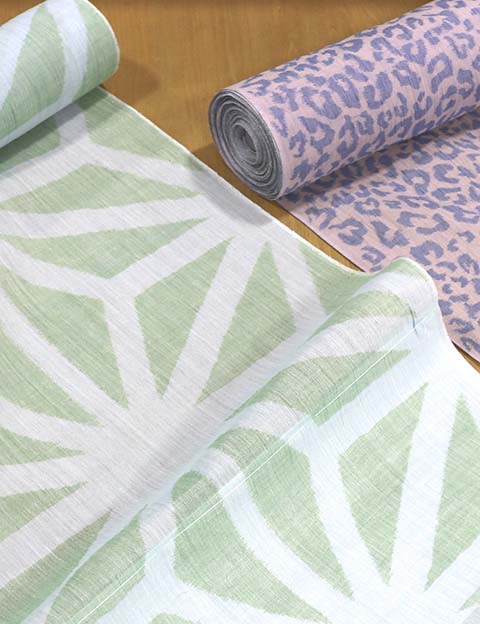
OJIYA Chijimi (Ramie Crepe Textiles)

Niigata Prefecture

The history of hemp weaving in Ojiya is long, with traces of the weave remaining on pottery believed to date back to the late Jomon period.
Linen textiles suited to the climate of Ojiya were highly valued and presented to the shogun.
In the early Edo period, improvements were made to the fabric for summer clothing. By applying a strong twist to the weft threads, it was possible to create a unique crinkled texture called "shibo" during the finishing process, which gives the woven fabric a cool feel. OJIYA Chijimi (Ramie Crepe Textiles), made using traditional techniques and methods, was designated a National Important Intangible Cultural Property in 1955.

  • Technology/techniques/raw materials

    Technology/techniques

    1. The fabric must be a kasuri textile woven using one of the following techniques or methods.
    (1) The fabric shall be plain weave with pre-dyed yarn.
    (2) Kasuri yarn shall be used as weft or as both weft and warp.
    (3) The weft threads shall be twisted threads.
    (4) By manually matching the patterns and selvages of the ikat threads, the ikat pattern and selvage markings are aligned to create the ikat pattern.


    2. The wrinkles are formed by "hot water massage".


    3. The dyeing method for the ikat thread shall be by "hand-tying" or "hand-printing." In this case, a "wooden ruler" shall be used as the horizontal guide.
     

    raw materials

    The thread to be used should be hemp thread.

  • Work scene

    The process of making OJIYA Chijimi (Ramie Crepe Textiles) is complex, but broadly speaking, it consists of warp and weft dyeing, weaving, and finishing. Linen is used for the threads, and ikat patterns are applied to them. The warp threads are plain, and the pattern is created solely by the ikat weft threads. This is called weft ikat and is said to be a characteristic of Ojiya textiles. When applying the ikat pattern to the weft threads, a ruler is first made, and marks are made with ink along the ruler. Then, dye is rubbed into the threads using a spatula called a rubbing spatula. After dyeing these threads, they are set on the loom and weaving can finally begin. Even then, the weaving is done carefully while checking the position of the ikat pattern. Finally, a process unique to chijimi called yumomi is performed to create the wavy, uneven texture called shibo.

    Step 1: Design (creating ikat patterns and making rulers)

    Based on the original design or sample, the pattern placement is determined on graph paper to create the ikat pattern. Next, more than a dozen fine grooves are carved into a board or paper, and the ikat pattern is transferred onto them. This breaks down the pattern into linear shapes. Furthermore, the pattern is transferred onto a ruler made of stacked thin boards. This ruler is called a wooden ruler. The ruler determines where the color should be placed in the thread to create the ikat pattern. One ruler represents the pattern of one pass of weft thread. This process is repeated to create rulers for all the ikat patterns.

    画像をクリックすると動画が再生されます

    Step 2: Making the yarn

    The warp and weft threads are twisted together separately. In addition, the weft threads of the base fabric are sizingd and then strongly twisted to create a crinkled texture, resulting in highly twisted yarn.

    Process 3: Yarn reeling, hand rolling, warp rolling, weft rolling

    The threads are placed on a dragonfly frame, and a part called a "fukube" is attached to a winding machine. The threads are then wound from the dragonfly frame onto the fukube. The warp threads are then adjusted on a warp stretching stand to the number and length specified in the design using a repetition machine. For the weft threads, 8 to 16 threads wound on the fukube are arranged in groups, a twill pattern is created, and they are stretched out on a stretching stand. With the threads now prepared, the process of creating the ikat pattern can begin.

    Step 4: Marking and shaping

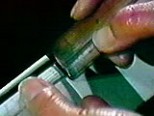
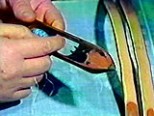
    The weft threads are stretched onto a stretching stand, and the marks on both ends of the ikat ruler, which indicate the selvage of the woven fabric, are aligned with the ink marks indicating the pattern position. Next, the ink-marked parts of the weft threads are tightly tied with old hemp. This prevents the color from being absorbed into these areas.

    Step 5: Rubbing and dyeing

    Using a rubbing spatula, the dye is rubbed into the areas of the thread that have been marked with ink. The thread is tied into a skein and dyed by repeatedly rubbing it together with the base thread. The color is then fixed by placing it in steam at a temperature of about 100 degrees Celsius.

    Step 6: Preparation for weaving, weaving

    The warp and weft threads are tightly wound up, with their positions corrected according to the design, but the process differs for the warp and weft. The warp threads are passed one by one through the heddles of the loom, and then two at a time through the reed. The standard number of warp threads is around 1200. The weft threads are unbound and then wound into 8 to 16 strands on a reeling frame, and then separated one by one on a small reeling stand. Finally, they are wound onto bobbins for weaving. Now the fabric is ready to be woven, and the weaving can begin. The pattern is created by aligning the marked selvages on the woven fabric.

    工程7: 仕上げ

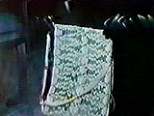
    The fabric is kneaded by hand in hot water to create a crinkled texture. Then, it is exposed to snow, and the ozone bleaches it, making the white background and kasuri patterns beautiful. Finally, it is inspected for weaving irregularities and other imperfections.

    画像をクリックすると動画が再生されます


  • Close-up

    OJIYA Chijimi (Ramie Crepe Textiles) Chijimi, a fabric that blossoms from the long winter and the perseverance of weavers.

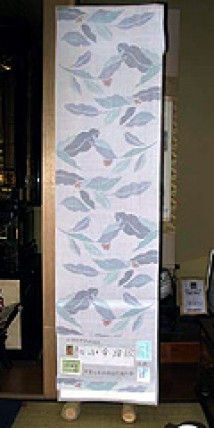
    Made with lustrous linen threads, Ojiya crepe fabric continues to be produced today. Derived from Echigo linen, OJIYA Chijimi (Ramie Crepe Textiles) is characterized by its linen and textured surface. It is a kimono perfectly suited for summer wear.


    Traditional techniques passed down through generations

    Traditional Japanese clothing included silk, used by the upper class, and wisteria cloth and hemp cloth, used by commoners. Hemp, in particular, has a long history, and hemp cloth produced in the Echigo region was known as Echigo Jofu and was beloved by the people. OJIYA Chijimi (Ramie Crepe Textiles) originated from the techniques of Echigo hemp cloth and has a history of maturing as a craft during the long, snow-covered winters of Echigo. Even today, these traditional techniques are passed down, producing high-quality hemp textiles. This time, we spoke with Bonshu Takahashi, a craftsman of OJIYA Chijimi (Ramie Crepe Textiles) and a certified traditional craftsman.

    With a humming sound, the thread is spun.

    OJIYA Chijimi (Ramie Crepe Textiles) by improving Echigo hemp cloth.

    The hemp weaving technique, which has continued for over a thousand years, was improved during the Kanbun era (around 1670) by Hori Masatoshi, a samurai of the Akashi domain. He developed a technique to create wrinkles by twisting the weft threads. Furthermore, he devised ways to weave patterns such as stripes and floral designs on a white background, and thus Ojiya crepe was founded. Its greatest characteristic is the wrinkles that are still preserved today. "When you wear a kimono or shirt in the heat, the fabric tends to stick to you, right? That feeling is eliminated by the unevenness of these wrinkles. So it doesn't stick." The feel against the skin is refreshing. Also, "Hemp is very breathable, so when you go into the shade and the wind blows, it feels really cool." And, "It's water resistant, so it doesn't wear out even if you wash it often in the summer," says Takahashi. Hemp and the smooth feel against the skin due to the wrinkles. "There is no better combination for a summer kimono."
    The nagauta (long song) "Echigo-jishi," composed in 1811 (Bunka 8), already features OJIYA Chijimi (Ramie Crepe Textiles) OJIYA Chijimi (Ramie Crepe Textiles), as it is customary in this land to easily see where it is from," suggest that Ojiya-chijimi has been cherished since ancient times. Its high regard remains unchanged even today.

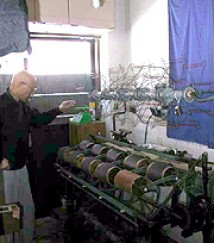
    The work continues carefully and requires concentration.

    It takes time and effort, but there's no point in emphasizing that.

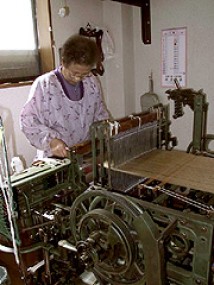
    "We can't make a lot of it. It takes time," says Takahashi. Among the many materials used for kimonos, hemp is particularly difficult to handle and time-consuming to work with, but the fact that hemp crepe continues to be made is because "the artisans of Ojiya have patiently preserved the good qualities of hemp." It is also because the climate of this heavy snowfall region is suitable for hemp. Hemp is susceptible to drying out, so it needs a moderate amount of humidity to be woven properly. This region of Niigata, which is particularly prone to heavy snowfall, has an environment that is suitable for hemp weaving, as it retains moisture. However, the fact remains that weaving crepe is a very difficult process. Recently, some parts of the process are being done by machine, but when it comes to weaving, the dyed ikat threads are matched with patterns and woven by hand.
    Pointing to a woman working on weaving, Takahashi said, "Even if the surroundings become machines, the crucial parts still need to be done by people." This extremely painstaking manual labor continues.

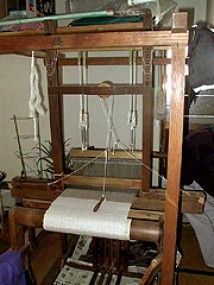
    The loom (takahata) is a tool that still retains its original form from ancient times.

    Creating Ojiya textiles that can thrive in the present moment.

    "Well, our job is to make good products properly and deliver them to everyone," says Takahashi. Regarding the time-consuming work, she states with a resolute voice, "I consider it the natural thing to do." While her words convey the weight of the history of OJIYA Chijimi (Ramie Crepe Textiles), her eyes are fixed on the future. "Isn't it enough to simply satisfy what the customer wants 100%? Ultimately, what matters is the effort put in to get to that point."

    "You won't know until you try it on." The comfort is exceptional.

    Craftsman Profile

    Takahashi Bonshu

    "Even among the works I've created, there's still nothing that I feel is perfect. It's a very deep subject," he says.

    Anecdotes

    Hegisoba, a type of soba noodles unique to textile-producing regions.

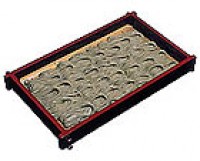
    Hegi soba. This unfamiliar name of soba is a specialty of Ojiya. Its distinguishing feature is the use of "funori," a type of seaweed, as a binder. Funori and textiles may not seem related at first glance, but in the past, funori was used to starch the warp threads when weaving crepe fabric. Hegi soba is soba made using this funori as a binder. A hegi is a large, steamer-like container made of cedar wood, into which about 30 bite-sized balls of soba are placed, and it is eaten by 3 or 4 people gathered around it. The soba arranged in the hegi is said to represent ocean waves, giving it a refreshing feel. It is also called "hand-shaking soba" because of the unique action of shaking the noodles as they are taken out of the water and placed in the hegi. The smooth texture and uniquely rich flavor are its highlights. Funori was used in the process of making crepe fabric, which is made in the deep snow near the Shinano River. Be sure to taste it in Ojiya while imagining such scenery. Shinano River and snow

    • Hegisoba


overview

Craft item name OJIYA Chijimi (Ramie Crepe Textiles)
Reading Ojiya Chijimi
Classification of crafts fabric
Main Products Kimono fabric, Western clothing, interior decor
Main manufacturing area Nagaoka City, Ojiya City, Tokamachi City
Designated date September 4, 1975

contact address

■ Production area association

Ojiya Textile Industry Cooperative Association
947-0028
1-8-25 Jonai, Ojiya City, Niigata Prefecture
Inside Ojiya City Traditional Industries Hall (Sunplaza)
TEL: 0258-83-2329
FAX: 0258-83-2328

https://ojiya.or.jp/

Features

OJIYA Chijimi (Ramie Crepe Textiles) is made from ramie fibers, which easily absorb moisture and release it quickly, so it dries fast. In addition, the unique crinkled texture OJIYA Chijimi (Ramie Crepe Textiles) prevents it from sticking to the skin, making it comfortable as a summer kimono.

How to make it

Ramie fibers are spun to create yarn, and the weft threads are strongly twisted to create the characteristic crepe texture of OJIYA Chijimi (Ramie Crepe Textiles) fabric. The ikat patterns are applied to the yarn before weaving, and the patterns are aligned as the fabric is woven. The crepe texture is then created on the finished fabric during the finishing process.

Please see here for information on traditional craftspeople.

Japanese traditional craftsman
top