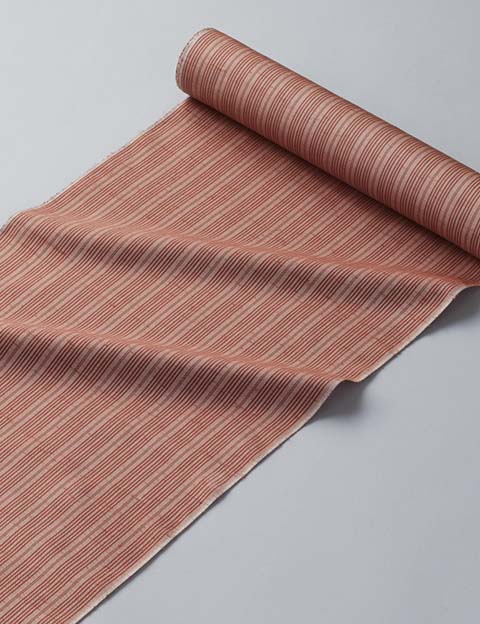
USHIKUBI Tsumugi (Pongee)

Ishikawa Prefecture

The name USHIKUBI Tsumugi (Pongee) originates from the place name Ushikubi Village (present-day Shiramine Village, Ishikawa Prefecture) at the foot of Mt. Hakusan, where it is produced. It is said that when the Ohata clan, refugees of the Minamoto clan who were defeated in the Heiji Rebellion at the end of the Heian period, fled to Ushikubi Village and built a mountain castle, the wives of the Ohata clan who accompanied them were skilled in weaving, and taught their techniques to the women of the village, which is how it all began. The earliest documented mention of it is in the early Edo period, in the name "Kebukigusa". It is said that it was widely sold throughout Japan in the late Edo period, and production peaked around 1935.

  • Technology/techniques/raw materials

    Technology/techniques

    The textile must be woven using the following techniques or methods.
    (1) The fabric must be plain weave and pre-dyed or pre-processed.
    (2) The threads used for the warp threads shall be raw silk, and the threads used for the weft threads shall be reeled silk produced by hand.
    (3) A hand-thrown shuttle or a pull shuttle shall be used to insert the weft threads.
     

    raw materials

    The thread used must be raw silk or slub silk.

  • Work scene

    The production of USHIKUBI Tsumugi (Pongee) involves many processes, from yarn making to indigo dyeing and weaving. Here, we will introduce the main steps of the production process.

    Step 1: From the cocoon

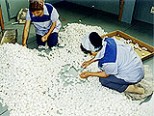
    We remove cocoons that cannot be reeled by hand and select high-quality double cocoons.

    Process 2: Boiled cocoons

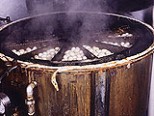
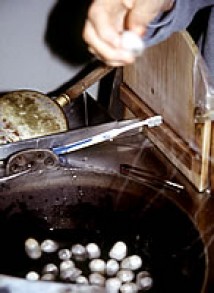
    To help the silk threads unravel in an orderly manner, the cocoons are placed in a pot of boiling water and boiled while being submerged with a spatula. After that, they are treated alternately with steam and boiling water using a cocoon boiling machine.

    Step 3: Hand-reeling silk

    Using a foot-operated reeling machine, the required number of threads are combined from the cocoons to create a single thread. There are two methods for silk production: the "submerged reeling method," in which the cocoons are submerged in a reeling vat while the thread is extracted, and the "floating reeling method," in which the cocoons are floated while the thread is extracted.

    画像をクリックすると動画が再生されます

    Step 4: Kudama

    The yarn, which has been taken out of the reeling process and is still moist, is wound onto a wooden tube.

    Process 5: Hatcho twisting yarn

    Using a twisting machine, the warp threads are twisted 280 times per meter and the weft threads 180 times per meter from the threads on the wooden bobbins, and then wound onto a wooden frame.

    Process 6: Scouring

    Soap and sodium carbonate are added to boiling water, and the warp threads are kneaded for about 70 minutes, while the weft threads are kneaded for about 85 minutes. This process creates the feel and luster of silk.

    Step 7: Thread beating (thread dusting)

    This process restores the unique "undulation" of silkworm thread, resulting in a thread that contains more air.

    Process 8: Indigo dyeing

    The dye is made by mixing sukumo (the raw material for indigo) with wood ash lye and lime, and then fermenting the mixture.

    Process 9: Boiled vegetable dyes

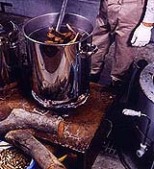
    The roots, bark, leaves, and stems of plants are boiled to separate the pigments.

    Step 10: Gluing

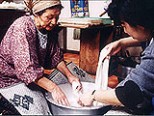
    This process is carried out during manufacturing to prevent the yarn from becoming fuzzy or frayed. The starching method involves squeezing the yarn through a wringer or spin dryer to remove the starch.

    Step 11: Winding the thread

    After scouring, dyeing, and sizing, the skeins are wound onto small frames using a reeling machine.

    工程12: 整経

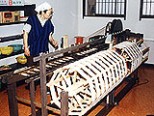
    To prepare for weaving, the warp threads are measured to the required number and length for the desired fabric, arranged evenly to the desired width, and wound onto a warp frame. There are two methods for warping: the "drum method" and the "warp stand method."

    Process 13: Machine setup

    The reed is attached to the heddle threading stand, and the upper and lower threads are threaded through each of the reed's teeth as a pair, preparing the machine for weaving.

    Step 14: Kudama

    The weft thread is wound onto a tube that goes inside the shuttle used for weaving.

    工程15: 製織

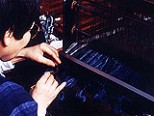
    This is hand weaving on a loom. By alternating foot movements, the warp threads are separated into upper and lower sections. By pulling a cord with the right hand, the shuttle is moved from side to side, carrying the weft thread. This motion is repeated to create the cloth. This weaving requires exceptional skill and incredible patience.

    画像をクリックすると動画が再生されます


  • Close-up

    Silk fabrics woven from the small mysteries of nature

    USHIKUBI Tsumugi (Pongee) is a traditional, homemade textile that has been woven for centuries in Shiramine Village (formerly Ushikubi Village) at the foot of Mount Hakusan. This region has historically relied on sericulture and weaving as its livelihood. Originally, the term "tsumugi" seems to have originated during the feudal period when townspeople who were forbidden from wearing textiles used the name to distinguish it from silk.


    A craftsman's spirit passed down through two generations of family.

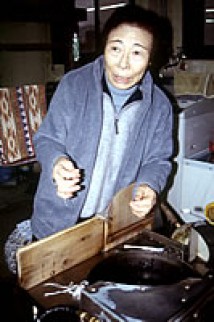
    Throughout its history, USHIKUBI Tsumugi (Pongee) has undergone various changes depending on the era, but it is currently designated as one of Ishikawa Prefecture's intangible cultural properties. We spoke with Tomi Yamashita, a veteran craftswoman with 30 years of experience spinning silk. "My family has been raising silkworms and taking good care of them since my grandmother's generation," she quietly told us. A major characteristic of USHIKUBI Tsumugi (Pongee) is that it is woven with thread that is directly spun by hand from double cocoons. Double cocoons are cocoons that two silkworms create together, and because the threads of the two silkworms are intricately intertwined inside, the threads are more prone to breaking than those of ordinary cocoons, making the thread-spinning process extremely difficult and requiring skilled hands. However, it is these double cocoons that create the unique texture that comes from the natural knots in the fabric. USHIKUBI Tsumugi (Pongee) is woven using threads made from these double cocoons as the weft and threads made from regular cocoons as the warp, creating a beautiful twill weave.

    USHIKUBI Tsumugi (Pongee), with its unique small knots within its lustrous sheen, subtly changes color depending on the light.

    USHIKUBI Tsumugi (Pongee) is supple yet durable, with a lifespan of over 100 years.

    As Yamashita skillfully spins the yarn, she says, "Such a difficult task surely couldn't be done by machine. But I think this is what gives handwoven fabrics their unique texture, the luster of silk, and their exceptional durability, making them so highly valued." Indeed, it's not just beautiful, but also a sturdy silk fabric that, if properly cared for, can last for 100 years and be passed down through three generations. "In the old days, we would feed the silkworms mulberry leaves gathered from the mountains twice a day, morning, noon, and night, for six days in total. Once they started spinning cocoons and the cocoons became translucent, we would place them on a stand called a 'mamushi' and leave them there for a week."

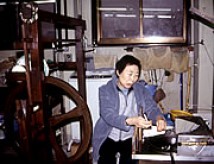
    A foot-operated spinning wheel that I've been using for a long time.

    The painstaking process of spinning the thread is the technique that underpins the traditional crafts of Ushikubi.

    "If you don't apply heat to the cocoons, they'll break apart easily, so we carefully unravel them using a tool called a 'kohanagire' (small wing scraper). At this time, the cocoon threads are easily broken, so we have to be careful." This is a craft that machines cannot replicate, and it requires meticulous attention and concentration. "We spin one thread from several dozen cocoons, so to make one bolt of cloth, we need about 4,000 cocoons." In winter, the steam and heat make it pleasantly warm, but in summer, it's hot and humid, making it a very difficult job. Because of this, it's difficult to find someone to take over this demanding work for the next generation.

    Using small pieces of feather, carefully unravel the silk threads of the cocoon without tearing them.

    A world of ultra-fine threads: approximately 200 denier warp threads and approximately 280 denier weft threads.

    "I still haven't been able to make perfect yarn. At first, the yarn would stick to my fingers and it wouldn't work well, and even when I thought I had spun it nicely, when I looked at it later, the thickness was slightly different... The yarn gets thicker or thinner depending on even a slight change in my mood. I still can't do it well. It's quite difficult..."
    If even Yamashita-san, a veteran of 30 years, can't spin perfect yarn, how many more years of this painstaking yarn-spinning work will it take to become a master?

    "It's hard work, but what makes me happy is meeting people wearing Tsumugi silk. I don't know if they wove it with my own threads or not, but it always brings a smile to my face. Just the other day, actress Yoshie Mizutani came here wearing USHIKUBI Tsumugi (Pongee). I was so moved."
    The reason why women become even more beautiful when they wear kimonos may be a testament to the delicate world they inspire, and the graceful, natural beauty they exude.
    An eight-series twisting machine used to twist yarn. Until very recently, yarn twisting was done by hand.

    • The generation of people like Mr. Yamashita is our last hope. If there are no longer people to spin this thread, weaving tsumugi silk will become impossible.

    • The generation of people like Mr. Yamashita is our last hope. If there are no longer people to spin this thread, weaving tsumugi silk will become impossible.

    Craftsman Profile

    Yamashita Tomi

    Tomi Yamashita has been spinning yarn for 30 years. She often wears a kimono while working. Her age is a secret.

    Anecdotes

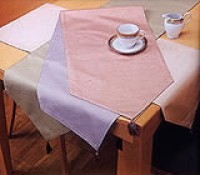
    USHIKUBI Tsumugi (Pongee) that gently adorns the dining table.

    Recently, USHIKUBI Tsumugi (Pongee) has been used not only for kimonos but also as tableware.

    The lustrous beauty and soft texture of natural silk complement both Western and Japanese styles.

    USHIKUBI Tsumugi (Pongee) tableware, which expresses the beautiful changing seasons of spring, summer, autumn, and winter with the colors of plant dyes for each season, will add a touch of elegance and splendor to your dining table.

    The soft texture created by the double silkworm cocoons is unique to USHIKUBI Tsumugi (Pongee). Because the threads, which feel as if they contain air, are woven on a handloom, the cushions also have a lustrous and gentle feel.

    From coasters and table runners to cushions, why not incorporate the unique surface beauty and deep colors of these natural dyes into your everyday interior decor?

    • A sophisticated collection of tableware made from USHIKUBI Tsumugi (Pongee) in refined colors.

    • A table center that creates a slightly luxurious atmosphere.

    • I want at least one cushion with a soft texture.


overview

Craft item name USHIKUBI Tsumugi (Pongee)
Reading cowhide wheat
Classification of crafts fabric
Main Products Japanese clothing items, kimono fabrics, obi sashes, accessories
Main manufacturing area Hakusan City
Designated date June 9, 1988

contact address

■ Production area association

Ishikawa Prefecture USHIKUBI Tsumugi (Pongee) Production Promotion Cooperative
〒920-2501
17 Nu, Shiramine, Hakusan City, Ishikawa Prefecture
TEL: 076-273-2400
FAX: 076-273-4414

http://www.icnet.or.jp/dentou/national/09.html

Features

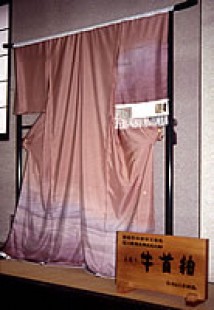
This fabric is characterized by its use of thick, knotty threads, which are made from double cocoons produced jointly by two silkworms. The unique knots and distinctive luster of the threads, when dyed rather than left as plain white fabric, bring out a rustic elegance and a simple, folk-art-like charm.

How to make it

Starting with the selection of cocoons, the process involves 14 major steps, including silk reeling, twisting, scouring, dyeing, and weaving, with many of these steps carried out entirely by hand, utilizing traditional techniques. In particular, silk making is a crucial step that determines the quality of the final product.

top