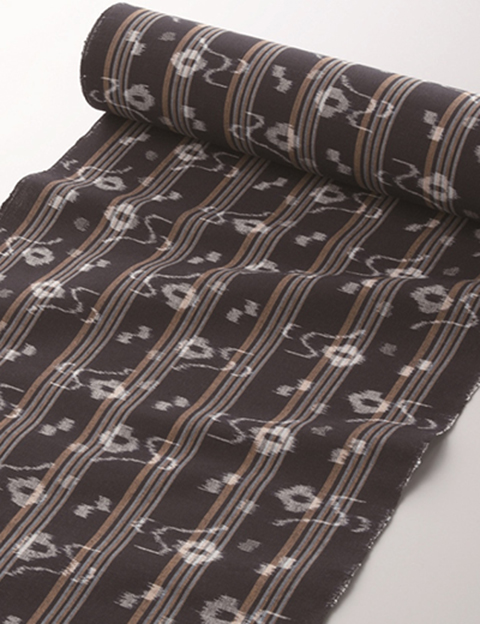
YUMIHAMA Kasuri (Ikat)

Tottori Prefecture

In the Yumigahama region of western Tottori Prefecture, cotton production for personal use using sandy soil began in the latter half of the 17th century. In the mid-18th century, when wholesalers of indigo dye were established, the production of cotton, a fiber made from cotton, increased.
In the early 19th century, a type of ikat fabric called Hamano-me-kasuri began to be woven by farm women in Yonago and Yumigahama.

  • Technology/techniques/raw materials

    Technology/techniques

    1. The fabric must be a kasuri textile woven using one of the following techniques or methods.
    (1) The fabric shall be plain weave with pre-dyed yarn.
    (2) Kasuri yarn shall be used as the weft.
    (3) Matching the patterns of the ikat threads by hand to weave the ikat pattern.

    2. The dyeing method for ikat threads is by "hand-tying".
     

    raw materials

    The yarn used should be cotton.

  • Work scene

    YUMIHAMA Kasuri (Ikat) originated as clothing for farmers themselves, and is therefore characterized by its simple and rough texture.
    The basic principle of the manufacturing method is to "use ikat threads dyed in different colors for the weft and weave ikat patterns in a plain weave," and the process is broadly divided into the weft process, the warp process, and the final process.
    All of these processes are done by hand using traditional methods, but the process called "seed thread making" in particular is a unique technique that has been passed down for generations only in YUMIHAMA Kasuri (Ikat).
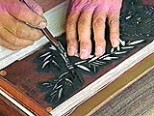
    This is a preparatory process carried out by specialized yarn makers, where they mark the areas of the weft threads to be dyed. They carve patterns into waxed Japanese paper, place it on top of the laid-out weft threads, and rub in ink. These ink marks serve as markers for the dyers when they dye the threads.
    Here, we will explain the process of "seed thread making," which is a unique technique.

    Step 1: Weft warping

    Stretch the required number of weft threads along the seed thread.

    Step 2: Creating the original drawing

    I will draw the ikat pattern on washi paper at actual size.

    Process 3: Seed paper

    When weaving in large quantities, the design is carved into stencil paper.

    Step 4: Making the yarn

    To prevent the thread from stretching, stiffen it and wind it onto a small reel.

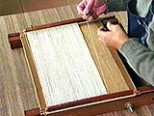
    Step 5: Threading the picture stand

    The threads are stretched onto the yarn stand according to the specified thread density, the length of the pattern, and the width of the fabric.

    Step 6: Marking

    Apply ink to the thread according to the sketch.

    Step 7: Weft tying

    The warped weft threads are tied using the marked areas on the seed threads as a guide.

    画像をクリックすると動画が再生されます

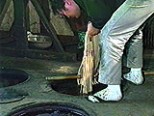
    工程8: 染色

    The yarn is dyed with indigo, natural dyes, or chemical dyes.

    Step 9: Untying the Kasuri (ikat) knots.

    Untie the ikat knots.

    画像をクリックすると動画が再生されます

    Step 10: Splitting the weft threads of the ikat fabric.

    The weft threads are separated one by one, wound onto the frame, and the seed threads are removed.

    Step 11: Winding the weft thread onto a bobbin

    Wind the required length of thread for weaving one pattern onto a bobbin.
    In this way, after the weft thread process is complete, the warp threads, which are made in a separate process, are woven together, and YUMIHAMA Kasuri (Ikat) is finished.

  • Close-up

    Simple YUMIHAMA Kasuri (Ikat) patterns nurtured by mother and daughter working late into the night.

    Encouraged by the feudal domain as a way to produce their own clothing and as a side business, women spun thread in between farming and housework, or at night, dyeing the weft threads with ikat patterns. It was said that "a woman who can weave good ikat will find a good husband." The women worked hard to acquire the skills, refined their techniques, and wove YUMIHAMA Kasuri (Ikat).


    Its main features are its simple illustrations and rough texture.

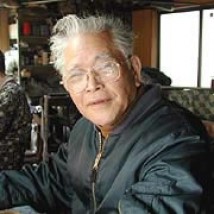
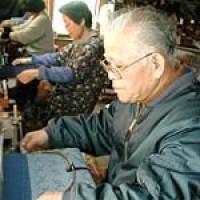
    This pre-dyed plain-weave cotton pongee features a beautiful white ikat pattern against a deep indigo background, but its origins lie in clothing made for farmers' self-sufficiency. We spoke with Katsuyoshi Murakami, a traditional craftsman who has dedicated over 40 years to this YUMIHAMA Kasuri (Ikat) technique. His wife, Kazue, is also a traditional craftsman, and the couple weaves ikat together harmoniously.

    Traditional craftsman Katsuyoshi Murakami

    It is a source of pride for YUMIHAMA Kasuri (Ikat), which supported essential farm work.

    Murakami describes the characteristics of YUMIHAMA Kasuri (Ikat) as follows: "First of all, since the ikat fabrics here were used for work clothes, they had to be durable. That's why the indigo dyeing, which is said to get better with each wash, really comes into play. Secondly, there's the texture and feel. The unique characteristics of Hakushu cotton give it a warmth and softness similar to wool. And thirdly, there's the simplicity of the patterns. I have a strong affection for the patterns that have been passed down for over 200 years, the patterns left behind by our ancestors who sought to express their love through ikat."

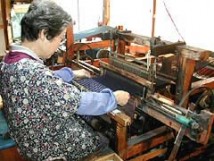
    A well-worn loom for weaving YUMIHAMA Kasuri (Ikat) textiles.

    A tradition can only survive by letting go of unnecessary attachments.

    Murakami, who has a strong love for and confidence in YUMIHAMA Kasuri (Ikat), reflects on her own journey and says, "I'm originally from Hiroshima, and during the post-war cotton shortage, I came here to buy cotton. By chance, a relative of mine was doing Kasuri in Yonago, and that's how I started, without becoming a master or apprentice, just by watching and imitating. I started from scratch on my own, but I don't particularly feel like I had a hard time. Maybe it's because I was always working hard..." During the Meiji era, Tottori Prefecture was the third largest producer of Kasuri textiles in Japan. However, it was overtaken by the development of Western-style spinning and was unable to keep up with the changes in lifestyle, forcing many of its competitors to go out of business.
    "If I had clung unnecessarily to tradition, I might have had to close my business. But I haven't been attached to traditions; I've always focused on improving technology and developing new products. That's why I've been able to enjoy my work," Murakami said with a boyish smile. Beside him, his wife nodded gently with a supportive smile.

    Cotton is both soothing and ecological.

    Recently, there has been a quiet boom in demand for the texture of cotton. Apparently, a kasuri (ikat) kotatsu cover made by Mr. and Mrs. Murakami was featured in a magazine. "I think the simplicity and gentleness of cotton is what makes Japanese people feel most at ease. We will continue to make works that will be a source of comfort for the hearts of Japanese people," Mr. and Mrs. Murakami told us, as the sound of the factory looms quietly and continuously echoed in the background.

    Anecdotes

    Our pride YUMIHAMA Kasuri (Ikat) loom

    When I visited Mr. Murakami's factory, I was surprised to see his prized YUMIHAMA Kasuri (Ikat) weaving loom. He said he has been using it with great care for 40 years since the company was founded.
    Mr. Murakami laughed and said, "I'm a traditional craftsman in the field of repairing this machine too." They say that good craftsmen cherish their tools, and that's absolutely true.

    • Well-worn looms and craftsmen

overview

Craft item name YUMIHAMA Kasuri (Ikat)
Reading Yumihama gasu
Classification of crafts fabric
Main Products Kimono fabric, cushions, curtains, bags
Main manufacturing area Yonago City, Sakaiminato City
Designated date September 4, 1975

contact address

■ Production area association

Tottori Prefecture YUMIHAMA Kasuri (Ikat) Cooperative Association
684-0041
5473 Nakano-cho, Sakaiminato City, Tottori Prefecture
Inside YUMIHAMA Kasuri (Ikat) Workshop
TEL: 080-4731-8712

https://sites.google.com/view/yumihamagasuri/

Features

As it originated as clothing for farmers themselves, it has a simple and rough texture. Utilizing the technique of picture ikat weaving, patterns related to everyday life, such as "lucky charms," "warding off evil," and "auspiciousness," are expressed with both delicacy and boldness.

How to make it

The raw yarn is purified by removing impurities, then it is divided into about 80 strands, and the parts that will form the pattern are tied and dyed. After dyeing and drying, the tied threads are removed, leaving only the tied parts undyed and white. By separating the 80 strands one by one and weaving them together while matching the white parts, a pattern can be created.

Please see here for information on traditional craftspeople.

Japanese traditional craftsman
top