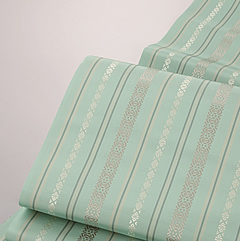
Technology/techniques
1. For presentations and alternative presentations, the fabrics shall be patterned textiles woven using the following techniques or methods:
(1) The fabric shall be a plain weave variation using a pre-dyed or pre-processed plain weave fabric made on a "jacquard loom" or "dobby loom" (for presentation purposes, limited to warp rib weave).
(2) The warp threads shall be grouped into groups of eight or more, and then each reed shall be pulled in by hand. In this case, the reed density shall be 72 or more reeds per 3.78 centimeters.
(3) Adjusting the position of the "Twill Bamboo" and weaving while manually adjusting the tension of the warp threads to be uniform.
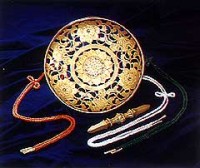
(4) The crest shall be represented by a "floating" design.
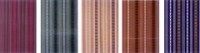
(5) The patterns to be presented shall be "Dokko," "Hanazara," and "Shima."
2. In the case of Hirahakata, the plain fabric shall be woven using the following techniques or methods.
(1) The fabric must be pre-dyed or pre-processed and woven using a warp rib weave.
(2) The warp threads shall be grouped into groups of eight or more, and then each reed shall be pulled in by hand. In this case, the reed density shall be 72 or more reeds per 3.78 centimeters.
(3) The weft threads shall be driven in using a hand-thrown shuttle, a pull shuttle, or a drive shuttle.
(4) Adjusting the position of the "twill bamboo" and weaving while manually adjusting the tension of the warp threads to be uniform.
3. In the case of striped fabrics, the fabric shall be striped fabric woven using the following techniques or methods:
(1) The fabric must be a plain weave variation, twill weave, satin weave, or a variation thereof, using a pre-dyed or pre-processed plain weave with a jacquard weave or dobby weave.
(2) The warp threads shall be grouped into groups of eight or more, and then each reed shall be pulled in by hand. In this case, the reed density shall be 72 or more reeds per 3.78 centimeters.
(3) Adjusting the position of the "Twill Bamboo" and weaving while manually adjusting the tension of the warp threads to be uniform.
4. In the case of a fully woven fabric, it shall be a patterned fabric woven using the following techniques or methods:
(1) The fabric shall be a pre-dyed or pre-processed warp-layered weave using the "jacquard weave" technique.
(2) The warp threads shall be grouped into groups of 10 or more, and then each reed shall be pulled in by hand. In this case, the reed density shall be 70 or more per 3.78 centimeters.
(3) Adjusting the position of the "Twill Bamboo" and weaving while manually adjusting the tension of the warp threads to be uniform.
(4) The crest shall be represented by a "floating" design.
5. When weaving in layers, the patterned fabric shall be woven using the following techniques or methods.
(1) The fabric shall be a pre-dyed or pre-processed warp and weft overlay weave using the "jacquard weave" technique.
(2) The warp threads shall be grouped into groups of 13 or more, and then each reed shall be pulled in by hand. In this case, the reed density shall be 73 or more per 3.78 centimeters.
(3) Adjusting the position of the "Twill Bamboo" and weaving while manually adjusting the tension of the warp threads to be uniform.
(4) The crest shall be represented by warp threads or warp and weft threads.
6. When weaving with a gauze weave, the gauze fabric shall be woven using the following techniques or methods.
(1) The fabric shall be a pre-dyed or pre-processed warp-woven fabric using the "jacquard weave" method.
(2) For weaving machines that use a hand-thrown shuttle or a pull shuttle to insert the weft threads, the warp threads shall be grouped into sets of five or more threads and then manually pulled in one by one into each reed dent. For other machines, the warp threads shall be grouped into sets of eleven or more threads and then manually pulled in one by one into each reed dent. In this case, the reed density shall be 15 or more dents per 3.78 centimeters, and 60 or more dents per 3.78 centimeters for other machines.
(3) Adjusting the position of the "Twill Bamboo" and weaving while manually adjusting the tension of the warp threads to be uniform.
(4) The crest shall be expressed by "floating" or by using the ground thread or the weft thread for the design.
7. In the case of Hakata with picture weft, the patterned fabric shall be woven using the following techniques or methods.
(1) The fabric shall be a plain weave variation, twill weave, satin weave, or a variation thereof, which is pre-dyed or pre-processed using the "jacquard weave" technique.
(2) The warp threads shall be grouped into groups of six or more, and then each reed shall be pulled in by hand. In this case, the reed density shall be 55 or more per 3.78 centimeters.
(3) Adjusting the position of the "Twill Bamboo" and weaving while manually adjusting the tension of the warp threads to be uniform.
(4) The pattern shall be made with weft threads. In this case, the weft threads of the pattern, other than those of plain weave variations, shall be sewn together with warp threads on the back.