SHURI Ori (Textiles)

Okinawa Prefecture

The Ryukyu Kingdom of the 14th and 15th centuries actively traded with Southeast Asia and China, learning weaving techniques through these exchanges. Over the following centuries, Ryukyu textiles, each with its own unique character, were created, nurtured by Okinawa's climate and natural environment.
In particular, in Shuri, which flourished as the castle town of the Shuri royal government, a tradition of weaving elegant, graceful, and beautiful textiles, with colors and patterns perfected to the utmost degree for the nobility and samurai of the royal government, has continued to this day.

  • Technology/techniques/raw materials

    Technology/techniques

    1. In the case of Shuri Kasuri, it shall be a kasuri fabric woven using the following techniques or methods:
    (1) The fabric shall be plain weave with pre-dyed yarn.
    (2) A hand-thrown shuttle is used to insert the weft threads.
    (3) The dyeing method for the ikat thread shall be by "hand-tying", "weaving tie", or "hand-binding".

    2. In the case of Shuri Hanaori, it shall be a patterned fabric woven using the following techniques or methods:
    (1) The fabric shall be plain weave with pre-dyed yarn.
    (2) A hand-thrown shuttle is used to insert the weft threads.
    (3) The crest shall be drawn using a "flower heddle" or a "sewn shuttle".

    3. In the case of Shuri Doton weaving, the patterned fabric shall be woven using the following techniques or methods:
    (1) The fabric shall be plain weave with pre-dyed yarn.
    (2) A hand-thrown shuttle is used to insert the weft threads.
    (3) The crest shall be made using four or more heddles.

    4. In the case of Shuri Hanakura weaving, the patterned fabric shall be woven using the following techniques or methods.
    (1) The fabric shall be a mixed weave of pre-dyed plain weave and gauze weave.
    (2) A hand-thrown shuttle is used to insert the weft threads.
    (3) The crest shall be made using "Hanasōkō" and "Rosōkō".

    5. In the case of Shuri Minsa, the patterned fabric shall be woven using the following techniques or methods:
    (1) The fabric shall be pre-dyed and ribbed.
    (2) A hand-thrown shuttle or a board shuttle shall be used to insert the weft threads.
    (3) The crest shall be represented using either "Ayatake" or "Hanasōgō".
     

    raw materials

    The threads to be used are raw silk, spun silk, hand-spun floss silk, cotton thread, hemp thread, or banana fiber thread.

  • Work scene

    Shuri boasts a wide variety of textiles, including Hanakura-ori, Hanaori, Doton-ori, Kasuri, Minsaa, and handkerchiefs. The threads used are primarily silk, but cotton and hemp are also employed. Here, we will look at the process of making Kasuri. Shuri's Kasuri is said to be the original form of Kasuri, due to its unique hand-tying technique.

    Step 1: Design

    Designs are determined by referring to illustrated books and other reference materials. Shuri Kasuri has a set of basic patterns, which are said to be the origin of Japanese ikat weaving. Many of the basic patterns depict familiar things such as flowing rivers, clouds, plants and animals, and everyday objects, and there are more than 500 types of basic patterns. Original designs are created by combining these patterns.

    Step 2: Winding the thread

    The threads are scouring to remove impurities, then sizing, and finally reeled in.

    工程3: 整経

    This is the process of preparing the number and length of threads needed for one bolt of fabric.

    Step 4: Kasuri tying

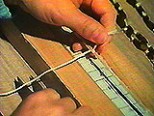
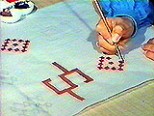
    The warp threads are stretched out and marked according to the design, and the ikat patterns are tied by hand. For intricate ikat patterns that are difficult to tie by hand, a tying machine is used. The weft threads, which have been prepared for warping, are then prepared according to the design, determining the number and length of the ikat threads, and small sieves wider than the width of the fabric are made. The sieves are stretched onto a tying stand, ink is applied according to the design, and the ikat patterns are tied by hand.

    工程5: 染色

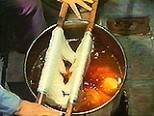
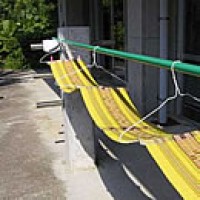
    The dyes used are plants native to Okinawa, such as Ryukyu indigo, Rhaphiolepis indica, and Garcinia subelliptica. Preparing the indigo solution for dyeing takes one week in summer and two weeks in winter. When the indigo flowers turn reddish and the solution turns bluish, the dye is ready. The yarn is placed in the indigo vat and gently rubbed by hand to allow the dye to penetrate the yarn. The dyed yarn is wrung out tightly, oxidized in the air, and dried in direct sunlight. The golden color is made by boiling the bark of the Garcinia subelliptica. Dyeing is a painstaking process that requires repeated steps.

    Step 6: Preparation for weaving

    The ikat threads, after being untied, are arranged according to the design and stretched out. The ikat threads, stripe threads, and ground threads are then separated. After that, the threads are temporarily threaded through the reed, wound up, threaded through the heddles, and threaded through the reed. The weft threads are separated into ikat threads, wound onto bobbins, and placed in the shuttle.

    画像をクリックすると動画が再生されます

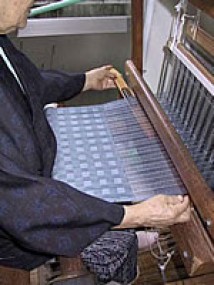
    Step 7: Weaving

    The weft threads are carefully shifted to match the pattern as we weave. After washing and stretching, the fabric is complete.

    画像をクリックすると動画が再生されます


  • Close-up

    High-quality textiles that are rooted in court culture.

    In Shuri, where the Ryukyu Kingdom government was located and where royalty and samurai lived, a wide variety of textiles flourished. These included patterned weaves such as Hanakura-ori, Hana-ori, and Doton-ori, as well as ikat weaving, resulting in refined and elegant kimonos. We spoke with Chiyo Tokuyama, a certified Okinawan craftswoman.


    The Hanakura-ori fabric worn by the queen and princess

    Based on the "Goezucho," a design book created by a designer of the Shuri royal government, the Ryukyu Kingdom commissioned women in the Miyako and Yaeyama regions to weave bolts of cloth. The finest pieces were sent as gifts to the Shimazu clan and China, while the rest were worn by the samurai class in Shuri. In samurai households, the women wove clothing for their families. Shuri, where many nobles and samurai lived, is said to have had a different language spoken than other regions. Shuri weaving is a SHURI Ori (Textiles) that flourished in such a town.
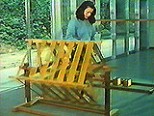
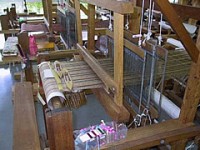
    I visited the workshop adjacent to Ms. Tokuyama's home. SHURI Ori (Textiles) is not done by division of labor; one person makes everything from the design to the finishing touches. Paper with designs and threads were placed in the workshop, and three looms were lined up. A partially woven Hanakura weave was hanging on one of them.
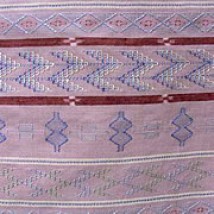
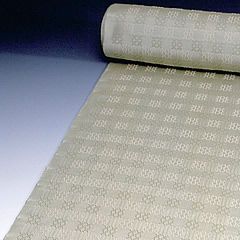
    Hanakura-ori is the most prestigious type of Shuri weaving, used for summer kimonos worn by the queens and princesses of SHURI Ori (Textiles). In addition to the hana-ori weaving technique, which involves weaving small square dots to resemble flowers, it incorporates sheer ro-ori weaving in checkerboard and diamond patterns. The transparency of the ro-ori gives the fabric a light and cool appearance.

    Tokuyama's colorful works

    The feelings embedded in each and every piece of fabric

    After the abolition of the feudal domains and the establishment of prefectures, the art of Hanakura weaving declined, but its advanced techniques were revived after the war. The weaving process is complex, and mistakes can easily be made if one is not careful. Even with careful weaving, progress is only about 30 centimeters per day. After weaving one bolt of cloth, the back of the thighs where the loom boards touched becomes sore and irritated.
    "I think people in the past were very clever to come up with something so difficult. It's so hard that not many people want to weave. I only do it for about two hours in the morning and two hours in the afternoon. Weaving for long periods of time is difficult."
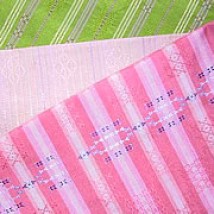
    Ms. Tokuyama keeps samples of the fabrics she has woven over the past 30 years in a wicker basket. She showed me some of her other works. She took out pieces of fabric, about 30 centimeters in size, one by one and spread them out. There were lovely light pink floral weaves, men's Doton weaves with stripes on dark green and navy backgrounds, and even obi fabrics. Each piece was filled with memories: the joy of a successful design, the feelings of weaving it for her daughter, the happiness of receiving thank-you notes from those who wore it.
    Shuri is well known not only for its patterned weaves like Hanaori and Dotonori, but also for its ikat weaves. Ms. Tokuyama's favorite is Tijima (hand-stripe). It's a pattern with ikat designs of birds and other motifs within a checkered pattern, and she says it's a joy just to look at. Some Shuri ikat fabrics have bold color combinations reminiscent of Madras checks, and they have an appeal that attracts even people unfamiliar with kimonos.

    The obi fabric is also on display at the Naha City Traditional Crafts Center.

    A smile spreads across her face when she finishes weaving.

    When she was young, Ms. Tokuyama began weaving under the guidance of Hatsuko Miyahira, a Living National Treasure.
    "My teacher was very gentle and taught me proper language and manners. I was able to follow her because I respected her. Once I started, I enjoyed it so much that I couldn't stop. Even now, I think to myself, 'If only I could do this without doing housework,' and I'm truly grateful to my teacher."
    Even now, while looking at old Okinawan textiles and the works of my teachers, I am constantly trying to find ways to speed up the time-consuming Hanakura weaving process and to create better patterns.
    "I can think things through more calmly now than when I was younger and constantly chasing deadlines. But when I see young people working so hard, it makes me feel like I need to work even harder."
    There's joy in each step of the process, whether it's when you unexpectedly get a beautiful color during dyeing or when you start weaving and the pattern turns out exactly as you envisioned. And when you look at the finished product, you can't help but smile.

    Weaving is a task that requires concentration and patience.

    Craftsman Profile

    Tokuyama Chiyo

    Born in 1926. He was the first person in Okinawa Prefecture to be certified as a traditional craftsman. He is the former chairman of the Naha Traditional Textile Business Cooperative Association.

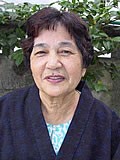
    Chiyo Tokuyama speaks with a calm expression.

    Anecdotes

    The power of tradition that seeps into your body without you even realizing it.

    SHURI Ori (Textiles) weaving design is conceived by the individual artisan. While each piece reflects the individual's personality, why is it that all Shuri weaving pieces share a similar sense of refined elegance?
    Misako Azama, the director who works on her own projects while also instructing students, says, "There are things that are conveyed through the land, the air, and the objects." Initially, everyone takes the course because they want to try weaving. After practicing and continuing for several years, they begin to understand the historical background. It's as if the essence of SHURI Ori (Textiles) seeps into their bodies without them even realizing it.
    "From that, the idea of trying to create this kind of color emerges. That's why even with the same Hanaori weave, the unique character of the production area comes through."
    In Okinawa, a region with many islands, the climate, language, and customs vary from area to area. Naturally, these differences lead to different cultural influences. This explains the development of unique textiles in each region.
    After hearing that story, I came across Ms. Azama's work at the "Oki-ten" exhibition, which features works by Okinawan arts and craftspeople. The kimono fabric, dyed with fukugi in a vibrant yellow with a brown and green checkered pattern, had the elegant splendor of Shuri.

    • The Fukugi tree is used to produce yellow dye. The bark is primarily used.

    • The pale pink color of the bottle-necked kiwi fruit


overview

Craft item name SHURI Ori (Textiles)
Reading Shuriori
Classification of crafts fabric
Main Products Kimono fabric, obi (sash), table runner
Main manufacturing area Naha City, Nishihara Town (Nakagami District), Haebaru Town (Shimajiri District)
Designated date April 27, 1983

contact address

■ Production area association

Naha Traditional Textile Business Cooperative
〒903-0822
2-64 Shuri Momohara-cho, Naha City, Okinawa Prefecture
TEL: 098-887-2746
FAX: 098-885-5674

https://shuri-ori.com/

Features

A distinctive feature of SHURI Ori (Textiles) is its wide variety of weaving techniques, ranging from simple weaving to ikat. Among these, Hanakura-ori and Doton-ori were reserved exclusively for the royal family and nobility, and were woven only in Shuri.

How to make it

The raw materials mainly consisted of silk threads, along with other natural fibers such as cotton and hemp threads. The dyes used included plant-based dyes such as Ryukyu indigo, Fukugi, Tekachi, Shibuki, and Guru, as well as chemical dyes. These were used to weave traditional textiles such as Shuri Kasuri, Shuri Hanaori, Shuri Dotonori, Shuri Hanakuraori, and Shuri Minsaa.

top