YAEYAMA Minsaa (Obi sash Textiles)

Okinawa Prefecture

It was introduced from Afghanistan via China, and records of the use of cotton cloth (minsa) date back to the early 16th century during the royal court period.
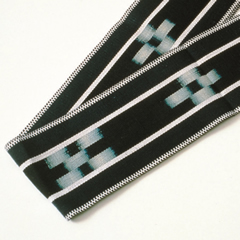
It is believed that minsa fabrics were already being woven in the Yaeyama region around this time. The name YAEYAMA Minsaa (Obi sash Textiles) is said to come from the words "min" (cotton) and "sa" (narrow sash). In the era of visiting marriages, it was customary for women to give these fabrics to the men they loved, and the five or four patterns are said to represent "a vow of unchanging love that will last for generations."

  • Technology/techniques/raw materials

    Technology/techniques

    1. The fabric must be a kasuri textile woven using one of the following techniques or methods.
    (1) The fabric should be pre-dyed and ribbed.
    (2) A hand-thrown shuttle or a board shuttle shall be used to insert the weft threads.

    2. The dyeing method for ikat threads is by "hand-tying".
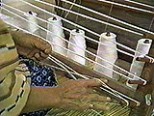
     

    raw materials

    The yarn used should be cotton.

  • Work scene

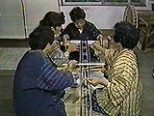
    Both the warp and weft threads are made of cotton. The warp threads are dyed and arranged to create a white ikat pattern, and then the weft threads are inserted to create the fabric. Weaving is the final stage, and the preparation leading up to it takes a long time and a lot of effort.

    工程1: 整経

    Calculate the number of warp threads needed for the desired width and ensure they are all the same length. This process is repeated for each type of thread: the ikat threads that will form the white square pattern, the striped threads that will form the white lines, and the ground threads that will form the navy blue areas. This is a crucial step in determining the width and length of the obi.

    Step 2: Kasuri tying

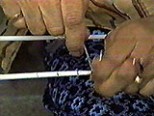
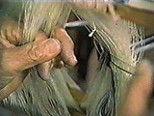
    The warped ikat threads are stretched in water and prepared for indigo dyeing. The parts of the ikat pattern that are to remain white are tied with string to prevent the indigo dye from seeping in. A ruler with the size of the ikat pattern is placed on the thread, and marks are made on the thread before tying. Nowadays, plastic string is used, but in the past, it was done with the bark of the Japanese banana plant.

    Process 3: Indigo dyeing

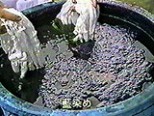
    The threads used to tie the ikat fabric are soaked in water, then wrung out and immersed in the indigo dye solution. The fabric is dyed while being moved around as if being rubbed. After 2-3 minutes, it is removed and exposed to air to oxidize and develop the color. This process is repeated many times until a sufficiently dark color is achieved. The time and number of repetitions are determined by feel. The indigo used is mainly Indian indigo grown in fields. When other colors are desired, the fabric is dyed using plants such as Fukugi, Bayberry, Gardenia, Castanopsis, Japanese Red Maple, and Koro (a type of cinnamon).

    Step 4: Kasuri weaving

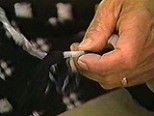
    Once the ikat threads are dyed, carefully remove each tied string one by one. Care must be taken not to cut the threads.

    Step 5: Glueing

    To prevent the ikat pattern from shifting while weaving, the threads are starched to ensure uniform tension. Cotton threads stretch considerably, so they are evened out at this stage. This is done by stretching the threads between stakes driven into the stone wall of the house. This process makes weaving easier.

    画像をクリックすると動画が再生されます

    Step 6: Temporary reed threading

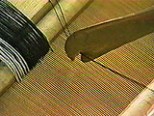
    The warp threads (ground thread, ikat thread, stripe thread) are arranged according to the pattern and passed through the reed, and the width of the fabric is checked.

    Step 7: Warp winding

    The warp threads, which have been passed through the temporary reed, are stretched taut, and the threads are wound while taking care to prevent the ikat pattern from shifting. Any slack or twists are corrected as the threads are wound.

    Step 8: Threading the heddles and the reed

    The ends of the warp threads, wound in a roll, are passed through the needle holes of the heddle, one thread at the front and one at the back. The threads are then passed through the reed. If weaving by hand, the threads are not passed through the reed.

    工程9: 製織

    We begin weaving after adjusting the tension of the threads. Using a shuttle, we insert the weft threads (indigo-dyed ground threads) into the warp threads. Once weaving is complete, it is washed to finish. The quality of the preparation before weaving, such as ikat tying and kachitami, is what contributes to the beauty of the fabric.

    画像をクリックすると動画が再生されます


  • Close-up

    A treasure that has been indispensable to island life, both now and in the past.

    YAEYAMA Minsaa (Obi sash Textiles) is a textile with a history of 300 years. Each narrow obi (sash) embodies the various thoughts and feelings of the people who lived in each era. For Ms. Uchimori, minsa is a lifelong treasure. She wants to continue weaving it forever.


    A gift from a new wife to her future husband

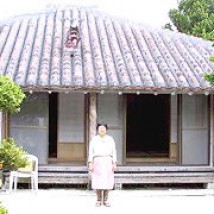
    Stepping onto the pure white coral sand, I peered into a red-tiled house surrounded by stone walls, and saw two looms lined up on the veranda. This was the workshop of Sumi Uchimori, who was born and raised on Taketomi Island and has been familiar with weaving since childhood. One loom was laden with silk fabric, and the other with a vibrant minsa weave of white ikat on a navy background.
    Minsaa are narrow cotton sashes woven in various parts of Okinawa Prefecture, including Yaeyama, Yonaguni, Yomitan, and Shuri. They are typically indigo-dyed and about 10 centimeters wide, but the patterns vary slightly depending on the region.
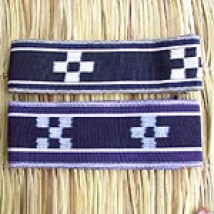
    The Yaeyama pattern is a combination of four and five rectangles. It is said to embody the wish for "forever and ever (5) and into the ages (4)" and was woven by the woman and given to the man when their engagement was decided. The border pattern is "yashirami," which means centipede legs, and is said to mean "please visit often."

    Ms. Uchimori runs a guesthouse while dedicating herself to weaving.

    The comfortable fit is unique to "hand-tightened" belts.

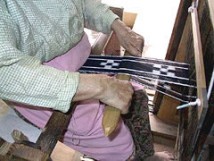
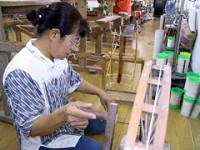
    I was shown how Ms. Uchimori weaves. She swiftly placed her small body onto the loom and began moving her arms and legs quickly. Her movements were somehow different from ordinary weaving. This was the "hand-tightening" weaving method unique to the Minsa weaving of Taketomi Island.
    When inserting the weft threads between the warp threads, instead of tapping the reed, the shuttle is pulled firmly towards the player to bring the weft threads together. This requires strength, and considerable skill is needed to ensure a consistent width for the obi (sash).
    "Hand-tying is hard work. But the finished product has character. It has warmth. I don't really want to call something woven with a reed 'Minsa weaving'."
    Although reed-beating became more common after the war, there are still weavers who insist on hand-tying the yarn. Indeed, when you compare the two, the hand-tyed yarn, despite being cotton, is moist and soft. The weave is tighter, and the patterns stand out. Above all, it is well-known for its comfortable feel when tying the yarn, and it is said that it develops a unique character the more you use it.
    A kimono sash is something you can use for a lifetime once you acquire it. I'd love to have a sash like this in my possession and see how it changes as I grow older.
    Because it's something that will be used for a long time, a long, narrow piece of cloth can hold a lot of meaning and sentiment.
    "My father, my husband's father, had a grandmother who wove traditional Okinawan textiles (minsaa) on this island as a protective charm when he was a child. So he always wore his grandmother's obi (sash), ever since I got married. He used it so much that the threads at the end broke. When I offered to exchange it for a new one, he said, 'It was a protective charm, so it's like a part of my mother's body,' and he absolutely refused to wear it. He folded it in half and continued to use it. He wore that obi until he passed away."

    Weaving minsā cloth by hand.

    The era when we helped the people of Taketomi Island

    Ms. Uchimori was most active in weaving Minsaa textiles from the late 1950s to the 1960s. The number of tourists visiting Taketomi Island increased, and Minsaa textiles became popular as souvenirs. Groups of wives of American military officers would come and buy obi sashes and Minsaa table runners.
    Even with 73 women on the island weaving, it wasn't enough to keep up. The whole family pitched in to help. Grandma made the warp threads, and Dad wound the ikat fabric. Indigo dyeing was also done in each household.
    Thanks to weaving in every spare moment, Mr. and Mrs. Uchimori were able to send their children to higher education. The minsā loom became a lifelong treasure for Mr. Uchimori. Although he now weaves more silk and hemp, he always makes sure to use one of his two looms to weave minsā.
    "I don't want to erase it from the loom. Even when I'm weaving something I love, there's always a part of me that feels like I have to keep it. I want to keep it on the loom forever. It's something important that has helped me."
    During the Seed Planting Festival, the biggest event on Taketomi Island, people wear a bashofu (banana fiber cloth) garment called a muicha and a minsa (a type of sash) to participate in the dance. It seems that, then, now, and in the future, these garments will remain an indispensable part of life in the Yaeyama Islands.

    • The top one is hand-beaten, the bottom one is beaten with a reed. The difference is clear.

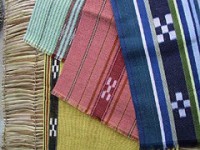
    • Colorful minsar dyed with plant dyes

    Craftsman Profile

    Uchimori Sumi

    Born in 1925 (Taisho 14).
    She grew up watching her mother weave, and after getting married, she took up weaving seriously. She is the chairperson of the Taketomi Town Textile Business Cooperative.

    Anecdotes

    Hemp, banana fiber, silk... a diverse array of textiles from Taketomi Island

    On Taketomi Island, blessed with abundant nature, a variety of traditional fabrics are woven, including Yaeyama YAEYAMA Minsaa (Obi sash Textiles), YAEYAMA Jofu (Ramie Textiles) (a hemp fabric), Bashofu (banana fiber fabric), and Gunbou (a cotton and ramie fabric).
    It is said that hemp was introduced during the Ryukyu Kingdom era. According to legend, an official from Shuri Castle took a girl named Nubemaa from the Nakasuji settlement and gave him hemp seedlings and jars as a token of gratitude.

    • Indian indigo dye, ramie for spinning thread, banana plantations

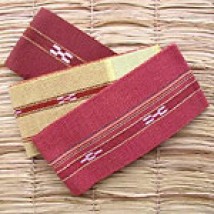
    • Table runners with the traditional Okinawan minsar pattern are also popular.

overview

Craft item name YAEYAMA Minsaa (Obi sash Textiles)
Reading Yaeyama Minsa
Classification of crafts fabric
Main Products Men's obi sashes, women's obi sashes, ties, accessories
Main manufacturing area Ishigaki City, Taketomi Town, Yaeyama District
Designated date April 11, 1989

contact address

■ Production area association

Taketomi Town Textile Business Cooperative
〒907-1101
381-4 Taketomi, Taketomi-cho, Yaeyama-gun, Okinawa Prefecture
TEL: 0980-85-2302
FAX: 0980-85-2302

Ishigaki City Textile Business Cooperative
〒907-0004
783-2 Tonoshiro, Ishigaki City, Okinawa Prefecture
TEL: 098-082-5200
FAX: 098-082-5200

Features

Its origins date back to before the 17th century. The etymology is uncertain, but it is believed that "minsaa" came from "wata-kyobi," a narrow cotton sash. The ikat pattern is hand-tied and made of pre-dyed indigo with a warp-ribbed weave. Five ikat patterns and four ikat patterns are arranged alternately, making it a men's sash symbolizing "forever and ever."

How to make it

Kasuri fabric is woven using a hand-tied technique, with pre-dyed warp weave and a hand-thrown shuttle or knife shuttle used to weave the weft threads.

top