KYO Nui (Embroidery)

Kyoto Prefecture

KYO Nui (Embroidery) is said to have originated when Heian-kyo (Kyoto) was built, and a department called Oribe-no-Tsukasa was established to employ artisans who did embroidery.
Until Miyazaki Yuzensai perfected Yuzen dyeing in the mid-Edo period, embroidery, along with kanoko shibori and surihaku, was an important method for decorating fabrics. In particular, embroidery played an important role in the expression of new designs called "Kanbun patterns," created by townspeople who had gained economic power. The kakefusa (hanging cloth) preserved at Kofukuin Temple in Nara Prefecture can be said to be a representative example of the dignified works of the mid-Edo period.

  • Technology/techniques/raw materials

    Technology/techniques

    1. When using dyed yarn, the yarn should be dyed before winding.

    2. The yarn must be twisted using either a "spinning" or "hand-twisting" method.

    3. Embroidery shall be done using a hand embroidery needle, with techniques such as "embroidered cutting," "pine embroidery," "horse-shaped embroidery," "stitched embroidery," "cross-stitch embroidery," "mist-pressed embroidery," "split embroidery," "suga embroidery," "braided cord embroidery," "sagara embroidery," "arranged pattern embroidery," "mustard embroidery," "filled-in embroidery," "Takeyamachi embroidery," or "chain embroidery."
     

    raw materials

    1. The threads used for "embroidery" shall be silk thread, lacquer thread, gold thread, silver thread, gold foil thread, or silver foil thread.

    2. The "embroidered base" shall be made of silk or linen fabric.

  • Work scene

    Step 1: Draft

    I will start the preliminary sketching process. I will create the design by drawing the original image with a pencil or brush (ink).

    Step 2: Sketching

    Place the sketch on a lighting stand, then place a cloth over it and hold it up to the light to accurately transfer the image.

    Process 3: Color scheme

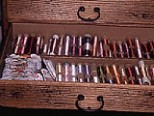
    Inside the drawer, silk threads of many different colors are neatly arranged.
    While considering the embroidery technique, we select threads that match the fabric color and pattern.

    Step 4: Fabric stretching

    Fabric stretching is divided into two processes: "frame stretching" and "frame stretching." Frame stretching involves passing the fabric through a grooved rod and stretching it vertically, ensuring that the fabric is stretched precisely to prevent distortion. Then, the fabric is stretched horizontally with appropriate tension using stitching thread. On the other hand, when sewing small items such as crests, a square frame called frame stretching is used.

    Process 5: Embroidery processing

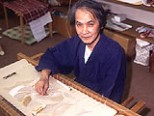
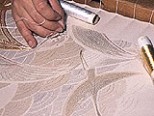
    Fumi Komatsu embroiders on bolts of fabric.
    There are over 10 types of embroidery needles, each with a flat eye and a consistent length, and they are all handmade. In embroidery, these needles are used to stitch patterns stitch by stitch according to the design. KYO Nui (Embroidery) creates works using more than 15 types of traditional techniques (*).

    工程6: 仕上げ

    The work continues for many hours.
    Apply glue to the back of the embroidered area and let it dry, and you're done.
    (*) Various embroidery techniques
    Festival embroidery
    This technique involves stitching and embroidering in a way that creates a "no" shape (like the Japanese character "の").
    Tube stitching (Suganui)
    This technique involves threading the fabric through the weave without leaving any gaps.
    Cutting and securing stitch
    This technique involves stitching diagonally over the previously embroidered threads with a thread that is one-fifth the thickness of the original thread, in order to hold down the existing threads and prevent them from lifting.
    Komaburi
    This technique involves stitching thick gold and silver threads onto pieces that have been pre-drawn according to a preliminary sketch.
    Embroidery with meat filling
    This technique creates a puffy effect by placing cotton or other materials as an underlayer and then stitching over it to give it a three-dimensional look. As a skilled technique, the needle is rotated with the right hand just before inserting it into the fabric, creating a slight twist. Skill is also required in the movements of the left hand.
    Embroidery
    This technique involves sewing small patterns regardless of the fabric's weave, resulting in a strong yet natural feel.
    Sagara embroidery (Sagaranui)
    This technique involves creating a loop with the thread, bringing the embroidery needle from the bottom of the fabric to the top, and then embroidering in a dotted pattern within that loop.
    Split embroidery
    This technique involves embroidering leaf or floral patterns at a V-shape angle.
    Embroidery
    This technique involves embroidering a single pattern over and over, and you can also create blurred effects by changing the stitching thread.
    Embroidered Patterns
    This technique involves embroidering a design and several patterns, and includes techniques such as "Hikita embroidery" and "Kanoko embroidery."
    Braided embroidery (Kumihimo sewing)
    This is a technique used to realistically depict thread.
    Takeyamachi Shu
    This technique involves picking up the weft threads along the warp threads and using them as binding threads to create a pattern that resembles bricks stacked at equal intervals.


  • Close-up

    KYO Nui (Embroidery) an art form that transcends the boundaries of traditional embroidery.

    The Gion Festival signals the arrival of summer in Kyoto. Needless to say, the main attraction for many tourists is the procession of the 32 floats. But did you know that the magnificent adornings of the floats as they slowly and gracefully parade through the town, including the elaborate tapestries and rear decorations, are all crafted with KYO Nui (Embroidery)?


    A veteran craftsman with 27 years of experience.

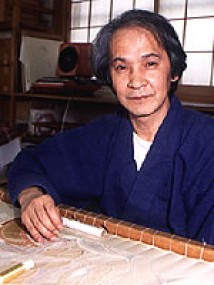
    I visited for the interview in March, when it was still quite chilly. I was introduced to Mr. Fumizo Komatsu, who stopped what he was doing and welcomed me warmly. The work Mr. Komatsu had been doing was repairing the body coverings of the Yamahoko floats. "When they get damaged, you have to repair them," he said, indicating that Kyoto was already preparing for summer. The body coverings are made using a technique called "nikuire-nui," where cotton and other materials are inserted inside to create a three-dimensional embroidery. Repairing them is also a time-consuming and painstaking task.

    Mr. Fumizo Komatsu. He transitioned from being a sewing machine operator to the art of KYO Nui (Embroidery). He is a veteran with 27 years of experience in this field.

    Originals based on tradition

    KYO Nui (Embroidery) where the design and color scheme are entirely left to the craftsman's sensibility, results in truly unique, one-of-a-kind pieces. "Every time I embroider, I feel the wonder of the tradition that has been passed down and the incredible skill involved," says Komatsu. Now the eleventh generation to carry on the tradition, Komatsu says that during his apprenticeship, he would secretly observe the work of his teachers and seniors while practicing at Ashiko. "I would think, 'What would I do? How could I do it?'" Because each piece is handmade by individual craftsmen, their individuality, the way they move their hands, and their earnest dedication all come together to create a truly unique work of art.

    Drawing with thread and needle

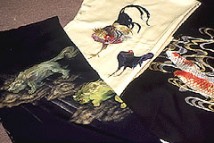
    When you see her work, you might doubt your eyes and wonder if it's a painting. It's that delicate and appears three-dimensional. "To embroider it so that it blends into the background color is something that can only be done by hand," Ms. Komatsu says with a smile. When I asked how long it takes to complete a piece, she replied, "It varies greatly depending on the piece. Some masterpieces can easily take a year," which is a mind-boggling thought. However, the style and elegance unique to KYO Nui (Embroidery) become deeply appealing precisely because it takes months, or even years, to complete. Furthermore, the sense of accomplishment that comes from completing one piece becomes the energy that motivates the craftsman to create the next work.

    The numerous works. They possess a delicate yet profound elegance that can only be achieved through embroidery.

    There is no end to KYO Nui (Embroidery)

    "My training will continue until I stop working. There's no end to striving for improvement," says Komatsu, as she attempts the next step. Her passion for KYO Nui (Embroidery) is palpable. Recently, she has been working on table runners and framed pictures for shrines, as well as chair backs, but she also says, "These aren't things that can be washed, so the range of my work is limited." She entered this world because she loves making things, a world where she can express herself boldly despite the unassuming nature of the work. Now, Komatsu is weaving her own individuality into tradition.

    Anecdotes

    The Gion Festival features a procession of 32 floats adorned KYO Nui (Embroidery).

    The Gion Festival, which heralds the arrival of summer in Kyoto, originated in 869 when a plague broke out and the Gion Goryo-e ceremony was held to pray for the removal of disaster. Later, in the 11th century, the floats appeared, and after the Onin War, the festival was revived in 1500. It is a festival created by the self-governing organizations of the townspeople and can be said to be a part of the spiritual history of the citizens of Kyoto. During the Yoiyama (evening festival) from July 13th to 16th, the town halls of each float district display the sacred objects that adorn the floats, as well as the magnificent hangings and rear panels adorned with KYO Nui (Embroidery). Of course, on the 17th, during the Yamahoko procession, the 32 floats, adorned with magnificent decorations, slowly make their way through the streets of Kyoto. You will be captivated not only by the lively atmosphere of the festival but also by the beauty of Kyoto's traditional crafts.


overview

Craft item name KYO Nui (Embroidery)
Reading Today's sewing
Classification of crafts Other textile products
Main Products Kimono fabric, haori jacket, flag curtain, stage curtain
Main manufacturing area Kyoto City, Uji City
Designated date December 15, 1976

contact address

■ Production area association

Kyoto Embroidery Cooperative Association
603-8321
5 Hirano Toriimae-cho, Kita-ku, Kyoto City, Kyoto Prefecture
TEL: 075-406-5953
FAX: 075-406-5954

Features

Using silk and linen fabrics, along with silk threads, gold and silver threads, and employing advanced traditional embroidery techniques, these pieces convey the splendor and elegance of the Heian period.

How to make it

There are currently about 30 different KYO Nui (Embroidery) techniques in use. The basic techniques include 15 types such as nyugiri, komazukai embroidery, matsui embroidery, sashi embroidery, watari embroidery, suganui, wari embroidery, kumihimo embroidery, sagara embroidery, Takeyamachi embroidery, keshinui, and kusari embroidery.

top