AIZU HONGO Yaki (Ceramics)

Fukushima Prefecture

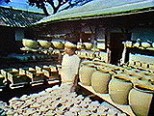
It is said that pottery making in Aizu-Hongo began during the Sengoku period when roof tiles were fired for use on the roof of Kurokawa Castle (Wakamatsu Castle) in Aizu-Wakamatsu. In the early Edo period, the lord of the Aizu domain protected and fostered pottery making, and AIZU HONGO Yaki (Ceramics) flourished as the official kiln of the Aizu domain. Later, the production of everyday tableware for the general public also began.
Although it suffered damage from the Boshin War at the end of the Edo period and a major fire during the Taisho era, it has recovered and continues to produce pottery today. It is also the oldest production area of white porcelain in the Tohoku region.

  • Technology/techniques/raw materials

    Technology/techniques

    1. Molding shall be carried out by the following techniques or methods:
    (1) Made by pottery wheel forming, hand-building, or slab building.
    (2) In the case of porcelain, in addition to the molding method specified in (1), the body shall be molded by bag casting or "double casting" which involves scraping and wiping the entire surface of the body to ensure that it has properties equivalent to those obtained by the molding method specified in (1).


    2. When decorating the base material, the following methods may be used: stamping, combing, brushing, slip trailing, beveling, pasting, cloth patterning, decorative coating, or carving.


    3. When applying underglaze decoration, use line drawing, dipping, dipping, or smearing. In this case, the pigments used shall be "cobalt blue pigment," "iron rust pigment," or "copper pigment."


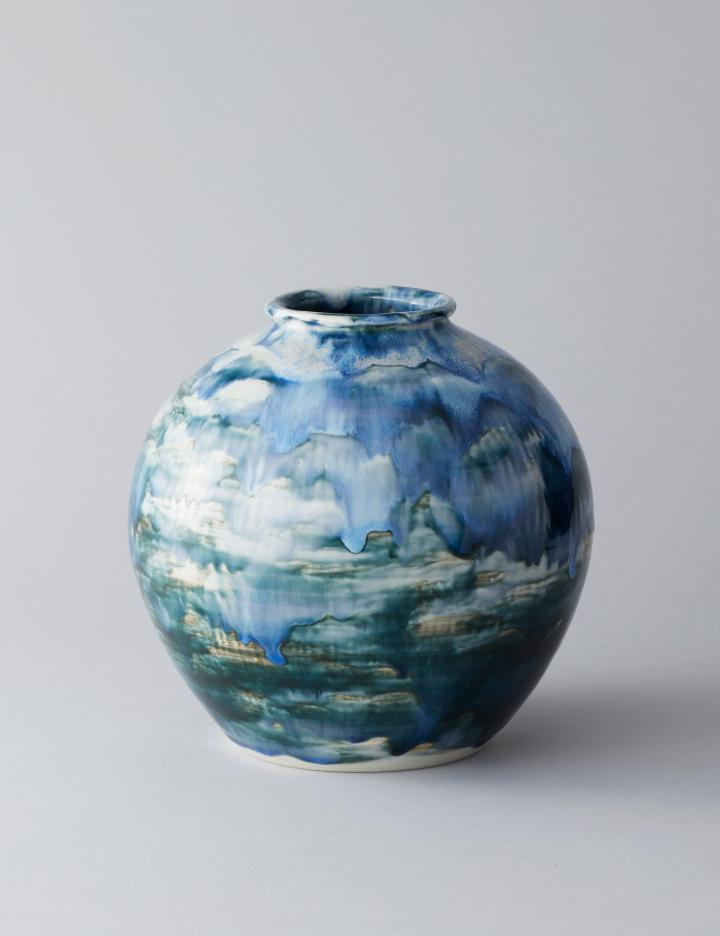
    4. Glazing shall be done by dipping, pouring, or coating. In this case, the glaze shall be "wood ash glaze," "lime glaze," "celadon glaze," "sea cucumber glaze," "iron glaze," "copper glaze," "yellow porcelain glaze," or "gold crystal glaze" for porcelain, and "earthenware ash glaze," "amber glaze," "white flow glaze," "blue flow glaze," "iron glaze," "copper glaze," "yellow porcelain glaze," "crazing glaze," or "milky white glaze" for earthenware.


    5. When applying overglaze decoration, use line drawing, dabbing, or dabbing techniques.
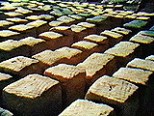
     

    raw materials

    The clay used shall be "Okubo clay," "gravel clay," "stomach clay," or a material of equivalent quality for porcelain, and "Matoba clay," "Okubo clay," or a material of equivalent quality for earthenware.


  • Work scene

    Step 1: Exposed to the elements

    The discarded soil is piled up and exposed to wind and rain for over a year.

    Process 2: Soil kneading

    The soil is crushed, the coarse parts are removed with a sieve, and then water is added and kneaded.

    画像をクリックすると動画が再生されます

    Step 3: Wheel-thrown

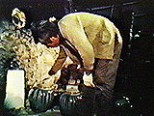
    Place the clay in the center of the potter's wheel, add water while tapping it with both hands, and stretch it out while rotating the wheel until it becomes uniform. Then, press and stretch the clay into the desired circular shape, insert the trowel into the inside with your right hand and settle it in the center, while supporting the outside with your left hand to shape it and push it upwards. Stop the wheel, use a rounding tool to determine the dimensions, rotate the wheel again, and smooth the edges with tanned leather.

    画像をクリックすると動画が再生されます

    工程4: 乾燥

    There are two drying methods: natural drying and heat drying, both of which aim to reduce the moisture content of the molded product to a minimum. Some methods involve applying the underglaze directly to the dried molded product, while others involve applying it after bisque firing.

    工程5: 焼成

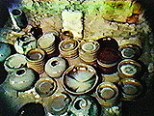
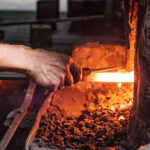
    The gas kiln burner, kerosene kiln burner, and electric kiln are ignited, and the firing process is carried out while taking care to slow down the heat and equalize the room temperature. In this case, the firing temperature is 800 to 900 degrees Celsius for oxidizing flame firing, and the firing time is approximately 10 hours.

    工程6: 窯出し

    The fired pieces are slowly cooled in the kiln for 5 to 30 hours before being removed.

    Process 7: Inspection

    After baking, defective products are sorted out.


  • Close-up

    Techniques brought back from Arita: the art of underglaze blue decoration on white porcelain.

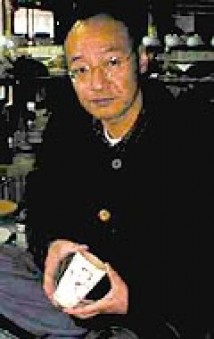
    The origins of AIZU HONGO Yaki (Ceramics) date back to 1593, when Gamo Ujisato was entrusted with Aizu by Toyotomi Hideyoshi and took up residence in the region. He commissioned the firing of roof tiles for the castle's repairs. Over time, Sato Ihei, who dreamed of creating white porcelain in Hongo, embarked on a journey to Arita—a journey that could only be described as a life-or-death espionage mission—to learn and bring back the techniques of white porcelain making. More than 200 years after his departure in 1797, the white porcelain technique was perfected by his apprentice, Tedai Koemon. Watanabe Masahiro is the fifth generation of the Hozan Kiln, and he continues to carry on the traditional techniques of this innovative white porcelain underglaze blue decoration.


    Ihei and the modernity of white porcelain

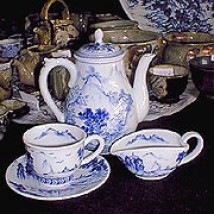
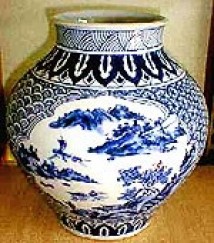
    Ihei's remarkable achievements were established in Hongo after many years of trial and error. During the Meiji period, the technique of underglaze blue decoration on white porcelain flourished, and the reputation of AIZU HONGO Yaki (Ceramics) spread throughout Japan. The white porcelain is primarily decorated with landscapes, flowers, birds, and the moon. Its breathtakingly delicate and elegant appearance makes it easy to understand why feudal lords of the past had such a strong admiration for white pottery. From large vases and plates to teapots, water pitchers, water coolers, and teacups, each piece exudes the beauty of the Orient. However, the number of underglaze blue decoration artisans is decreasing, and works requiring such techniques are becoming rare. Mr. Watanabe has compiled Ihei's way of life and the surviving documents from that time into a single book. The modernity of Ihei's wild lifestyle and the refined modernity exuded by underglaze blue white porcelain—it all crystallized here in Aizu Hongo, the oldest white porcelain village in Tohoku, as a timeless modernity that feels completely unfamiliar.

    • AIZU HONGO Yaki (Ceramics) is a rare production area that produces both earthenware and porcelain. Some kilns even manufacture both types of pottery. All of the porcelain is hand-painted, with many pieces featuring mountain motifs and floral and bird designs in cobalt blue underglaze, as well as elegant blue and white patterns.

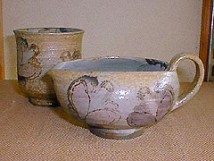
    • The pottery is based on traditional colored glazes, and many pieces are simple and warm in appearance.

    The joy of making everyday tableware

    "Until my father's generation, distribution was through wholesalers, but Bernard Leach's movement brought a boom in folk crafts and led to a re-evaluation of them. Since then, customers have been coming all the way to Hongo, and we've started to have direct conversations with them," says Watanabe, emphasizing the importance of being dedicated to the craft while also highlighting the value of creating and handing over beloved everyday tableware. Students come from far away to attend the pottery class he started with two friends. The students themselves say things like, "Next, let's make that," or "My family has asked me to make something like this," and they are always lively and engrossed in their work. "It's really fun," says Watanabe. He cherishes the joy of creating things. At Watanabe's Hozan Kiln, the designs of the tableware and the painting on the porcelain have changed along with the changes in food culture, and they now also produce everyday items such as beer cups with brightly colored peony flowers.

    Elegant white porcelain with underglaze blue decoration

    To breathe fresh air

    Before taking over the family business as the fifth generation, Watanabe studied at a university in Tokyo and trained in Kyoto. For a long time, he was away from his hometown and involved with pottery from a different place. The outside world that Watanabe has experienced has entered Hozan Kiln, and his own touch has been added to the tradition. Unlike in the past, there are no longer craftsmen who divided the work, and he now makes every step of the process himself. When it comes to making pottery, he says, "Going outside and breathing the air of that place is the best way to learn. Living there, making friends, becoming familiar with the place, and breathing the same air becomes a great asset later on." Watanabe infuses the atmosphere of his experiences living elsewhere into his pottery making. And now, he is re-examining the white porcelain underglaze blue of AIZU HONGO Yaki (Ceramics), made by his predecessor, with his own eyes.
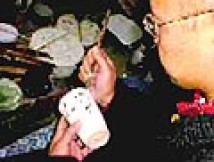
    For Mr. Watanabe, the art of underglaze blue porcelain, passed down through generations through meticulous effort, is like a way of life that he must continue to carry on. It is time-consuming and requires extraordinary concentration. "I must increase the amount of underglaze blue porcelain I make and cherish it," he says. History rests in Mr. Watanabe's hands.

    • Masahiro Watanabe

    • Modern everyday items

    Anecdotes

    Everyday beauty: Herring bowl

    One of Aizu's most representative local dishes is pickled herring with sansho pepper. Dried herring is pickled in sake, soy sauce, and sansho pepper leaves. The herring bowl was specially made for pickling this dish. It's just the right size to hold the herring and is exceptionally convenient for stacking and pickling. These herring bowls have been made as everyday items by potters since ancient times.
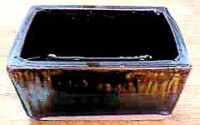
    In contrast to the elegant porcelain of AIZU HONGO Yaki (Ceramics) ware, everyday pottery is called "sodabutsu." The herring bowl is one such example. It is a square bowl with handles and a dark amber glaze. Its simple, rustic design is appreciated as a functional beauty for everyday use, and it won the Grand Prix at the Brussels World's Fair in 1958.

    •  


overview

Craft item name AIZU HONGO Yaki (Ceramics)
Reading Aizu Hongouyaki
Classification of crafts Ceramics
Main Products Tableware, tea sets, vases, sake sets
Main manufacturing area Aizumisato Town, Onuma District
Designated date July 2, 1993

contact address

■ Production area association

AIZU HONGO Yaki (Ceramics) Business Cooperative
〒969-6042
3162 Seto-machi Ko, Aizumisato-machi, Onuma-gun, Fukushima Prefecture
TEL: 0242-56-3007
FAX: 0242-93-6035

Features

This region produces both pottery and porcelain. Some manufacturers even produce both types of ceramics. Porcelain comes in various styles, including underglaze blue using a blue pigment called gosu, and multi-colored enamel decoration using Japanese and Western pigments. Pottery is mostly made for practical purposes. Traditional glazes such as amber glaze and ash glaze are used on these pieces.

How to make it

Pottery is primarily shaped on a rotating platform called a potter's wheel, where the clay is rotated as it is formed. Other methods include slab pottery (using clay cut into sheets), hand-building (shaping solely by hand), and using plaster molds. Using locally sourced porcelain stone and earthenware clay as the main raw materials, each pottery studio employs its own unique techniques to create a variety of works.

top