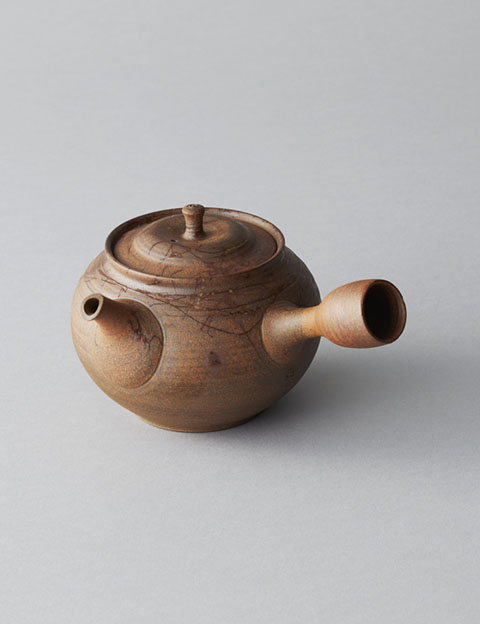
TOKONAME Yaki (Pottery)

Aichi prefecture

The origins of TOKONAME Yaki (Pottery), also known as Old TOKONAME Yaki (Pottery), can be traced back to the end of the Heian period, and it is counted as one of Japan's six ancient kilns. During the Heian period, sutra burial jars (kyozukatsubo) were made, in which Buddhist scriptures were placed and buried in the ground to pray for blessings.
During the Muromachi and Azuchi-Momoyama periods, tea ceremony and flower arrangement utensils were mainly produced. Until the mid-Edo period, jars were produced, and from the late Edo period onward, in addition to tea ceremony and flower arrangement utensils, everyday tableware became the main products.
From the Meiji era onward, the region also actively produced sanitary ware such as earthenware pipes, washbasins, and toilets, as well as tiles and flowerpots. The history of the region's main products, blessed with abundant and high-quality clay, has led to the wide range of products it offers today.

  • Technology/techniques/raw materials

    Technology/techniques

    1. The molding shall be done by wheel-throwing, press molding, or hand-turning.

    2. For unglazed products other than Nanban-style ware, the "body polishing" process should be performed.

    3. When decorating the base material, the following methods may be used: carving, kneading, comb marks, stamping, "flying plane," pasting, "insect-eaten pattern," fingertip pattern, lathe marks, carving marks, decorative coating, inlay, "stencil printing," or "pine bark pattern."

    4. When glazing, the method shall be dipping, coating, spraying, overlapping, pouring, slip trailing, or waxing. In this case, the glaze shall be "ash opaque glaze," "shark glaze," or "sea cucumber glaze."

    5. If the clay body is not polished, decorated, or glazed, a natural glaze, salt glaze, seaweed glaze, or fire-striped glaze may be revealed.
     

    raw materials

    1. The clay used shall be "Fuki clay," "Itayama clay," "Kowa clay," or "shale clay," or a material of equivalent quality.

    2. The feldspar and silica used in the glaze shall be "Sanage feldspar" or "Mikawa silica," or of equivalent material quality.

  • Work scene

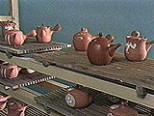
    Tokoname, one of Japan's six ancient kilns, has produced a wide variety of products over its 900-year history, from the late Heian period to the present day. Its products range from everyday items such as jars, pots, plates, bowls, vases, and flowerpots to earthenware pipes and sanitary ware. Among these, vermilion clay tea utensils (made using clay rich in iron, fired at high temperatures to produce a distinctive vermilion color) are relatively new to TOKONAME Yaki (Pottery) ware, having been produced from the late Edo period to the early Meiji period. However, they have since become one of the representative ceramics of TOKONAME Yaki (Pottery). Here, we will introduce the manufacturing process of vermilion clay teapots.

    Step 1: Mix the soil

    The collected clay is elutriated (water is added and allowed to settle repeatedly to select only the fine-grained clay) and then kneaded thoroughly. Red clay is characterized by its high iron content.

    Step 2: Throw on a potter's wheel

    We use a potter's wheel to shape each part. First, we make the body of the teapot. We make sure that the thickness is the same. Particular care is taken with the shelf where the lid will rest. We make the lid, handle, spout, etc., and once each part is finished, we let it dry until it is partially dry. At this time, we make sure that each part dries to the same degree.

    画像をクリックすると動画が再生されます

    Step 3: Finishing each part

    Once the moisture has evaporated and the material has reached a suitable consistency, use a spatula or similar tool to trim away any excess material. At this stage, ensure that the body and lid are the same size. Carefully trim while repeatedly checking the fit. Finally, polish each part. The final finish will be significantly different depending on how carefully you polish it at this stage.

    工程4: 組み立て

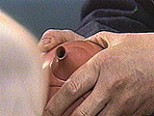
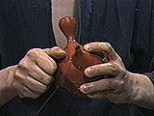
    The finished parts are assembled. First, the tea strainer is attached. A round hole is made in the body using a compass-like tool, and the tea strainer is fitted into it. Then the spout and handle are attached. At this point, the finished product will not be good unless the dryness of each part is consistent. The craftsman uses his years of experience to carefully judge the hardness of each part.

    画像をクリックすると動画が再生されます

    工程5: 乾燥

    Let the assembled teapot dry.

    Step 6: Surface polishing

    The dried product is polished with a cloth to give it a shine. By polishing it repeatedly at each stage of the process, the unique luster of the red clay is achieved.

    工程7: 彫刻

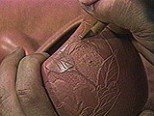
    At this stage, before firing, the carving is done. Pictures and patterns based on history and nature are meticulously carved using carving tools.

    工程8: 焼成

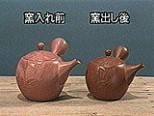
    Now it's time to load the kiln. The pieces are fired at a temperature of around 1100 degrees Celsius for 12 to 18 hours. At this stage, even a difference of just 10 degrees Celsius in the kiln temperature can completely change the color of the fired pieces, so this was a very delicate process until modern kilns with computer-controlled, stable temperatures became available. Once fired, the pieces are left to cool in the kiln overnight before being removed. They shrink by about 20% compared to before firing, but the vibrant vermilion color unique to vermilion clay is revealed.

    Step 9: Ink application and washing

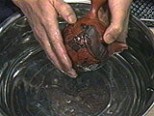
    The finished product is polished, and ink is applied to the engraved areas to enhance its texture. When the ink is washed away with water, the engraved design becomes clearly visible.

    工程10: 仕上げ

    Finally, the body and lid are carefully rubbed together, and the red clay teapot is complete.


  • Close-up

    TOKONAME Yaki (Pottery), with its 900-year history, and the art of hand-molding.

    There are three main techniques for making TOKONAME Yaki (Pottery) ware: wheel throwing, mold pressing, and hand-building. Of these, hand-building is the oldest method, dating back to the very beginning of pottery making in Tokoname, and is also one of the unique characteristics of TOKONAME Yaki (Pottery), which is rare even on a national level. This time, we spoke with Kengo Maekawa, who makes vases and jars using the hand-building technique.


    "Human Pottery Wheel"

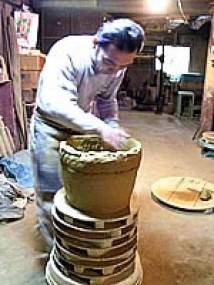
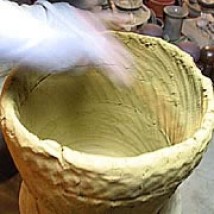
    Mr. Maekawa is a craftsman who specializes in large, hand-molded pieces. He calls it "human pottery," using the "yoriko-zukuri" technique, where the potter spins around the potter's wheel (at a considerable speed!) while winding up a thick coil of clay. This technique is rare throughout Japan, but it is likely a technique unique to Tokoname, a place that has long produced large items such as jars and pots. It is a physically demanding technique that makes you sweat even in the cold workshop after doing it for a while.
    Maekawa says that she started practicing hand-building pottery because of the influence of her father, who was also a potter. She grew up watching her father make turtles by hand, and that's how she started doing it herself.

    Mr. Maekawa creates large vessels using the "Yoriko-zukuri" method.

    It's your job, so you can't hate it.

    "I decided to take over the family business when I was in fifth grade," says Maekawa. He helped his father with his work from elementary school and somehow thought it looked interesting. Maekawa's attitude is unique: "It's work, so you can't hate it. You have to love it." He does it when he wants to and doesn't do it when he doesn't want to. True to his word, he has done what he wanted to do since he was young. About two years after graduating from high school and starting to help out at home, he went to the Philippines for two years to teach pottery as part of the Japan Overseas Cooperation Volunteers. It is an unusual career path for a craftsman.
    When he returned, his father told him to think for himself what he wanted to make, and he thought, "Now, what should I do?" While those around him were going to learn how to make a living, Maekawa made pottery using his own methods, such as pouring and hand-pressing.

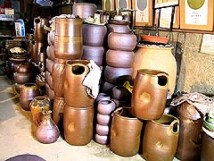
    A large vase was placed at the foot of the workshop.

    Hand-twisting is a technique with a 900-year history.

    Ultimately, the reason he settled on the simplest method, hand-molding, was because his father, who had wanted to become a traditional craftsman, passed away without obtaining the qualification due to unforeseen circumstances. This happened when Maekawa was 29 years old. When it came time for him to obtain the traditional craftsman qualification, Maekawa chose to pursue hand-molding, a method he had grown up watching his father at work.
    Pottery made using the hand-building technique is magnificent. Many of the pieces are large, such as jars, braziers, and vases, but the characteristic of TOKONAME Yaki (Pottery) is that it is unglazed, and the reddish-brown and brownish colors that develop from firing at a relatively low temperature of around 1150 degrees Celsius have an indescribable power and presence. "I want to preserve the large hand-building pieces. That's because it can only be done this way," says Mr. Maekawa. Hand-building is a technique that has remained unchanged for 900 years, yet it is a perfected technique.

    Thick, string-like pieces of clay are rolled up to form the shape of a vessel, and any gaps are filled in by hand.

    Embrace new things

    I heard from someone in the association that Tokoname has an image of being a good place to become an artist. The city's ceramics research institute and other facilities accept young people and are focusing on training successors, so many people come to Tokoname from other prefectures aiming to become ceramic artists. There is a gap in mindset between the generation of craftsmen who were drilled to "make it look like it was made by machine even if it's made by hand" and the young people aiming to become artists, so there are problems, but it is quite an achievement that half of the 20 or so people who come each year end up staying. Mr. Maekawa himself has also mentored young people who came to live with him, and he says it is stimulating and good. Cherishing tradition while incorporating new things and changing is also part of TOKONAME Yaki (Pottery) 's 900-year history.

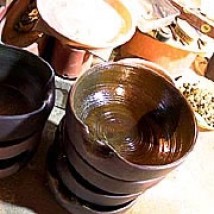
    The stacked braziers in the center would make a lovely wine cooler or flower vase.

    Craftsman Profile

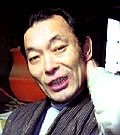
    Kengo Maekawa

    Born in 1947 (Showa 22).
    After graduating from high school, he began helping with the family pottery business. He specializes in large, hand-formed pieces, a characteristic of TOKONAME Yaki (Pottery).

    "Pottery shrinks when it's fired, so I really want to make things that expand. Like bread, for example."

    Anecdotes

    TOKONAME Yaki (Pottery) used in suikinkutsu (water harp cave)


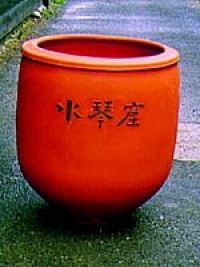
    • This is a suikinkutsu (water harp cave) at the former Imai family residence in Mino City. This one was restored using an old TOKONAME Yaki (Pottery) ware pot that was used for making washi (Japanese paper), rather than a pot made by Mr. Maekawa.


overview

Craft item name TOKONAME Yaki (Pottery)
Reading Tokoname yaki
Classification of crafts Ceramics
Main Products Tea utensils, flower vases, ornaments, flower pots, jars, pots
Main manufacturing area Tokoname City, Handa City, Chita City
Designated date June 2, 1976

contact address

■ Production area association

Tokoname Pottery Cooperative
479-0836
3-8 Sakaemachi, Tokoname City, Aichi Prefecture
TEL: 0569-35-4309
FAX: 0569-34-8893

http://www.tokonameyaki.or.jp/

Features

A distinctive feature of this clay is that the iron content in the raw materials causes it to develop a red color. A variety of products are available, including those that utilize the natural texture of the clay and those that are glazed.

How to make it

We produce pieces of all sizes, from large to small, using traditional shaping methods such as the potter's wheel, molds, and hand-building. The clay we use as raw material is sticky and has fine particles, allowing us to shape it by carving and polishing. We produce many products using these techniques unique to TOKONAME Yaki (Pottery).

Please see here for information on traditional craftspeople.

Japanese traditional craftsman
top