ECHIZEN Yaki (Pottery)

Fukui Prefecture

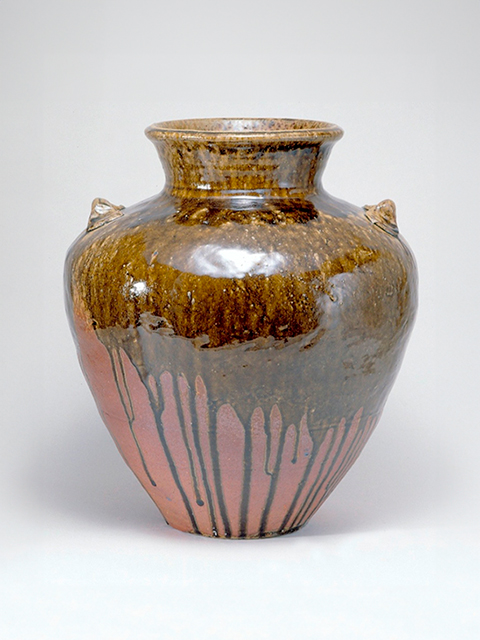
ECHIZEN Yaki (Pottery) is considered one of Japan's six ancient kilns, and its history is very old.
Pottery was fired in these kilns from the late Heian period onward, and more than 200 old kilns have been discovered to date. These large, ancient kilns were used to fire everyday items such as jars, pots, mortars, sake bottles, and jars used for blackening teeth.

  • Technology/techniques/raw materials

    Technology/techniques

    1. Forming shall be done by "threading," lathe forming, hand twisting, press forming, or slab forming.

    2. When applying patterns to the base material, the following methods may be used: combing, pasting, spatula drawing, stamping, piercing, decorative coating, or scraping.

    3. When glazing, the method shall be "dobo-gake," "nagashi-gake," "tsutsu-gake," "chirashi-gake," or "kabushi-gake." In this case, the glaze shall be "tsubo-gake," "betsuhata-gake," "dohai-gake," "warahai-gake," "irabo-gake," "namako-gake," "tenmoku-gake," or "ame-gake."
     

    raw materials

    The clay used shall be "Aoneba," "Akabeto," or "Taikodo," or a material of equivalent quality.

  • Work scene

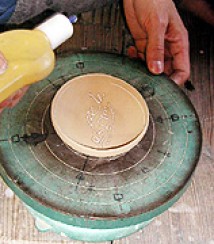
    Echizen is a historic pottery-producing region, counted among the Six Ancient Kilns of Japan. While various techniques are now employed to create diverse types of pottery, historically, it seems that kitchen utensils such as jars, pots, and mortars were produced there. Particularly distinctive is its stoneware, which is a hybrid of earthenware and porcelain, and is made from clay that fires to a high density. Furthermore, the natural glaze, which is yellowish-green and created by the melting and flowing ash from firewood instead of using a glaze, is another attractive feature of ECHIZEN Yaki (Pottery).
    Generally, the pottery-making process begins with "clay collection," where clay is taken from the soil. After that, impurities are removed and the clay is prepared into uniform particles through a process called "elutriation" (a process that separates clay particles into groups of different sizes by utilizing the fact that different sizes of clay particles settle at different rates in water), and then the clay is left to rest for a while. This resting period allows the clay to develop the necessary stickiness for shaping. Further kneading is performed in a process called "chrysanthemum kneading," where the clay is kneaded to create a uniform softness and stickiness, and to expel air from within the clay. The name comes from the fact that the shape of the kneaded clay resembles the petals of a chrysanthemum flower. Before mechanization, clay preparation was a laborious and physically demanding task.
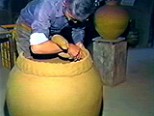
    Once the clay preparation is complete, the shaping process begins. There are various shaping methods depending on the shape. Circular shapes are made using a potter's wheel. Square and complex shapes are made using slip casting, where a mold is made from plaster and slip is poured into it. There are also various other shaping methods, such as hand-building. Large jars and pots, which are a characteristic of ECHIZEN Yaki (Pottery) and can exceed one meter in height, cannot be made on a potter's wheel. Therefore, they are made using ring stacking, where a coil of clay about 5 to 10 centimeters in diameter is twisted and stacked. The vessel being made does not rotate; rather, the potter shapes the pot by moving in a precise circle around it.
    The molded vessels are then fired. Unglazed, unfired stoneware, considered to be the original form of ECHIZEN Yaki (Pottery), is created when wood ash falls onto the reddish-brown surface of the vessel as it is fired in the kiln.
    Now, let's take a closer look at the ring-stacking technique used when creating large turtles and pots.

    Step 1: Making the base

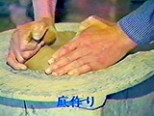
    Place the soil that will form the bottom on a wooden stand to create the base.

    Step 2: Tapping

    Hold a ball of clay about 5-10 centimeters in diameter and 40 centimeters long in your right hand, twist it with your right hand, and attach it to the bottom layer of clay. Use your left hand to support the force of your right hand pushing the clay, and use your thumb to even out the height of the twisted clay. Walk around the bottom layer, moving to the left and slightly behind you, completing one full circle. Repeat the same process for the second and subsequent layers.

    画像をクリックすると動画が再生されます

    Step 3: Flatten into a leaf shape

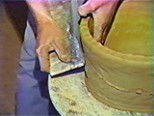
    The seams on the outside are smoothed out by rubbing them from top to bottom around the entire perimeter using a piece of wood. Next, while moving around the right rear, the side walls are stretched out in a fan shape using the piece of wood.

    Step 4: Dry and repeat steps 2 and 3.

    Once the lower part is formed, it is allowed to dry and become strong enough to withstand the weight of the upper part before repeating the twisting and straightening process.

    Step 5: Prepare your mouth

    Next, create the mouth of the finished pot (jar). Using a damp cotton cloth, stretch the clay by pressing it with both hands, and shape the mouth. You can change the shape of the mouth by adjusting how you hold your fingers.

    画像をクリックすると動画が再生されます


  • Close-up

    ECHIZEN Yaki (Pottery) where the finest clay nurtures new sensibilities.

    When people think of Echizen ECHIZEN Yaki (Pottery) many pottery enthusiasts might picture large, naturally glazed jars. However, modern Echizen, which has attracted many potters from all over the country, has transformed into a pottery producing region with a free and vibrant atmosphere where all kinds of techniques and styles coexist.


    This historic production area, with its history dating back to the Middle Ages, continues to evolve even today.

    Pottery enthusiasts will likely be familiar with it. Echizen is one of the Six Ancient Kilns, alongside Seto, Tokoname, Shigaraki, Tanba, and Bizen. It is a historic production area with a history dating back to the Middle Ages. A distinctive feature is the yellowish-green natural glaze that appears when ash falls into the kiln. It has traditionally been said ECHIZEN Yaki (Pottery) ware mainly consists of everyday items such as jars, pots, and mortars, with few tea ceremony utensils. However, with the establishment of the Echizen Pottery Village in Miyazaki Village in 1971, young potters gathered from all over the country, and the landscape of Echizen ware changed dramatically.

    I also enjoyed my tea in a teacup made by Mr. Kitano.

    The country's finest quality stoneware clay contributes to the development of pottery culture.

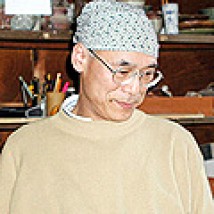
    "These days, ECHIZEN Yaki (Pottery) 's defining characteristic is its lack of defining characteristics," says Takayasu Kitano, ECHIZEN Yaki (Pottery) craftsman born and raised in the area. "The clay in Echizen is excellent. It's a stoneware clay that fires well and has good flexibility when shaping. I believe that modern ECHIZEN Yaki (Pottery) is about freely experimenting with that clay." Even today, young people from all over Japan who aspire to become potters gather in this area.

    "Working in the fields when it's sunny, pottery when it rains, every day is Vietnam."

    "It's snowing today, so I guess it's pottery day," Kitano joked, looking out the window. His family originally ran a farm, and he continues to farm alongside his pottery work. His business card reads, "Farming in sunny weather, pottery in rainy weather, every day is Vietnam." "Vietnam is the local word for soil."
    "While I'm plowing the rice fields on the tractor, I'm thinking about what I'll make next." Kitano's lifestyle of farming and pottery seems to match the pace of his creative activities.

    Mr. Kitano's lifestyle of farming in fine weather and pottery in rainy weather

    The techniques of "slip tracing" and "scratching".

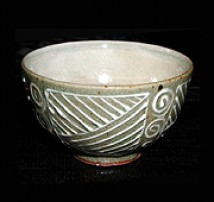
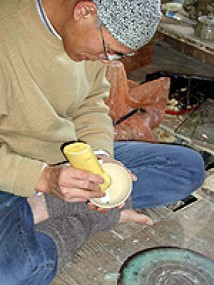
    Kitano's representative works include "ittchin-gaki," a method of drawing patterns by squeezing out white clay, similar to decorating a cake, and "kakiotoshi," a method of revealing patterns by scraping off white slip. He is a craftsman renowned throughout Japan for his work in these fields.
    "I've always loved drawing pictures and patterns. I used to draw intricate patterns, but recently I've been wanting to create depth in my rougher-looking drawings." Learning ink painting has also allowed her to incorporate free-flowing and powerful lines into her work.
    "I practice the designs many times until the patterns feel natural to me. Until then, many of them end up being unusable (and not ready to be sold)." He observes his own work with a critical eye. Many of the "failed pieces" lined up around the kiln are so flawed that it's hard to tell what's wrong with them to the untrained eye. It gives a sense of the unwavering dedication of a craftsman.

    Demonstrating the smooth slip-trailing technique.

    The profound art of teapot making: unglazed stoneware that "develops" beautiful colors over time.

    Furthermore, he studied teapot making in Shigaraki from 1983 to 1987, and has also created teapots using Echizen clay. He has even held solo exhibitions dedicated solely to teapots. Pottery made from the highly fired clay of Echizen develops a beautiful color and luster as it is polished by the palm of the hand with use.
    "Teapots are a complex art. You really get the hang of them by using them. When I make one with a good spout that drains well, I think, 'Yes!' Customers don't know if it's good or bad when they buy it in the store. They go home, use it, and say, 'That teapot was great.' When I hear things like that, I'm really happy."
    What makes me happiest is the customers' reactions. "This area is deep in the mountains, so it gets buried in snow during the winter. Yet, some customers come all the way from town to buy our products. It makes me so happy. And then, when a customer who bought a yakishime teapot from us years ago sent it back to us for repair (on the handle made of ivy), it was clear that it had been well used and had developed a beautiful patina."

    The humorous fish is a "pattern that feels familiar in the hand."

    "A craftsman who thinks for himself" is his motto.

    Kitano says he doesn't want to do work that's just about quantity. "My motto is to be a craftsman who thinks. I want to make things that are suited to modern life and that take into account the lives of the people who will use them." Kitano describes himself as a "jack of all trades, master of none." He is very versatile, and his works include innovative and modern items such as pen holders. You can also see dinosaurs, cars, and cute cat figurines. "I make a lot of things, and if I come up with something good, I'll turn it into a product," he says. Kitano's desire to try many more things is endless.

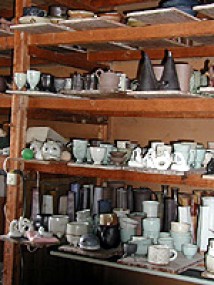
    Various works are lined up on the shelves in my workspace.

    Craftsman Profile

    Takayasu Kitano

    Born in ECHIZEN Yaki (Pottery), Fukui Prefecture, the home of Echizen ware. Started pottery making at the age of 27. His motto is "a craftsman who thinks."

    Anecdotes

    A holiday immersed in pottery at Echizen Pottery Village

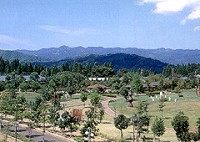
    ECHIZEN Yaki (Pottery) Pottery Village was established in 1971 in Miyazaki Village, Fukui Prefecture, the birthplace of Echizen ware. It is a rare "village" in Japan, with facilities related to pottery gathered on a large site. At the Fukui Prefectural Pottery Museum, you can learn about the history through its abundant exhibits, and it is also fun for the whole family to touch clay in a pottery class. You can also relax with a leisurely picnic or nap in the spacious park. There are many kilns of local potters in the surrounding area, and there is also a direct sales store within the pottery village. Surrounded by mountains and full of nature, it is a perfect place to spend a relaxing holiday even if you are not a pottery enthusiast. Furthermore, there is a pottery festival every May, so why not visit at least once? You will surely be able to feel the deep flavor of ECHIZEN Yaki (Pottery) nurtured in the midst of nature.

    • Pottery facilities are clustered together in a vast expanse of greenery.


overview

Craft item name ECHIZEN Yaki (Pottery)
Reading Echizen-yaki
Classification of crafts Ceramics
Main Products Sake cups, flower vases, tea sets, everyday utensils, jars, pots
Main manufacturing area Fukui City, Awara City, Echizen Town (Nyu District), Wakasa Town (Mikata-Kami-Naka District)
Designated date March 12, 1986

contact address

■ Production area association

ECHIZEN Yaki (Pottery) Industry Cooperative
〒916-0273
5-33 Ozohara, Echizen-cho, Nyu-gun, Fukui Prefecture
TEL: 0778-32-2199
FAX: 0778-32-3251

http://www.echizenyaki.com/

Features

These ceramics feature a simple, rustic texture, primarily using techniques such as unglazed firing (yakishime), ash glaze, and iron glaze. Their unadorned design and the warmth of the clay give them a beauty that makes them perfect for everyday use.

How to make it

They primarily mix clays found at the bottom of local rice paddies—known as "Aoneba," "Akabeto," and "Taikodo"—to create pottery clay and then shape it. The unique twisting technique of Echizen pottery is still practiced today. The pieces are then fired in a kiln at high temperatures of 1,200 to 1,300 degrees Celsius.

Please see here for information on traditional craftspeople.

Japanese traditional craftsman
top