KYO-KIYOMIZU Yaki (Ceramics)

Kyoto Prefecture

The origins of pottery in Kyoto can be traced back to before the Heian period, but it was with the construction of Heian-kyo (Kyoto) that pottery production truly began. Since then, Kyoto has produced a succession of excellent potters and masterpieces. In the 17th century, renowned potters such as Ninsei and Kenzan emerged, and in the 19th century, Eisen succeeded in firing porcelain. In addition, master craftsmen such as Mokubei, Hozen, and Ninnami were remarkably active.
With the arrival of the German craftsman Wagner during the Meiji era, techniques from various foreign countries were incorporated, and KYO-KIYOMIZU Yaki (Ceramics) developed rapidly.

  • Technology/techniques/raw materials

    Technology/techniques

    1. For the clay, use "White Korean Clay," "Upper Stone Clay," "Semi-Porcelain Clay," "Kneaded Clay," "Shigaraki Clay," "Awata Clay," "Red Blended Clay," or "Raku Clay."


    2. Molding shall be carried out by the following techniques or methods:
    (1) Made by lathe forming, mold forming, hand forming, joinery forming, carving, hammering, slab forming, or slab forming.
    (2) In the case of porcelain, in addition to the molding method specified in (1), the body shall be molded by bag casting or "double casting" which involves scraping and wiping the entire surface of the body to ensure that it has properties equivalent to those obtained by the molding method specified in (1).


    3. When decorating the base material, the following methods may be used: carving, stamping, comb marks, brush marks, glaze application, inlay, slip trailing, scraping, pasting, cloth texture, shaping, scraping, raised edges, crepe-like texture, polishing, or iron application.


    4. When applying underglaze painting, the following techniques should be used: outline drawing, shading, application, blending, shading, white-out, or blowing. In this case, the pigments used should be "cobalt blue pigment," "rust pigment," "copper red pigment," or "Dutch pigment."


    5. When glazing, the following methods shall be used: pouring, dipping, coating, spraying, slip trailing, or dipping. In this case, the glaze shall be: earthenware glaze (including colored glazes), iron glaze, copper glaze, or raku glaze (including colored glazes).


    6. When applying overglaze decoration, the following techniques may be used: outline drawing, application, layered painting, insertion, shading, blurring, creasing, white-out, lacquer sprinkling, sprinkling, dabbing, gold leaf application, blowing, or cloth texture. In this case, the paints shall be "brocade overglaze paints," "gold and silver paints," or "Kochi sansai paints."
     

    raw materials

    1. The pottery stone or clay used for the topsoil shall be Kakitani pottery stone, Amakusa pottery stone, Gairome clay, feldspar, Kibushi clay, kaolin, or yellow ochre, or a material of equivalent quality.

    2. The foil shall be gold or silver foil.

  • Work scene

    Step 1: Mixing the soil

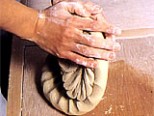
    The clay used as raw material is mainly Shigaraki clay for pottery and Amakusa, Iga, Seto, and Izushi clay for porcelain. For pottery clay, kaolin, kibushi clay, silica, and feldspar are added, and for porcelain clay, kaolin, silica, pottery stone, and feldspar are added, and these are kneaded by hand.

    工程2: 成形

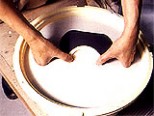
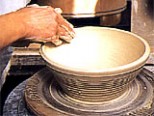
    Pottery wheel shaping involves placing a lump of kneaded clay on the center of a rotating disc and using centrifugal force to create the shape. There are various types of pottery wheels, including hand-operated wheels, kick wheels, and mechanical wheels. This method requires advanced skills. Another method is twisting, where the clay is kneaded and shaped using the fingertips and a bamboo spatula.

    Step 3: Drying and sanding

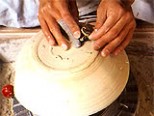
    After letting it dry completely, when the dough is semi-dry, use a metal spatula to trim it and shape it. Then, use finishing tools such as a water brush to make it beautiful, and then let it dry in the sun.

    Process 4: Bisque firing

    To achieve the necessary strength for painting and glazing, the pieces are bisque-fired at a low temperature of around 600-800 degrees Celsius.

    Step 5: Underpainting

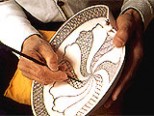
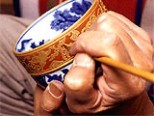
    Metals and pigments such as cobalt blue and iron oxide are hand-painted using a brush.

    Step 6: Glazing

    A glaze is applied to give it transparency and gloss.

    Step 7: Final firing

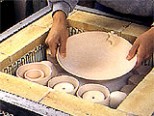
    The glazed pieces are loaded into the kiln and fired at a high temperature of 1200-1300 degrees Celsius. In the past, climbing kilns were used, but nowadays gas kilns and electric kilns are used.

    Process 8: Overglaze

    The pieces are colored with metallic pigments made from oxides such as cobalt, iron, and copper. Some pieces are not decorated with overglaze.

    Step 9: Overglaze firing

    The overglaze paint is fired at a low temperature of 600-800 degrees Celsius to enhance its color and gloss, and to prevent it from easily peeling off.


  • Close-up

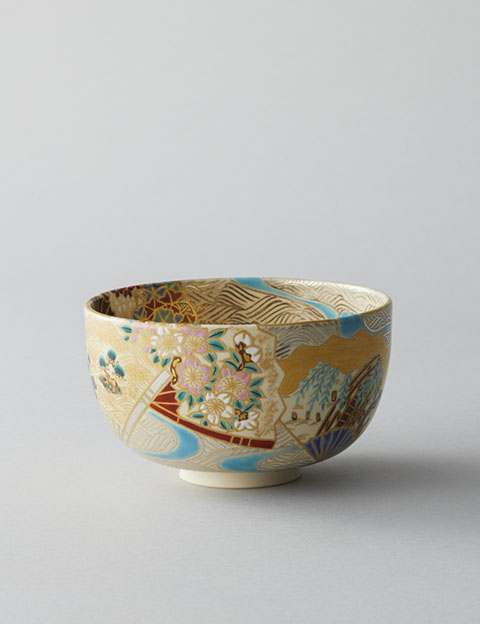
    Delicate and elegant Kyoto ceramics

    If you've ever seen Kyoto pottery, you'll be struck by its refined beauty. It's not just the skillful techniques, but also the delicate forms created by the hands of the craftsmen, and the comfortable feel that you experience each time you use it. Perhaps it's the very essence of the craftsman's soul, meticulously crafted piece by piece.


    A taste unique to the city of Kyoto

    Gojo-zaka is the main approach to Kiyomizu-dera Temple. Just off it is a narrow alleyway. It's a common sight in Kyoto, with traditional townhouses lining the street. But next to the nameplates, there are other nameplates, such as those for pottery wheelers and ceramic painters.
    Kyoto pottery has remained largely unmechanized to this day, with 90 percent still being handmade. This is due to a division of labor and the fact that the work is carried out in a small, home-based setting.
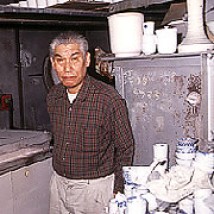
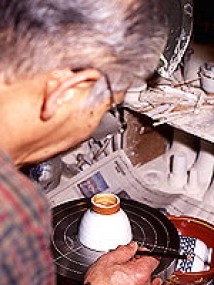
    I visited Shosen Tsuchiyama, who was working on his potter's wheel in a room of about four and a half tatami mats in his home.

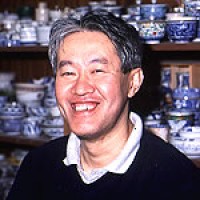
    Tadao Tsuchiyama (the first Matsuizumi). A born potter with an irresistible love for craftsmanship.

    A born potter

    Influenced by his father, a potter, Tsuchiyama began working with clay at the age of 14. He went on to the Ceramics Department of the Second Industrial High School (later the Ceramics Department, which no longer exists), the predecessor of Fushimi High School, and became fascinated by the joy of craftsmanship. His father's presence was significant to him at that time, and he recalls constantly thinking, "I want to get good quickly," while watching his father work. "You can learn to spin the potter's wheel in two years. However, in reality, we craftsmen have to produce large quantities of the same shape and size. Well, even a skillful person will take ten years to become a full-fledged craftsman," Tsuchiyama says casually, his words revealing the confidence he has gained from working with the potter's wheel for over fifty years. Certainly, if you pour the clay into a mold using a machine, errors will be eliminated. However, since you are spinning the potter's wheel by hand, errors are bound to occur. Nevertheless, to finish the roundness and thickness without changing for several minutes shows his experience and professional pride.

    Tsuchiyama-san doing the underpainting.

    The life of a potter

    "There's no end to how much you can improve if you keep looking up," says Tsuchiyama. While he finds satisfaction in creating something, his self-assessment of his work is quite harsh. That's why daily effort is necessary. It's about "continuing to create and refining one's eye." He also puts himself in the position of a consumer, looking at and using the products to enhance his sensibilities. Tsuchiyama as a potter cannot be described by his profession alone. He expresses his way of life itself in his works.

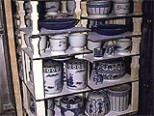
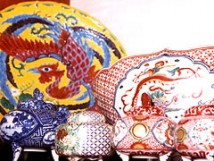
    A collection of works by Mr. Tsuchiyama

    Craftsmanship that conveys the elegance of Kyoto

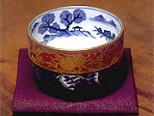
    "Kyoto pottery is a pleasure to look at and easy to use," Mr. Tsuchiyama said, as he led me to a room on the second floor. Two eight-tatami-mat rooms were filled with Mr. Tsuchiyama's own works. In addition to decorative plates and vases with beautiful use of color, there were teacups and bowls with shapes designed to be easy to hold and use. Kyoto craftsmen are conveying elegance even in everyday life.

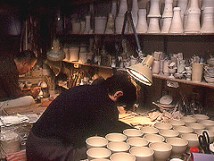
    Tsuchiyama's workplace

    Anecdotes

    Pottery class taught by traditional craftsman Takashi Takagi


    • Takagi-san applying the glaze


overview

Craft item name KYO-KIYOMIZU Yaki (Ceramics)
Reading Kyoyaki/Kiyomizuyaki
Classification of crafts Ceramics
Main Products Tableware, flower vases, tea sets, incense ceremony supplies
Main manufacturing area Kyoto City, Uji City, Joyo City, Mukō City, Kameoka City, Nagaokakyo City
Designated date March 20, 1977

contact address

■ Production area association

Kyoto Ceramic Manufacturers Cooperative Association
607-8322
6-2 Kawada Shimizu-yaki Danchi-cho, Yamashina-ku, Kyoto City, Kyoto Prefecture
Corpo Kiyomizu 203
TEL: 075-582-3113
FAX: 075-582-3114

http://www.kyoyaki.com/

Features

Delicate, elegant, and intricate pottery that values tradition coexists with innovative pieces that are suitable for enriching modern life, each maintaining its own unique atmosphere.

How to make it

Since Kyoto does not have access to the raw materials such as pottery stone and clay, these are sourced from Amakusa in Kumamoto Prefecture and Shigaraki in Shiga Prefecture, and the materials are adjusted according to the type of product being made. The raw materials are turned into clay, shaped, and dried. After that, they are trimmed and finished, and then bisque-fired. Next, underglaze is applied, glaze is applied, and then the piece is fired again to complete it. If color is to be added, the overglaze is applied after the final firing, and the overglaze is fired to set the finished product.

Please see here for information on traditional craftspeople.

Japanese traditional craftsman
top