HASAMI Yaki (Porcelain)

Nagasaki Prefecture

It is believed to have been started at the end of the 16th century by Korean potters brought back by the lord of the Omura domain when he returned to Japan after participating in Toyotomi Hideyoshi's invasion of Korea.
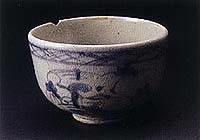
In the early Edo period, porcelain began to be produced, and everyday items such as tea bowls, plates, and sake bottles were manufactured. Among these, thick, blue-and-white tea bowls were used as tableware to sell sake and food to people on boats at the Osaka port, and were well known as "Kurawanka bowls."

  • Technology/techniques/raw materials

    Technology/techniques

    1. The molding shall be done by wheel-throwing, press molding, die-casting, hand-twisting, or by bag-casting or "double-casting" which involves scraping and finishing the entire surface of the base material so that it has properties equivalent to those obtained by these molding methods.

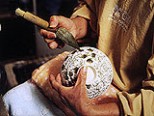
    2. When decorating the base material, the following methods may be used: line engraving, openwork, relief carving, slipcarving, slip trailing, weaving, firefly pattern, pasting, comb marks, or stamped patterns.

    3. When applying underglaze, the following methods may be used: dipping, line drawing, smearing, ink splattering, brushstrokes, blown ink, or stamping. In this case, the pigments used shall be "cobalt blue pigment" or "rust pigment."

    4. Glazing shall be done by dipping, pouring, or coating. In this case, the glaze shall be "lime glaze," "oak ash glaze," or "celadon glaze."

    5. When applying overglaze decoration, it shall be done by drawing lines, smearing, or applying directly. In this case, the paints shall be "Japanese pigments" or "gold pigments."
     

    raw materials

    The clay used for the clay base shall be Amakusa pottery stone, Mimata pottery stone, or a material of equivalent quality.

  • Work scene

    Step 1: Ceramic stone crushing

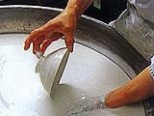
    HASAMI Yaki (Porcelain) uses Amakusa pottery stone as its main raw material. It shrinks little during firing, has a moderate viscosity, and is fired at a high temperature, resulting in an elegant white color. This is the secret to the beauty of HASAMI Yaki (Porcelain) 's white porcelain, its primary characteristic. This pottery stone is then finely crushed into a powder.

    工程2: 成形

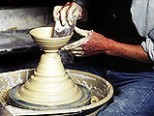
    Besides hand-building, where the shape is freely created using only the hands, there are also mechanical methods such as using a potter's wheel, roller machine, and slip casting. In slip casting (bag casting), a basic mold is made from plaster, and then clay is poured into the mold.

    工程3: 素焼き

    After shaping, the clay is trimmed and finished, then thoroughly dried in a well-ventilated, sunny place. Afterward, it is placed in a kiln and fired at approximately 900 degrees Celsius. This is a necessary step to facilitate underglaze painting and glazing.

    Step 4: Underglaze painting

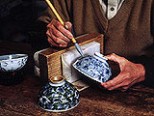
    Designs are applied to unglazed pottery using pigments (underglazes) that develop color at high temperatures. Underglaze painting with cobalt (a mineral that is the raw material for the indigo pigment used in underglaze blue porcelain. It contains cobalt compounds and has a dark bluish-green appearance, but turns a beautiful blue when fired) is a typical example.

    Step 5: Glazing

    The surface is then dipped in glaze to create a smooth finish.

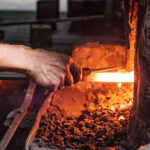
    Step 6: Final firing

    It is fired at approximately 1300 degrees Celsius. The glaze melts at high temperatures, creating a thin, glassy film on the surface. This serves purposes such as decoration, smoothing the surface, and hardening the piece by eliminating water absorption.

    Step 7: Overglaze painting

    Pigments that melt at low temperatures (overglaze paints) are used to paint designs over the glaze. Red paint and gold decoration are commonly used. The pieces are fired at approximately 800 degrees Celsius.

    工程8: 検品

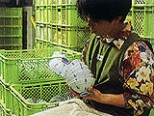
    After completion, each product undergoes rigorous inspection, is carefully packaged, and then shipped nationwide.


  • Close-up

    Tableware that has been used continuously and has become deeply ingrained in society.

    Hasami is a major pottery-producing region, second only to Mino and Arita in terms of the volume of everyday tableware produced. In the late Edo period, HASAMI Yaki (Porcelain) boasted the highest production volume in Japan and continues to be used by many people as everyday Japanese tableware. We visited a master of pottery wheel shaping who has been pursuing the beauty of functionality for 50 years.


    Born in a land of pottery

    Born in a pottery-producing region, Heizo Nakamura naturally became a craftsman, a profession he has pursued for 52 years. He says he somehow ended up in his current job during the post-war period when there were few jobs. "I didn't have any particular aspirations or anything. My older brother, who is 20 years older than me, was using a potter's wheel, so I apprenticed under him. Eight of my classmates (in this area) all ended up working in pottery-related fields."

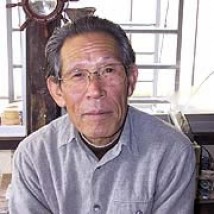
    Nakamura-san at the workshop

    Work is tough and difficult. You can't get better at it if it's just fun.

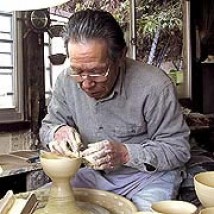
    The apprenticeship lasted three years, followed by one year of service as a token of gratitude, meaning that for these four years, he received no salary. "I couldn't ask the potter for money, so I'd get pocket money from my brother to go to the movies and things like that." Apprentices had to do odd jobs for their seniors, start fires from kindling, knead the clay, remove air bubbles, and make it a uniform consistency. On top of that, they were constantly on the move from early morning until late at night, using a potter's wheel that was kicked with their feet.
    The molding process was also a challenge. It was necessary to create pieces that were exactly the same size and shape, but making 100 or 200 pieces identical was no easy feat. They had to consider shrinkage rates during natural drying and firing in the kiln, but even with careful planning, things didn't always go as planned. Apparently, they cried many times because of it.

    Quickly shape it on the potter's wheel.

    "I'm glad I was able to take things easy."

    The 50 years that Mr. Nakamura has lived as a craftsman have been a time when the mechanization of pottery wheel shaping has advanced. However, because Mr. Nakamura himself was in a small pottery studio, he was separated from that trend. After the collapse of the bubble economy, as value-added products produced in small quantities with a wide variety of items began to be recognized, pottery wheel shaping once again came into the spotlight. "If you're making 100 or 200 pieces, it's faster to do it by hand than by machine." "I'm happy that I've been healthy, had work, and never once worried about what I would do tomorrow for these 50 years," said his wife, Yoshiko, who is in charge of painting. And it was impressive when Mr. Nakamura said with deep emotion, "I'm glad I've been able to do it at my own pace" (I'm glad I've been able to do it at my own pace without worrying too much about what others think).

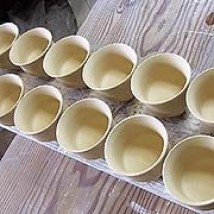
    The finished bowl is flawless, without a single imperfection.

    50 years in a 400-year history

    Looking back on the past 50 years, Nakamura says, "When I think of it as 50 years in a 400-year history, I feel like I've made history. Hasami pottery is made of everyday materials, so it breaks easily. That's precisely why the tradition has survived. Perhaps that's what made it so good." He wants to inherit what has been passed down through that history and the best way of making pottery. Nowadays, artists attract more attention than craftsmen, but what artists make are one-of-a-kind or large pieces. For that, they need more clay and different kilns. In that case, it's not just a part of history, but everything starts from scratch. That's why he wants to inherit the skills of craftsmen.

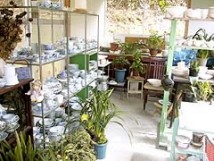
    Yoshiko's painting workshop is surrounded by lots of greenery.

    Placing our hopes on the transmission of technology

    He continues to be passionate about mentoring younger generations. Since around 1970, he has been teaching HASAMI Yaki (Porcelain). He says he has taught at least 200 students so far. Many people come to him from far away as well as from the local area, hoping to become craftsmen, open pottery classes, or become artists. "I've seen several of them, and they've all gone through the same struggles as I did. I often drank with my apprentices who couldn't sleep at night because they were worried about their pottery. Only those who have cried like that can understand the hardships. Four or five of them have become full-fledged potters," he said with a smile.

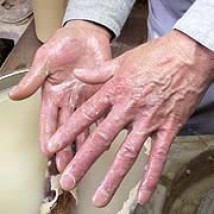
    Nakamura's hands, which have produced so many pieces of pottery

    I want to create tableware that is not only meant to be displayed, but also to be used.

    Nakamura says that "alcohol is my reason for living," and while he says he "wants to quit pottery making, I'm so tired of it," he also says, "As long as my body can move, I'll keep working. There's no other way."
    "Until now, I've mostly just done what I was asked to do, so I hardly have any original work. That's why I want to create my own work. And not just something to display, but something that people can actually use," she said with a smile.

    Craftsman Profile

    Heizo Nakamura

    A traditional craftsman who apprenticed under his older brother at the age of 16 and has been involved in pottery wheel shaping for half a century ever since.

    Anecdotes

    The Pottery Triangle: Its Historical Background

    Hasami, Mikawachi, and Arita are located at roughly equal distances from each other, forming a triangle. While the raw materials and techniques are almost identical and the appearance is very similar, they have different historical backgrounds and possess the following characteristics:

    Hasami primarily produced everyday tableware, such as the "Komprabin" bottles, which were filled with sake and soy sauce and exported in large quantities to the Netherlands and Southeast Asia from Dejima in Nagasaki, and the "Kurawanka bowls," which are said to have greatly changed Japanese food culture.

    In Arita, porcelain was produced and shipped from Imari Port to Europe, initially in the style of Jingdezhen porcelain from China, and later in Japanese styles such as Kakiemon porcelain. It became popular in European countries and rapidly developed as a result.

    Mikawachi was the first to discover and use Amakusa pottery stone, which is renowned worldwide. During its time as the official kiln of the Hirado domain, it produced products that could not be manufactured in other regions, such as tribute items for the imperial court and the shogunate, and gifts for feudal lords throughout the country.

    • MIKAWACHI Yaki (Porcelain)

overview

Craft item name HASAMI Yaki (Porcelain)
Reading Hasamiyaki
Classification of crafts Ceramics
Main Products Japanese food and drink tableware
Main manufacturing area Hasami Town, Kawatana Town, and Higashisonogi Town in Higashisonogi District
Designated date February 6, 1978

contact address

■ Production area association

Hasami Ceramic Industry Cooperative Association
859-3711
2239 Iseki-go, Hasami-cho, Higashisonogi-gun, Nagasaki Prefecture
TEL: 0956-85-3003
FAX: 0956-85-6108

https://www.hasamiyaki.or.jp/

Features

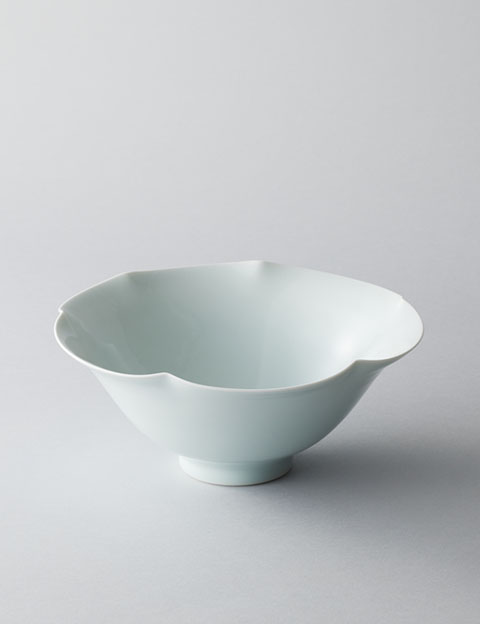
Characterized by the beauty of its translucent white porcelain and the delicate yet profound flavor of its underglaze blue (gosu) paintings, this porcelain boasts a wide range of products, from traditional to modern, thanks to continuous improvements made to adapt to changing times. The prices are also reasonable.

How to make it

The raw materials used are pottery stone from the Amakusa region. After shaping the pieces using techniques such as hand-throwing on a potter's wheel, hand-building, mold-making, and bag-pouring, they are bisque-fired at approximately 900 degrees Celsius. Then, they are painted with underglaze paints that develop color at high temperatures, dipped in glaze, and fired again at approximately 1300 degrees Celsius. For products that are overglazed, the designs are painted over the glaze with overglaze paints that melt at an even lower temperature, and then fired at approximately 700-800 degrees Celsius to fix the overglaze paint.

Please see here for information on traditional craftspeople.

Japanese traditional craftsman
top