TSUGARU Nuri (Lacquerware)

Aomori Prefecture

The origins of TSUGARU Nuri (Lacquerware) can be traced back to the early Edo period. It is said to have been started by a lacquerware craftsman employed by the lord of the Tsugaru domain.
TSUGARU Nuri (Lacquerware) took shape as an industry in the early Meiji era, developing on the foundation of traditional techniques accumulated during the Edo period. Since then, many artisans have continued to refine their skills and innovate, building upon TSUGARU Nuri (Lacquerware) we know today.

  • Technology/techniques/raw materials

    Technology/techniques

    1. The base coat is made by applying raw lacquer directly to the wood, then covering it with cloth, and finally applying a mixture of raw lacquer, ground powder, rice paste, or polishing powder repeatedly to create a "genuine hard base."


    2. The lacquer coating shall be applied in one of the following ways:
    (1) In the case of Chinese lacquerware, the following techniques or methods shall be used:
    (i) Using a "setting spatula," apply refined black lacquer and then "paint in different colors" using various types of refined colored lacquer.
    (b) After applying the "tsuma-nuri" (a type of lacquering technique) and then applying refined transparent lacquer, the surface is polished using a "Oshimizu whetstone" or similar tool.
    H. To apply a "various finish".


    (2) In the case of Nanako lacquerware, the following techniques or methods shall be used:
    (i) After applying the undercoat and sanding the undercoat, apply refined colored lacquer or refined black lacquer, and then sow rapeseed seeds.
    (b) Remove the rapeseed, apply refined colored lacquer, and then polish it using a "Daishimizu whetstone" or similar.
    H. To apply a "various finish".


    (3) In the case of Nishiki lacquerware, the following techniques or methods shall be used:
    (i) After applying the intermediate coat and sanding it down, apply red and yellow refined colored lacquer as a "seed lacquer coating," and then sow rapeseed seeds.
    (b) After removing the rapeseed, sharpen the stone using a "Oshimizu whetstone" or similar.
    (h) After drawing arabesque and geometric patterns using refined black lacquer, cloud patterns and other designs are drawn using refined green colored lacquer.
    2. Applying refined colored lacquer and sprinkling "color powder," which is a mixture of vermilion and tin powder.
    Ho: To apply a "various finish".


    (4) In the case of patterned gauze lacquering, the following techniques or methods shall be used:
    (i) After applying an undercoat and sanding the undercoat, and drawing the "pattern," apply refined transparent lacquer and sprinkle rice husk charcoal powder or polishing charcoal powder.
    To apply a "various finish."
     

    raw materials

    1. The lacquer used must be natural lacquer.

    2. The wood used shall be cypress, magnolia, katsura, or zelkova, or timber of equivalent quality.

  • Work scene

    TSUGARU Nuri (Lacquerware), characterized by its repeated application and polishing, is made through three processes: preparing the wood, preparing the base coat, and applying the final coat.
    The wood preparation process involves everything from felling and drying the wood to shaping it on a lathe. The undercoating process involves rubbing lacquer onto the wood, applying cloth, and then applying the undercoat of lacquer. Finally, the painting process involves repeatedly painting and polishing to bring out the elegant patterns that are characteristic of TSUGARU Nuri (Lacquerware).
    Here, we will introduce the process of making TSUGARU Nuri (Lacquerware) using the Kara-nuri technique.

    Process 1: Tree removal

    After the cut lumber has dried, it is cut into appropriate pieces. During the cutting process, the core, hard parts of the wood, knots, and cracked sections are roughly removed.
    For joinery items such as trays and low tables, which are made by combining planks, we use cypress wood, while for turned items such as bowls, which are carved on a lathe, we use magnolia wood.

    Step 2: Covering with fabric

    There are several methods for preparing the base coat, but here we will focus on the hard base coat made by applying cloth, which is the most common method used in TSUGARU Nuri (Lacquerware).
    The entire polished wood surface is evenly coated with lacquer to provide waterproofing. Then, a paste made by mixing rice paste and lacquer (nori-urushi) is applied to a cloth such as hemp cloth and wrapped around the surface of the wood. It is important to ensure that the wood and cloth are tightly adhered to each other.

    画像をクリックすると動画が再生されます

    Step 3: Ground preparation

    First, the coarsest base lacquer is applied, and then finer lacquers are applied gradually. For TSUGARU Nuri (Lacquerware), the base lacquer is made by mixing Yamashina powder, glue lacquer, and raw lacquer, and is applied evenly with a spatula. Once the base lacquer is completely dry, the surface is sanded flat, and then finer wood chips and rust lacquer are applied and sanded in the same way. Up to this point, sanding is done without water to avoid wetting the wood.

    画像をクリックすると動画が再生されます

    Step 4: Setting up the rig

    Next, a speckled pattern is applied to the finished base. The special lacquer used here is made by mixing pigment, plain black lacquer, and egg white to increase its viscosity. The lacquer is taken with a spatula and the speckled pattern is applied to the entire surface by lightly tapping it. The surface is then allowed to dry slowly over several days to allow the lacquer to dry completely.

    画像をクリックすると動画が再生されます

    Step 5: Coating

    Colored lacquer is brushed onto the dried lacquer base. A color that strongly contrasts with the design of the mechanism is used to make the mechanism stand out clearly. Yellow lacquer is commonly used for black mechanisms.

    Process 6: Coloring

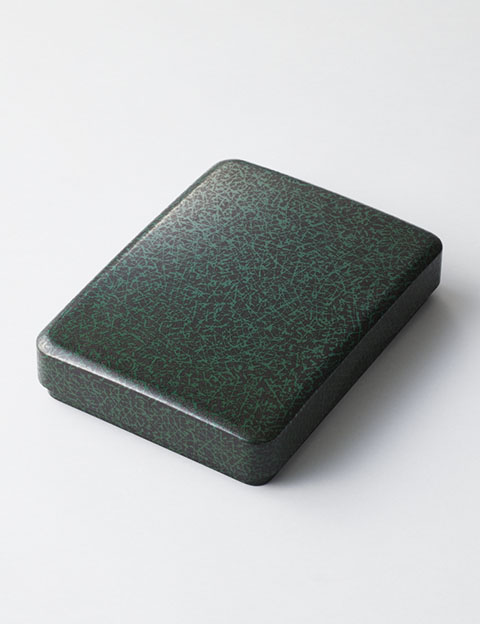
    The technique of adding color to the overall color scheme of Tang-style lacquerware by scattering patterns with colored lacquer is called "saishiki" (coloring). Vermilion and green are frequently used, and these are collectively known as "ryōsaishiki" (double coloring). The way the patterns are scattered creates unique Tang-style lacquerware designs, with no two pieces being exactly alike.
    A transparent, reddish-brown lacquer is applied over the colored areas to tone down the vibrant hues.

    Step 7: Gable plastering

    Tsuma-nuri involves applying a thin, even layer of colored lacquer to the entire surface. After applying the plain black lacquer, tin powder is sprinkled on top.
    When the lacquered pattern is polished using the tsuma-nuri technique, it outlines the boundary between the base color and the pattern, creating an effect that enhances the design.

    Step 8: Top coat

    The final coat application is the last step in the Tang-style lacquering process, where the top coat of lacquer is applied. The top coat of lacquer is applied as thickly as possible with a brush.
    Kara-nuri lacquerware is called by different finishes depending on the base color, such as red finish, black finish, or pear-skin finish.
    Throughout the process, various colored lacquers have been applied in layers over the underlying structure, creating a textured, uneven surface. Within this layer, the unique abstract patterns characteristic of Tang-style lacquerware are encased.

    Step 9: Sharpening

    First, the unevenness is roughly removed. Since the lacquer on the carved surface is not completely dry, it is dried in a lacquer bath before the pattern is carved out. Lacquer is applied to the recessed areas using the same technique as for the final coat, and the lacquer on the flat areas is wiped off.

    画像をクリックすると動画が再生されます

    Step 10: Body rubbing

    The polishing powder, made by mixing polishing powder with rapeseed oil, is applied to a cloth and repeatedly polished. This removes all traces of previous polishing. Since any remaining oil will prevent the lacquer applied on top from drying, the oil is completely wiped off. This process is also called "senben koguri" because it involves polishing a thousand times.

    画像をクリックすると動画が再生されます

    Step 11: Lacquering (polishing the lacquer finish)

    In TSUGARU Nuri (Lacquerware), this technique is called "ro-nuri," but technically it refers to "ro-iro polishing." Ro-iro lacquer is a type of lacquer used for polishing. "Ro-iro" is said to mean "wax color," meaning that the surface becomes like it has been polished with wax. Ro-iro lacquer is applied to charcoal, and the surface is polished in 3-4 cm square sections, wiped, polished, wiped, polished, and the entire surface is polished while observing the condition of the painted surface until it is complete.

    画像をクリックすると動画が再生されます

  • Close-up

    TSUGARU Nuri (Lacquerware) A crystallization of beauty created by the ingenuity of artisans.

    TSUGARU Nuri (Lacquerware), created by repeatedly applying and sanding lacquer, is characterized by its incredible durability, which is unexpected given the beauty of its patterns. These sturdy lacquerware pieces, made with use in mind, add a gentle touch of color to everyday life.


    As the northernmost lacquerware technique in Japan

    The origins of TSUGARU Nuri (Lacquerware) are said to date back to the Genroku era (late 1600s to early 1700s), when craftsmen gathered from all over Japan during the reign of Lord Nobumasa, the lord of the Tsugaru domain.
    TSUGARU Nuri (Lacquerware) is characterized by four main types: Kara-nuri, which features a distinctive spotted pattern; Nanako-nuri, which uses rapeseed seeds dropped onto the lacquer to create the shape of fish eggs (nanako); Monsha-nuri, which involves sprinkling charcoal powder and polishing it to reveal a jet-black pattern; and Nishiki-nuri, which incorporates arabesque or saya-gata patterns onto a Nanako-nuri base.

    Durable lacquerware created through repeated coating and polishing.

    TSUGARU Nuri (Lacquerware) is characterized not only by its visual beauty but also by its exceptional durability. Starting from the base coat, it is painted and sanded over 10 times, with the process repeated each time. "When sanding, we change the whetstone each time," explained Takeji Iwatani, chairman of TSUGARU Nuri (Lacquerware) Traditional Craftsmen's Association. He is a traditional craftsman who goes by the name Gozan. "In Tsugaru, this stone is quarried locally. This stone has been used to preserve the techniques. It is a precious stone that is not taken to other regions." His workshop is simple, with only tools lined up on a wooden floor. At first glance, it is hard to believe that such beautiful lacquerware is produced here. However, the more I listened to him, the more I came to understand that this simplicity is just right for pursuing the art of lacquerware.
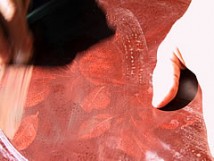
    "The true beauty of TSUGARU Nuri (Lacquerware) can only be appreciated through use. Even if the color fades, a little polishing will restore its luster," he said, demonstrating the polishing process. As he polished, patterns that had been hidden before began to appear.


    When the red tea caddy was polished, a pattern of leaves appeared.

    A commitment to tools for creating high-quality products

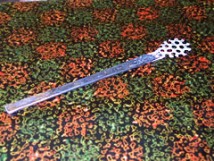
    TSUGARU Nuri (Lacquerware) polished using locally sourced stones. Finally, charcoal is used to polish it and give it a shine. This dedication to tools extends even to the brushes used to draw the patterns. "If you use an ordinary brush for this Nanako pattern, the bristles get caught in the lacquer and break easily. The best is a mouse's whisker. This brush was made by catching mice on the back of a mouse." Opening the toolbox reveals not only his own brushes, but also handmade tools such as lacquer brushes and spatulas used to create patterns in Tang lacquerware.

    The lacquered pattern on this stand was also painted using this special tool.

    Using it now connects the history of lacquerware.

    "At an exhibition, someone said to me, 'TSUGARU Nuri (Lacquerware) is weak.'" It's hard to believe that someone would say that about Tsugaru TSUGARU Nuri (Lacquerware) which is known for its durability compared to other lacquerware. However, upon closer inspection, it seems that the person was simply not taking care in how they were using it. "Apparently, they put it directly into the refrigerator and it cracked. The inside of a refrigerator dries out the lacquer, so it's a harsh environment for it." There were also stories of people TSUGARU Nuri (Lacquerware).' She said she learned how to care for it by watching her grandmother use it. With a little care, TSUGARU Nuri (Lacquerware) lacquerware can last for decades." These words make you feel that if we just took a little care of our furnishings, we could actually live a richer and more peaceful life.

    Take your time and make the most of your skills.

    Aomori, located at the northernmost tip of Tohoku, is not exactly blessed with abundant job opportunities. It is said that many people working in dangerous jobs are from Aomori. "People these days don't like to spend time acquiring skills by hand. TSUGARU Nuri (Lacquerware) is a good job for long-term employment, but if you try to make money quickly, you end up not learning anything." Mr. Iwatani was born with a physical disability, but through extraordinary effort he has acquired the skills of a master craftsman and is now known as a leading craftsman of Tsugaru. Many customers come directly to purchase Mr. Iwatani's works. "When you acquire a skill, it leads to confidence." He has overcome his handicap through hard work and has earned respect. There is a good thing about the world of craftsmen where those who work hard are respected.

    A willingness to incorporate good things

    TSUGARU Nuri (Lacquerware) incorporates cutting-edge technology if it is of good quality. They have successfully improved the resistance of lacquerware to heat and abrasion, which were weaknesses of lacquerware, by using a new material called wood ceramics, developed at the lacquerware department of the nearby Aomori Prefectural Industrial Technology Center, as a base for the monsha lacquer finish.

    TSUGARU Nuri (Lacquerware) is made using locally sourced cypress wood, local whetstones, and even mice that have been removed from the production process. New materials are also developed at a local research institute. Grown in the harsh winters of the northernmost part of Michinoku, Tsugaru lacquerware possesses an inherent strength, and its true quality becomes apparent only through use.

    Craftsman Profile

    Takeharu Iwatani

    "If you're going to take pictures, it's better to do it where the sun is shining, right?" Iwatani makes full use of the materials in nature. Even the word "sun" sounds natural to him.

    Anecdotes

    Let's compare lacquer and chemical paints.

    In recent years, there has been an increase in the number of people developing chemical sensitivity, a condition in which allergic reactions occur to even trace amounts of chemicals. Initially, there may be no symptoms, but once the condition develops, even very small amounts of contact with or inhalation of chemicals can trigger symptoms. Since common paints are made from petroleum, they can cause chemical sensitivity. Furthermore, solvents such as paint thinner can damage the nervous system.
    On the other hand, while lacquer can cause a rash when it's in liquid form due to urushiol, its main component, it becomes harmless once it dries. Moreover, the more you get used to it, the less likely you are to get a rash from touching lacquer.
    When we re-examine chemical paints, which cause allergies and poisoning symptoms the more they are used, and lacquer, which becomes less harmful the more it is used, from the perspective of harmony with human health, we can appreciate the value of things that have been used continuously over time.

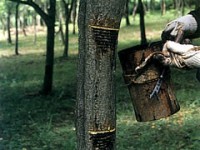
    • Although imports are increasing, lacquer was originally harvested locally.

overview

Craft item name TSUGARU Nuri (Lacquerware)
Reading Tsugaru lacquer
Classification of crafts lacquerware
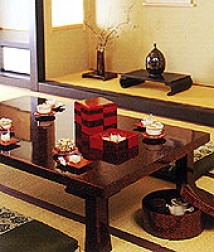
Main Products Furniture, low tables, tea sets, tableware, writing boxes, trays, inkstone boxes, chopsticks, flower vases
Main manufacturing area Aomori City, Hirosaki City, Kuroishi City, Hirakawa City, Fukaura Town (Nishitsugaru District), Fujisaki Town (Minamitsugaru District), Itayanagi Town (Kitatsugaru District)
Designated date May 10, 1975

contact address

■ Production area association

Aomori Prefecture Lacquerware Cooperative Association
〒036-8061
2-4-9 Kanda, Hirosaki City, Aomori Prefecture
Inside Hirosaki City Traditional Industries Hall
TEL: 0172-35-3629
FAX: 0172-35-3629

[※Moving to the address below from January 2026]
〒036-8072
3-8-5 Seinobukuro, Hirosaki City, Aomori Prefecture
Inside Hirosaki City Traditional Industries Hall

https://www.tsugarunuri.org/

Features

TSUGARU Nuri (Lacquerware) is a traditional lacquerware from the northernmost part of Japan, primarily produced in Hirosaki, Aomori Prefecture. It possesses a warmth and richness, and a unique charm that only handmade products can offer. It is characterized by various techniques, such as "nanako-nuri," which features small patterns reminiscent of the intricate designs on kimonos, and "monsha-nuri," which has a matte black background that gives it a sophisticated and modern feel.

How to make it

TSUGARU Nuri (Lacquerware) is made from cypress wood and completed through approximately 50 processes. Cloth is stretched over the wood, and a lacquer undercoat is applied to create a sturdy base for the lacquerware. Colored lacquers are then applied in layers and polished repeatedly. Finally, high-quality Japanese lacquer is used to carefully polish the piece, resulting in a robust and elegant finish.

top