HIDEHIRA Nuri (Lacquerware)

Iwate Prefecture

HIDEHIRA Nuri (Lacquerware) originated in Hiraizumi, Iwate Prefecture, at the end of the Heian period, under the Oshu Fujiwara clan, who wielded immense power and wealth and brought Buddhist art, including the Konjikido (Golden Hall) of Chuson-ji Temple, to the region.
Although the history of the area for several hundred years since the fall of the Fujiwara clan is still unclear, lacquerware production flourished in Kinugawa Village, adjacent to Hiraizumi Town, from the late Edo period onward, and continues to this day.

  • Technology/techniques/raw materials

    Technology/techniques

    1. In the preparation of wooden bowls, the shape shall be the "Hidehira type" using the following techniques or methods.
    (1) The rim should be tapered inwards.
    (2) The body should be rounded.
    (3) The elevated area should be shaped to widen at the bottom.


    2. The base preparation shall be carried out by one of the following methods:
    (1) In the case of "Honkenjikaji," after "cloth covering" using hemp or cheesecloth, "ground application" using ground powder, "cut powder application" using a mixture of ground powder and polishing powder, and "rusting application" shall be performed.
    (2) In the case of "lacquer base coat," the process involves repeatedly applying a mixture of refined raw lacquer and refined black undercoat lacquer, followed by wet sanding.


    3. The lacquering shall be carried out using the following techniques or methods:
    (1) Apply a base coat and an intermediate coat.
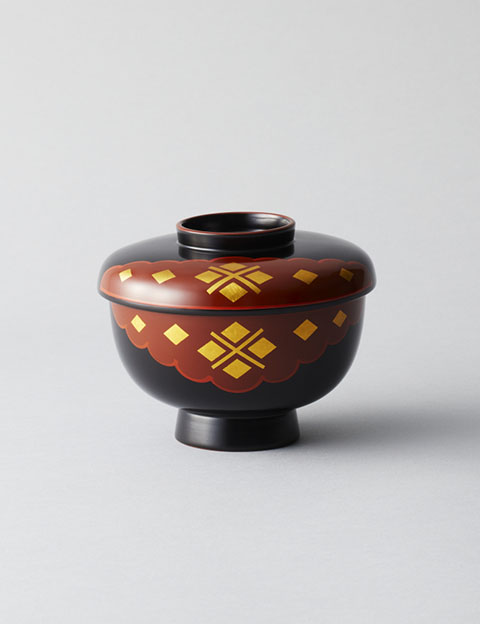
    (2) The "top coat" shall be either a floral or multi-colored lacquer finish, and in the case of bowls, the exterior shall be black and the interior red.


    4. The decoration shall consist of "cloud-patterned painting," "gold leaf application," and "lacquer painting" to create the "Hidehira pattern."
     

    raw materials

    1 漆は、天然漆とすること。


    2. The woodwork shall be one of the following:
    (1) In the case of turned wood, the material shall be zelkova, magnolia, horse chestnut, beech, or a material of equivalent quality.
    (2) In the case of joinery, the materials shall be zelkova, magnolia, cypress, or materials of equivalent quality.


    3. The foil used for decoration shall be gold, and the purity of the gold shall be 966 parts per thousand or higher.

  • Work scene

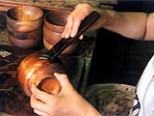
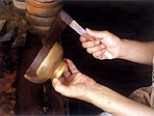
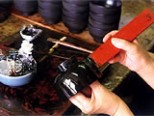
    HIDEHIRA Nuri (Lacquerware) is made through three main processes: "wood preparation," which involves cutting the raw wood and turning it into the bowl shape on a lathe; "lacquering," which involves applying lacquer to the wood; and "decoration," which involves drawing the unique cloud pattern of HIDEHIRA Nuri (Lacquerware) and applying gold leaf. The finished product is the result of the coordinated skills of the craftsmen who are in charge of each process.
    Furthermore, lacquerware from Iwate Prefecture, which has long been known as a production area for lacquer sap, is still coated with lacquer that was harvested locally, although this practice has become less common today.

    Step 1: Lacquer tapping

    From June to October is the season for collecting lacquer sap from lacquer trees. Lacquer tappers run around the mountains from sunrise to sunset, making cuts in the trees and collecting the sap that oozes out.
    During the season, we collect lacquer from a single lacquer tree once every four days, yielding a total of approximately 150 grams of sap. This amount is enough to fill about 20 bowls.

    Step 2: Cutting and shaping the logs

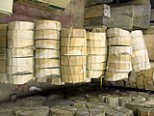
    The process involves cutting beech and horse chestnut logs into rings and drying them slowly for three years. This long drying process makes the logs less prone to dimensional changes later on.
    The bowl is roughly carved, larger than its intended shape. If you carve it to the exact dimensions all at once, it will crack or deform, so carve it gradually while it dries. Adjust the moisture content to about 20%, and then smoke-dry it.

    Step 3: Turning the wood

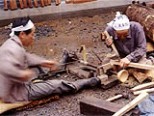
    The wood is shaped into a bowl on a potter's wheel. Since bowls need to be perfectly round, a guide is attached to the wheel to ensure a perfect circle. However, if the wood has been dried too quickly, it is prone to warping. It is necessary to take your time and slowly create the shape of the wood.

    Step 4: Wood hardening

    From here, we move on to the base preparation process.
    The lacquer is applied by rubbing it into the wood, which has been precisely carved to the correct dimensions. If the wood absorbs moisture, it will warp during subsequent painting processes and use, so the wood is hardened to suppress moisture penetration.

    Step 5: Applying cloth and primer.

    To reinforce the thinner parts of the wood, such as the upper edge and the base, a cloth soaked in a paste made from lacquer and rice flour is wrapped around them.
    Then, a mixture of a special powder called "ji-no-ko" and lacquer paste is applied to the entire surface of the wood to increase its strength (priming), and then a rust-like finish is applied on top of that (rusting). Rusting refers to applying a mixture of polishing powder and raw lacquer to the wood. All of these steps are to create a strong base.

    Step 6: Coating

    The lacquer is applied in three stages: undercoat, intermediate coat, and topcoat. After each coat, it is thoroughly dried in a high-humidity room called a lacquer bath. The lacquer bath is a drying room that utilizes the property of lacquer to dry in high humidity.
    Before each coating step, the dried lacquer surface is polished with a whetstone to remove any large irregularities and create a rough surface that allows the next coat of lacquer to adhere more easily. The top coat is the most delicate step in the lacquering process, as not a single speck of dust can get on it. This completes the coating process.

    Step 7: Decoration

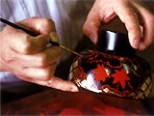
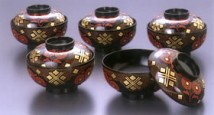
    The pattern drawn on washi paper is transferred onto the bowl after the top coat has been applied. Cloud patterns are then drawn in vermilion lacquer to match the design. Diamond-shaped gold leaf is then applied on top of that. Spring and summer flowers and fruits are then drawn between the clouds. This pattern is unique to HIDEHIRA Nuri (Lacquerware) and is called the "Hidehira pattern." This is how HIDEHIRA Nuri (Lacquerware) is completed.

     
  • Close-up

    The golden diamond-patterned Hidehira HIDEHIRA Nuri (Lacquerware) conveys the magnificent culture of Oshu to this day.

    HIDEHIRA Nuri (Lacquerware) lacquerware from Iwate Prefecture has preserved and nurtured its techniques and prestige from the era of flourishing craft culture in the Tohoku region to the present day. Passed down through generations in the harsh, snow-covered climate of Michinoku, HIDEHIRA Nuri (Lacquerware), with its red and black color scheme and gold Yusoku Hishimon (traditional diamond pattern), is a traditional vessel that exudes elegance and strength.


    Exploring the Roots of Michinoku Lacquerware

    It is said that HIDEHIRA Nuri (Lacquerware) originated in the late Heian period, during the time when the Heian culture of Oshu flourished. HIDEHIRA Nuri (Lacquerware) is adorned with a unique diamond-shaped pattern of gold leaf, a design attributed to the lacquerware being made by artisans invited from Kyoto during the construction of the Konjikido (Golden Hall) in the time of Fujiwara no Hidehira, the third generation of the Fujiwara clan.
    HIDEHIRA Nuri (Lacquerware), which has been cultivated and passed down from the Heian, Kamakura, and Muromachi periods to the present day, exudes a strength and dignity that only something with a long history can possess.

    HIDEHIRA Nuri (Lacquerware) Lacquerware

    The feedback from people who are actually using it is encouraging.

    In a room spotless from a speck of dust, the only faint sound is the gentle "swish, swish" of a brush rubbing against the surface. We spoke with Shoichi Iwabuchi, who has worked as a lacquer craftsman in such a room for many years.
    "The happiest moments are when customers who are actually using the product give us their feedback," says Iwabuchi. "Sometimes we receive kind words like, 'It's beautiful and easy to use,' but sometimes we receive harsh criticism from discerning customers. When that happens, it motivates us to think, 'Okay! I'll acquire even better skills!' and further refine our techniques."
    For a craftsman, there is no end to their work. They must constantly challenge themselves to go one step further and continuously hone their skills so that they never become dull. This is the spirit that has been passed down through more than 800 years in HIDEHIRA Nuri (Lacquerware).

    "I'd like to use local lacquer."

    One reason why lacquerware production flourished in Iwate is that it was the land ruled by three generations of the Fujiwara clan, but a major factor was the abundance of lacquer found in the surrounding fertile mountains. Even today, Iwate accounts for 75% of the nation's lacquer production. Unfortunately, 90% of the lacquer used in Japan is imported. For craftsmen who use lacquer every day, there is a natural preference for domestically produced, locally sourced lacquer. "Using lacquer produced in Japan results in incredibly strong vessels. It also seems to have good compatibility with the wood. Recently, there has been a lot of imports from China and Southeast Asia, but that kind of lacquer has a lot of rubbery material and is not suitable for lacquerware," says Mr. Iwabuchi. I think it's not just craftsmen who desire domestically produced lacquer.

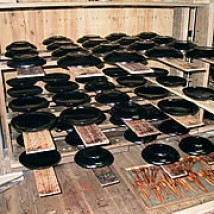
    Lacquered vessels are lined up in the lacquered bath.

    The craftsman's work begins even before the actual work starts.

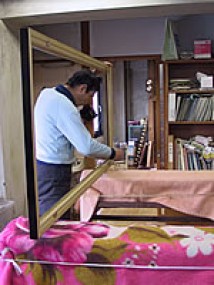
    In the painting process, especially during the final topcoat application, not a single speck of dust can be found on the vessel. Therefore, every day before starting to paint, Mr. Iwabuchi meticulously cleans his workshop. For him, the day's work begins from the moment he starts cleaning. "When I start wiping, I feel myself becoming more focused. As I wipe, I gradually increase my concentration. By the time I finish wiping, I'm ready to paint." It is only with such mental preparation that this traditional technique can be perfected.

    In addition to applying lacquer to lacquerware, they also repair national treasures.

    A quiet space transcends time

    Because he cannot stir up dust while working, Mr. Iwabuchi keeps his body movements to a minimum. The lacquer is applied in the silent space. And one by one, the finished vessels are lined up. The air in the room stops moving, and one gets the illusion that time has stopped as well. This feeling makes one think that craftsmen in the distant Heian period must have applied lacquer in a similar silence, and for a moment, one feels as if they have returned to the Heian period. Tradition may be something that connects and nurtures not only skills, but even the atmosphere itself.

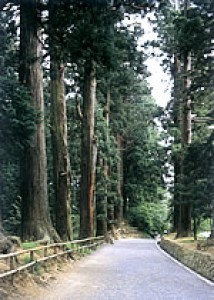
    A row of cedar trees leading to the Golden Hall.

    Lacquerware living in a new era

    HIDEHIRA Nuri (Lacquerware) is now widely produced throughout the prefecture. While preserving the dignified patterns and traditional techniques that convey the splendor of the past, there is also a demand for creativity that harmonizes with modern life. From the Heian period to the Heisei era, it is a Michinoku vessel that continues to add color to people's lives.

    Craftsman Profile

    Shoichi Iwabuchi

    A lacquerer with 25 years of experience: "When I start wiping the surfaces, I feel a sense of focus and determination as I prepare to begin painting."

    Anecdotes

    The novel "Hidehira's Lacquer"

    The novel "Hidehira's Lacquer" by author Kyōzō Miyoshi tells the story of Sōsuke, who, against his will, inherits his family's lacquerware business, becoming increasingly captivated by the allure of lacquerware as he explores the history of HIDEHIRA Nuri (Lacquerware). The novel blends fiction with real historical figures and historical research, making it intriguing for readers. At the time the novel was written, historians generally believed that the roots of HIDEHIRA Nuri (Lacquerware) dated far beyond the Fujiwara clan's era, perhaps only to the Momoyama period. In the novel, Sōsuke embarks on a journey to the Heian period to uncover the origins of HIDEHIRA Nuri (Lacquerware). Since the novel's publication, historical site investigations in the ancient capital of Hiraizumi have uncovered wooden artifacts believed to have been covered in gold leaf, and lacquer brushes have been found at the site of what is believed to be the residence of Fujiwara no Hidehira's third son, Izumi Saburō Tadahira. Is fiction becoming reality?
    Wouldn't it be wonderful to use lacquerware while reflecting on what it was like a thousand years ago?


overview

Craft item name HIDEHIRA Nuri (Lacquerware)
Reading Hidehiranuri
Classification of crafts lacquerware
Main Products Bowls, trays, confectionery containers, tiered boxes, tea sets, flower vases
Main manufacturing area Morioka City, Hanamaki City, Ichinoseki City, Oshu City, Hiraizumi Town, Takizawa City
Designated date May 22, 1985

contact address

■ Production area association

Iwate Prefecture Lacquerware Cooperative Association
〒020-0124
1-18-13 Kurikawa, Morioka City, Iwate Prefecture
Urumi Kogeisha Co., Ltd.
TEL: 019-641-1725
FAX: 019-641-9133

Features

The base coat uses honkataji, which is said to be the most durable type of lacquerware. The decoration is modeled after the "Hidehira bowl," a type of lacquerware that has been passed down in this region for generations, and depicts the "Genji cloud" shape and the "Yusoku Hishimonyo," a pattern made up of several diamond shapes. At first glance, it looks like a very ornate design with gold leaf, but when you actually hold it in your hand, you can appreciate the beautiful luster inherent in lacquer, as the top coat of black or vermilion lacquer and decorations have a subdued finish.

How to make it

Depending on its intended use, the wood, such as horse chestnut or zelkova, is processed while being dried. The finished wood is hardened with raw lacquer, and cloth is applied to weaker areas. A mixture of raw lacquer and a base powder is then applied on top of the cloth. The surface is then polished with a whetstone several times until it is smooth, at which point a mixture of whetstone powder kneaded with water and raw lacquer is applied. After this step, the surface is polished and hardened with a whetstone. Then, the process of applying black lacquer and polishing the surface is repeated many times, and finally, black or vermilion lacquer is applied, clouds are drawn, and gold leaf is applied. Finally, an overglaze is applied to the outside of the clouds to complete the piece.

top