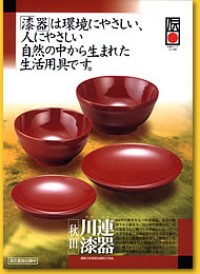
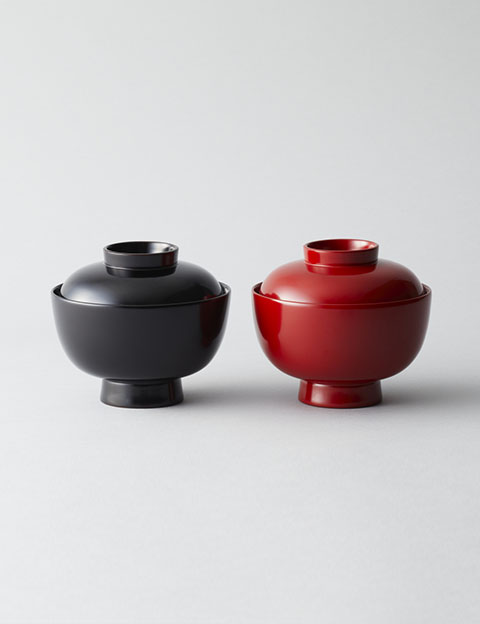
KAWATSURA Shikki (Lacquerware)

Akita Prefecture

It is said that the origin of this craft dates back to the Kamakura period, when the younger brother of the local lord who ruled the region ordered his retainers to use beech wood and lacquer cut from the local mountains to apply lacquer to weapons as a side job.
Serious bowl making began in the mid-Edo period, and in the later period, it developed mainly in the three areas of present-day Kawatsura, Odate, and Mitsunashi, flourishing as a production center for everyday goods.

  • Technology/techniques/raw materials

    Technology/techniques

    1. The woodworking process shall be carried out in one of the following ways:
    (1) For turned products, the shape shall be formed using a lathe and a lathe plane. In this case, boiling and smoking shall be performed.
    (2) In the case of "square objects", "turning and bending", "fastening", or "mortise and tenon joints" shall be used.
    (3) In the case of bent products, the bending process shall be carried out using a roller.


    2. The base coat shall be applied by one of the following methods:
    (1) In the case of "Makijichi," after applying "Kakeji" using raw lacquer and charcoal powder, apply "Jinuri" using raw lacquer.
    (2) In the case of a "persimmon tannin base coat," the process shall include "charcoal application," "persimmon polishing," and "priming" using raw lacquer.
    (3) In the case of a "lacquer base coat", the following steps shall be taken: "cloth application" using "adhesive lacquer", "cloth texture rubbing" using "rust", "ground powder application", "cut powder application", "rust application", and "ground coating" using raw lacquer.


    3. The coating shall be applied in one of the following ways:
    (1) In the case of "flower painting," a base coat, intermediate coat, and top coat using refined lacquer shall be applied. In this case, a lacquer brush shall be used for painting.
    (2) In the case of "roiro lacquering," the undercoat and intermediate coat shall be made using "plain black lacquer," followed by the topcoat using "roiro lacquer," and then the roiro finish shall be applied.


    4. When decoration is to be applied, it shall be done using the "Chinkin Gunna" (a type of decorative carving tool) or maki-e (lacquerware decoration).
     

    raw materials

    1. The lacquer used must be natural lacquer.

    2. The wood used shall be magnolia, horse chestnut, zelkova, or beech, or timber of equivalent quality.

  • Work scene

    KAWATSURA Shikki (Lacquerware), known for its durability, is made through the following three main processes.
    The process involves carving the wood from the raw timber, preparing the base coat for durability, and applying lacquer. If decorations such as maki-e or chinkin are to be added, a decorative process is added after these steps.
    KAWATSURA Shikki (Lacquerware) takes a year to produce, from raw wood to finished product. Here, we will explain the process for making round items such as bowls and basins.

    Process 1: Log

    For round items, horse chestnut and beech are mainly used, while for square items such as trays and tiered boxes, magnolia is used. Since the raw materials come from large trees over 200 years old, maintaining the mountains is crucial to ensure that these raw materials do not become extinct.

    Process 2: Tree cutting

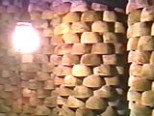
    After slicing the log crosswise, cut it into blocks of roughly the size you want to create.

    Step 3: Coarse grinding

    The selected wood pieces are then carved into the shape of a vessel.
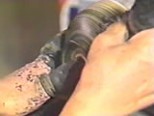
    A piece of wood is attached to a lathe, and the outside is roughly turned while the inside is hollowed out. (Woodwork made by hollowing out wood on a lathe is called turned wood.) After hollowing it out, it is soaked in water to remove the camphor wood.

    工程4: 乾燥

    The wood is left in a smoke-filled environment for one month to allow it to smoke-dry. This process reduces warping of the wood.
    Dry the wood until its moisture content stabilizes at around 10%.

    Step 5: Finishing milling

    After the dimensions have stabilized due to drying, the finishing turn is performed. The piece is then mounted on the lathe again, and the surface is planed to create a beautiful finish.
    The base of the bowl is also carved out (this is called "sloping down"), and the bowl's shape is completed.
    This completes the wood preparation process.

    画像をクリックすると動画が再生されます

    Step 6: Applying charcoal and shaping persimmons

    Now we move on to the priming process, which creates a sturdy base. First, we apply a mixture of persimmon tannin and magnolia charcoal powder using a straw brush, and then sand it down once it's dry.

    Step 7: Primer

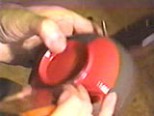
    Once the persimmon tannin has dried, apply raw lacquer by rubbing it in using a brush made from horsehair.
    By repeating the persimmon polishing and priming process five or six times, moisture penetration into the wood is suppressed, creating a robust base for lacquerware that will not warp.
    This completes the base preparation process.

    画像をクリックすると動画が再生されます

    Step 8: Base coat, undercoat, top coat, and decorative painting.

    In the lacquering process, once the base coat dries, it is sanded down, and then the lacquer is applied and sanded repeatedly, creating a base coat, intermediate coat, and top coat. With each coat applied, a lacquer color similar to the top coat is used. Sanding is performed between each step, but the final finish, also known as "hana-nuri" or "nuritate," is an advanced technique where the lacquer is dried without sanding after application to produce a smooth surface.
    Further decorations such as chinkin (gold inlay) and makie (lacquerware with gold or silver powder) can be added to create an even more luxurious appearance.


  • Close-up

    Traditional KAWATSURA Shikki (Lacquerware) nurtured in rural life.

    Amidst the increasing popularity of ornate lacquerware, KAWATSURA Shikki (Lacquerware), characterized by its practicality and simplicity, continues to be used by local people in the rural mountain villages of Akita Prefecture. The techniques cultivated over 800 years of tradition, while emphasizing simplicity, bring warmth and tranquility to meals.


    Durability that can be used for generations, even for grandchildren.

    KAWATSURA Shikki (Lacquerware), which is made by directly applying "persimmon tannin" and "raw lacquer" to the wood to prevent distortion of the main body, is so durable that it is said that once you buy it, you can "use it for generations to come."
    KAWATSURA Shikki (Lacquerware) is made from locally sourced wood and lacquer, and has primarily been used by people living in the local farming and mountain villages. As a result, it is not flashy in its decoration and is made with the intention of being truly usable.
    KAWATSURA Shikki (Lacquerware) is said to have originated in the Kamakura period when Michinori, the younger brother of Shigemichi Onodera, the lord of Inaniwa Castle, built a residence in Koshio Nojiri, which is now the center of lacquerware production, and had his retainers apply lacquer to sword scabbards, bows, armor, and other items. It is a traditional technique that originated in a mountain village and flourished as a full-fledged lacquerware production area during the Edo period.

    In a dust-free workshop

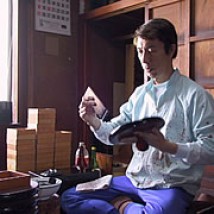
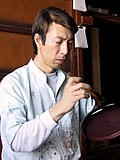
    When I visited the workshop to hear his story, I was told to "close the door immediately" as soon as I entered the room. Dust is the enemy of lacquerware work. The person who spoke to me this time was lacquerware craftsman Kenkichi Asano. In the world of craftsmen, where many are older, he is still a young lacquerware craftsman at 44 years old. Even though he is young, he has been lacquering since he was 15 years old, so his career already spans 30 years.
    "You'll understand the quality of lacquerware once you use it," he says, describing the difference in texture. "Recently, more and more production areas are applying lacquer to a plastic base. You'll immediately notice the difference in the base when you actually use it." The feel when you hold it in your hand or bring it to your lips is completely different from plastic. If you put hot soup in a plastic cup, the surface will quickly become hot and you won't be able to hold it, but that never happens with lacquerware that uses wood as a base. The biggest difference, however, is the warmth it feels when you bring it to your lips.

    KAWATSURA Shikki (Lacquerware) is created in a tranquil space.

    The difference in teaching methods added depth to the technique.

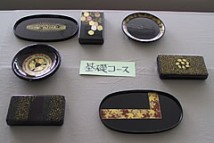
    KAWATSURA Shikki (Lacquerware) is arguably one of the most successful traditional craft producing regions in terms of training successors. Currently, they offer training courses to acquire skills, divided into stages such as basic and advanced courses, to pass on the craftsman's techniques to the next generation. When Mr. Asano first started working in lacquering, there were no courses like the ones that exist today, but he had the opportunity to learn techniques from many craftsmen. "Each senior had a different way of doing things. If I used the method I was taught, another senior would get angry at me. But thanks to that, I was able to learn a method that suited me by learning from various people." He smiled wryly as he demonstrated his lacquering technique, saying that the same thing is probably happening in the current training program as well.

    The focused brushwork continues.

    He swiftly picks up a vessel and slides a lacquer brush, with lacquer on the tip, across it. After applying the lacquer, he carefully checks for any dust, then places a wooden base between each vessel, ensuring they don't touch each other as he stacks them. Because this is a dust-averse task, the air in the closed room remains still. If you don't open your mouth, there's no sound disturbing the air either. A sense of focused concentration fills the silent space.
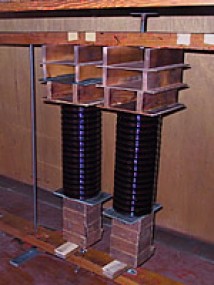
    Suddenly, a loud grinding noise broke the silence. "You have to turn the painted vessels upside down from time to time." Inside the door was a machine that rotated periodically to prevent the lacquer from dripping.
    This is the density that creates the lacquerware.

    It rotates periodically, switching between top and bottom.

    Re-evaluating the value of lacquerware from a new perspective

    Recently, there has been a growing movement in the prefecture to use KAWATSURA Shikki (Lacquerware) for school lunch tableware. This is because plastic tableware is suspected of leaching environmental hormones that affect reproductive function. Furthermore, aluminum, which is often used as an alternative, is also suspected to be a contributing factor to Alzheimer's disease.
    In that respect, lacquerware, whose safety has been confirmed over time, offers peace of mind. When actually used, although it requires a little more effort to handle, it is very popular with children. "KAWATSURA Shikki (Lacquerware) is inherently sturdy, but we have developed even more robust manufacturing methods so that it will not break even if handled a little roughly," said Kohei Sato, chairman of the Akita Prefecture Lacquerware Industry Cooperative Association. "We also suggest that parents buy a set when their child enters school and continue using the same tableware until graduation," he added, suggesting that it is also ideal for teaching children to take care of their belongings.
    Experiencing the custom of using lacquerware tableware at school might help students learn about the importance of recognizing and cherishing truly valuable things that have been forgotten in recent decades.
    I hope the future is bright for the children who use lacquerware.

    The quality is so good you wouldn't think it was made by a student in training.

    Craftsman Profile

    Kenkichi Asano

    KAWATSURA Shikki (Lacquerware) craftsman who has dedicated his life to lacquering since graduating from junior high school. "After doing this for decades, I've gained a sense of ease. I can now handle requests for repairs as well."

    Anecdotes

    Seeking safety, we embrace the past while embracing the new: KAWATSURA Shikki (Lacquerware) for the health and safety of children!

    It's been five years since the reproductive abnormalities in the human body and the natural environment caused by endocrine disruptors, or more accurately, "exogenous endocrine-disrupting chemicals," became widely known. When they stop being talked about, it's easy to get the illusion that the danger has disappeared, but the dangerous chemicals around us haven't decreased. Fetuses and children who are still growing are the ones who suffer the most from endocrine disruptors.
    Twenty years have passed since KAWATSURA Shikki (Lacquerware) was first donated as school lunch tableware, with the hope that children would use comfortable tableware. Now, the merits of lacquerware are being re-evaluated from a different perspective. Lacquerware, which emits no harmful substances whatsoever, has been adopted as school lunch tableware in the local Inagawa town.
    The idea of sending lacquerware as school lunch tableware is something unique to KAWATSURA Shikki (Lacquerware), which has always prioritized usability. Crafts like this tend to be prohibitively expensive for the average person. However, KAWATSURA Shikki (Lacquerware), whose techniques were originally developed with the assumption that it would be used by local farmers and mountain villagers in their daily lives, has now established new manufacturing techniques that can withstand the rough handling of school lunches.
    When I learned about the techniques of KAWATSURA Shikki (Lacquerware), which have been passed down for 800 years, I discovered a new appreciation for safe, pleasant-to-use products and a renewed sense of cherishing things.


overview

Craft item name KAWATSURA Shikki (Lacquerware)
Reading Kawatsurashikki
Classification of crafts lacquerware
Main Products Bowls, dishes, plates, trays, tiered boxes
Main manufacturing area Yuzawa City
Designated date December 15, 1976

contact address

■ Production area association

Akita Prefecture Lacquerware Industry Cooperative Association
〒012-0105
142-1 Nakano, Odachi, Kawatsura-machi, Yuzawa City, Akita Prefecture
TEL: 0183-42-2410
FAX: 0183-42-2633

https://www.kawatsura.or.jp/

Features

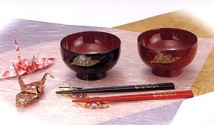
All products are made of wood and finished with lacquer. While they don't have any immediately striking features, the emphasis on the base coat and the resulting hard finish make them extremely durable, and yet the prices are kept low. We offer a wide variety of products, from small accessories to furniture.

How to make it

Round items such as bowls and platters are made from horse chestnut or beech wood, while square items such as tiered boxes are made from magnolia wood. Persimmon tannin and raw lacquer are applied directly to the pieces several times, followed by an undercoat, and then finished using a highly skilled technique called hananuri (flower painting), before being dried. Decoration is added using maki-e (gold lacquer) and chinkin (gold inlay) techniques.

Please see here for information on traditional craftspeople.

Japanese traditional craftsman
top