ODAWARA Shikki (Lacquerware)

Kanagawa Prefecture

It is said that the practice began in the mid-Muromachi period when turned wooden vessels made from the abundant timber of the Hakone mountain range were coated with lacquer.
Later, the Hojo clan, who ruled the region, invited lacquerware artisans to the castle town to develop ODAWARA Shikki (Lacquerware), and the technique of colored lacquer painting (iro-urushi-nuri) was introduced. During the Edo period, lacquer was applied not only to everyday items such as trays and bowls, but also to weapons and armor, and it is believed that the technique of making lacquerware as a practical product was established.

  • Technology/techniques/raw materials

    Technology/techniques

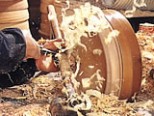
    1. The woodworking process involves shaping the wood using a lathe and a lathe plane.


    2. The lacquer coating shall be applied in one of the following ways:
    (1) In the case of "rubbed lacquer finish," the wood is polished with water, and refined raw lacquer is repeatedly rubbed directly onto the wood surface. Then, the surface is rubbed, and a mixture of refined raw lacquer and refined glossy lacquer is used for the "finishing rub" and "polishing rub."
    (2) In the case of Kijiro lacquerware, the following techniques or methods shall be used:
    (i) For the base preparation, the wood is hardened using refined raw lacquer, then a mixture of refined raw lacquer and polishing powder is used to create a "rust-like finish," followed by wet sanding.
    The intermediate coat is applied by first applying refined transparent lacquer, and then sanding it with water.
    H. The top coat shall be applied in one of the following ways:
    1) For a lacquered finish, apply refined, transparent gloss lacquer.
    2) For a roiro finish, refined transparent roiro lacquer or refined nashiji lacquer is applied, followed by "roiro polishing" and body rubbing, then a rubbed lacquer using refined raw lacquer is applied, and the process of "roiro polishing" is repeated.

    (3) In the case of colored lacquer painting, the following techniques or methods shall be used:
    (i) For the base preparation, the wood is hardened using refined raw lacquer, then rust is applied using a mixture of refined raw lacquer and polishing powder, and finally, it is wet-sanded.
    The intermediate coat is applied by first applying refined black lacquer, and then sanding it with water.
    (h) The top coat shall be vermilion lacquer or refined black lacquer.
    2. When applying a roiro finish, after performing "top coat sanding" and body rubbing, apply rubbed lacquer using refined raw lacquer and repeat the "roiro polishing" process.
     

    raw materials

    1 漆は、天然漆とすること。

    2. The wood used shall be zelkova, sen, mulberry, or horse chestnut, or timber of equivalent quality.

  • Work scene

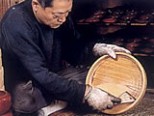
    In the case of ODAWARA Shikki (Lacquerware), it's fair to say that the woodturning process comes first. Using superior lathe techniques, the wood grain is beautifully brought out during the turning process. That's why, when the transparent, lustrous lacquer is applied, the wood grain stands out even more.

    Step 1: Wood preparation

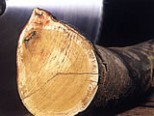
    1. The logs are sorted by type and selected according to their intended use and dimensions. Once the dimensions are determined, the logs are cut using a circular saw or similar tool (log lumbering).

    2. Check the surface condition of the material, and using the marked end grain for the product as a reference, cut the wood using a circular saw or band saw (cutting). Then, use a compass to trace the shape and cut it off.

    3. Secure the material firmly with the retaining claws and use a roughing plane to create the approximate shape (roughing).

    4. The basic principle of drying wood is to provide it with the right temperature and humidity. Sawdust is burned to create smoke, which dries out the moisture in the wood. Next, the end grain is treated to prevent cracking, the carved pieces are stacked, and dried in a smoke-drying chamber. After that, they are removed and allowed to air dry.

    5. Using a medium-sawn plane, shave the wood down to just before the final size, then smooth the surface with a finishing plane. Next, apply water to the wood surface and carefully polish it using horsetail (Equisetum hyemale).

    Process 2: Lacquer processing

    Suri lacquer coating
    1. Apply raw lacquer (kiurushi = sap collected directly from the lacquer tree) to the wood using a spatula or a brush and rub it in thoroughly. Wipe off any excess lacquer with a cotton cloth and dry in a drying bath for 1-2 days. Apply raw lacquer again and let it dry.

    2. To smooth the wood grain and improve the adhesion of the lacquer during the subsequent polishing process, the wood is wet-sanded on a polishing lathe.

    3. Apply raw lacquer to the entire surface and immediately wipe it off carefully with a cotton cloth. Repeat this 7 or 8 times. There is a knack to getting the timing right between rubbing and wiping. If you do it too early, the color will be dull, and if you do it too late, it will be difficult to wipe off.

    4. Apply oil-based polishing powder to a cotton cloth dampened with water and rub it evenly against the surface to polish and smooth the lacquer film. Then, rub only the polishing powder into the surface.

    5. To give it a glossy finish, a very small amount of raw lacquer mixed with vermilion lacquer (a type of glossy lacquer) is applied thinly and wiped off (finishing rub). It is then placed in a drying bath and dried for 2-3 days to complete the process.

    Kijiro lacquer finish
    1. Rub raw lacquer into the unfinished wood and polish it well. To seal the grain and make it stand out, rub lacquer rust all over the wood (rust application). Repeat this process about twice and leave it for 2-3 days.

    2. To highlight the wood grain, the wood is rusted and polished with a whetstone and sandpaper. Rust is applied to areas where the lacquer rust has not been sufficiently rubbed in, and the repaired rust is polished. Raw lacquer is applied to harden the rust, and the piece is placed in a drying bath.

    3. To create a thin lacquered surface, apply Kijiro lacquer (raw lacquer with the moisture removed) that has been strained through Yoshino paper (undercoat). Place in a drying bath and let it dry for 1-2 days.

    4. To improve the adhesion of the undercoat, the undercoat is sanded with charcoal or sandpaper. Next, to increase transparency, the Kijiro lacquer is applied smoothly to ensure a uniform film thickness (undercoat), and then dried in a drying room for 1-2 days. The undercoated piece is then sanded with charcoal.

    5. Apply the Kijiro lacquer evenly and to a uniform thickness, being careful not to leave brush marks or allow any debris to adhere (top coat). Allow to dry in a drying room for 2-3 days.

    6. Sand with water using sandpaper, then polish with a finer abrasive. Next, polish with oil powder and rub in the raw lacquer thoroughly. After this, rub in the raw lacquer twice more, but before the third time it dries completely, polish it with horn powder for a finishing touch. This completes the Kijiro lacquer finish.


  • Close-up

    ODAWARA Shikki (Lacquerware) simple aesthetic that subtly reveals sophisticated craftsmanship.

    ODAWARA Shikki (Lacquerware) was born, taking advantage of the bounty of the rich forests that spread out behind the city. Behind this lies the woodturning technique passed down since the Muromachi period. By utilizing these ancient techniques, Odawara has become a major production center for everyday lacquerware.


    Thanks to the history of woodturning

    On a hill overlooking the Sagami Sea, a graceful castle tower stands tall. This is Odawara, the gateway to Hakone. Against the backdrop of the lush forests that spread throughout the area, woodturning techniques were born, and later, by actively adopting lacquerware techniques, it became a major production center for lacquerware. This marked the birth of what is known as ODAWARA Shikki (Lacquerware).
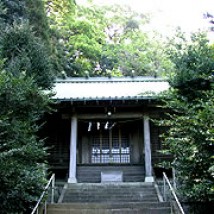
    Its origins can be traced back to the mid-Muromachi period (or possibly the Heian period) when woodturning using a lathe was practiced in the mountains of Hakone. Kii Shrine, located in Hayakawa within the city, is a shrine deeply connected to woodturning. It enshrines Prince Korekata, who is considered the ancestor of woodturners, and the place name Kijibiki still remains in the surrounding area.
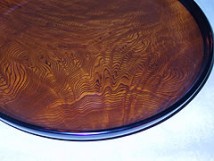
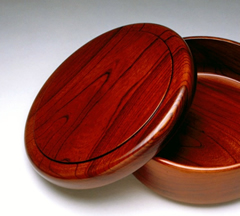
    ODAWARA Shikki (Lacquerware) is primarily made from zelkova wood, and its most distinctive feature is the full utilization of the natural wood grain. The transparent lacquer finish comes alive only thanks to the excellent woodturning techniques. In present-day Odawara, a complete division of labor is in place for woodworking and lacquering, and a mass production system is in place. As a result, tableware such as bowls, plates, trays, dishes, rice bowls, confectionery containers, and tea caddies, suited to people's lifestyles, continues to be produced.

    • Kii Shrine is located in Hayakawa, Odawara City. Locals affectionately call it "Kinomiya-san." A wooden bowl made during the Muromachi period is preserved as a shrine treasure.

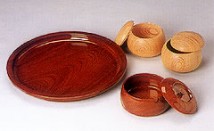
    • These are works by Mr. Okawa. The beauty of the wood grain in each one is outstanding.

    Everyday use and approachable ODAWARA Shikki (Lacquerware)

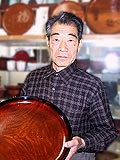
    Kiyoshi Okawa, a woodturner, entered this world at the age of 18, influenced by his older brother.
    "When I started, there were no machines. We did the rough sawing by hand. It was really hard work. Back then, we also did mountain work like felling trees." For Mr. Okawa, who handled everything from sawing raw timber, the joy of finding a tree with a good grain is priceless. This is because wood with a complex grain is more highly valued as timber.
    "You could tell the quality of the wood just by looking at the bark of the raw timber, even when it was standing upright." In the 1950s and 60s, when manufacturing flourished, the town of Odawara was bustling with the production and export of woodworking products. "Salad bowls were especially popular; we couldn't keep up with the demand no matter how much we made." Just 30 or 40 years ago, the sound of lathes turning echoed everywhere in Odawara. At its peak, there were said to be over 300 woodturners and over 100 lacquerers. Now, those numbers have decreased to 30 and 5 respectively. The focus now is on training successors.
    The greatest appeal of ODAWARA Shikki (Lacquerware) is undoubtedly its affordable price compared to other lacquerware, making it suitable for everyday use. Its unpretentious charm belies the subtle hints of sophisticated turning and painting techniques. Each time you gaze upon its beautiful wood grain patterns, the picturesque forests surrounding the castle town of Odawara will come to mind, adding a new touch of elegance to your dining table.

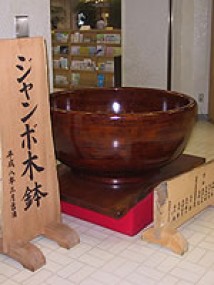
    • A giant wooden bowl on display at the city hall. It's about the size of a bathtub.

    • Mr. Okawa's prized tray artwork. A rare piece with an intricately intricate design.

    Craftsman Profile

    Kiyoshi Okawa

    Born in 1930. "We all made a giant machine together in the union. It's on display at Odawara City Hall, so please come and see it."

    Kiyoshi Okawa, a woodturner. He currently serves as the chairman of the Traditional ODAWARA Shikki (Lacquerware) Cooperative Association.

    Anecdotes

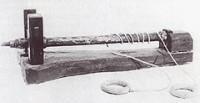
    The oldest known example of woodturning in Japan is a pedestaled cup from the Yayoi period.


    • Wooden bowls passed down at Kii Shrine in Hayakawa

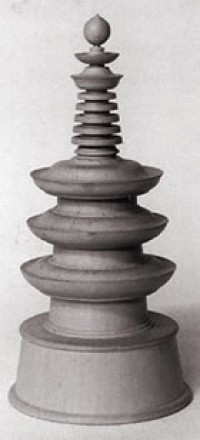
    • A million pagodas made using a potter's wheel


overview

Craft item name ODAWARA Shikki (Lacquerware)
Reading Odawara Shikki
Classification of crafts lacquerware
Main Products Tray, plate, bowl, tea coaster
Main manufacturing area Odawara City
Designated date May 31, 1984

contact address

■ Production area association

Traditional ODAWARA Shikki (Lacquerware) Association
250-0055
621 Kuno, Odawara City, Kanagawa Prefecture
Kanagawa Prefectural Government, Bureau of Industry and Labor, Small and Medium Enterprise Department, Small and Medium Enterprise Support Division
Odawara Liaison Office (Crafts Technology Workshop), 4th Floor
Within the Hakone Products Association (General Incorporated Association)
TEL: 0465-32-5252
FAX: 0465-32-5253

Features

Its distinguishing features are its superior woodturning techniques and the way it fully utilizes the natural beauty of the wood grain. These include the "suri-urushi" (rubbed lacquer) and "kijiro-nuri" (wood grain lacquer) techniques, which fully bring out the beauty of the wood grain without compromising it.

How to make it

The woodworking process involves shaping the wood using a lathe and a lathe plane. Once the shape is complete, it is polished using materials such as horsetail. "Rubbing lacquer" involves rubbing raw lacquer directly into the wood and repeating a process called "body rubbing" many times to finish the piece. "Kijiro lacquer" is finished with a transparent lacquer, while "colored lacquer" involves applying black lacquer as an undercoat between the base coat and the topcoat, and then applying either vermilion or black lacquer as the topcoat.

Please see here for information on traditional craftspeople.

Japanese traditional craftsman
top