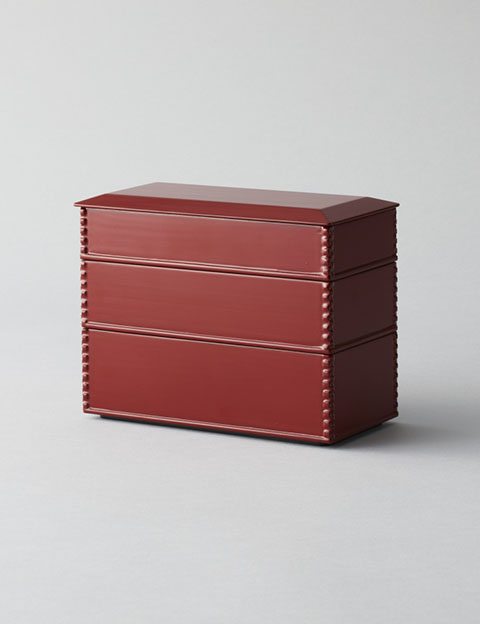
KISO Shikki (Lacquerware)

Nagano Prefecture

Its origins date back to the early 17th century. The region was originally known for its thriving woodworking industry using the abundant cypress wood of Kiso, and it flourished under the generous patronage of the Owari Tokugawa clan during the Edo period.
Kiso lacquerware was a popular souvenir for travelers passing through the Nakasendo road.
In the early Meiji period, a type of clay called "sabi-tsuchi," essential for preparing the base of lacquerware, was discovered locally, leading to the production of more durable lacquerware compared to other regions.

  • Technology/techniques/raw materials

    Technology/techniques

    1. In the case of Kiso Shunkei, the following techniques or methods shall be used:
    (1) For lacquering, without using a base coat, refined raw lacquer is repeatedly rubbed directly onto the wood, and then refined transparent lacquer is applied.
    (2) Woodworking involves splitting a log using a "mandarin orange splitting" method, then splitting it using a "hegi-hocho" (a type of knife), and shaping it into planks or bent wood.

    2. In the case of Kiso-style lacquerware (Kiso-tsuishu), the following techniques or methods shall be used:
    (1) The base coat is made by repeatedly applying a mixture of raw lacquer and rust-colored clay, etc., to create a "hard base coat."
    (2) For the top coat, refined roiro lacquer is applied using a pad, then various types of refined colored lacquer are applied in layers, and finally the surface is polished using a whetstone, charcoal, etc.
    (3) The finishing touches shall be done by "roiro lacquering".

    3. When applying different colors to a surface, the following techniques or methods shall be used:
    (1) The base coat is made by repeatedly applying a mixture of raw lacquer and rust-colored clay to create a "hard base coat."
    (2) The top coat is applied using various types of refined colored lacquer in a "color-blocking" manner.
    (3) The finishing touches shall be done by "roiro lacquering".
     

    raw materials

    1 漆は、天然漆とすること。

    2. The wood used shall be cypress, katsura, or horse chestnut, or timber of equivalent quality.

  • Work scene

    Step 1: Wood preparation

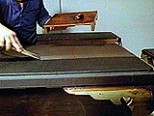
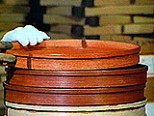
    We use naturally dried wood to create the desired shapes, such as writing boxes, trays, and low tables.

    Step 2: Preparing the base

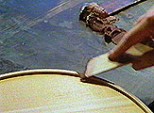
    We mix rice flour and raw lacquer to make "kokuso." We then apply it to eliminate any gaps or unevenness.

    Step 3: Primer application

    Raw lacquer and rust-colored clay are mixed together to create a thick, solid base coat of lacquer. The color is gray.

    Step 4: Intermediate Coat

    Apply raw lacquer. It's important to apply it carefully to avoid creating dust.

    Step 5: Mold placement

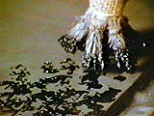
    Using a tampon, a technique called "kata-oki" is used to create a textured pattern with lacquer.

    Step 6: Applying colored lacquer

    Pigments are mixed with the raw lacquer, and the resulting colored lacquer is applied in layers, drying after each coat, until it reaches the same height as the molded lacquer. This process is repeated 12 to 18 times or more.

    画像をクリックすると動画が再生されます

    Step 7: Grinding

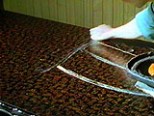
    After the colored lacquer has dried, if you sand it with wet sandpaper and a whetstone for a while, a beautiful pattern resembling the annual rings of a tree will appear.

    画像をクリックすると動画が再生されます

    Step 8: Body rubbing

    It is polished using a mixture of charcoal powder, oil, and polishing powder.

    Step 9: Applying lacquer

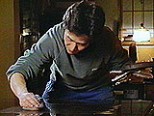
    Apply raw lacquer to cotton, rub it on, and wipe it off with Japanese paper.

    工程10: 磨き

    Apply polishing powder, sap powder, and oil, then polish evenly with cotton (making sure to do it the same way all over) to finish.


  • Close-up

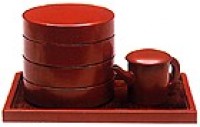
    KISO Shikki (Lacquerware) everything from everyday items to high-end furniture.

    KISO Shikki (Lacquerware) includes "Kiso Kawari-nuri (Kiso Tsuishu)," "Nurikake Roiro-nuri," and "Kiso Shunkei." We spoke to two craftsmen who are carrying on these traditional techniques.


    Lacquerware for the common people

    Tadao Ishimoto and Yasuyuki Ogimura are traditional craftsmen of KISO Shikki (Lacquerware). Both are fellow apprentices who trained under the same master. Ishimoto is the senior apprentice, and Ogimura is the junior apprentice. They have known each other for over 40 years. Both studied at the "Donguri-kai," an organization created to improve lacquer painting techniques, and at the Naragawa Village Industrial School. "Kiso originally produced a lot of practical lacquerware for ordinary people, such as 'menpa' (oval bento boxes made of cypress), but it's far from big cities, so it was difficult to sell. That's why we decided to put more effort into Kiso-style lacquerware to make the region stand out," Ishimoto recalls of the time.

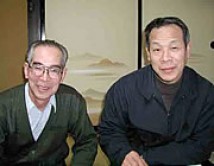
    Tadao Ishimoto (left) and Yasuyuki Ogimura. These two men, who are carrying on the tradition of KISO Shikki (Lacquerware) have known each other for 40 years.

    The sixth son of a lacquerware craftsman

    Mr. Ishimoto was born in 1932 in Hirasawa, Naragawa Village, as the sixth son of a lacquerware craftsman. "Considering the social trends of the time, it was unthinkable for the sixth son to take over his parents' business. But when I was in junior high school, I contracted tuberculosis, and that became the catalyst for me to start lacquering. I started helping with the family business because it was something I could do from home." He has continued to apply lacquer for over 50 years since then. Today, Mr. Ishimoto is one of the leading lacquerware artisans in Kiso and has even risen to the position of chairman of the Traditional Craftsmen's Association. If he hadn't contracted tuberculosis, Mr. Ishimoto might not be where he is today. When you think about it that way, life is a strange thing.

    Apparently, this kind of thing is becoming quite popular these days.

    No salary until age 20

    Ogimura was born in Nagoya in 1940. "I came here (Hirasawa, Naragawa Village) after the war. This was my father's hometown." When Ogimura was in junior high school, about a third of his 40 classmates went on to higher education, and the remaining two-thirds went into the world of lacquerware. "I was one of them, and I became an apprentice to Ishimoto's father. I lived there and shared a room with the other apprentices. They also held workshops on lacquering, which was very educational." It was a so-called apprenticeship system. He says he never received a proper salary until he was 20. "But that was normal back then. When I turned 20, I finally stopped living there and started commuting from elsewhere." This is how Ogimura steadily acquired his lacquering skills.

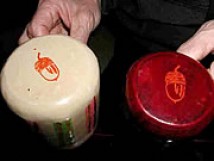
    An acorn mark is drawn on the back of Ishimoto's lacquerware.

    Lacquerware continues to be used

    "Kiso Kawari-nuri" and "Nurikake Roiro-nuri" are polished to a mirror-like shine after the lacquer is applied with a brush. On the other hand, "Kiso Shunkei" is finished as is after being applied with a brush. Because it is "naturally beautiful without polishing," it is also called "Hana-nuri" in the Kiso region. Each has its own characteristics, so it is good to use them according to your preference and the occasion. Mr. Ishimoto says, "When you use it, you can feel the warmth of the wood, and you feel peace and comfort. And it makes food taste better too." Mr. Ishimoto is confident in his lacquerware. "I think lacquerware will continue to be used for a long time to come." These are the words of Mr. Ishimoto, who is convinced that good things will continue to be used.

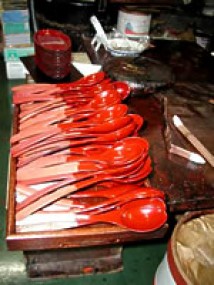
    The workshop was filled with spoons that were still being painted.

    It has the image of being expensive.

    Ogimura explains, "People think lacquerware is expensive, but it lasts a long time, so in the end it's not that expensive. And above all, it's good for your health." He then suggests that it's time to put an end to the disposable era and instead use good quality items for a long time. "To achieve that, the most important thing is to get people to use it. I want them to use it and give me lots of feedback." This positive attitude seems to symbolize the high quality of KISO Shikki (Lacquerware).

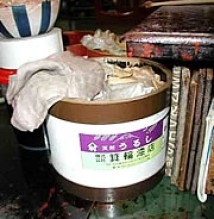
    The lacquer is stored in this barrel before it is applied.

    Anecdotes

    In search of better lacquerware: The discovery of rust-colored clay.

    KISO Shikki (Lacquerware) with its 600-year history, is characterized by its high-quality wood and durability, but the techniques that support this durability were established over a hundred years ago, around the beginning of the Meiji era. At that time, craftsmen traveled to Wajima to study in search of better lacquerware techniques. There, they learned that the durable lacquerware of Wajima was supported by a type of clay called "ji no ko" (ground powder). The craftsmen searched for similar clay in Kiso, and finally discovered clay containing a large amount of iron in Narai, Naragawa Village. This clay was named "sabi-tsuchi" (rust clay). By mixing this clay with lacquer and applying it as a base coat, they were able to create durable lacquerware that rivaled that of Wajima. It can be said that the dedication of the craftsmen of that time to lacquerware led to the discovery of sabi-tsuchi.

    • Locally produced "rust clay" is essential for making durable KISO Shikki (Lacquerware)


overview

Craft item name KISO Shikki (Lacquerware)
Reading kiso shikki
Classification of crafts lacquerware
Main Products Low tables, trays, serving trays, tiered boxes, soba noodle making equipment, flower vases, furniture
Main manufacturing area Matsumoto City, Shiojiri City, Kiso Town, Kiso District
Designated date February 17, 1975

contact address

■ Production area association

KISO Shikki (Lacquerware) Industry Cooperative Association
〒399-6302
2272-7 Kiso-Hirasawa, Shiojiri City, Nagano Prefecture
TEL: 0264-34-2113
FAX: 0264-34-2820

http://kiso.shikkikumiai.com/

Features

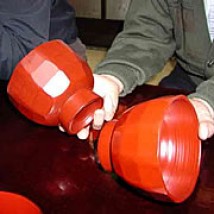
The distinctive features of this lacquerware include "Shunkei-nuri," which brings out the beauty of the wood grain; "Tsuishu," which creates a mottled pattern with multiple layers of lacquer; and "Nuriwake Roiro-nuri," which creates geometric patterns with colored lacquer.

How to make it

"Shunkei lacquerware" uses a method of rubbing lacquer into the wood to express the natural characteristics of cypress wood. "Tsuishu lacquerware" creates a hard base using locally sourced rust-colored clay, applies multiple layers of colored lacquer on top, and then polishes it to create a striped pattern. "Nurikake roiro lacquerware" applies different colored lacquers according to the pattern, and then polishes the surface to finish.

Please see here for information on traditional craftspeople.

Japanese traditional craftsman
top