Technology/techniques
1. The woodworking process shall be carried out in one of the following ways:
(1) For boards, use "edge clamps".
(2) In the case of bent products, the bending shall be done by rolling or turning.
(3) In the case of carved objects, rough carving shall be performed first, followed by finish carving.
(4) In the case of turned objects, the shaping shall be done using a lathe and a lathe plane.
(5) In the case of dry lacquer, refined lacquer is applied to the original form, followed by "rusting," "ground application," and cloth covering, and then "demolition."
2. The undercoat, intermediate coat, and top coat shall be applied in one of the following ways:
(1) When applying the plaster, the following techniques or methods shall be used:
(i) The base should be constructed using a "genuine, solid foundation" method.
The intermediate coat involves applying black lacquer and then sanding it with water.
H. For the top coat, after applying a "rubbed lacquer" with raw lacquer, refined lacquer is applied.
(2) In the case of multi-colored plastering, the following techniques or methods shall be used:
(i) The base should be constructed using a "genuine, solid foundation" method.
The intermediate coat involves repeatedly applying black intermediate lacquer and then sanding it with water.
The top coat is applied by first applying roiro lacquer, then sanding and rubbing it, and finally applying raw lacquer as a "rubbing lacquer" and repeatedly sanding it again.
(3) In the case of brushwork, the following techniques or methods shall be used:
(i) The base should be constructed using a "genuine, solid foundation" method.
The intermediate coat involves applying black lacquer and then sanding it with water.
H. For the top coat, raw lacquer is "rubbed lacquer," and then shibori lacquer is applied using a brush.
(4) In the case of lacquering, one of the following shall apply:
(i) For plastered finishes, the following techniques or methods shall be used:
1) The base should be constructed using the "genuine solid foundation" method.
2) For the undercoat, apply black undercoat lacquer and then sand it with water.
3) For the top coat, apply a multi-colored lacquer, sand it with water, and then apply a red lacquer.
(b) For plaid finishes, the following techniques or methods shall be used:
1) The base should be constructed using the "genuine solid foundation" method.
2) For the undercoat, apply black undercoat lacquer and then sand it with water.
3) For the top coat, apply the roiro colored lacquer, wet sand it, apply the vermilion roiro lacquer, sand it in roiro, and rub the surface, then repeatedly rub raw lacquer and polish it in roiro.
(5) In the case of pear-skin lacquerware, the following techniques or methods shall be used:
(i) The base should be constructed using a "genuine, solid foundation" method.
The intermediate coat involves applying black lacquer and then sanding it with water.
The top coat is applied by first applying black lacquer or red iron oxide lacquer, then sprinkling pear-skin powder, applying powder stopper, dry sanding, applying pear-skin roiro lacquer, roiro sanding, and rubbing the surface, and then repeatedly applying raw lacquer and roiro polishing.
(6) In the case of absorption coating, one of the following shall be used:
(i) For plastered finishes, the following techniques or methods shall be used:
1) The base should be constructed using the "genuine solid foundation" method.
2) For the undercoat, apply black undercoat lacquer and then sand it with water.
3) For the top coat, raw lacquer is "rubbed," refined lacquer is applied, "baked lacquer" is used to "pat" it, and then it is wiped off.
(b) For plaid finishes, the following techniques or methods shall be used:
1) The base should be constructed using the "genuine solid foundation" method.
2) For the undercoat, the process involves repeatedly applying black undercoat lacquer and then sanding it with water.
3) For the top coat, after applying the roiro lacquer, sanding it with roiro lacquer, rubbing the surface, "tatting" with "yakishiru" and wiping it off, raw lacquer is "rubbed lacquer" and then polished with roiro lacquer, and this process is repeated.
(7) In the case of Negoro lacquerware, the following techniques or methods shall be used:
(i) The base should be constructed using a "genuine, solid foundation" method.
The intermediate coat involves applying black lacquer and then sanding it with water.
The top coat is applied by applying black roiro lacquer, rough sanding, applying vermilion roiro lacquer, wet sanding, applying raw lacquer ("suri-urushi") and rubbing the surface, and then repeatedly applying raw lacquer ("suri-urushi") and polishing to a roiro finish.
(8) In the case of Akebono lacquering, the following techniques or methods shall be used:
(i) The base should be constructed using a "genuine, solid foundation" method.
The intermediate coat involves applying black lacquer and then sanding it with water.
The top coat is applied by applying red roiro lacquer, rough sanding, applying black roiro lacquer, wet sanding, "rubbing lacquer" using raw lacquer, and then rubbing the surface, and repeating the process of "rubbing lacquer" with raw lacquer and polishing to a roiro finish.
(9) In the case of Ikkan-nuri, the following techniques or methods shall be used:
(i) The base coat is prepared by hardening the wood with raw lacquer, then applying Japanese paper, and finally applying refined lacquer.
The intermediate coat involves applying black lacquer and then sanding it with water.
H. For the top coat, raw lacquer is "rubbed lacquer," and then refined lacquer is applied.
(10) In the case of plastering, the following techniques or methods shall be used:
(i) For the base coat, apply a mixture of persimmon tannin and polishing powder, polish it, and then apply refined lacquer.
The intermediate coat involves applying black lacquer and then sanding it with water.
H. For the top coat, raw lacquer is "rubbed lacquer," and then refined lacquer is applied.
(11) In the case of a cloth-textured coating, one of the following shall be used:
(i) For plastered finishes, the following techniques or methods shall be used:
1) The base coat is prepared by hardening the wood with raw lacquer, then covering it with cloth and applying a "rust-patterned finish," followed by "rust-polishing."
2) For the undercoat, apply black undercoat lacquer and then sand it with water.
3) For the top coat, raw lacquer is "rubbed lacquer," and then refined lacquer is applied.
(b) For plaid finishes, the following techniques or methods shall be used:
1) The base coat is prepared by hardening the wood with raw lacquer, then covering it with cloth and applying a "rust-patterned finish," followed by "rust-polishing."
2) For the undercoat, the process involves repeatedly applying black undercoat lacquer and then sanding it with water.
3) For the top coat, after applying raw lacquer ("suri-urushi"), applying roiro lacquer, roiro sanding, and body rubbing, the process of applying raw lacquer ("suri-urushi") and roiro polishing is repeated.
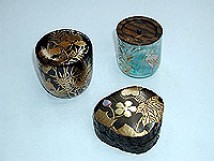
3. When applying maki-e (gold lacquer) decoration, the following techniques or methods shall be used:
(1) In the case of flat maki-e, the pattern is drawn using "okime" and painted lacquer, followed by "powder sprinkling" and "powder hardening," and then "powder polishing."
(2) In the case of raised lacquerware, the process involves "setting the edges," "raising the lacquer with charcoal powder," "polishing the charcoal powder," and "raising the lacquer" using raised lacquerware, followed by "raising the lacquer," "underpainting the top," "rubbing the body," "rubbing the lacquer" using raw lacquer, and drawing patterns using painted lacquer, after which "sprinkling the powder," "hardening the powder," "polishing the powder," and "polishing the powder."
(3) In the case of polished maki-e, patterns are drawn using "okime" and "rose lacquer," followed by "powder sprinkling," "powder hardening," and application of various lacquers, then rough polishing, "rubbing lacquer" using raw lacquer, roiro fine polishing, body rubbing, "glossy rubbing lacquer" using raw lacquer, and final polishing to a glossy finish.
(4) In the case of raised maki-e, the technique or method shall be one that applies raised maki-e with "sabi-takaage" and "takahadaage" and polished maki-e.