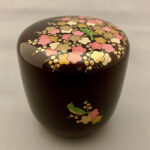
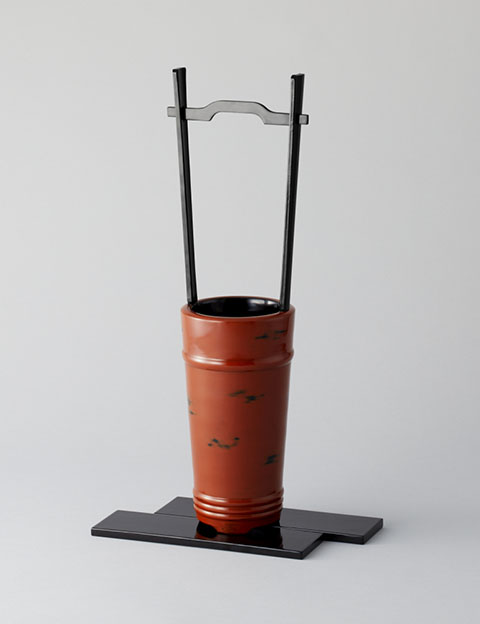
KISHU Shikki (Lacquerware)

Wakayama Prefecture

From the Muromachi period to the Sengoku period, a group of woodworkers from the area around present-day Shiga Prefecture settled in this region and began manufacturing wooden bowls using the abundant Kishu cypress wood.
This led to the production of Shibuji bowls, which are bowls with a tannin-based undercoat applied to the wooden base. During the Edo period, lacquerware production flourished even more, and Kishu became known throughout Japan as a major production center for Shibuji bowls. KISHU Shikki (Lacquerware) was initially called "Kuroe-nuri," but after its production volume increased, it spread as KISHU Shikki (Lacquerware), and it remains so to this day.

  • Technology/techniques/raw materials

    Technology/techniques

    1. The woodworking process shall be carried out in one of the following ways:
    (1) In the case of bent metal products, the process shall be either "hot water bending" or "turning bending".
    (2) In the case of joinery, fastening is required.
    (3) In the case of turned objects, the shaping shall be done using a lathe and a lathe plane.

    2. The base preparation shall be carried out by one of the following methods:
    (1) In the case of a tannin base coat, apply a cloth, then apply a mixture of raw lacquer and charcoal powder, and then polish with charcoal.
    (2) For a lacquer base coat, apply a cloth, then apply a mixture of raw lacquer and ground powder, and then sand the surface.

    3. The top coat should be applied using refined lacquer in a "flower pattern" or "roiro pattern."

    4. When decoration is to be applied, it shall be done using maki-e, chinkin, aogai-zaiku, or iryū-e.
     

    raw materials

    1 漆は、天然漆とすること。

    2. The wood used shall be cypress, horse chestnut, camphor, zelkova, sen, or timber of equivalent quality.

  • Work scene

    Process 1: Lacquer harvesting/lacquer making

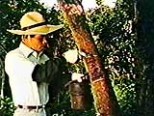
    The lacquer used in lacquerware is extracted from the sap of the lacquer tree, known as "lacquer sap." The process of making incisions in the lacquer tree and collecting the sap that oozes out is called "lacquer harvesting." The process of processing and refining the raw lacquer that has been harvested is called "lacquer processing." Lacquer processing involves removing the moisture from the raw lacquer to increase its transparency and give it a glossy finish.

    Step 2: Wood preparation

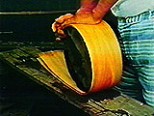
    Wood is processed to create wooden bases. There are three types of wooden bases: "turned wood," "bentwood," and "flat wood." First, "turned wood" is a general term for circular products made by shaping wood using a lathe or turning machine. Bowls and trays are made from this. Next, "bentwood" is made by softening wood by steaming, bending it using a wooden mold, joining the ends, and then adding a bottom plate or top plate. Steamers and tea caddies are examples. Finally, "flat wood" is made by processing and shaping wood that has been cut into sheets. First, the individual parts of the vessel are cut from the wood, then those parts are joined together, and finally the entire assembled piece is carved and finished.

    Process 3: Groundwork

    The process of applying lacquer is broadly divided into two parts, one of which is "undercoating." Undercoating serves to strengthen the lacquerware and to fill in rough areas and scratches on the wood grain, making the surface smooth. There are different types of undercoats, such as "lacquer undercoat," "persimmon undercoat," and "animal glue undercoat," and they are used according to their purpose. First, "lacquer undercoat" is used for high-grade lacquerware. "Persimmon undercoat" is used for durable and inexpensive practical lacquerware. It prevents the wood from absorbing the lacquer and improves the quality of the topcoat. Persimmon undercoat is used for persimmon-coated bowls, which are a specialty of KISHU Shikki (Lacquerware). Finally, "animal glue undercoat" is widely used because it has a good appearance, is inexpensive, and the process is simple. This "animal glue undercoat" is made by mixing undercoat powder with a solution of animal glue, and it has various names depending on the type of undercoat powder used.

    画像をクリックすると動画が再生されます

    Step 4: Top coat

    The process of applying paint to a base material after the undercoating process is complete is generally called "topcoating." Topcoating is done in three stages: "primer," "intermediate coat," and "topcoat." After both the primer and intermediate coats are applied, the material is dried in a high-humidity drying room called a lacquer bath, taking care to prevent dust from adhering to it. Once drying is complete, the painted surface is leveled and sanded to improve adhesion with the next coat of lacquer. For the topcoat, the lacquer is applied a little thicker. After that, the piece is turned upside down at regular intervals to allow it to dry and prevent the lacquer from running and pooling at the bottom.

    工程5: 加飾

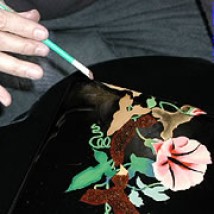
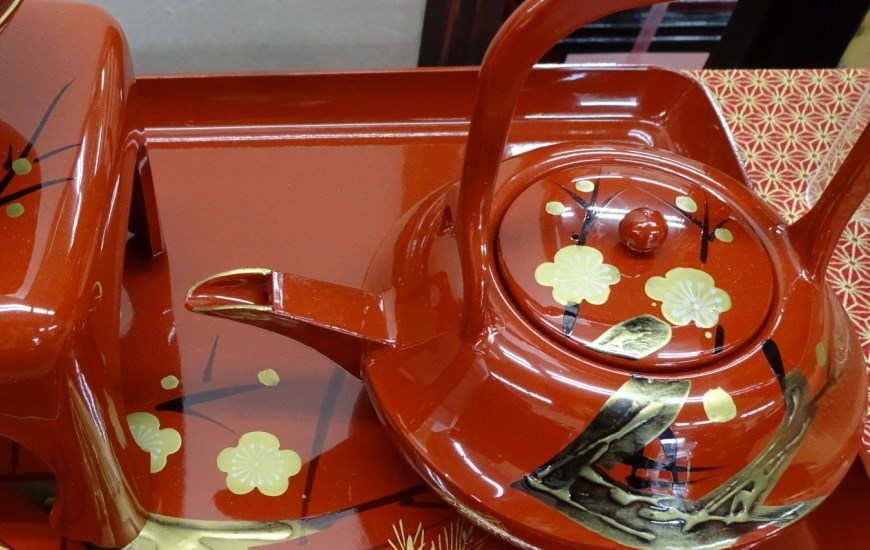
    There are various techniques for "decoration" of lacquerware after the lacquer has been applied, such as makie, raden, and chinkin. Makie is a technique in which a long, slender brush called a makie brush is dipped in lacquer liquid to draw a picture, and before the lacquer dries, dried gold, silver, tin, or colored lacquer powder is sprinkled on to create a pattern. Raden has two methods: one involves cutting out thick shells (about 1 mm thick), attaching them to the base, applying a rust-like finish, and then grinding them smooth with a whetstone; the other involves carving a shell pattern into the finished surface, inlaying the thick shells, and then grinding them smooth with a whetstone. Attaching thin shells or sprinkling fine shell powder is called aogai-zaiku (or somata). Raden refers specifically to the technique using the thick shells described above. "Chinkin" is a technique in which patterns are incised using a special tool called a chinkin chisel, raw lacquer is rubbed into the incised pattern, and then gold leaf is attached to the lacquer. It is a relatively durable decorative technique and is widely used on everyday items. KISHU Shikki (Lacquerware) is made through these various processes.

    画像をクリックすると動画が再生されます


  • Close-up

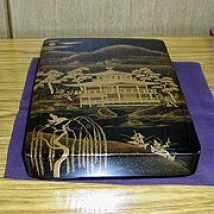
    The ultimate beauty of Japan: Maki-e (lacquerware with gold or silver inlay).

    In Europe, "China" refers to porcelain. Similarly, "Japan" refers to lacquerware, particularly those adorned with maki-e (gold lacquer) decoration. The maki-e technique, which has developed uniquely in Japan, is rich in Japanese aesthetics and offers a wide range of expressive methods. We spoke with a master craftsman to learn more about the profound world of maki-e.


    What is maki-e?

    The final step in the manufacturing process of lacquerware is decoration, and one of the techniques used is maki-e. Maki-e involves sprinkling gold, silver, and other powders onto a lacquered picture before it dries. Why is maki-e so captivating? Master craftsman Joji Deguchi says, "Even after 50 years of practicing maki-e, I'm still learning," highlighting its profound complexity. It is easily affected by the weather and drying conditions. He says that spring is the most difficult season to work with maki-e.

    Deguchi's work

    Exploring the charm of maki-e (lacquerware with gold or silver inlay) through its techniques.

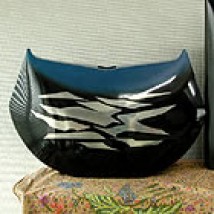
    Seeing the maki-e technique in action reveals its true appeal. There are three main techniques, distinguished by the size of the sprinkled powder, the way the lacquer is applied, and how the surface is polished. First is "hiramakie" (flat maki-e). This technique involves drawing a pattern on the lacquered surface with lacquer, and then effectively displaying gold and silver powder on top of the finished surface. Next is "takamakie" (raised maki-e). The pattern is raised in relief using lacquer or an undercoat, the pattern is drawn on top, gold and silver powder is sprinkled on and hardened, and then polished to finish. There are three main methods for raising the surface in "takamakie": urushiage (also called takaichi), sumikoage (charcoal powder raising), and tonsabi (smoked lacquer). The third technique is "togidashi maki-e" (polished maki-e). This technique involves drawing a pattern on the lacquered surface with lacquer, sprinkling coarse gold and silver powder on top, applying layers of lacquer until the powder is embedded, and then polishing it with charcoal to reveal the pattern. None of these techniques are easy, but "Togidashi Makie" in particular is difficult to master, as it involves repeatedly applying lacquer and polishing the gold powder with charcoal. When asked how far to polish, Mr. Deguchi explained, "We polish until the cross-sectional area of the gold powder is at its maximum. That's where the shine is greatest. If we polish any shallower or deeper, the gold's luster becomes dull." We were shown both "Togidashi Makie" and "Hira Makie," and at first glance, "Hira Makie" seemed to shine more, but upon closer inspection, "Togidashi Makie" had a more refined and profound beauty. It exuded a calm and serene beauty. It became clear that makie represents the Japanese sensibility and is a truly captivating art form.

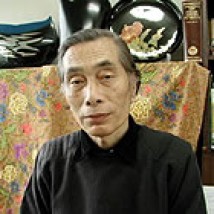
    His serious expression conveys a sense of tension.

    Bringing old traditions to life in the present day

    Mr. Deguchi always keeps in mind, "While preserving tradition is certainly important, how can we make it relevant to the present?" as he dedicates himself to his work. He is also actively involved in creating framed pictures, ornaments using buffalo horn and ivory, and brooches. "The uses of each item change with the times, so I want to continue taking on new challenges without being bound by the past," he says. Perhaps because of this attitude, or perhaps because his name is "George," he has many customers from overseas. Some even come to ask Mr. Deguchi directly. Of course, Mr. Deguchi welcomes them with open arms. In 1998, he was a guest of the Historical Road Promotion Council and gave demonstrations and hands-on workshops on maki-e (lacquerware with gold or silver inlay) in Detroit and Los Angeles, USA. He also teaches 7-8 students twice a week as he trains successors. We look forward to his continued success in the future.

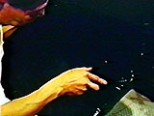
    • Sprinkle gold powder using a sprinkling tube.

    • New works

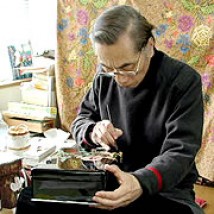
    • Truly a gentle master craftsman, Deguchi

    Craftsman Profile

    George Ideguchi

    Joji Deguchi has 48 years of experience in maki-e (lacquerware with gold or silver inlay), and is the fifth generation descendant of the first Shimizu Sanshiro from the late Edo period. He is a master craftsman of Wakayama Prefecture and a certified traditional craftsman. His warm personality, which seems to embrace those around him, is particularly impressive.

    Anecdotes

    Walking through the streets of Kuroe

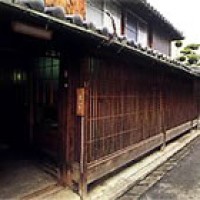
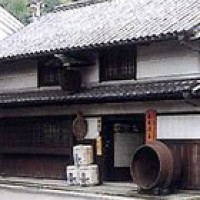
    Kuroe is the birthplace of KISHU Shikki (Lacquerware), a town even mentioned in the Manyoshu, an ancient collection of Japanese poetry. Long ago, when this area was a beautiful inlet, there was a black rock in the mudflats that resembled a cow, hence the name Kurogyu-gata (Black Cow Lagoon) or Kurogyu-no-e (Black Cow Lagoon), which is said to be the origin of the name Kuroe. The townscape remains largely unchanged from the past. If you get off at Kuroe Station on the JR Kinokuni Line and walk along the Kumano Kodo for about 15 minutes, you will reach Kawabata-dori, which could be called the main street of Kuroe. Just on the left corner is the landmark Onko Denshokan (Museum of Tradition and Heritage). This was a sake brewery that was loved by lacquerware artisans since the Edo period, and it is now a museum exhibiting Edo-period sake brewing methods, tools, and records of the business. Around Kawabata-dori, the residences and workplaces of former lacquerware artisans and wholesalers are lined up in a regular pattern. In the late Edo period, it flourished as a town with over 1,300 households and 4,500 inhabitants, creating the historical townscape that remains today. But there's something strange about the townscape. The houses aren't lined up in a straight line. It feels like the houses are all facing me.
    If you look closely, the houses are lined up in a regular pattern like the teeth of a saw, facing the street. Why is this? According to the late Norimitsu Saiga, a painter and local historian, "There are many theories, such as the idea of house layout, the idea that it was convenient for parking carts, and the idea that it was a place to put goods when they were unloaded from the river. Originally, this area was the sea, and because it was a peninsula called Ikezaki, the shoreline was formed at an angle. A road was built along the waterline, and land reclamation took place, but the central drainage channel (now Kawabata Street) was not at a right angle to it, resulting in a parallelogram-shaped plot of land. Therefore, when a square house was built, triangular open spaces were left in the front and back." Looking at the old houses, they have a very charming design. The exterior has white walls on the upper part and wooden planks with Kishu latticework on the lower part, giving it a Kyoto-style appearance. Stepping inside, you feel at ease in the traditional farmhouse-style layout. If you venture a little way into the side streets, you'll find Nakagoto Shrine at the end, which enshrines the local guardian deity of Kuroe Village. This shrine is known for its "Kurogyu no Mizu" (Black Cow Water), one of Kishu's 100 Famous Waters. Returning to Kawabata Street and walking to the outskirts, you'll find Konpira Daigongen. This is the guardian deity of maritime transport, so it may be proof that this area was reclaimed land in the past. Walking through the streets of Kuroe like this, you feel as if you've traveled back in time hundreds of years. The old woman who gave me directions earlier also spoke slowly. Being here makes you feel like you no longer need to rush around.

    • The townscape of Kuroe

    • Museum of Traditional Traditions


overview

Craft item name KISHU Shikki (Lacquerware)
Reading Kishu Shikki
Classification of crafts lacquerware
Main Products Trays, confectionery bowls, tableware
Main manufacturing area Wakayama City, Kainan City, Kimino Town, Kaiso District
Designated date February 6, 1978

contact address

■ Production area association

KISHU Shikki (Lacquerware) Cooperative
642-0001
222 Funao, Kainan City, Wakayama Prefecture
Inside KISHU Shikki (Lacquerware) Traditional Industry Hall
TEL: 073-482-0322
FAX: 073-483-2341

Features

The focus is on lacquerware that can be easily used in everyday life, and the overall impression is simple and sturdy. Kuroe-nuri and Negoro-nuri are among the representative types of lacquerware.

How to make it

There are many different types of lacquerware, but taking a simple round tray as an example, the process involves 50 to 70 steps in total, including the wood preparation, coating, and decoration. Including drying time, it takes about three months to complete. Furthermore, when making traditional lacquerware, the work is divided among woodworkers, undercoat makers, lacquerers, and maki-e (gold lacquer) artisans, each specializing in their respective fields, and it takes about 10 years to become proficient in these skills.

Please see here for information on traditional craftspeople.

Japanese traditional craftsman
top