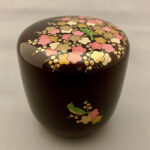
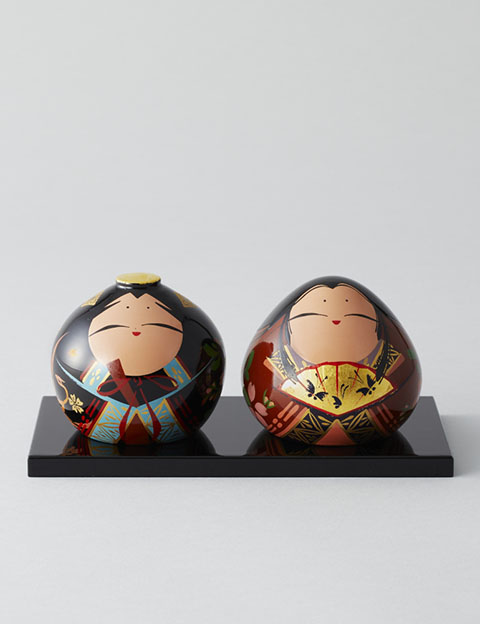
OUCHI Nuri (Lacquerware)

Yamaguchi Prefecture

It is said that OUCHI Nuri (Lacquerware) originated in the Muromachi period when the Ouchi clan, who held power in what is now Yamaguchi Prefecture, encouraged its production as an important export product in order to promote trade with Korea and Ming China.
Although trade ceased afterward, the technology was passed down through the Edo period and continues to be used today.

  • Technology/techniques/raw materials

    Technology/techniques

    1. The base layer shall be prepared using either a "standard hard base layer" or a "rust-resistant base layer."

    2. The lacquering shall be carried out using the following techniques or methods:
    (1) Apply a base coat and an intermediate coat.
    (2) The top coat shall be "flower paint".

    3. When decoration is to be added, it shall be done by "lacquer painting" or "gold leaf application".
     

    raw materials

    1 漆は、天然漆とすること。

    2. The wood used shall be Ilex rotunda, Biscutella japonica, Hinoki cypress, Aesculus hippocastanum, Zelkova serrata, Styrax japonica, or timber of equivalent quality.

  • Work scene

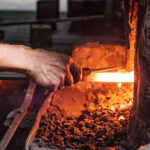
    The production of OUCHI Nuri (Lacquerware) mainly involves four processes: wood preparation, undercoating, painting, and decoration. The wood preparation is done by a woodworker, and the decoration is done by a lacquerer. Almost all of the work is done by hand, and it takes about 1 to 2 months to make one piece.

    Step 1: Wood base

    The felled logs are slowly air-dried over a period of 4 to 5 years. If necessary, they are also placed in a "smoked drying room" where they are dried by smoking. The wood is selected for its suitability to the piece and roughly cut to the desired shape. Bowls, round trays, and figurines are shaped using an electric lathe plane, while joinery such as tiered boxes and inkstone boxes are carved using saws and planes.

    画像をクリックすると動画が再生されます

    Process 2: Groundwork

    To ensure the lacquer is applied evenly to the finished base, we check for any scratches or imperfect adhesion in the wood. If there are any scratches, we fill them in with "kokuso-urushi," a mixture of raw lacquer, rice paste, and sawdust, to smooth them out. We reinforce areas that are prone to cracking, such as the bottom and rim of the bowl, by applying Japanese paper or cloth.
    The unevenness of the wood surface is smoothed out, and a "base lacquer" mixture of raw lacquer, polishing powder, and ground powder is applied with a spatula or brush. The dried base lacquer is then wet-sanded with a whetstone or sandpaper.

    Step 3: Primer

    After the base coat has been polished, a primer lacquer is applied. This step is to smooth the surface, and it is applied evenly and thinly. Once dry, it is wet-sanded with charcoal or sandpaper. This is done to ensure that the next coat of lacquer adheres well. The priming, drying, and sanding process is repeated as needed.

    Step 4: Intermediate Coat

    After the base coat has been polished, an undercoat of lacquer is applied. A color similar to the lacquer to be used for the topcoat is used. In the case of vermilion lacquer, a red ochre lacquer is mixed in. After this, drying and polishing are repeated as needed.

    Step 5: Top Coat

    When applying the top coat of lacquer, great care must be taken regarding the drying process and the resulting color and sheen. Various lacquers and pigments are mixed to adjust the color, and the mixture is strained through a sieve about three times to create the top coat. The top coat of lacquer is applied in a well-cleaned, dust-free room. For items such as bowls, the product is attached to the end of a stick for easier application, and the piece is applied by holding the stick. Finally, the piece is dried in a room with controlled humidity and temperature, or in a rotating bath.

    画像をクリックすると動画が再生されます

    工程6: 加飾

    While there are "hananuri" pieces that are finished simply by applying a coat of lacquer, most pieces undergo decorative work. Techniques include "urushie" (lacquer painting) where patterns are drawn with colored lacquer, "hakue" (gold leaf painting) where patterns are added by applying gold or silver leaf, "chinkin" (gold inlay) where patterns are drawn by carving the topcoat surface with a small chisel-like tool and then gold leaf is embedded in the carved areas, "makie" (gold or silver powder sprinkled from a bamboo tube onto a lacquer-painted pattern), and "raden" (mother-of-pearl inlay) where thinly shaved luminous parts of abalone, turban shell, or mother-of-pearl are embedded or attached to the topcoat.

  • Close-up

    OUCHI Nuri (Lacquerware) which preserves the essence of Ouchi culture to this day.

    During the Muromachi period, the Ouchi culture flourished in Yamaguchi under the rule of the Ouchi clan, the most powerful daimyo in western Japan. OUCHI Nuri (Lacquerware) lacquerware is still cherished today as a legacy of that culture. We visited Nakamura Folk Craft Company in Yamaguchi City and spoke with Isao Nakamura, who is in charge of the decorative finishing department, about his recent work and his commitment to quality.


    Integrated production by parent and child

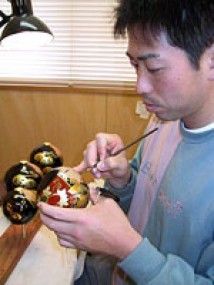
    At Nakamura Folk Craft Company in Ouchi, Yamaguchi City, they handle all stages of production, from priming and lacquering to painting. President Jun, who has been working with OUCHI Nuri (Lacquerware) for over 40 years, mainly prepares the priming, his second son Ken does the lacquering, and his eldest son Isao is in charge of maki-e (gold lacquer) and painting. Isao spent two years after graduating from high school at the Ishikawa Prefectural Wajima Lacquerware Training Center, and then five years as an apprentice to a maki-e artist. Ken also apprenticed with a WAJIMA Nuri (Lacquerware) artist for five years. Isao says, "The first two years were tough because I suffered from lacquer allergies. I had no resistance to taking over OUCHI Nuri (Lacquerware) because I had seen it since I was little. Now, I just study every day." His father's teaching is "always have a spirit of inquiry." He also takes an interest in the works of other companies and is looking to learn from them.

    Ken-san is in charge of the lacquer painting.

    "I'm learning something new every day," says Ko-san.

    The "Ouchi pattern" is a representative design.

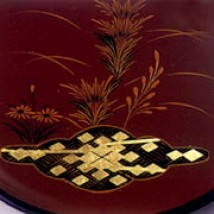
    OUCHI Nuri (Lacquerware) products come in a wide variety of items, including round trays, vases, bowls, tiered boxes, and figurines. Representative designs include a deep vermilion color known as "Ouchi-shu," traditional autumn grass patterns painted in greenish-yellow lacquer, and the "Ouchi-bishi" pattern, featuring diamond shapes in gold leaf. The Ouchi-bishi pattern is based on the Ouchi family crest and, along with the delicate and graceful lines of the autumn grass pattern, is said to symbolize "family prosperity."
    While some products have a black lacquer base, others feature designs of pine trees or five-story pagodas, Mr. Isao says, "The round trays with autumn grass and Ouchi diamond patterns sell well. Many customers prefer OUCHI Nuri (Lacquerware) is all about.'" As a lacquer craftsman, he is particular about the chrysanthemum flower pattern, which is also the official flower of Yamaguchi City, and the lustrous color, which he describes as "slightly redder than bengara lacquer."

    The "Ouchi pattern" features autumn grasses and the Ouchi diamond motif.

    It originated from Hirose's devotion to his wife.

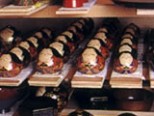
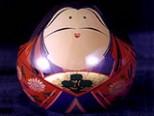
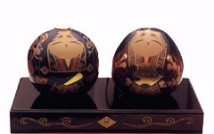
    The "Ouchi Dolls" account for the majority of sales. These dolls consist of a pair of lord and princess dolls shaped like rice balls.
    Long ago, Ouchi Hiroyoshi married a beautiful princess from the Sanjo family in Kyoto. However, the princess longed for the capital so much that he summoned many doll makers from Kyoto and decorated his entire mansion with dolls. This legend, which illustrates Hiroyoshi's devotion to his wife, is said to be the origin of the pair of male and female Ouchi dolls.
    The round faces, small mouths, and almond-shaped eyes vary subtly from artist to artist. Ko says, "Dolls with curt eyes are sad to look at. I want to depict warm expressions that soothe people. But it's difficult to consistently achieve this. It depends on my mood that day, and it all comes down to the difference in touch."

    The "Ouchi Doll" originates from Hirose's devotion to his wife.

    New products coming one after another, including prototypes.

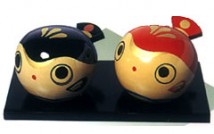
    In recent years, various OUCHI Nuri (Lacquerware) shops have been introducing ingeniously designed new dolls. These include "Ouchi Fugu," which is modeled after the tiger pufferfish, a specialty of Yamaguchi Prefecture, "Basket Dolls," which are dolls placed in bamboo baskets, as well as other products such as "Lacquered Box Dolls" and "Ouchi Kokeshi Dolls."
    Dolls are often used as wedding favors and various commemorative gifts. Nakamura Folk Crafts has also created "Ouchi Hina Dolls," a set that includes a folding screen and paper lanterns. "We would also like to try our hand at products related to Boys' Day and Tanabata," they said enthusiastically.
    When Yamaguchi City solicited new designs for OUCHI Nuri (Lacquerware) from the public for the purpose of creating prototypes and exhibits, they received a total of 245 unique ideas, including cell phone straps, lampshades, and artificial nails.

    "Ouchi pufferfish" was also released.

    A place for a rare experience

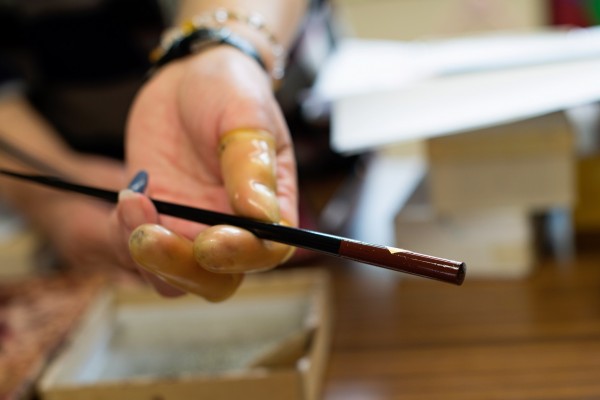
    The Furusato Densho Center in Yamaguchi City offers OUCHI Nuri (Lacquerware) experience workshop. Approximately 3,000 people, mainly elementary school students, visit annually. Participants can create their own pieces by decorating pre-coated chopsticks with the "Ouchi Hishi" (a diamond pattern) in gold leaf.
    There is also a "lacquerware class" that teaches lacquerware throughout the year, where 60 people ranging in age from their 20s to their 70s are diligently studying. Some young people even go on to become professional craftsmen. Junji Tomita, a craftsman of OUCHI Nuri (Lacquerware), who is in his third generation, and an instructor at the class, says, "Pottery classes are common, but lacquerware classes are rare. We would love for people to come from all over the country." The Nakamura family also says, "It is a valuable opportunity for people to feel closer to the art of lacquerware making."

    Anecdotes

    Lacquerware was a trade item with the mainland.

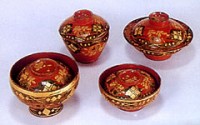
    The origins of OUCHI Nuri (Lacquerware) are uncertain, but the "Annals of the Joseon Dynasty" (1393-1863), a document from the Joseon Dynasty of Korea, describes the trade activities of the Ouchi clan during the Muromachi period, revealing that lacquerware was an important export product. The "Ouchi Clan Regulations" from Bunmei 17 (1485) also record the fees for applying lacquer to sword handles and scabbards, suggesting that lacquerware was flourishing in Yamaguchi at the time. The "Ouchi Bowl" in the Mori Museum in Hofu City is said to be a work from that period, and features a red base with gold leaf and colored lacquer applied to create diamond shapes, cloud shapes, and chrysanthemum branch patterns.
    With the fall of the Ouchi clan in 1552, foreign trade ceased, and the lacquerware industry suffered a blow. However, the production of everyday lacquerware continued throughout the Edo period. In the Meiji era, it regained prominence as a traditional craft and was revived as a prominent local industry.

    • The "Ouchi Bowl" in the collection of the Mori Museum

overview

Craft item name OUCHI Nuri (Lacquerware)
Reading Ouchi lacquer
Classification of crafts lacquerware
Main Products Round tray, individual plates, tea coasters, dolls
Main manufacturing area Yamaguchi City, Hagi City
Designated date April 11, 1989

contact address

■ Production area association

OUCHI Nuri (Lacquerware) Lacquerware Promotion Cooperative Association
753-0214
4138 Ouchi-Mihori, Yamaguchi City, Yamaguchi Prefecture
Nakamura Folk Craft Co., Ltd.
TEL: 083-927-0619
FAX: 083-927-4619

■ Visits to production areas from overseas
image
OUCHI Nuri (Lacquerware)- A Visit to the Production Area

Features

OUCHI Nuri (Lacquerware), which preserves the legacy of Yamaguchi, once known as the "Kyoto of the West," is characterized by its unique patterns: a subdued Ouchi vermilion base coat, onto which autumn grasses are painted with yellow-green colored lacquer, cloud shapes are added, and the family crest (Ouchi菱) is applied in gold leaf.

How to make it

The process can be broadly divided into four stages: wood preparation, undercoating, painting, and decoration. Natural woods such as Ilex rotunda, Biscutellaria, Hinoki cypress, and Zelkova are used for the wood base. In particular, the decoration of Ouchi bowls involves applying a tannin base coat, followed by a floral painting technique using red ochre lacquer, and then applying gold leaf and lacquer painting.

Please see here for information on traditional craftspeople.

Japanese traditional craftsman
top