Kaba Zaiku (Cherry Bark Work)

Akita Prefecture

It is believed that Kaba Zaiku (Cherry Bark Work) originated at the end of the 18th century when the Satake Kita family introduced the technique from the Ani region in northern Akita Prefecture to Kakunodate.
Kaba Zaiku (Cherry Bark Work), which received generous protection from the lord of the Satake Kita family's castle, spread as a side business for lower-ranking samurai. In the Meiji era, samurai who had lost their stipends began to take up the craft seriously in order to earn an income, and works that can be considered the prototypes of today's creations began to be produced.

  • Technology/techniques/raw materials

    Technology/techniques

    1. The "preparation" involves using a "bark-breaking knife" to "bark crack," "scattered," "regular bark," "crepe," "golden," "silver," "amber bark," or "double bark" by "bark breaking" the birch bark.


    2. The craftsmanship shall be in one of the following ways:
    (1) In the case of "formed products," the following techniques or methods shall be used:
    (i) "Preparation" involves "creating the core body," "covering the body with leather," "covering the inside of the body with leather," and "covering the mouth with birch bark." In this case, the bonding is done by "applying animal glue" using a "wooden mold" and a trowel.
    The joining of the "body hide" and "mouth bark" shall be done using the "butt joint" method.
    H. To determine the starting point.
    2. When performing "cutting the body," "rubbing" the parts together is necessary.
    H. To apply "small border trim".
    To apply leather to the top, inside the top, bottom, and inside the bottom.

    (2) In the case of "wooden products," the following techniques or methods shall be used:
    (i) Woodworking involves shaping the finished components after the "lining" has been applied using wooden nails or animal glue.
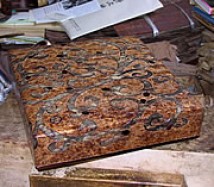
    (b) Apply an "exterior covering". In this case, the "exterior covering" of the rounded corners of the wood should be done using a "butt joint" technique.

    (3) In the case of "folded items", the following techniques or methods shall be used:
    I. "Birch tatami" is made by applying glue to knot-free, glossy birch wood and then pressing it together using a heated iron plate.
    (b) For shaping, use a butt saw and a small knife.


    3. The "finishing" involves leveling the surface using a "rough leveling knife," horsetail, and a "finishing knife," followed by polishing with hackberry leaves and polishing powder.
     

    raw materials

    1. The bark used shall be from either Prunus serrulata or Prunus jamasakura.
    2. The wood used shall be magnolia, cedar, cypress, hinoki cypress, or paulownia, or a material of equivalent quality.

  • Work scene

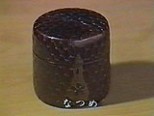
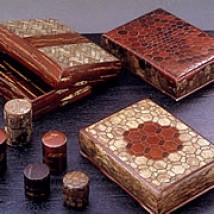
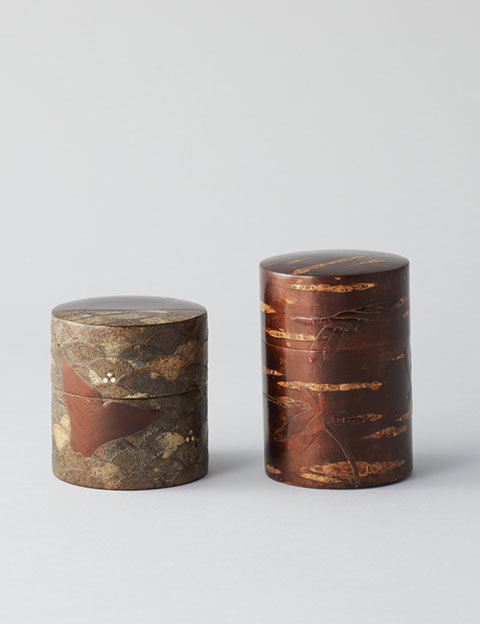
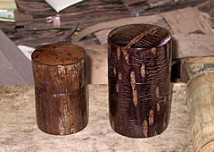
    Kaba Zaiku (Cherry Bark Work) is described as "a bark art unparalleled in the world." It involves stripping the bark of wild cherry trees, thinly shaving it, and using it to decorate furnishings, making the most of the bark's texture. Kaba Zaiku (Cherry Bark Work) can be broadly classified into three types of products: molded items such as inro (small containers for medicine) and tea caddies wrapped in bark; folded items made by layering multiple pieces of bark, which were historically used for obi clasps and are now made into brooches and pendants; and wooden items with a surface covering. The bark of the wild cherry tree (cherry bark) is thinly processed and attached with a trowel, creating works that make the most of the material's characteristics. Here, we will introduce the process of making molded items, which are representative of Kaba Zaiku (Cherry Bark Work).

    Step 1: Filefish

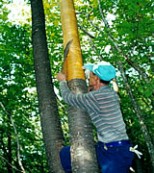
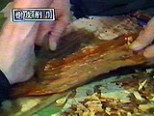
    The bark is stripped from the wild cherry tree. The bark from older trees that have withstood wind and snow is more varied and has a more beautiful appearance when used in crafts than the bark from planted trees. The bark is given different names depending on its appearance. There are many varieties, such as "cracked bark," which is considered the finest bark with a deep luster and vertical cracks, "amber bark," which is smooth, and "crinkled bark," which is so named because the gelatinous part inside the bark looks like crinkled fabric. Birch bark is harvested by making a cut about 30 centimeters deep into the bark, peeling back the outer layer, and slowly peeling it off. Stripping the bark is detrimental to the tree, but as long as the entire bark of a tree is not stripped off, the tree will not weaken, and the bark will gradually regenerate.

    Step 2: Shaving the birch

    First, select birch wood and cut it to the desired size for your project. A heated iron, moistened with water, is applied to straighten the birch and remove any rounded edges. Then, the surface is shaved with a wide knife, bringing out a sheen. It's said that mastering this process alone takes three years.

    Step 3: Applying animal glue

    The birch wood is thinly shaved to make it easier to work with, then glue is applied and it is allowed to dry.

    Step 4: Preparation

    These molded pieces are also known as "prepared pieces." Birch bark is wrapped around a wooden mold made of Japanese maple, and a trowel is used to set the curl. Once the curl is set, the birch bark is removed from the wooden mold and polished.
    画像をクリックすると動画が再生されます

    Step 5: Application

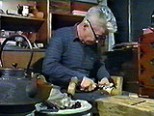
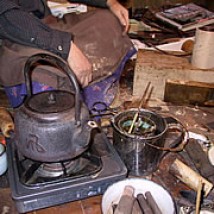
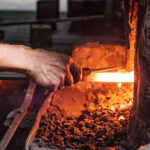
    Birch bark is attached to a core piece of wood. Glue is applied, and the birch bark is carefully glued in place using a trowel to prevent wrinkles. Using synthetic adhesive instead of glue inevitably results in more wrinkles. The temperature of the glue and trowel, as well as the way the trowel is applied, require skill. A fire is always burning in the workshop of Kaba Zaiku (Cherry Bark Work) craftsman, and a jizaikagi (adjustable hook) is hanging because the glue and trowel must be kept constantly warm.

    Step 6: Topping and filling

    We will work on the top and bottom of the cylinder. We will use a small knife to shave it and then a plane to smooth the rim. In the same way as the cylinder, we will use glue and a trowel to attach the birch wood. Once the top is done, we will work on the bottom in the same way.
    画像をクリックすると動画が再生されます

    Step 7: Finishing (polishing)

    To remove the roughness from the birch surface and bring out its luster, the polishing is done in several stages. After polishing with horsetail and hackberry leaves, wood powder is applied and polished. Applying a little hair oil and polishing with a cloth deepens the luster, and a subdued shine appears, as if life has been breathed into the birch again.
  • Close-up

    The beauty of cherry blossoms in our lives: Birch Kaba Zaiku (Cherry Bark Work)

    Kakunodate is the only place in Japan where the Kaba Zaiku (Cherry Bark Work) of making kabazaiku, which utilizes the texture of the bark of the wild cherry tree, is still practiced. The unique technique that gives the wild cherry bark a luster, and the simple patterns bring warmth and color to everyday life.


    The beauty of nature that developed from the samurai's side business

    Kakunodate's Kaba Zaiku (Cherry Bark Work), said to be a unique bark craft unlike any other in the world, is said to have originated during the Tenmei era (1771-1788) when Fujimura Hikoku, a retainer of the Satake family who ruled the area, was taught the technique by a Shugendo practitioner from the Ani region. Developed as a side job for lower-ranking samurai, cherry bark Kaba Zaiku (Cherry Bark Work) initially only produced small items such as inro (small cases) and tobacco pouches, but gradually expanded to include cylindrical items and wooden objects such as tea caddies, small boxes, and square tea caddies. Kaba Zaiku (Cherry Bark Work) involves working with the bark of wild cherry trees that grow naturally in the surrounding mountains, bringing out its beauty to the fullest extent. The person who shared its charm with us was Kintaro Koyanagi, a leading figure in Kaba Zaiku (Cherry Bark Work) Kaba Zaiku (Cherry Bark Work), whose name comes up even before the traditional craftsman certification system was established.

    From the joy of being recognized together with my teacher

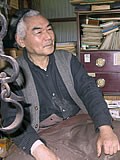
    In the small workshop, which is less than six tatami mats in size, well-used furnishings that exude a sense of history are lined up. Steam rises several feet high from an old iron kettle on the fire, blending into the room. In this unadorned workshop, Mr. Koyanagi has continued to quietly create Kaba Zaiku (Cherry Bark Work), and is a modern master craftsman who has received numerous awards, including the Minister of Labor Award. He spoke to me, shifting his cushion slightly, as he sat in the same spot every day. "Being recognized by Mr. Soetsu Yanagi (President of the Japan Folk Crafts Association) when I was young was a major turning point in my dedication to this work." He said that being praised for the durability, ease of use, and unparalleled beauty of Kaba Zaiku (Cherry Bark Work), which are unmatched in the world as bark crafts, allowed him to take pride in Kaba Zaiku (Cherry Bark Work). As he quietly spoke while polishing a tea caddy he was working on, his demeanor conveyed the pinnacle of his craft, cultivated through many years of experience. His exquisite technique, which continues to be honed even after 65 years, breathes life and brilliance into the originally rough bark of the wild cherry tree. "I believe that handcrafted items used in general must be both functional and durable." He argues that if something is beautiful but lacks durability, it won't become a tool that people hold, use, and cherish.
    This workshop is perfectly suited to the quiet, humming sounds of an iron kettle.
    Why are people so drawn to the bark of the wild cherry tree?

    Ornamentation isn't always necessary for everyday use. So why are people so drawn to bark crafts? When I asked Mr. Koyanagi this, he replied, "I think it's human instinct to seek out nature." Humans have been on Earth for about 5 million years. For most of that time, humans have lived in forests. Perhaps the sense of peace we feel from tree bark, which we have been with and observed throughout that time, is an instinct folded deep within the human nature. "These days, the bark is processed by machines, so it's hard to see the differences between individual pieces of bark." Bark, being a natural material, is inherently unique; no two pieces are exactly alike. It is the craftsman's job to adapt to these differences and bring out the best in each piece of bark. The numerous works that were carefully wrapped and stored away were all unique, individual Kaba Zaiku (Cherry Bark Work).
    Creating artwork tailored to each individual piece of wild cherry bark.
    Preserving the traditions of the region through training successors

    Currently, Mr. Koyanagi is not taking on apprentices. He says that while he was able to mentor apprentices when he was younger, now that he is older, he wants to concentrate on his own work. Kakunodate has produced many master craftsmen in the past, and they are still enthusiastic about training successors. At the Kakunodate Kaba Zaiku (Cherry Bark Work) Craft Museum, craftsmen demonstrate Kaba Zaiku (Cherry Bark Work) making process every day. Kaba Zaiku (Cherry Bark Work) is a unique, intricate bark craft made by hand, one of a kind in Japan, or even the world, setting it apart from the inferior mass-produced goods made by machines in other regions. The techniques of Kaba Zaiku (Cherry Bark Work) making, which are also a major local industry, are only passed down to craftsmen who work locally. It seems that some people come from outside to learn the techniques, but they don't seem to last long.
    Paperback: I look forward to taking out the book.
    Protecting the mountains, preserving traditions

    The bark of the wild cherry tree, used as the raw material, is collected in the mountains by people called "kawahagi." Traditional kawahagi, which protected the wild cherry trees by not stripping the entire bark from a single tree, seems to have changed after the war, with more and more people damaging the trees by stripping Kaba Zaiku (Cherry Bark Work) for kabazaiku, and the harvesting exceeded the regenerative capacity of the mountains. Traditional Kaba Zaiku (Cherry Bark Work) did not involve destroying the wild cherry trees or the mountains, but in the current situation of severe damage, the town and local cooperatives are actively working to plant wild cherry trees. The bark of the wild cherry tree, which has ended its life once after being stripped from the tree, is given new life again by the hands of skilled craftsmen. Kaba Zaiku (Cherry Bark Work), with its deep colors that evoke the warmth of nature, is a gift from the mountains that brings a mysterious sense of peace to everyday life.

    Craftsman Profile

    Kintaro Koyanagi

    Born in 1921 (Taisho 10), he is one of the greatest master craftsmen of our time, having dedicated almost his entire life to the art of Kaba Zaiku (Cherry Bark Work) craftsmanship.

    Anecdotes

    Beauty born from harsh survival

    Due to the increased use of tree bark in other fields, a period of overharvesting has led to a shortage of bark available for Kaba Zaiku (Cherry Bark Work). In recent years, the planting and research of wild cherry trees have become more active, and the conditions necessary for obtaining good quality bark have been identified. Trees grown under favorable conditions through reforestation do not produce the astringent bark suitable for Kaba Zaiku (Cherry Bark Work). The bark suitable for Kaba Zaiku (Cherry Bark Work) comes from poor trees that were shaded by other plants and did not receive sufficient nutrients. Such bark allows craftsmen to fully utilize their skills and breathe new life into their creations. It is because the bark of trees that have bravely endured the harsh winter cold and snowfall of Kakunodate that it can be transformed into a beauty that speaks to the human heart. The blessings of the mountains seem to convey to us the resilience of all living things in the natural world.

    • It is given life again and becomes Kaba Zaiku (Cherry Bark Work).
overview

Craft item name Kaba Zaiku (Cherry Bark Work)
Reading Kabazaiku
Classification of crafts Woodwork/bamboo products
Main Products Tea caddy
Main manufacturing area Semboku City
Designated date February 26, 1976

contact address

■ Production area association

Kakunodate Crafts Cooperative
〒014-0352
18 mountains outside Kakunodate-machi, Semboku City, Akita Prefecture
TEL: 0187-53-2228
FAX: 0187-53-2293

Features

These items are made using the bark of the Japanese cherry tree (Prunus jamasakura), and are unique to Japan. There are about 12 different types of bark used, including amber bark, scattered bark, and cracked bark, and they are used according to their intended purpose. No two finished pieces are exactly alike.

How to make it

The bark of the wild cherry tree is shaved and glued onto the surface of the wood, or multiple layers of bark are glued on, then the piece is carved, polished, and finished.

Please see here for information on traditional craftspeople.

Japanese traditional craftsman
top