OKU-AIZU Amikumi Zaiku (Basketry)

Fukushima Prefecture

At the Arayashiki archaeological site in Mishima-machi, Onuma-gun, Fukushima Prefecture, fragments of ropes and woven baskets have been excavated, revealing that weaving techniques and methods existed from the Jomon period.
The "Aizu Agricultural Book" records that baskets were made in the Aizu region using ropes made from wild grasses, and the "Eastern Travel Miscellany" records that in the vicinity of present-day Mishima town, woven crafts such as raincoats were made using mountain sedge (hiroro) as a material. Furthermore, the "Ina Ikita Valley Four Group Customs Record" describes how baskets were made by thinning the vines of silver vine and bags (baskets) were made from the bark of wild grapes. This suggests that even in this era, hiroro crafts, silver vine crafts, and wild grape crafts were made as everyday household items and have been passed down to the present day.
In Mishima Town, Onuma District, Fukushima Prefecture, the number of people engaged in woven craft production has been decreasing since the 1960s due to an aging population. Therefore, with the aim of maintaining and passing on the techniques and methods that have been handed down for hundreds of years, and promoting and developing lifestyle crafts as a local industry that aim for coexistence with nature, the town has been promoting the "Lifestyle Craft Movement" as a key policy, including technical guidance, quality control, and market development for woven crafts. Today, the number of people engaged in the craft is increasing.

  • Technology/techniques/raw materials

    Technology/techniques

    1. In the case of "Hiroro craftwork," the following techniques or methods shall be used:
    (1) The Hirolo rope must be 2 to 4 millimeters in thickness and have at least 20 twists in a length of 10 centimeters.
    (2) The base and starting stitches shall be made using the "arrow feather stitch" or "shelf stitch".


    2. In the case of "wild grape crafts," the following techniques or methods shall be used:
    (1) The wild grape skins should be thoroughly tanned, cut along the fibers, and the width adjusted.
    (2) The bottom and top weaves of the handbags shall be made using either the "double-strand skip weave" or the "sieve weave".
    (3) The edges of handbags and similar items shall be finished with a "arrowhead-shaped edge."
    (4) The bottom of the square box baskets shall be woven using the "four-eye weave" or "two-strand skip weave." The top of the basket shall be woven using the "sieve weave."
    (5) The bottom of round baskets shall be woven using the "sieve weave," "four-eye weave," or "two-strand skip weave." The top of the basket shall be woven using the "sieve weave" or "two-strand skip weave."


    3. In the case of "silver vine crafts," the following techniques or methods shall be used:
    (1) The preparation of the ingredients involves peeling, splitting, cutting, and cutting to a uniform width.
    (2) The bottom of the rice washing basket is woven using the "two-strand skip weave" method, with two pieces of material forming a pair, and the bottom is rounded using the "two-strand skip weave" method with a single piece of material. The top is woven using the "sieve weave" method.
    (3) The bottom weave of the bean strainer and soba sieve shall be made using the "two-strand skip weave" method, with two pieces of material forming one set. The top weave shall be made using the "two-strand skip weave" method with one piece of material.
    (4) The base of the four-eye basket shall be woven using the "four-eye weave," which involves using two pieces of material as a pair. The top of the basket shall be woven using the "basket weave."
    (5) The bottom of the baskets shall be woven using the "sieve weave" method, which uses two pieces of material as a pair. The top of the baskets shall be woven using the "sieve weave" method with a single piece of material.
    (6) After production, the fabric must be bleached in cold or snow.
     

    raw materials

    1. For "Hiroro crafts," the materials used should be Miyamakansuge (also known as Honhiroro) and Okunokansuge (also known as Ubahiroro), collected in the mountainous areas of Okuaizu.

    2. In the case of "wild grape crafts," the skin of wild grapes collected in the mountainous areas of Oku-Aizu must be a single skin before it splits into two layers.

    3. For "Matatabi crafts," the vines should be those of young, mature matatabi plants collected in the mountainous areas of Oku-Aizu. The core material of the rim should be kumagozuru or a material of equivalent quality.

  • Work scene

    There are three types of OKU-AIZU Amikumi Zaiku (Basketry): hiroro crafts, matatabi crafts, and wild grape crafts.
    Here, we'll show you how to make a basket using silver vine craftsmanship.

    <Ingredients> Silver vine
    Actinidia polygama is a deciduous shrub that grows in a vine-like manner, and in Oku-Aizu, it has been used since ancient times as a material for weaving baskets and sieves.

    Preparation of materials

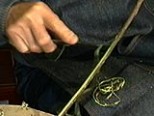
    Process 1: Collection

    Harvesting takes place from early November to early December, when the vines of the silver vine begin to bear fruit.
    The producers go to a designated collection site called a "toritsukeba" and harvest the silver vine.
    Each producer has a designated "collection site," and they collect the silver vine while considering its growth stage, so that they can continue to harvest it consistently within that site.

    Step 2: Peeling

    Before the harvested vines dry out, carefully scrape off the outer bark with a knife.

    Step 3: Splitting

    Use a special tool to split the vine lengthwise.
    Depending on the thickness of the vine, split it into four or five strands.

    Step 4: Core removal

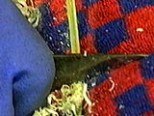
    Using a sharp knife, shave off the soft core of the vine from the vine that has been split lengthwise. This creates the bamboo strips for crafting.

    The process from harvesting to making the strips is done all at once before the vines dry out. The strips are then stored and used for crafting.

    Braided

    Step 5: Knitting the base


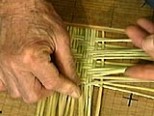
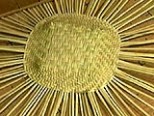
    Take 20 bamboo strips, each 80 cm long, and arrange them vertically, keeping them aligned.
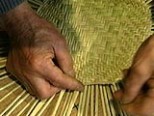
    By passing the horizontal bamboo strips through the vertical ones, a square surface with 20 strips on each side is woven together.
    This square forms the base, and the parts extending beyond the four sides of the square become the warp threads on the sides.


    画像をクリックすると動画が再生されます

    Step 6: Horizontal knitting


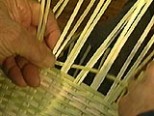
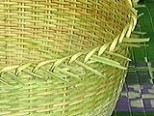
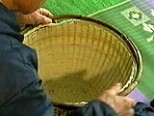
    Once the base is woven, select one of the outermost bamboo strips of the square and attach a long bamboo strip for the weft of the sides to it. Wrap the weft strip around the perimeter of the square and weave it in a spiral pattern to widen the base into a round shape. After weaving about seven and a half rounds from the base, start raising the sides.

    Step 7: Edge finishing


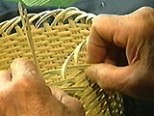
    Once you've crocheted the sides to a height of about 25cm, wrap the protruding silver vine around them to secure the edges.

    Step 8: Reinforcing the edges


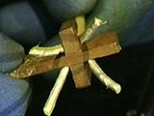
    Create a ring using vines such as *Kumago vine* and attach it to the edge.

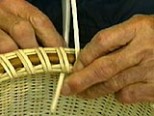
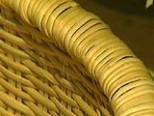
    Wrap the attached ring with catnip and secure it firmly to the main body.

    工程9: 乾燥

    Once the border is made, hang it outside and let it dry in the open air for a month, and it's finished.


  • Close-up

    A life lived in harmony with nature: OKU-AIZU Amikumi Zaiku (Basketry)

    In Oku-Aizu, Fukushima Prefecture, a plateau enveloped in crisp, clean air is covered in endless white snow during the winter. In Mishima Town, Oku-Aizu, weaving and braiding using mountain plants and trees has been passed down since the Edo period as a winter craft for farmers in this snowy region. They gather only the necessary amount of plants and trees from the mountains. OKU-AIZU Amikumi Zaiku (Basketry) a life lived in harmony with nature.
    On a small hill where a refreshing breeze from the plateau blows through the trees stands the Mishima Town Lifestyle Crafts Center. The Lifestyle Crafts Center is a facility that opened in 1986 as a point of contact between the townspeople and the traditional craftsmanship that has been passed down through generations. Here, various handicrafts, including OKU-AIZU Amikumi Zaiku (Basketry) are taught, and product development takes place. It is, in a sense, the heart of Mishima Town's craftsmanship. We spoke with Teruko Hasegawa, who teaches hiroro weaving here.


    Using mountain plants and trees as materials

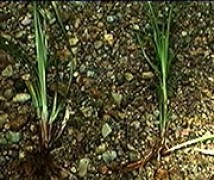
    OKU-AIZU Amikumi Zaiku (Basketry) are divided into three types depending on the type of plant used: hiroro crafts, matatabi crafts, and wild grape crafts. All of these are plants that grow naturally in the mountains of Okuaizu. Hiroro is a long, slender grass that grows in wetlands such as streams, and ropes made from its leaves are used as crafting materials. Matatabi and wild grape are both vines that grow by twining around trees. In the case of matatabi, thinly shaved branches are used as crafting materials, while in the case of wild grape, the bark is used.
    Hirolo and wild grape vine crafts are used for various types of baskets, while silver vine crafts are used for cooking utensils such as strainers.

    Crafts that coexist with nature

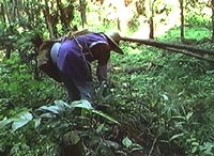
    OKU-AIZU Amikumi Zaiku (Basketry) are made entirely by hand, from gathering the materials to the final finishing touches. In the case of hiroro, this begins 210 days after the start of spring. As the season shifts from summer to autumn, the craftsman goes into the mountain streams to gather hiroro himself.
    Hirolo is a perennial herb with roots. Its long, slender leaves can be easily pulled off the stem near the base if pulled firmly. Only these removed leaves are used for the craft.
    "When you're picking them, make sure you don't pull them out by the roots. Make sure you firmly step on the base of the hiroro plant with your foot before you pull," Hasegawa explains, describing the harvesting process.
    Hirolo leaves can be harvested repeatedly from the same plant by leaving the roots in the soil. However, some care is needed to ensure that good quality leaves grow. When harvesting, leave the smaller leaves and remove the larger ones. Do not harvest from the same plant the following year.
    "It's the same as with ostrich fern or royal fern. You know how they say to leave one stalk per plant when gathering wild vegetables?" Hasegawa says that in Mishima Town, everyone naturally learns this custom of gathering.
    Herein lies the wisdom to ensure that the blessings of the mountains do not run out, year after year, and the year after that as well.

    Shapes born from a single rope

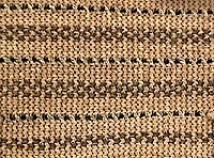
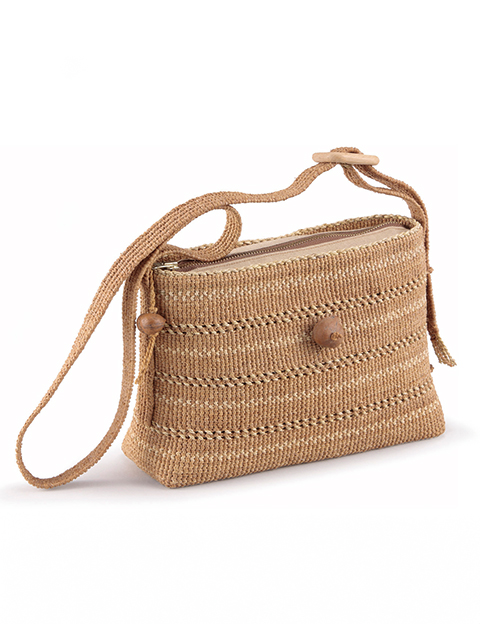
    Hirolo crafts are made by folding a single rope made from hirolo fibers multiple times and then weaving them together with fibers taken from various plants. The weave is fine, and the finished product resembles lace. The rustic texture of the plants and the delicate craftsmanship are gently harmonized. Hirolo crafts have a gentle presence that soothes the soul.

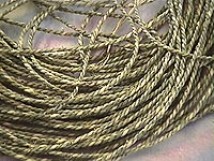
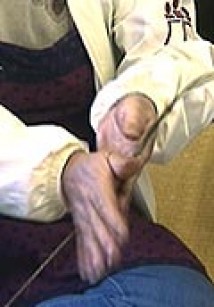
    The foundation of hiroro crafts lies in rope making, known as "rope making." The rope is made by rehydrating dried hiroro in water or lukewarm water and twisting several strands together. At this stage, if there are inconsistencies in thickness or twisting, the craft will not be beautiful. The rope is about 2 to 4 mm thick. Although it varies slightly depending on the person making the rope, typically one bundle of dried hiroro can produce 100 meters of rope. This is enough to fill two small bags.
    "The key is to make lots of long, beautiful ropes," Hasegawa explained, demonstrating the process. A few leaves rolled in his palm quickly transformed into thin ropes. He effortlessly produced thin ropes of consistent thickness and twist. He told me he'd been making ropes since he was a small child. In Oku-Aizu, craftsmanship is an integral part of people's lives, passed down through generations.

    The beauty of natural colors

    In OKU-AIZU Amikumi Zaiku (Basketry), the materials themselves are not dyed. The colors of hiroro crafts are created by the weft threads used to weave and connect the hiroro fibers. The weft threads are made from various plants found in the area, including fibers extracted from the bark of the linden tree called mowada, as well as choma and ramie. Even myoga ginger, which is used as a condiment, has its stems used as weft threads. The works are created by making the most of the natural colors of these materials.
    For example, even the same linden bark has white and reddish-brown parts. The color also varies depending on the degree of drying. Patterns can be created using the colors of these materials, so no dyeing is done. Even without dyeing, the works are filled with gentle, natural colors. Soft cream, pale orange reminiscent of a sunset sky, moss green like a deep forest. Looking at OKU-AIZU Amikumi Zaiku (Basketry), one is reminded anew of the rich colors that the materials themselves possess.

    Preserving and passing on the skills and spirit of handcrafts that coexist with nature.

    OKU-AIZU Amikumi Zaiku (Basketry) have been practiced as a side business during the off-season for farming since the Edo period. There, "craftsmanship" has always been carried out with consideration for not depleting the mountain resources, which are their own treasure. This consideration is certainly still passed down today. They make things using materials that are given to them without putting a strain on the mountains. There is a spirit of "craftsmanship" that can only be made because it is a side business. Through "craftsmanship," OKU-AIZU Amikumi Zaiku (Basketry) continue to convey to people the spirit of coexisting with nature.

    Craftsman Profile

    (Teruko Hasegawa)

    Teruko Hasegawa

    Instructor at the Mishima Town Lifestyle Craft Center.
    For many years, she has been creating household goods using hiroro wood. In 1998, she became a hiroro wood craft instructor. In addition to teaching visitors how to make hiroro wood crafts, she is also involved in the development of new products conducted by the Museum of Lifestyle Crafts.

    Anecdotes

    It's never too late to start.

    OKU-AIZU Amikumi Zaiku (Basketry) are supported by people aged 65 and over. While this age group would be considered elderly in urban areas, in Mishima Town, they are still expected to be active contributors. Many begin creating these crafts after retiring from their previous jobs, often prompted by instruction at the local craft center.
    When we talk about successors, we tend to focus on young people, but in Mishima Town, which is looking to its aging society, there seems to be no need to worry about a shortage of successors.


overview

Craft item name OKU-AIZU Amikumi Zaiku (Basketry)
Reading Okuaizu Amikumizaiku
Classification of crafts Woodwork/bamboo products
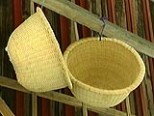
Main Products Handbag, carrying basket, shoulder basket, waist basket, confectionery container, rice washing sieve, red bean strainer, soba strainer
Main manufacturing area Mishima Town, Onuma District
Designated date September 10, 2003

contact address

■ Production area association

Okuaizu Mishima Braided Products Promotion Council
〒969-7402
395 Suwanoue, Oaza Nairi, Mishima-machi, Onuma-gun, Fukushima Prefecture
Inside Mishima Town Lifestyle Crafts Center
TEL: 0241-48-5502
FAX: 0241-52-2175

https://www.okuaizu-amikumi.jp/

Features

This woven craft uses plants such as hiroro, wild grapes, and matatabi, which are collected in the mountainous regions of Oku-Aizu, as materials. Traditionally, it has been passed down as a handcraft during the snowy season in mountainous areas, producing baskets and sieves for everyday use. Currently, Mishima Town in Onuma District, Fukushima Prefecture, is the main production area, where handbags, carrying baskets, shoulder baskets, confectionery containers, and cooking utensils are made from hiroro, wild grapes, and matatabi. Its characteristic features are the sturdy and simple hand-woven quality using natural materials.

How to make it

[Hiroro Crafts]
The hiroro stalks are twisted into ropes, which are then woven to create handbags, baskets to carry, and shoulder baskets. The weave is fine, resulting in a lace-like finish that is both rustic and uniquely delicate.
[Wild grape crafts]
The raw material is the bark of the wild grape, which is harvested around June when the chestnut blossoms are in bloom. The material is strong and durable, and different weaving techniques are used depending on the intended use to create handbags, carrying baskets, and confectionery containers.
[Sweet vine crafts]
Made from thick, mature branches 1 to 3 meters long that grow from a single vine, these utensils are primarily used for cooking. They are characterized by their excellent drainage and, when moist, their flexibility, which reduces the risk of injury to the hands. Different weaving techniques are used depending on the intended use.

Please see here for information on traditional craftspeople.

Japanese traditional craftsman
top