EDO Sashimono (Wood Joinery)

During the Edo period, the Tokugawa shogunate invited many craftsmen from all over the country and created craftsman districts such as Daikumachi (carpenter's district), Kajimachi (blacksmith's district), and Konyamachi (dyeing district) around Kanda and Nihonbashi, fostering the development of handicrafts.
In the mid-Edo period, with the development of consumer lifestyles, the work of carpenters split into various professions such as oak woodworkers, door and screen makers, and palace builders. One of these was the joiner, a profession that continues to this day.

  • Technology/techniques/raw materials

    Technology/techniques

    1. Drying should be done by natural drying.

    2. Manufacturing shall be carried out using the following technologies or techniques:
    (1) When cutting wood, use a ruler, square, workbench and handsaw.
    (2) Joints shall be made using a wooden block, plane, long-handled plane and end plate, using lap joints, mortise and tenon joints.
    (3) For planing, use a flat plane, a long-handled plane, a scoring tool, and an end-grain plane.
    (4) The joints shall be made using a saw, ruler, plane and chisel, and shall be of the following types: mitered concealed dovetail joint, candle tenon, mortise and tenon joint, dovetail joint, pull-in miter joint, three-way miter tenon, butt tenon, or a joint equivalent to these methods.
    (5) When carving or hollowing out, use a chisel, carving knife, hollowing knife, coping saw and plane.
    (6) Assembly shall be carried out by applying adhesive to the joints using Sanada cord, a hammer, a wooden mallet, a metal plate, a backing block, a chamfering plane, a flat plane, and a round plane.
    (7) For finishing, use a flat plane, a chamfering plane, and a round plane.
    (8) For polishing, use horsetail leaves, hackberry leaves, or something with equivalent properties.
    (9) The finish shall be made using lacquer, privet wax, polishing powder, or a material of equivalent quality, and shall be a wiped lacquer finish, a waxed finish, or an antique finish.
     

    raw materials

    The timber should be from mulberry, zelkova, Amur cork tree, maple, Japanese snowbell, paulownia, or a material of equivalent quality.

  • Work scene

    工程1: 乾燥

    We source our materials, such as cedar, mulberry, and Amur cork tree, which have beautiful grains, not from ordinary lumberyards, but from specialty wood shops. We saw the logs to the appropriate thickness for their intended use and stack them up around the craftsman's workshop or home to dry.

    Process 2: Tree cutting

    We carefully cut the wood to the dimensions of each part, considering how to best showcase the wood grain. This is where the grain is determined. Then, using a marking gauge (a tool for measuring the thickness of the board), a plane, and a ruler, we plane the board to the desired thickness and make it flat.

    Step 3: Jointing

    This process involves cutting mortises, or tenons, into two pieces of wood. If the mortises are even slightly misaligned, the boards will not fit together properly. The sides of the boards are planed to ensure the correct length and width, and lines are drawn to mark the positions where the mortises will be cut. Then, the mortises are cut using only a chisel. This is the most difficult part of EDO Sashimono (Wood Joinery) and a true test of the craftsman's skill.

    画像をクリックすると動画が再生されます

    Step 4: Pre-assembly and assembly

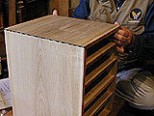
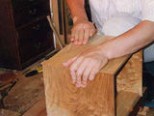
    We assemble the boards that have been processed with interlocking joints and test to see if they fit together perfectly. We carefully check for any parts that don't fit together well. Once the check is complete, we proceed with the final assembly. We apply a thin layer of glue to the joint surfaces and tap them together with our fists, then hammer them in further.

    Step 5: Exterior finishing

    The surface is carefully finished with a plane, checking with fingertips for any remaining fine scratches. Decorative processing, such as rounding the corners, is also applied. After that, the surface is polished to a smooth finish using sandpaper or a plant called horsetail. The final check is made by "feeling" the piece.

    Step 6: Lacquering and attaching metal fittings

    The finishing touch is lacquer coating. The process involves applying lacquer, letting it dry for a day, and then applying another coat, repeating this meticulous process many times. Unless it's a very large piece, this is not entrusted to a lacquer craftsman. Once the lacquering is complete, the metal fittings are attached, and the piece is finished.

    画像をクリックすると動画が再生されます


  • Close-up

    EDO Sashimono (Wood Joinery) that conveys the "chic" of Edo to the present day.

    The Edo spirit of "chic" lies in putting effort into the details that are not visible. The technique, which uses not a single nail, is delicate, elegant, and durable. These are exquisite pieces of "sashimono" (woodwork) that you will want to cherish and pass down from parent to child, from child to grandchild, and great-grandchild for generations. We spoke with Mr. Inoue, a sashimono craftsman with a keen eye for the quality of the materials and the beauty of the wood grain, about the charm of EDO Sashimono (Wood Joinery).


    I naturally entered this world.

    "After graduating from high school, I worked as an apprentice for a year, but then I naturally took over this business. I have two brothers, but the others are regular office workers," says Inoue, the second generation owner. He says that as a child he loved making toys out of wood that was around him. "My father was a true craftsman. He never wrote invoices or receipts," he recalls. However, he says he learned from his father about the importance of customer relationships as a craftsman and that "the quality of the finished product depends on how carefully you do the work." That's why he never cuts corners, no matter how small the item.

    The relationship between "master" and "craftsman" that has supported tradition

    Traditional Japanese joinery is also basically made to order. The development of EDO Sashimono (Wood Joinery) was supported by wealthy merchants known as "danna." Craftsmen would listen to the danna's wishes and bring them to life, receiving payment for the necessary materials and a small profit. "That relationship no longer exists. Currently, craftsmen are left with unsold inventory." In order to pass on traditional techniques and quality, wouldn't it be necessary for consumers to change their mindset and ask craftsmen to do good work for them?

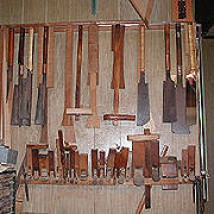
    A collection of well-used tools

    Good things have the power to appeal to people.

    "The more I do it, the deeper I realize it is. I've started to see the true meaning in people's work, not just in woodworking," he says. "I want to use woodworking techniques to create not just established pieces, but also to constantly adapt and try new things." His creative drive is more vigorous than ever. His son, Takeshi, is currently training to become the third generation, and it's been exactly 10 years. "I used to say some pretty cheeky things when I was in my 30s. My son is at that stage now. I think it's about time I gave him a stern talking-to." Inoue says this, but his eyes are always gentle.

    Anecdotes

    Loved by samurai, townspeople, and Kabuki actors, it flourished in Edo.

    "KYO Sashimono (Joinery) often consists of tea ceremony utensils favored by the court nobility, but EDO Sashimono (Wood Joinery), reflecting the culture of the samurai and townspeople, mainly consists of everyday items." The history of EDO Sashimono (Wood Joinery) dates back about 400 years to the mid-Edo period. The shogunate invited craftsmen from all over the country and created craftsman districts such as blacksmiths' towns and carpenter's towns to promote the development of handicrafts. Eventually, it branched out from temple carpenters into joiners, sculptors, and so on, and these became the independent art of "joinery."

    The name "sashimono" (joinery) is said to come from the fact that it is made using a ruler and that boards are joined together by joining them. A characteristic of sashimono is that no nails are used, and boards are joined together by assembling mortises (notches and grooves). Once assembled, the mortises are not visible from the outside. "To make it look 'stylish,' we make it a little 'delicate.' In other words, we use slightly thinner boards and thin measuring sticks. But that doesn't mean it's easily broken." Only perfect technique in cutting extremely precise mortises can make this possible. The world of "stylishness" of Edo people, where skill is put into things that are not visible, is still alive today.


overview

Craft item name EDO Sashimono (Wood Joinery)
Reading Edo Sashimono
Classification of crafts Woodwork/bamboo products
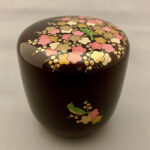
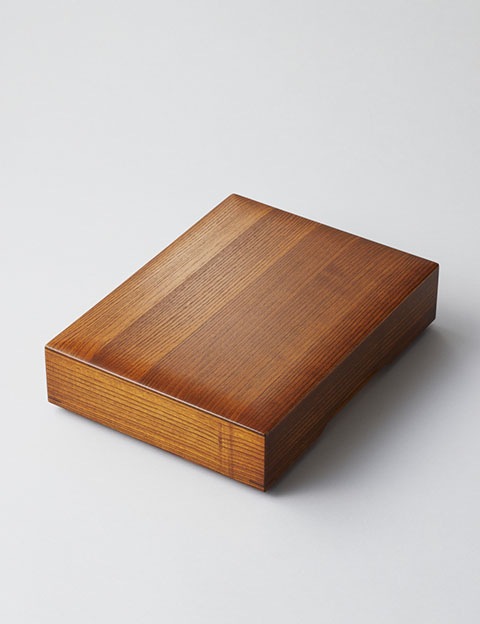
Main Products Chests of drawers, desks, stands, shelves, boxes, braziers, tea ceremony and traditional Japanese music supplies
Main manufacturing area Taito Ward, Arakawa Ward, Adachi Ward, Katsushika Ward, Koto Ward
Designated date May 14, 1997

contact address

■ Production area association

EDO Sashimono (Wood Joinery) Cooperative
112-0005
2-6-4 Suido, Bunkyo-ku, Tokyo
Ma Maison Kohinata 101
TEL: 03-3947-2797
FAX: 03-3947-2797

http://www.edosashi.com/

Features

While KYO Sashimono (Joinery) developed for use in the imperial court and tea ceremonies, EDO Sashimono (Wood Joinery) is characterized by its development for use in samurai families, merchants, and Edo Kabuki actors. It maximizes the beauty of the wood grain, avoids excessive ornamentation, and expresses the refined taste of Edo through its clean form and robust construction. In particular, mulberry wood from Mikurajima Island is known as "Shima Kuwa" and is highly regarded as the finest material.

How to make it

These pieces are made by carving interlocking grooves and protrusions into planks and rods using chisels and knives, without using nails. The edges of the planks are sometimes beveled using a handmade small plane. While the intricate joinery is not visible from the outside, the unseen parts are crafted with meticulous skill, resulting in extremely robust pieces that can last for decades.

Please see here for information on traditional craftspeople.

Japanese traditional craftsman
top