OSAKA Kongo Sudare (Bamboo Blinds)

Osaka Prefecture

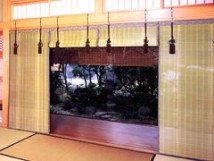
The origins of bamboo blinds are ancient, dating back to the Heian period. The misu blinds used as partitions and decorations in the imperial court and other places are said to be the prototype of the modern tatami room blinds.
Using high-quality bamboo that grows naturally at the foot of Mount Kongo, bamboo blind making flourished in the area of what is now Tondabayashi City, and a production center was established.

  • Technology/techniques/raw materials

    Technology/techniques

    1. Bamboo splitting involves rough splitting, fine splitting, and separating the skin and flesh.

    2. The weaving should be done by arranging the bamboo strips in an orderly manner so that the knots create a pattern on the surface of the blind. In this case, the tortoise shell weave should be done by hand.


     

    raw materials

    1. It shall be made of moso bamboo or a material of equivalent quality.

    2. The yarn used for knitting shall be silk or cotton.

  • Work scene

    The bamboo blinds produced in Tondabayashi and Kawachinagano, at the foot of the Kongo and Katsuragi mountain ranges, are named "Kongo-ren" after the local famous mountain, Mount Kongo. Many of the important processes in the manufacture of these blinds are done by hand. It all begins with "making the bamboo strips" that form the raw material. The strips are created through many stages of work and the hands of many craftsmen, and then they are put through a weaving machine to be woven into blinds. The process of matching the patterns and crests is particularly difficult, and even veteran craftsmen say that on days when they work intensely on this task, their nerves are on edge and they have trouble sleeping.
    Now let's take a look at how OSAKA Kongo Sudare (Bamboo Blinds) are made.

    Step 1: Cutting and felling bamboo

    In the Chugoku region, including Kyoto Tanba, Okayama, and Shimane prefectures, the bamboo is harvested between October and February of the following year, a period when the climate is driest. It is then dried and cut to the appropriate length for various uses.

    Step 2: Peeling

    Use a small knife that follows the curve of the blade to peel off the nodes, and then use a peeling knife to remove the outer layer.

    Step 3: Splitting bamboo

    Using a bamboo splitting knife, roughly split the round bamboo into 8mm wide pieces, then divide each piece into four equal parts. Next, separate the outer layer from the inner layer in half.

    画像をクリックすると動画が再生されます

    Step 4: Making the bamboo strips

    The 1/4-inch wide strips of linden are sorted to fit each blind and then put through a cutting machine.

    Step 5: Polishing and Coloring

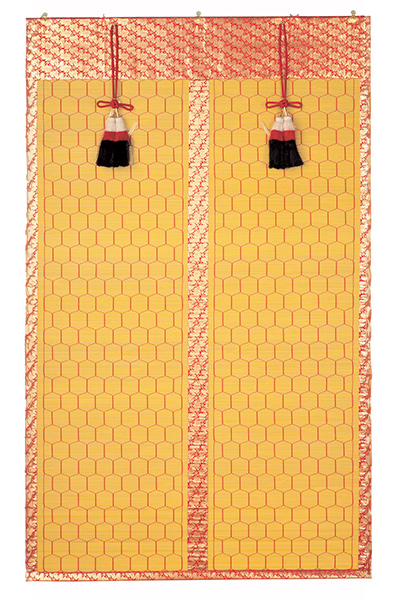
    For shrines and temples, the bamboo is dyed yellow. The thinned bamboo strips are then polished on a polishing machine to give them a shine.

    Step 6: Lace up

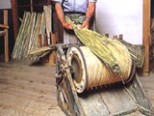
    The bamboo strips are placed on a weaving machine, and each strip is woven using the natural nodes of the bamboo to create a beautiful "L" shape pattern. Cotton yarn is used for weaving, but silk yarn is used for high-quality products.

    画像をクリックすると動画が再生されます

    Step 7: Cutting the Nishiki

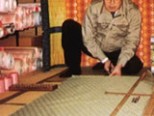
    The raw Nishijin brocade fabric is cut with hand scissors to within a minute's margin of error. When hanging several blinds in a straight line, care is taken to ensure that the patterns and designs are perfectly aligned next to each other. Attention is also paid to ensuring that the pattern on the edges is beautiful when the blinds are finished. This is the most difficult part, and it is where the craftsman's skill is truly showcased.

    Step 8: Edge attachment and hardware attachment

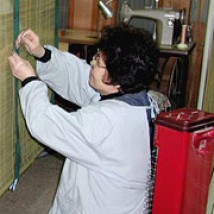
    The edges and center of the woven blind are sewn with a border, and then decorative items such as metal fittings and tassels are attached to complete it.


  • Close-up

    A summer tradition that brings coolness

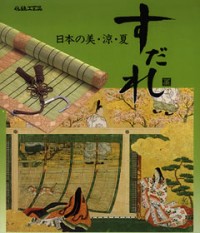
    Originating in the Heian period, the "sudare" (bamboo blinds) used in the imperial chambers known as "omisu" are depicted in works such as The Tale of Genji, exuding an air of refined elegance. Spaces adorned with such tasteful sudare blinds evoke the beauty of bamboo and a distinctly Japanese atmosphere.


    Everyday items used to be made of bamboo.

    Bamboo grows everywhere in Japan, but in the Kinki region, the area around Kyoto, Mount Kongo in Osaka, and the foothills of Mount Katsuragi are known as sources of high-quality bamboo. Since the Edo period, the region has been blessed with good quality moso bamboo, and in Tondabayashi and Kawachinagano, bamboo blinds have been made alongside agriculture. The production volume of bamboo crafts in this region is exceptionally high compared to other production areas. We visited Mr. Toshio Sugita of Sugita Seiren, which manufactures OSAKA Kongo Sudare (Bamboo Blinds). "Looking back, I've lived surrounded by bamboo mountains since I was a child. When I was a child, we made not only bamboo blinds, but also water guns, insect cages, lanterns, baskets, and all sorts of other everyday items out of bamboo." After the war, as lifestyles gradually changed, bamboo products were superseded by plastic and vinyl products. And bamboo products such as bamboo blinds gradually began to change from practical items to decorative and hobby items that made use of the unique texture of bamboo.

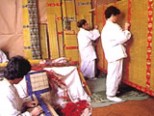
    Sitting on the front and back of the bamboo blind, they worked in unison to stitch the edges.

    Traditional bamboo blinds that preserve the techniques of the past.

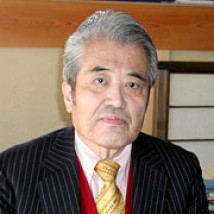
    Sugita Seiren Co., Ltd. was founded in 1839, giving it a history of approximately 160 years. Toshio Sugita is the fifth generation descendant of the first generation, Ihei Sugita. He has a career of over half a century as a craftsman of Kongo blinds. "This blind making was born in the natural environment and climate of Japan, and has been nurtured by history and tradition. The work is still done by hand, both now and in the past. Because bamboo is a natural material, the color and spacing of the nodes vary from piece to piece. In order to beautifully finish the sorting process, we must be able to distinguish subtle differences. This is a process that cannot be done by machine." Mr. Sugita is in charge of the edge cutting process. He cuts the raw materials of "Nishijin Donzu" and "Nishikiori" fabrics with just a pair of scissors. His skill in cutting straight lines without using a ruler is remarkable. He does not entrust this process to anyone else, but handles everything himself. In this way, he continues to make blinds using methods that have continued for over 200 years, preserving traditional culture.

    • The Sugita family has been making traditional bamboo blinds in this area for generations.

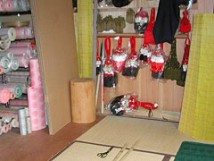
    • In Nishiki's cutting room, a variety of colorful satin fabrics are lined up.

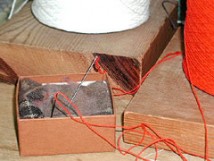
    • Needle and thread for edging

    Making bamboo blinds that suit the times

    Sudare blinds are traditional Japanese decorative items that have been used as sunshades and partitions. After World War II, there was a period when Japanese-style aesthetics were popular in America, and exports of sudare blinds increased dramatically. However, even in Japan today, with the increase in apartment buildings equipped with aluminum sashes and air conditioning, the emotionally evocative way of enjoying the coolness of summer with sudare blinds is becoming less common. As a symbol of summer, "Ozasiki sudare" (bathroom sudare) and "Gosui-ren" and "OSAKA Kongo Sudare (Bamboo Blinds)" (used as partitions in shrines, temples, and Buddhist temples) have survived by battling the times, and at times harmonizing with them. Supported by the recent trend towards authenticity and a renewed appreciation for traditional crafts, "Kongo-ren," which combines emotion, style, and functionality, is now being embraced by consumers once again as a Japanese interior item. This is because researchers are researching and creating wooden sudare blinds that adapt the goodness of sudare to modern lifestyles. The ability to easily adjust the amount of light and wind entering a room with sudare is once again being re-evaluated. Enjoying the changing seasons with your skin and eyes is something unique to Japan. The breeze blowing through the gaps in the bamboo blinds feels somehow cool. This is a way of spending summer in Japan that I want to continue to cherish and enjoy.

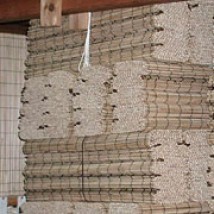
    • Bamboo blinds await shipment. Summer can't come soon enough.

    • Blinds that bring coolness in summer

    Anecdotes

    "Bamboo blinds" as sung about in the Manyoshu anthology

    "As I wait for you, longing for you, the autumn wind blows, rustling the bamboo blinds of my dwelling."
    This is a poem by Nukata no Ōkimi included in the Manyōshū anthology. The poem is accompanied by a preface that reads, "Composed out of longing for the Emperor of Ōmi." The poem expresses the helplessness of waiting for someone who will not come, and the swaying bamboo blinds in the wind are realistically depicted. Bamboo blinds were used in the aristocratic society of the Manyō era. Later, in The Tale of Genji, bamboo blinds are also depicted in the main house and side doors of the mansions of nobles. Bamboo blinds were an indispensable decorative item in homes of the Manyō era.


overview

Craft item name OSAKA Kongo Sudare (Bamboo Blinds)
Reading Osaka Kongo Sudare
Classification of crafts Woodwork/bamboo products
Main Products blind
Main manufacturing area Osaka City, Tondabayashi City, Kawachinagano City
Designated date April 8, 1996

contact address

■ Production area association

Osaka Blind Industry Cooperative Association
584-0024
2-4-25 Wakamatsu-cho, Tondabayashi City, Osaka Prefecture
TEL: 0721-26-1190
FAX: 0721-26-1190

Features

These elegant and dignified bamboo blinds, made from natural bamboo, are used as room dividers or sunshades, possessing a gentle beauty that evokes a distinctly Japanese atmosphere.

How to make it

The process of making a bamboo blind using madake bamboo is broadly divided into three stages: making the bamboo strips, weaving, and finishing.

Please see here for information on traditional craftspeople.

Japanese traditional craftsman
top