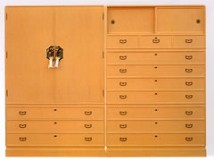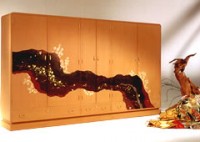
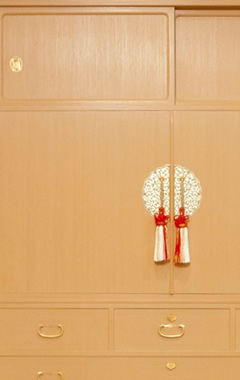
Kishu Tansu (a type of chest of drawers)

Wakayama Prefecture

In the late Edo period, a lightning strike caused the keep and other structures of Wakayama Castle to burn down, and many tools and equipment were reduced to ashes.
Records indicate that when the castle tower was rebuilt four years later, the lost chests and other box-shaped furniture were also remade at the same time. Furthermore, ancient documents and chests dating back to the mid-19th century have been discovered in townhouses throughout Wakayama Prefecture, indicating that chests were already being made in Wakayama as wedding furnishings, even outside of samurai families.

  • Technology/techniques/raw materials

    Technology/techniques

    1. Drying should be done by natural drying.

    2. The boards used shall be solid wood. In this case, the thickness of the boards shall be 19 mm or more for the top board, side boards, shelves, support boards and bottom boards, and 7 mm or more for the back board and drawer bottom boards.

    3. The joining of the top, bottom, and shelves to the side panels shall be carried out using the following techniques or methods:
    (1) The top panel shall be joined to the side panels by one of the following methods:
    (i) For those other than the round-bodied type, the construction shall be by a front-fastened lattice joint of seven or more pieces, a lattice joint with a front fastening, or a lattice joint with a wrap-around construction.
    (b) In the case of round-bodied pieces, the joint should be a body-attached mortise and tenon joint.
    (2) The base boards shall be joined to the side boards by a front miter joint or a mortise and tenon joint of seven or more boards.
    (3) The shelf boards shall be joined to the side boards by a butt joint.

    4. The drawer components shall be joined by a dovetail joint, a snap joint, a dovetail joint, or a simple dovetail joint.

    5. When installing doors or sliding doors, the following techniques or methods shall be used:
    (1) In the case of boards, the thickness of the board material shall be 19 millimeters or more, and the frame of the core material shall be joined by a miter joint.
    (2) In the case of framed structures, the thickness of the board material shall be 19 millimeters or more for frame members and 7 millimeters or more for end panels, and the frame members shall be joined by miter joints or mortise and tenon joints.

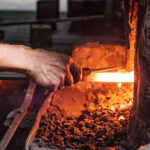
    6. The finishing touches involve applying a textured finish, coloring with alder wood, and then polishing with wax.
     

    raw materials

    1. The wood used should be paulownia.

    2. The nails shall be made of Deutzia wood or of equivalent material.

    3. The metal fittings shall be made of copper, copper alloy, or iron.

  • Work scene

    Kishu paulownia chests of drawers have been passed down since the Edo period. The dedication of the craftsmen who paid attention to even the unseen details is conveyed through these chests of drawers. Let's take a look at the delicate craftsmanship step by step.

    Process 1: Building material

    The first step in creating a superior chest of drawers begins with selecting good paulownia logs. Paulownia logs from trees aged 30 to 60 years with fine, even annual rings are selected for straight-grained lumber. Other logs are selected for flat-grained lumber. These logs are not immediately processed. They are naturally dried for six months to two years. This process removes impurities and cultivates the beauty of the wood grain.

    Process 2: Board processing

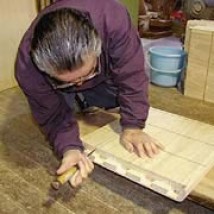
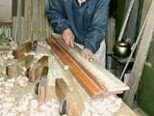
    After a long drying period, it's finally time to process the wood. The boards are cut to the appropriate size for each part of the chest of drawers. For the fronts of the doors and drawers, we use boards made from beautifully grained straight-grained wood. We select the quality of the wood, checking for warping, knots, and defects before cutting. We choose only boards with beautiful straight grain that are 2-3 cm wide. Then we glue them together, align the boards, firmly fix them in place, and apply pressure to make a single board. Finally, we carefully plane it to finish it into a single, smooth board.

    工程3: 組立

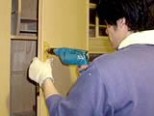
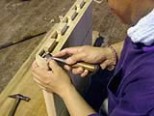
    Next, we move on to the process of assembling the boards that have been cut into individual parts. First is the "body" section. Interlocking notches are made in the parts that will be joined vertically and then assembled. These notches are called "mortise and tenon joints." There are types such as "dovetail joint joints" and "wrapped dovetail joint joints" where the joint is not visible from one side. In this way, each part of the "body" (top board, shelves, bottom board, side boards, and base) is assembled. As a precaution, a trial assembly adjustment is performed before the actual assembly. When fitting the back board, wooden nails are quickly driven in before the glue dries. After driving in the nails, the surface is wiped with water. This is to ensure the nails are tightly attached and to restore the nail marks. After it has dried completely, the surface is planed to finish. Ordinary nails are not used because of concerns about rust. Wooden nails are made from a hard wood called "Deutzia." Approximately 400 wooden nails are used in one paulownia chest of drawers. With this, the "body" is complete. Next is the "drawer" section. First, before assembling the "mortise and tenon joints," the wood is "settled." The corners and surfaces are hammered down to make it easier for the pieces of wood to fit together. The bottom is then secured with wooden nails, wiped with water, and finished with sanding. A common experiment to test how perfectly the drawers fit together is to insert one drawer and have the other already inserted drawer slide out. There is absolutely no gap. Next is the "tray" section. The frame is secured by wrapping it with hemp twine. The bottom board is fitted in, and wooden nails are driven in diagonally with the outside facing outwards. After drying, the outside is rounded to complete the piece. More than 50 different types of planes are used for various parts throughout the entire process.


    画像をクリックすると動画が再生されます


    画像をクリックすると動画が再生されます

    工程4: 仕上げ

    Now it's time for the finishing touches. First, we apply the "uzukuri" technique. "Uzukuri" is like a small broom made by wrapping and bundling the roots of the Japanese laurel tree with hemp thread. We use this to carefully polish the wood, bringing out the grain and making it beautiful. It also makes it easier to stain. To further enhance the beauty of the wood grain, we apply several layers of a mixture of the decoction of the fruit of the Japanese alder tree and polishing powder. Finally, we apply wax. Then we attach the door, fit the drawers together, and finally attach the hardware to complete the piece.


  • Close-up

    A commitment to traditional crafts that has finally come into the spotlight: the pride of Kishu paulownia chest craftsmen.

    KISHU Kiri Tansu (Paulownia Chests) have now become firmly established as the finest quality chests of drawers, but overcoming the difficulties to get to this point is the result of the efforts of 10 volunteers, including Mr. Kiyoshi Kaminaka, who is currently the chairman of the Kishu Paulownia Chest of Drawers Cooperative Association.


    The path to certification as a traditional craft

    Due to the slow pace of mechanization and the rise of Western furniture, the production of traditional paulownia wood chests of drawers had stagnated. Around 1955, there were about 80 manufacturers, but by 1984, that number had plummeted to just 20. Perhaps it was the local character of Kishu Wakayama, or perhaps a lack of a sense of crisis, but the chest-making continued at a leisurely pace. It was at this time that Mr. Uenaka stepped up, realizing that this situation couldn't continue. Determined to "preserve the name of the production area and establish a handmade brand," he began preparing to apply for certification as a traditional craft. However, even though everyone knew that the chests were made in Wakayama City, there was no historical proof to prove it. The evidence that everyone assumed existed simply didn't exist. Just when they were about to give up, they found ancient documents related to wedding preparations in 1844, 1853, and 1856 at the Sowa family residence in Kokawa-cho, Wakayama Prefecture (a family of the 33rd generation village headman). These documents clearly stated, "We will buy one chest of drawers in Wakayama." "This was the deciding factor," Uenaka says happily. Finally, after three years of preparation, their product received certification as a traditional craft, following in the footsteps of KISHU Shikki (Lacquerware). He still clearly remembers the then-governor of Wakayama Prefecture, Shiro Kariya, saying, "You did a great job. You've doubled the number of traditional crafts in Wakayama."

    Kishu Paulownia Chest of Drawers

    To have the true value recognized.

    However, simply receiving certification wasn't enough to guarantee sales. He personally demonstrated his products at department store exhibitions, traveling all over the country. These steady efforts gradually led to the market recognizing "authentic Kishu paulownia chests." In 1999, when he participated in the opening ceremony of the Wakayama City Multipurpose Hall as a demonstrator, Mr. Uenaka recounts his joy, saying, "I was deeply moved when Their Majesties spoke to me." He also mentions the support he received from within the industry, saying, "I was greatly helped by the diligent sales staff at department stores." In this way, Kishu paulownia chests have become a respected product, and demand has remained strong even during economic downturns. It can be said that this success is largely due to Mr. Uenaka's strong leadership.

    Work scene

    I am still grateful to my strict master.

    Fifty-three years ago, at the age of 14, Mr. Kaminaka began his apprenticeship as a chest maker. His master at the time was Shonosuke Takiya, who was from Shingu. There was an anecdote from his apprenticeship under his strict master: "I missed hammering in a nail, and when I hammered in a replacement, I forgot to remove the old one. Afterwards, my master was planing the board, but the blade got caught on the nail I had forgotten, and broke. Before he could even cut the board, the plane was thrown and flew right in front of my eyes." Thanks to such a strict master, Mr. Kaminaka learned the rigor of his work and the importance of valuing authenticity. That spirit will undoubtedly continue to be put to good use in his paulownia wood chest making.

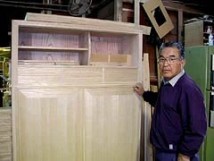
    Paulownia chest and Mr. Uenaka

    Craftsman Profile

    Kiyoshi Uenaka

    Born in 1933 (Showa 8).
    He became an apprentice at the age of 14 and is a veteran with 53 years of experience in chest making. He has held positions such as Chairman of KISHU Kiri Tansu (Paulownia Chests) Traditional Craftsmen's Association and Chairman of the Wakayama Furniture Manufacturers Association, among others. He has received numerous awards, including the Minister of International Trade and Industry Award and the Wakayama Prefectural Governor's Award.

    Anecdotes

    Various information about KISHU Kiri Tansu (Paulownia Chests)

    I've compiled some information related to KISHU Kiri Tansu (Paulownia Chests).
    Characteristics of Paulownia
    To talk about paulownia wood chests, we first need to consider the properties of the paulownia wood material itself. The first property is that it is "lightweight and has a beautiful grain," the second is that it has a "low shrinkage rate," the third is that it "insulates against moisture," and the fourth is that it has "low thermal conductivity."
    Characteristics of Paulownia wood chests
    The characteristics of paulownia wood, or rather, the features of paulownia chests of drawers, can be summarized in three practical terms: 1. The soft texture, color, and beautiful grain of paulownia wood match both Japanese and Western-style rooms, creating a peaceful and elegant atmosphere. 2. It is sensitive to the outside air and has a constant humidity property, absorbing moisture when it is humid and releasing moisture when it is dry. In the event of a fire, it absorbs water and is difficult to burn, hence the saying, "It burns the body to save the contents." 3. Paulownia chests of drawers are resistant to expansion and contraction, are lightweight and easy to move, making them ideal as storage furniture for long-term use.

    • A refined Kishu paulownia wood chest of drawers


overview

Craft item name Kishu Tansu (a type of chest of drawers)
Reading kishu tansu
Classification of crafts Woodwork/bamboo products
Main Products Paulownia wood chest of drawers
Main manufacturing area Wakayama City
Designated date April 18, 1987

contact address

■ Production area association

Kishu Paulownia Chests Cooperative Association
640-8511
23 Nanabancho, Wakayama City, Wakayama Prefecture
Wakayama City Industrial Exchange Bureau, Industry Department, Commerce and Industry Promotion Division, Industrial Promotion Section
TEL: 073-435-1233
FAX: 073-435-1256

https://kishutansu.com/html/business.html

Features

Paulownia wood has a beautiful, elegant pale yellow grain, and its softness and lightness make it an ideal material for storage furniture. Wakayama is also known for its meticulous and precise joinery work.

How to make it

The paulownia wood is desaturated, naturally dried, and then joined together to the required width. When the boards are planed and assembled into a box, traditional methods such as dovetail joints and grooving are employed. Once the main body, drawers, and doors are assembled, the finishing touches are applied to each part. Finally, the surface is dyed with a decoction of alder, a natural dye, and then polished with wax, a method that beautifully brings out the natural beauty of the wood.

top