BEPPU Take Zaiku (Bamboo Basketry)

Oita Prefecture

It is believed that the craft began in the Muromachi period when merchants started making and selling baskets for traveling goods. In the Edo period, as the name of Beppu Onsen (hot springs) became widespread, kitchenware for guests staying at the hot springs was made. As these items began to be taken home as souvenirs, bamboo crafts were produced in large quantities, and it became a local industry in the Beppu area.
In the late Meiji period, the Beppu Industrial Apprentice School's Bamboo Basketry Department was established, producing many excellent craftsmen and technicians, laying the foundation for present-day BEPPU Take Zaiku (Bamboo Basketry).

  • Technology/techniques/raw materials

    Technology/techniques

    1. The "strip cutting" and component construction shall be carried out using the following techniques or methods.
    (1) To use a "melody" or "rhythm".
    (2) For those that will be given a "painted finish" or a "rusted finish," the "bark peeling" must be performed.
    (3) Use a bamboo splitting knife for peeling.
    (4) The "plow" must be made by "hand plow" or "plow with a pig iron."
    (5) Use a "width-cutting knife" for "width-cutting".
    (6) For "chamfering," use a "chamfering knife" or a "chamfering kitchen knife."


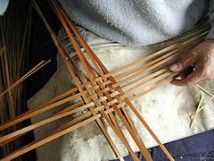
    2. The "weaving" shall be done using the following techniques: "four-eye weave," "six-eye weave," "eight-eye weave," "basket weave," "mat weave," "rope weave," "ring weave," or "chrysanthemum-bottom weave."


    3. The "edge finish" shall be one of the following: "matching edge finish," "reinforced edge finish," or "rolled edge finish."


    4. When attaching the bamboo, use either the "inserting method" or the "bending method".


    5. If a "foot stand" is to be attached, it should be either a "rolled foot stand" or a "decorative foot stand".


    6. When applying a "painted finish," after dyeing the base coat, apply refined lacquer and then polish it to a shine.


    7. When applying a "rust finish," the following techniques or methods shall be used.
    (1) After the base dyeing and top dyeing, polish the surface.
    (2) After applying a base coat using refined lacquer, apply a rust-like finish.
    (3) After applying a top coat using refined lacquer, polish it to a glossy finish.
     

    raw materials

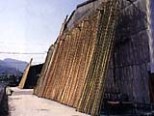
    1. The bamboo used shall be Madake, Hachiku, Kurochiku, Gomadake, Medake, or Shinodake, or a material of equivalent quality.

    2 漆は、天然漆とすること。

  • Work scene

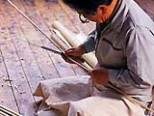
    Most BEPPU Take Zaiku (Bamboo Basketry) are made from locally sourced bamboo. We will guide you through the process of creating BEPPU Take Zaiku (Bamboo Basketry) which are made possible by the abundance of high-quality bamboo available in the area.

    Step 1: Cutting and oil removal

    The bamboo branches cut from the bamboo grove are trimmed and sorted by thickness. The bamboo is boiled in a solution containing caustic soda to extract the oil. The extracted oil is then wiped off. Bamboo intended to be used in its whole, round form is roasted over a fire to straighten out any bends.

    画像をクリックすると動画が再生されます

    Process 2: Sun drying

    The bamboo, after the oil has been removed, is dried in the sun. Drying is complete when an ivory-colored sheen appears. Sun-dried bamboo is called "sarashitake" (bleached bamboo).

    Step 3: Cutting and rough splitting

    The bleached bamboo is cut to the required length, and the raised nodes are shaved off with a hatchet. Next, the bamboo is split in two along the grain using a bamboo splitting knife. This process, called "rough splitting," is repeated, and the resulting pieces of bamboo are then split lengthwise to create the base for bamboo strips.

    画像をクリックすると動画が再生されます

    Step 4: Peeling

    The roughly split bamboo is peeled in a ratio of about 4 parts skin to 6 parts flesh. This is called "rough peeling." The roughly peeled bamboo is then split lengthwise and peeled into thin layers.

    Step 5: Finishing the bamboo strips

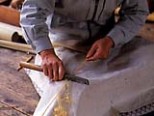
    The thinned bamboo strips are straightened by passing them between the blades of two small knives, which are fixed to the required width on a stand. The strips, now of uniform width, are then thinned to a consistent thickness using a tool called a "sen." Finally, the corners of the strips are chamfered with a chamfering knife, completing the bamboo strip making process.

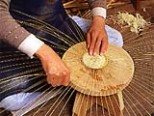
    Step 6: Knitting the base

    Bamboo crafts are always woven starting from the base. The most difficult part of the weaving process is creating the base, where the flat surface transforms into a three-dimensional shape. Once the base is firmly established, the weaving will be completed neatly.

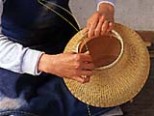
    Step 7: Knitting the body and neck

    Once the waist is done, the next step is the body. Even just the basic weaving techniques include four-eye, six-eye, eight-eye, woven pattern, mat pattern, and wire-like pattern. Depending on the shape, use, and design of the product, these weaving techniques are combined or modified.

    画像をクリックすると動画が再生されます

    Step 8: Edge finishing and mounting finishing

    The weaving is completed by finishing the edges. Edge finishing methods include "kyoen" (using the woven bamboo strips as they are), "ateen" (applying bamboo strips and tying them with bamboo strips or wire), and "makien" (wrapping with bamboo or rattan). After this, handles, bases, earrings, etc. are attached as needed.

    Step 9: Painting

    The finished pieces are then given either a "painted finish" using raw lacquer or a "rusted finish" using vermilion lacquer or raw lacquer. In either case, a base dye may be applied by boiling dye before painting, if necessary.


  • Close-up

    From souvenirs for spa-goers to works of art and crafts

    Beppu Onsen is famous throughout Japan. Bamboo crafts, originally souvenirs for spa-goers, were eventually elevated to fine arts and crafts by discerning individuals such as cultural figures. Beppu also made early efforts to train young craftsmen, and the techniques of BEPPU Take Zaiku (Bamboo Basketry) have advanced significantly.


    BEPPU Take Zaiku (Bamboo Basketry) developed alongside hot springs.

    Beppu is renowned as one of Japan's leading hot spring resorts. The bamboo craftsmanship of Beppu, like the hot springs themselves, has a long history, even being mentioned in the Nihon Shoki (Chronicles of Japan). In the Meiji era, when hot spring tourism developed, BEPPU Take Zaiku (Bamboo Basketry) became popular souvenirs among visitors, and the items they took home became popular in turn, spreading its reputation throughout the country. What had previously been a small-scale side business for farmers evolved into a major production center for bamboo crafts, with full-time artisans emerging.

    A knitting technique called four-eye knitting

    Establishment of a school to train skilled craftsmen

    As Beppu developed as a hot spring resort, businesspeople and cultural figures began to acquire villas there and visit regularly. These people increasingly sought bamboo crafts not only as souvenirs but also as works of art and craft. Therefore, in 1902 (Meiji 35), the Beppu-Hamawaki-Hama School Association Industrial Apprenticeship School was established, making it possible for young people aspiring to become craftsmen to acquire advanced skills. Many skilled artisans also moved to Beppu from other prefectures.
    Thus, alongside the prosperity of Beppu Onsen during the Meiji, Taisho, and Showa periods, bamboo craftsmanship also entered its golden age. Craftsmen honed their skills through friendly competition, producing many outstanding artisans. Even today, Beppu is home to Japan's only advanced technical school where one can learn specialized bamboo craft techniques.

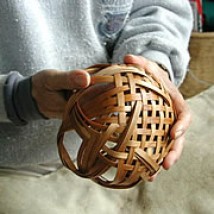
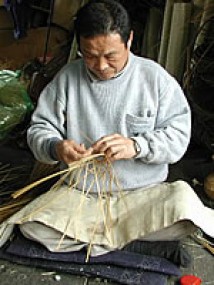
    The basket was made in no time.

    Dynamic "Yatara knitting"

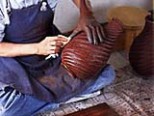
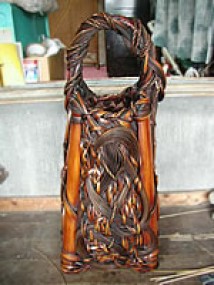
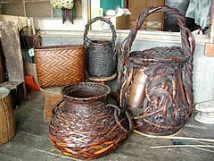
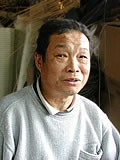
    Traditional craftsman Masataka Yufu was born in Beppu City in 1941. His father was also a bamboo craftsman, so Yufu naturally began helping out by imitation from around middle school age. Yufu's specialty is a weaving technique called "Yatara weaving," a dynamic, rough, and bold style. His father also specialized in this Yatara weaving technique. We were shown a vase made using this Yatara weaving technique, and were simply overwhelmed by its power and strong energy. Such distinctive works are apparently very popular as interior decorations in Europe and America.

    A large-scale Yatara knitting project

    The allure of bamboo, similar to that of women.

    "The feelings I have at the time are reflected in my work, so I cherish the feelings I had when I decided to create it." Fudo Myoo, waterfalls, the sea... these are some of the images that influence his work. Mr. Yufu is also a hobbyist who loves ikebana (flower arrangement) and shigin (recitation of poetry). "It's the best feeling when the image of the flowers and the vase I made match perfectly. Conversely, it's no good if the flowers are overpowered when I arrange them." One can sense an extraordinary love for flowers. From the straight, natural material of bamboo, human hands take it, weave and bend it to create something completely different, a beautiful curved object. And then, flowers, which are nature itself, are arranged in it. The harmony that is born from this is truly exquisite.
    "The charm of bamboo lies in its elasticity. It's like a woman; it has the strength of a spring, but at the same time, it's supple and shows its vulnerable side," Ms. Yufu said, and before we knew it, a cute little basket resembling a temari ball was taking shape in her hands. Her masterful movements were so impressive that we couldn't help but sigh in admiration.

    Knitting with delicate hand movements

    The user's affection for the product adds to its luster.

    "I feel more fulfilled and able to create better works when orders keep coming in one after another and I'm busy," says Mr. Yufu, who recently started playing golf after being invited by a friend. He also enjoys playing Go and Shogi, but says, "I try to be in the top five at everything, so it's not really refreshing." This diligence is probably the source of his energetic ability to create new works one after another.
    BEPPU Take Zaiku (Bamboo Basketry) possess a reliability born from a long history and the reliable skills of its artisans, as well as a unique charm that only genuine products can have. This is undoubtedly due to the daily efforts of the craftsmen who created them, but it will surely gain an even more beautiful sheen through the affection and care of those who acquire them.

    Some of Yufu's works

    Craftsman Profile

    Masataka Abufu

    Born in Beppu in 1941. Received a commendation from the Mayor of Beppu in 1988 as an outstanding skilled worker.


overview

Craft item name BEPPU Take Zaiku (Bamboo Basketry)
Reading Beppu Takezaiku
Classification of crafts Woodwork/bamboo products
Main Products Tea sets, flower vases, serving baskets, hand towel holders, individual plates, magazine racks, interior decor items
Main manufacturing area Oita City, Beppu City, Hita City, Kitsuki City, Yufu City, Hiji Town, Hayami District
Designated date August 3, 1979

contact address

■ Production area association

Beppu Bamboo Products Cooperative
874-0930
1-5 Hikari-cho, Beppu City, Oita Prefecture
Iwao Chikuranuchi
TEL: 0977-22-4074
FAX: 0977-22-4342

https://www.beppu-take-kumiai.com/

Features

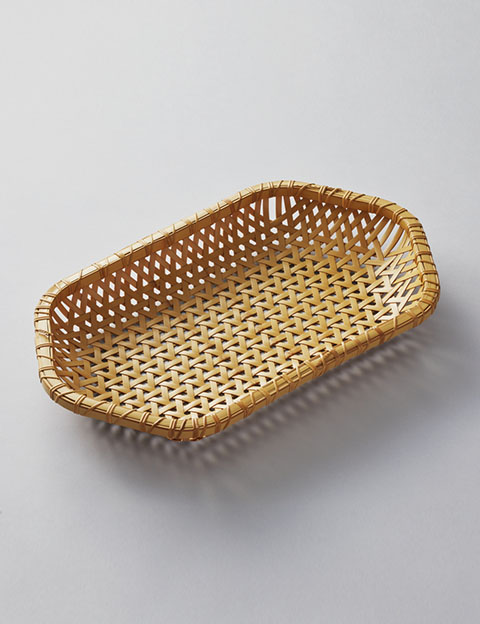
The main material used in BEPPU Take Zaiku (Bamboo Basketry) is Madake bamboo from Oita Prefecture, which is suitable for weaving. Other types of bamboo such as Hachiku, Kurochiku, Gomadake, and Medake are used depending on the application, and products that bring out the natural beauty of bamboo are made based on eight basic techniques.

How to make it

The bamboo is degreased, bleached, sun-dried, roughly split, and then roughly peeled, gradually becoming thinner through repeated splitting and peeling until it reaches the desired thickness and width for the product. There are over 400 different weaving patterns, and various products are made by combining them in different ways.

top