MIYAKONOJO Daikyu (Bamboo Bows)

Miyazaki Prefecture

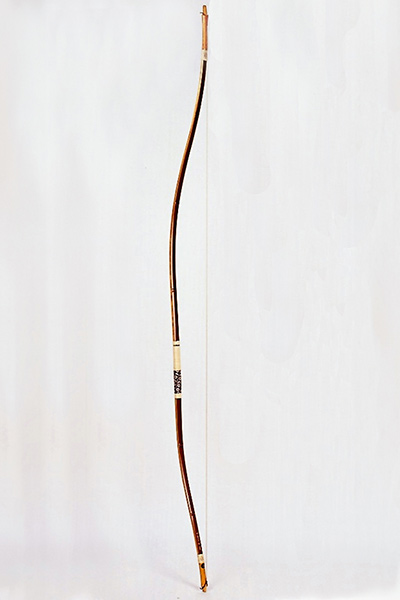
This large bow, which originates from the Kagoshima Nari style, was produced in large quantities during the late Edo period, as recorded in historical documents. In the Meiji era, the Kusumi father and son, who moved from the Kawauchi area, trained many bow makers. Blessed with abundant raw materials, the area became a major production center in the early Showa period, with products being sold as far as East Asia.
After the war, there was a period of decline, but at its peak, nearly 30 bow makers were active. Even today, it is the only production area in Japan that produces 90% of the country's bamboo bows.

  • Technology/techniques/raw materials

    Technology/techniques

    1. Drying should be done by natural drying.


    2. The bamboo should be "fired".


    3. The processing of the "bow core" shall be carried out using the following techniques.
    (1) The bamboo is sandwiched between "side pieces" and glued together, then secured with rope or wedges.
    (2) The upper and lower parts of the bow should be thinned down to be thinner than the grip.


    4. The processing of "bow bamboo" shall be carried out using the following techniques.
    (1) It is made of bamboo with six nodes on the inside and seven nodes on the outside.
    (2) Thicken the grip portion of the bow by about 0.4 mm from the top and bottom, and then finish carving it.


    5. The "striking" technique shall be as follows:
    (1) The "bow core" is sandwiched between "bow bamboo" and the "front board" and "gate board" are attached.
    (2) Attach a bamboo support to the bow, wrap it with rope or similar material, and tighten it with a wedge to create a semi-circular curve.


    6. "Stakeout" should be carried out using the following techniques:
    (1) Make a "yuhazu" on the "gakugi" and "sekiban" and leave it on the stretching stand for about half a day.
    (2) To shape the bow by stepping on it with your feet.


    7. The finishing touches include polishing the "frame board" and "gate board," and wrapping the "handle brackets," etc., with rattan.
     

    raw materials

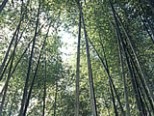
    1. The bamboo material used shall be Madake bamboo or a material of equivalent quality.

    2. The board material used shall be made of seam wood or a material of equivalent quality.

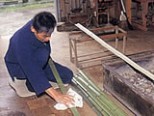
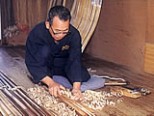
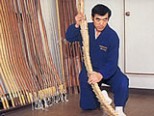
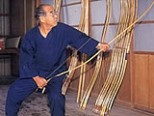
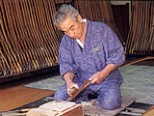
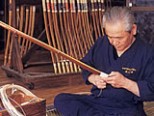
  • Work scene

    MIYAKONOJO Daikyu (Bamboo Bows), which inherits the tradition of the sturdy and practical Satsuma bow, is gaining increasing attention as time goes on, for the elegant beauty of its curves unique to bamboo bows and for its value as a traditional craft that should be passed down to future generations.
    The tradition of MIYAKONOJO Daikyu (Bamboo Bows) and its "world of refined elegance" is not all about hitting the target; it is a masterpiece that resonates with the soul of the archer.
    The materials used for MIYAKONOJO Daikyu (Bamboo Bows) are madake bamboo and sumac, nurtured by Miyakonojo's warm climate and abundant nature. The process of layering these materials to create a large bow is said to involve more than 200 steps. And all of these steps are completed by hand by a single bow maker.
    MIYAKONOJO Daikyu (Bamboo Bows) are characterized by their excellent arrow flight efficiency and comfortable string placement, along with the elegance unique to bamboo bows. Imagining the clear, resonant sound of the string at the moment the arrow is released, the bowmakers at the foot of the majestic Kirishima Mountains pour their hearts and souls into crafting each and every bow.
    Here, we will give a general explanation of the manufacturing process for MIYAKONOJO Daikyu (Bamboo Bows).

    Process 1: Bamboo forest

    High-quality bamboo grows in Miyakonojo. The material for the large bow is 3-year-old moso bamboo nurtured by the rich natural environment.

    Step 2: Cutting the bamboo

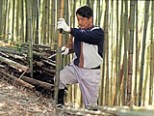
    The best time to harvest bamboo is during the cold months of November and December. Bamboo harvested during this cold period is considered the best material for bows because it is in the dry season. Two types of bamboo are cut: Madake bamboo with a circumference of 18-21 cm for the bow shaft and Madake bamboo with a circumference of 30 cm or more for the core shaft. After splitting these into smaller pieces, they are left to air dry for 3-4 months.

    Step 3: Degreasing and drying the bamboo bow.

    The bamboo used for the bow is roasted over charcoal to remove any oil it contains. The bamboo that will form the inside of the bow is smoked in a chamber to give it resilience, creating sooty bamboo. The process of washing away the soot with water is repeated for one to two years until the bamboo turns amber in color.

    Step 4: Heat treatment of the bow bamboo and core bamboo.

    To maintain the curve, the outside of the bow bamboo is heated only on the inside, while the inner bamboo and core bamboo are heated strongly on both sides until they are charred.

    Step 5: Attaching the bow core

    Four to seven thin slices of charred bamboo core are shaved, and both sides are glued together, wrapped with the side pieces of sumac wood. Wedges are driven in to tighten and straighten the bow core. The thread, whose length and weight are matched to the length of the warp, is twisted using a twisting wheel called a "hatcho."

    Step 6: Shaping the bow bamboo

    The heat-treated bamboo bow is shaved, focusing on the grip area. The finishing shaving is done evenly, so that the bow becomes slightly thinner towards both ends.

    Step 7: Planing the lining and back panel.

    This is used to prevent the inner bamboo from shifting at the points where the bowstring is attached at the top and bottom. Since the curves of the upper and lower parts are different, the bamboo is finished to match those curves.

    Step 8: Strike the bow

    The bow core is sandwiched between bamboo poles, and the forehead piece and the end piece are attached and glued in place. 80 to 100 wedges are used to tighten the piece while driving it in, creating a semi-circular curve.

    Step 9: Stretching the bow

    The wedge is removed, and the bow is shaped on a stringing stand. The string is attached, and the shape of the bow is refined by stepping on it with the foot while checking the shape of the top and bottom. The quality of the bow is determined at this initial stage of tensioning.

    Step 10: Finishing the bow

    After roughly shaping the bow, it is strung for about 10 days until the shape has settled. Then, the grip, forehead, and end plate are shaped using a hatchet or small knife in a way that suits the bow.

    Step 11: Grip and Bundle

    After the finished bow is further tensioned and adjusted, it is wrapped in rattan.

    工程12: 完成

    MIYAKONOJO Daikyu (Bamboo Bows) is made by hand through over 200 steps, and is completed in this way.


  • Close-up

    Inheriting the skills of master craftsmen, the "spirit of Japan" still lives on in MIYAKONOJO Daikyu (Bamboo Bows)

    MIYAKONOJO Daikyu (Bamboo Bows) has a tradition and technique that has been passed down since the Nanboku-cho period, and has been highly regarded by samurai in ancient times and by many archers in modern times.
    This region, known as a land of martial spirit, is said to have preserved the spirit of the Kamakura samurai until the Meiji era. Martial arts were encouraged, and the manufacture of martial arts equipment flourished.


    The origin of "MIYAKONOJO Daikyu (Bamboo Bows)"

    Miyakonojo is the birthplace of the Shimazu family, who ruled the largest manor in Japan known as Shimazu-sho during the Middle Ages and later became the lords of the Satsuma Domain. In the Satsuma Domain, which has a long history of martial arts, martial arts were encouraged and the manufacture of weapons and armor flourished. Among them, MIYAKONOJO Daikyu (Bamboo Bows) was particularly renowned, and it is said that its manufacturing method was already established in the early Edo period.
    Even today, Miyakonojo produces over 90% of the bamboo bows in Japan. This time, we spoke with Shigeji Nagano, a traditional craftsman and bow maker specializing in MIYAKONOJO Daikyu (Bamboo Bows) 's large bamboo bows.

    The History of "MIYAKONOJO Daikyu (Bamboo Bows)"

    Mr. Nagano's bow workshop was located in a quiet area about 20 minutes by car from downtown Miyakonojo. Mr. Nagano was a taciturn man, with the air of a true craftsman who makes traditional martial arts equipment. He spoke to me slowly and deliberately about the history of bows. "Originally, this area encouraged martial arts, but it was also a production area for high-quality bamboo. This is written in Edo period documents. Then, in the Meiji era, Mr. Kusumi, a bow maker from Kagoshima, came to Miyakonojo and trained many apprentices. All of the bow makers today are direct descendants of him. Furthermore, in the early Showa era, the market expanded to Asian countries, establishing Miyakonojo as a center for bow production."

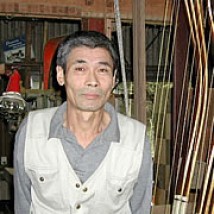
    Shigeji Nagano at his workshop

    The relationship between the Japanese spirit and archery

    There is a Japanese expression, "tegusune o hite matte" (to wait with one's hands full). The origin of this expression, tegusune, refers to a sticky substance made by mixing pine resin and oil, which was applied to the bowstring to increase its strength. In other words, it comes from the image of taking kusune in one's hand, applying it to the bowstring, and waiting for the enemy. There are many other idioms related to bows as well. This shows just how deeply Japanese culture and spirit are intertwined with the bow. Nagano told us, "I feel proud to be carrying on this ancient Japanese spirit."

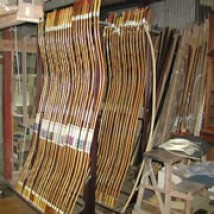
    MIYAKONOJO Daikyu (Bamboo Bows), awaiting final finishing touches.

    "Ah, this time I've made a fine bow."

    Bow making, of course, involves every single step being done by hand. Moreover, all of these steps are carried out by a single bow maker.
    "Of course, I also go into bamboo groves in search of good bamboo. Different types of bamboo are used for the inside, outside, and other parts of the bow. The time to cut bamboo is from November to December. This is the time when the bamboo enters its dry season, so it's the best time for bow making. It's a cold time of year, but when I find good bamboo, I'm so happy that I get so fired up that I forget the cold," says Nagano. "After that, the bow goes through many processes, but a bow is a living thing, so unless you make it with love and put your heart and soul into it, you can't make a bow that you can show to others."
    I asked him what he would do if he didn't like the bow he made. After a moment of silence, he replied, "I'd smash it to pieces." Each bow, crafted with meticulous care, has the maker's name engraved on it. It must be the craftsman's pride that prevents him from putting anything he's ashamed of out into the world.
    In response to the question, "So, what kind of feelings do you have when you've completed a bow that you're satisfied with?", Mrs. Nagano, who had been quietly listening beside him until then,
    "He looked so happy, saying, 'Oh, this time I've made a really good bow!'" she replied with a smile.

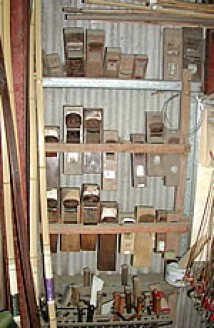
    A plane, a beloved tool that I've used for many years.

    Craftsman Profile

    Shigeji Nagano

    Born in 1937 (Showa 12).
    Following in the footsteps of my predecessor, I have been making large bows for 35 years now.

    Anecdotes

    History and Historical Sites of Miyakonojo

    The Miyakonojo region first appeared in historical records in the 8th century. At that time, the Hyuga Province was under a county system, and the Miyakonojo region belonged to Moroagata County. It is also said that in the 11th century, the Shimazu Manor was established as a manor through the development of Taira no Suemoto. At the beginning of the Kamakura period, Koremune no Tadahisa was appointed as the chief land steward of the Shimazu Manor by Minamoto no Yoritomo, and later Tadahisa changed his surname to Shimazu. His descendants later became the Shimazu clan, who held power throughout southern Kyushu.
    In the early Muromachi period, Suketada, the son of Shimazu Tadamune, the fourth head of the Shimazu clan, was granted this land, and he changed his surname to "Hongō" after the territory. From then on, the Hongō clan expanded its power, and by the time of the eighth head, Tadasuke, they had almost unified the Miyakonojo Basin. During the tenth head, Tokihisa, their power reached its peak. After Toyotomi Hideyoshi's conquest of Kyushu, the Hongō clan was forced to leave Miyakonojo due to a change in their positions, but after the Shōnai Rebellion in 1599, the Hongō clan returned to Miyakonojo.
    In the early modern period, this region was a private territory of the Satsuma Domain, governed by the Miyakonojo Shimazu (Kitago) clan. They had a stipend second only to the lord of the domain, and possessed an organizational structure similar to that of the main domain, governing their territory with local administrators (jito). Furthermore, 182 Miyakonojo soldiers participated in the Boshin War at the end of the Edo period, fighting alongside the main domain. In addition, 1,550 soldiers participated in the Satsuma Rebellion as part of Saigo's army.
    Following the abolition of the feudal domains and the establishment of prefectures in 1871, Miyakonojo Prefecture was established in this region, but it only existed for a short period of just over a year.
    In 1883, it was incorporated into Miyazaki Prefecture, became Miyakonojo Town in 1889, and was granted city status on April 1, 1924. Subsequently, it merged with the towns and villages of Okimizu, Ichiichi, Shiwaike, Shonai, and Nakago, resulting in its current form.

    • Miyakonojo Garrison (Local History Museum)


overview

Craft item name MIYAKONOJO Daikyu (Bamboo Bows)
Reading Miyako no Jōdaikyū
Classification of crafts Woodwork/bamboo products
Main Products Archery equipment
Main manufacturing area Miyakonojo City, Mimata Town, Kitamorokata District
Designated date April 4, 1994

contact address

■ Production area association

Miyakonojo Bow Manufacturing Cooperative Association
889-1901
3987-2 Kabayama, Mimata-cho, Kitamorokata-gun, Miyazaki Prefecture
TEL: 0986-52-2040
FAX: 0986-52-3719

https://www.miyakonojyo-yumi-kumiai.com/

Features

A bow is composed of seven sections on the outside and six on the inside, which determine its shape. The shape of a bow varies depending on the bow maker, but a good bow is one in which the weight is balanced from top to bottom, and the weight distribution and center of gravity are considered when the bow returns during shooting.

How to make it

A bow core made of Madake and Hagi bamboo is sandwiched between two pieces of bow bamboo, a forehead piece and a girdle are attached and glued together, then wrapped with rope and tightened with wedges to create a semi-circular curve. After being placed on a stretching stand, the bow shape is adjusted by stepping on it with the feet.

Please see here for information on traditional craftspeople.

Japanese traditional craftsman
top