TOKYO Ginki (Silversmithing)

Tokyo

The origins of "Tokyo silverware" can be traced back to the mid-Edo period, when silversmiths known as "shiroganeshi" (TOKYO Ginki (Silversmithing)) emerged to create the base materials for the objects engraved by metal engravers, as well as decorative artisans known as "kinkoshi" (metalworkers) who made combs, hairpins, and metal fittings for portable shrines.
The fact that these metalworkers thrived in Edo can be attributed to the presence of the Kinza and Ginza mints, which produced currency, as well as Edo being the political, economic, and cultural center where various feudal lords gathered.

  • Technology/techniques/raw materials

    Technology/techniques

    1. Molding shall be carried out by one of the following methods:
    (1) In metalworking, the base metal is shaped by hand using a hammer and metal fittings.
    (2) In the case of "spinning," the metal is placed on a wooden mold, and the mold is rotated and a spinning tool is used to manually shape the metal.


    2. When joining parts, use "silver soldering," "tin soldering," "crimping," or "riveting."


    3. When adding decoration, one of the following methods shall be used:
    (1) In the case of "pattern marking," it shall be done by hand using a hammer or chisel.
    (2) In the case of metal engraving, it must be done by hand.
    (3) In the case of cut-and-fill work, the "cut-off" of the design and the "creation of the gold crest" shall be done by hand using a jeweler's saw or chisel. The gold crest shall be attached with silver solder.
    (4) In the case of gilding, it shall be "inlaid gold plating" on the carved parts.


    4. When enhancing the color, use the "boiling method," "antique gold liquid," or "antique tanban liquid."


    5. Products formed by "metal spinning" shall be decorated.
     

    raw materials

    The base metal shall be silver, with a silver purity of 925 parts per thousand or higher.

  • Work scene

    Silver is a metal with many advantages: it is soft, easy to work with, has a luster, and does not rust. A single sheet of silver is hammered with a hammer and anvil to create three-dimensional shapes. Many of these techniques have been passed down since the Edo period and include forging, engraving, and inlay work.

    Process 1: Forging

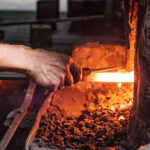
    1. The metal is heated to soften it and make it easier to work with (raw metal).
    2. Determine the dimensions of the piece and mark the required area on the silver plate with a compass. For round shapes, cut out a circle with scissors (metal cutting). For incense burners, determine the position where the feet will be hammered out.
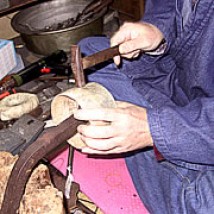
    3. When making a circular object, place the silver plate in the groove of the zelkova wood backing and tap it little by little with a wooden mallet to create a dish shape. Next, shape it using a hammer and backing plate (hammering). The backing plate and hammer are used according to the stage of hammering.
    4. The hardened metal is then carefully hammered with a gas burner, and the metal is gradually shaped by repeatedly hammering and shaping it.
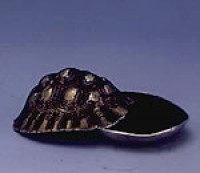
    5. After shaping the piece to a certain form, the pattern is hammered in. Patterns such as rock, mat, basket weave, and tortoise shell are hammered into the piece using pre-attached patterns on the hammer.

    画像をクリックすると動画が再生されます

    Step 2: Engraving and inlay work

    Metal engraving (a technique of carving patterns using a chisel)
    1. Draw the design and transfer it onto ganpishi paper, then carefully attach it to the incense burner, making sure not to distort the pattern. Apply some resin to the inside of the incense burner to make it easier to strike with the chisel.
    2. Use a chisel to make marks so that the design does not disappear, and use these as guides when carving (needle marking).
    3. Using different chisels depending on the technique, the patterns are brought to the surface.

    Kiribame (a technique where a patterned section of the base metal is cut out, and another metal is inlaid into the resulting gap).
    1. Take a silver plate and flatten it on an anvil (leveling process).
    2. The original design is traced onto ganpi paper and then pasted onto a silver plate, and the patterned portion of the base metal is cut out.
    3. Place another metal against the cut-out area of the base metal, mark it, and cut it out. For example, copper is used to represent brown, and red copper, an alloy of copper and gold, is used to represent black. Metals used to represent colors in this way are called "mon-gane" (metals used to represent colors).
    4. The intricate designs are then embedded into the metal. This is a delicate job that requires intense concentration on the fingertips.
    5. Apply borax to the area where the gold inlay was placed, and then solder it with silver solder. This is a skilled process because the base metal and the metal being soldered have different degrees of elasticity. File down any raised areas of the silver solder, and then smooth them out with a whetstone.

    画像をクリックすると動画が再生されます

    工程3: 仕上げ

    Simmered finish
    1. The incense burner, which has been cut and fitted, is carefully polished with fine-grained Suruga charcoal to enhance its color. The surface is then treated with polishing sand and baking soda to bring out the silver's surface.
    2. The metal is repeatedly subjected to a hammering process (hammering) to remove the shine from the base material and bring out the unique subdued look of silver.
    3. After treating with baking soda and corn powder and removing the oxidized film with plum vinegar, soak in grated radish juice. This helps to eliminate uneven coloring. After soaking in a broth of water in which copper sulfate and verdigris have been dissolved to color it, rinse thoroughly with water to finish (simmering for coloring).

    Antique gold finish
    1. Remove any oil with polishing sand or baking soda, and thoroughly prepare the material to expose the metal's surface.
    2. Apply coarse emery powder, then apply gold powder.
    3. Prepare the antique gold solution. Place the metal in a mixture of nitric acid and hydrochloric acid, heat to produce gold chloride, and add methanol to this to make solution A. Separately, add iodine to methanol to make iodine, which will be solution B. Mix solutions A and B appropriately depending on the item you are making. Apply the solution to the metal using cotton soaked in it, and expose it to sunlight to expose it to light.
    4. The tarnished silver surface is treated with keratin powder or baking soda. While maintaining the overall tone, the subtle atmosphere is expressed by expressing the shading, three-dimensionality, and perspective of the engraved pattern.

  • Close-up

    High-quality, substantial, and understated household items: TOKYO Ginki (Silversmithing)

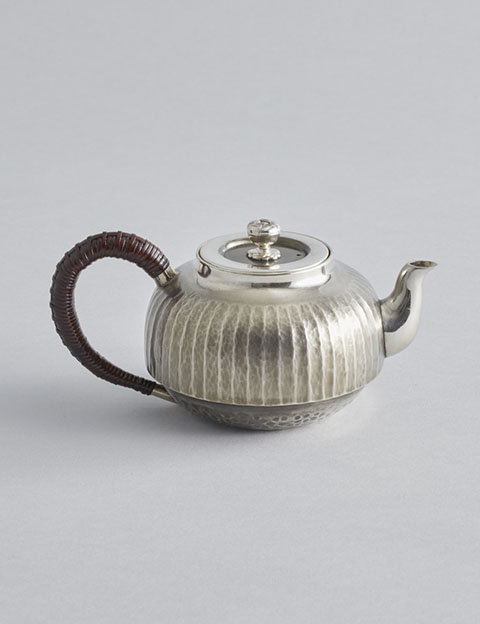
    While lacking the flashiness of gold, silverware possesses a deep, subtle patina and even a sense of warmth. Each piece is hammered and shaped, making them elegant works of art, yet also harmless and durable everyday items. And they only gain character with use.


    From a 2D plane to 3D space

    Tan tan tan tan tan ta tan—the rhythmic sounds of metal and hammers are pleasing to the ear. A single sheet of silver is hammered and shaped using a hammer and a backing plate, transforming a two-dimensional plane into a three-dimensional object. It is an incredibly painstaking, yet fascinating, and creative job.
    The history of silverware in Japan is surprisingly old, with silver tableware already appearing in Heian period documents. Later, with the development of the tea ceremony in the Muromachi period, silver tea kettles and tea caddies began to be produced. However, only a select few of the upper class could afford to use them. It wasn't until the Edo period that silverware became accessible to the general public. The techniques from Edo have been passed down through generations, and even today, tableware, tea utensils, vases, and other everyday items and decorative objects are made in various places throughout Tokyo.

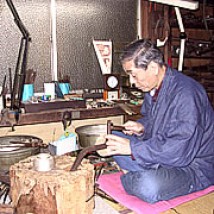
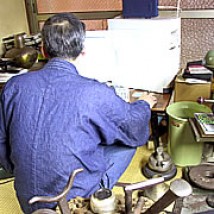
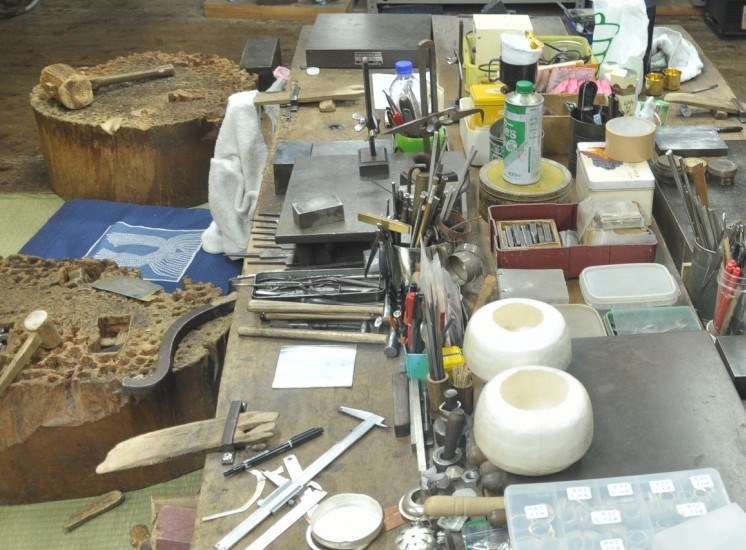
    • Nobuo Kasahara is in the middle of hammering metal. The room is filled with various tools for metalworking, which is quite overwhelming.

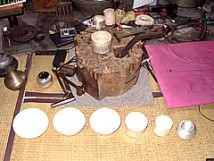
    • The plate-shaped object on the far left is transformed through hammering into a shape similar to the final product on the far right.

    As the industry as a whole improves, individual craftsmen will also improve.

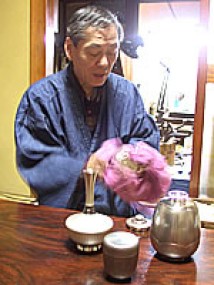
    Nobuo Kasahara, who lives in Hongo, Bunkyo Ward, is the second generation to take over the silverware making business from his father. Having grown up surrounded by the family business since childhood, he entered this world quite naturally. Kasahara says that the demand for silverware in Tokyo has changed with the times.
    "Right after the war, when the Allied occupation forces were still here, coffee and tea sets sold like hotcakes. Every workshop was working through the night just to keep up. During the period of rapid economic growth, golf cups were very popular. Now, I wonder what will be in demand from now on."
    In today's world, where time seems to be moving at an accelerating pace, the wave of IT advancement is undoubtedly sweeping across every sector. Kasahara's belief is that we must accurately grasp the tide of the times and make effective use of personal computers.
    "Each craftsman needs to have their own website, and it should be possible to link it to the union's website. We also need to develop new products for online sales through channels other than wholesalers. Of course, it's not okay to think in terms of pushing others aside for your own gain. It's important to have the mindset that improving the entire industry will benefit you as well."

    Ms. Kasahara loves tinkering with computers and even teaches at the union's computer classes. "I want to make use of convenient tools to revitalize the entire industry," she says.

    The joy of seeing antique art pieces revived through my work

    Kasahara's everyday work follows a somewhat division of labor system, and he proceeds with his tasks steadily. In contrast, the annual exhibition is his grand stage. He handles everything himself, from design to finishing, so the works are more like heartfelt creations than mere products. In addition, he also undertakes the work of reproducing national treasures. To date, he has been commissioned to reproduce the openings of lacquer boxes from Mishima Taisha Shrine (Shizuoka Prefecture) and hand boxes from Izumo Taisha Shrine (Shimane Prefecture).
    "The thought of bringing antique art pieces back to life across time and space through my work is incredibly exciting. It's like experiencing something extraordinary."
    Selling is important, but so is doing work that isn't solely for the purpose of selling. The point is to have a good balance between the two.

    Hit it patiently, one stroke at a time.

    Master the use of silverware and live a truly rich life.

    Surprisingly, many people avoid silver jewelry because it tarnishes. However, according to Ms. Kasahara, if you use it every day and take good care of it, it will never tarnish.
    "Gold has a strong decorative or asset value. But silver comes alive when it's used. It can be repaired and restored to a like-new condition. I hope people will depreciate it as much as possible."
    For Ms. Kasahara, the most important thing is making her customers happy.
    "When customers bring in items we made in the past for repair 20 or 30 years later, it warms my heart to see that they've taken such good care of them."
    There's a metaphor used to describe a person's charm: "like tarnished silver." It's not a flashy or glittering image, but rather a solid, weighty presence. This directly relates to the allure of silverware. Acquiring high-quality items that are by no means cheap, using them in daily life, and properly caring for them to last—in essence, owning good things requires having ample time. Perhaps the key to finding a truly fulfilling way of life lies hidden in this very aspect.

    The piece is being cared for. "Silverware develops character through use, so please use it often."

    Craftsman Profile

    Nobuo Kasahara

    Born in 1941.
    "Young people like foreign brands, but I really want them to know that Japan also has some great silver products. Maybe we should try a reverse import strategy."

    Anecdotes

    TOKYO Ginki (Silversmithing) embodies the delicate sensibilities of the Japanese people.

    When it comes to silverware, younger generations might instinctively think of European brands. But it's a case of "the darkest place is under the candlestick" to think that silverware has been made in Tokyo using techniques that have been passed down since the Edo period. TOKYO Ginki (Silversmithing) has a warmth and a uniquely Japanese flavor that imported European products lack. For example, in pasta dishes, while tomato and chili peppers are the main seasonings in Italy, soy sauce-based pasta was invented when it was introduced to Japan. Even though lifestyles are becoming more Westernized, there must be a sense of the seasons and a delicate sensibility that only Japanese people can understand. Perhaps it is TOKYO Ginki (Silversmithing), made in Japan, that best fits into Japanese homes (whether Japanese-style or Western-style rooms).

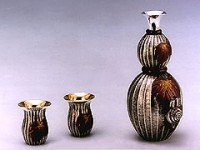
    • A vase that seems to emit the sound of a babbling stream and the splashes of water.

    • A sake set that looks like a snail could start moving at any moment (Winner of the Kanto Bureau of International Trade and Industry Award)

overview

Craft item name TOKYO Ginki (Silversmithing)
Reading Tokyo Bank
Classification of crafts Metalwork
Main Products Tea utensils, sake vessels, flower vases, ornaments, personal accessories
Main manufacturing area Special wards (excluding Minato Ward), Musashino City, Machida City, Kodaira City, Nishitokyo City
Designated date January 12, 1979

contact address

■ Production area association

Tokyo Gold and Silverware Industry Cooperative Association
110-0015
2-24-4 Higashi-Ueno, Taito-ku, Tokyo
TOKYO Ginki (Silversmithing) Hall
TEL: 03-3831-3317
FAX: 03-3831-3326

http://www.tokyoginki.or.jp/

Features

TOKYO Ginki (Silversmithing), considered the pinnacle of metalwork, is elegant, durable, and harmless, making it suitable for various aspects of daily life, including utensils, ornaments, and jewelry. Products are made using techniques such as "forging" (hammering) and "engraving" (carving patterns using chisels).

How to make it

Silver is hammered and forged to create the shape of an object from a single sheet of silver, and then the surface is decorated. The decoration is done using a hammer for making patterns, creating designs such as round hammer marks, mat-like patterns, and rock-like patterns. In some cases, chisels are used to engrave the pieces.

Please see here for information on traditional craftspeople.

Japanese traditional craftsman
top