TSUBAME Tsuiki Doki (Beaten Copperware)

Niigata Prefecture

The copperware industry in the Tsubame region is said to have begun in the mid-Edo period when itinerant craftsmen from Sendai introduced their techniques. Kettles and other similar items were produced using copper mined from the local Yahiko Mountain.
After the Meiji Restoration, technological exchanges with various regions flourished, and metalwork, including engraving techniques, established its status as a fine art and craft. This formed the foundation for the development of the metalworking industry in Tsubame City, Niigata Prefecture, today.

  • Technology/techniques/raw materials

    Technology/techniques

    1. Molding shall be carried out by one of the following methods:
    (1) In the case of "launched objects," one of the following applies:
    (i) Perform "batching" or "inserting", "filling", "overall leveling", and "finish leveling".
    The process involves "lowering the base," "leveling the ground," "overall leveling," and "final leveling."

    (2) In the case of "spinning products", after "rough cylindrical shaping", "filling", "overall leveling", and "finish leveling" shall be performed.

    (3) In the case of "rolled boards", the vertical and bottom parts shall be joined by "claw bending" and "brass soldering", and then "filling", "overall leveling", and "finish leveling" shall be performed.


    2. When joining parts, use "brazing," "crimping," or "riveting" with silver, brass, tin, or solder.


    3. When adding decoration, one of the following methods shall be used:
    (1) In the case of "pattern marking," it shall be done by hand using a hammer or chisel.
    (2) In the case of metal engraving, it must be done by hand.
    (3) In the case of kiribame, the openwork and gold inlay of the design shall be done by hand using a jeweler's saw or chisel. In addition, the gold inlay shall be attached with silver solder.
    (4) In the case of "surface alloys," the process must be done by hand.


    4. When coloring, use "black dyeing," "boiling," "smoking," or "mottled vermilion copper."
     

    raw materials

    The base metal shall be copper or silver, with a silver purity of 925 parts per thousand or higher.

  • Work scene

    The manufacturing process varies slightly depending on the shape of the copperware. Here, we will look at the basic flow along with the production of kettles. The process is broadly divided into four stages: copper sheet molding, sheet metal shaping, decorative processing, and finishing. Among these, the "hammering" technique in sheet metal shaping requires the most intuition and skill, and can be said to be the lifeblood of this craft. A magnificent form is born from the repeated process of hammering and stretching or shrinking a single sheet of copper and then hammering it smooth. This is a traditional technique that cannot be done without a keen sense of the subtle elasticity and hardness of copper.

    Step 1: Building up

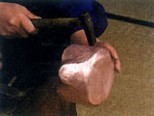
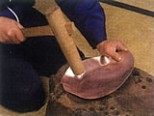
    The base metal used is either pure copper or pure silver. The process begins by first creating a template of the copper sheet and cutting it to size. The sheet is then placed on a wooden base with a unique indentation and hammered with a mallet to create raised edges on the sides. There are several types of indentations, and different ones are used depending on the part being raised, such as the sides or the spout. The strength and angle of the hammering must be subtly adjusted according to the strength and flexibility of the copper sheet. This kind of skill, which can be described as the culmination of experience and intuition, is also necessary for the subsequent "hammering and shaping" processes.

    Step 2: Pinning

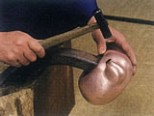
    This process involves using a wooden mallet to shape a copper plate, then hooking it onto a metal fitting called a "torikuchi" and hammering it further with a metal hammer. This fitting is also known as an "ategane," and various types are used depending on the shape of the product. It is inserted into a hole in a zelkova wood base called an "agariban." The spout of the teapot is finally formed by hammering and pounding the metal surface.

    Step 3: Annealing

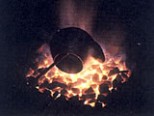
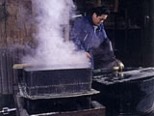
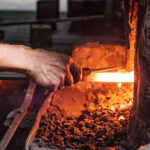
    Once hammered, the metal hardens, so it is placed in a furnace to soften the surface. Heating it to around 650 degrees Celsius changes its structure and softens it. The softened metal is then hammered again, and the hammering and annealing process is repeated dozens of times until the shape is complete.

    工程4: 成形

    We remove any unevenness or distortions from the entire piece, and refine the gold surface while adjusting the balance of the body and the spout. The more we tap the surface, the more it shines.

    Step 5: Engraving

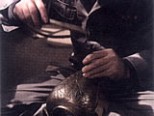
    The surface of copperware is decorated with patterns, inlays (a technique of embedding gold or silver), and other decorative elements. Chisels are used to draw, engrave, and hammer out intricate patterns. In this way, the addition of metalwork and surface alloys creates an elegant and refined splendor to the heavy texture of copper.

    Step 6: Coloring and finishing

    The copperware is immersed in a solution to induce a chemical reaction on the surface. This creates a rich, aged texture on the gold surface. There are two types of coloring methods: black and red.
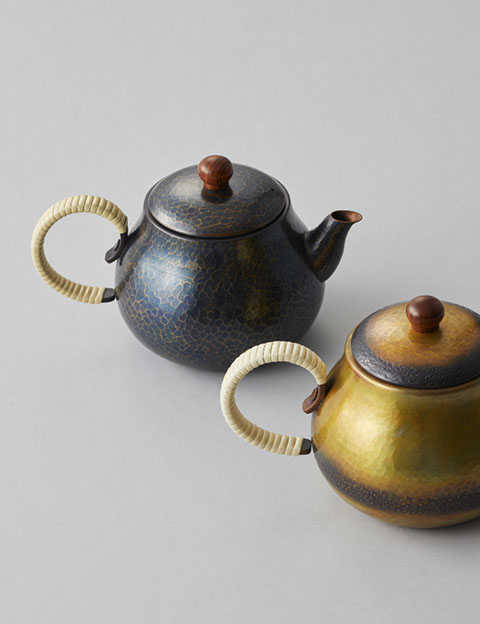
    For black copperware, the surface is first coated with tin, then fired once at 800 degrees Celsius and hammered. After that, it is immersed in potassium sulfide solution, polished with polishing powder, and then boiled for several minutes in a mixture of verdigris and copper sulfate. The black copperware colored in this way acquires a unique deep blackish-purple sheen known as "golden antique color."
    The reddish-yellow color, known as "Xuande color," is produced by simmering the metal in a mixture of verdigris and copper sulfate for several tens of minutes to several hours.


  • Close-up

    The mysterious glow created by the hammer: Tsubame-tsuiki copperware

    TSUBAME Tsuiki Doki (Beaten Copperware) changes color depending on the light. The mysterious luster that resides on its surface shines brighter with each hammering by the craftsman. The warmth of the copper feels smooth against the skin, and its luster increases with use.


    The origin of hammered copperware

    Tsubame City in Niigata Prefecture is renowned as a center for Western-style tableware. Here, the art of hammered copperware, passed down since the Edo period, still thrives. Characterized by its supple curves and refined designs, forged solely from a single sheet of copper using only hammers. Visiting the workshops, one can hear the sound of copper being hammered repeatedly. The term "tsuiki" (hammered copperware) originates from the words "hammer" and "raise." Although it simply means "raising" the copper, there are various techniques such as hammering and stretching, hammering and leveling, requiring advanced skills to use different tools such as anvils called "torikuchi," hammers, and wooden mallets depending on the purpose.

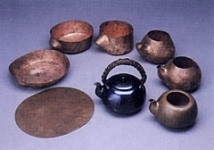
    The shaping process from a single copper sheet to the completion of a spouted water pitcher. Apparently, skilled artisans can figure out the process without being taught.

    Skilled technique, striking

    "For hammering, the work can only be done when the eyes, ears, and hands work in perfect harmony. You judge whether the hammer is hitting the exact point where the bird's beak and the copper plate meet by the sound," says Goro Hosono, who has honed his hammering skills for over 40 years. He has to select from countless hammers and over 200 types of bird's beaks according to the strength and flexibility of the copper plate, and then subtly adjust the strength and angle of the hammer strike. The culmination of these hammering techniques is the hammered spout water pitcher, made from a single sheet of copper. "The difficult part is balancing the spout and the body. Of all the parts, hammering the spout is the most difficult. The top of the spout inevitably becomes thin, so if you make a mistake, it will crack. Only skilled craftsmen can make this spout water pitcher," says Hosono. After hundreds of thousands of hammerings, the surface develops a smooth texture that is almost like pottery.

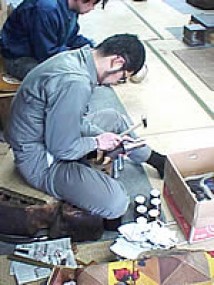
    A scene of copper hammering. Apparently, if the hammer hits the exact point where the bird's beak and the copper plate meet, it produces a "good sound."

    The exquisite luster brought about by the colored finish

    The process that adds a rich texture to this surface is called "coloring finish." A mixture of verdigris and copper sulfate or potassium sulfide solution is used to cause a chemical reaction on the surface. "The state of the colored water (the solution used for coloring) varies from day to day and time to time. The colored water gets tired with each use, and its ability to change color gradually diminishes. Therefore, it has to be given a rest or readjusted to some extent. It is very difficult to keep this colored water in just the right balance." In this way, deep colors are imbued into the surface, and then decorations such as engraving, surface alloys, and patterned hammering are added, giving the work an elegant splendor.

    Everything around me is a reference.

    We spoke to Kaoru Yamakawa, a traditional craftsman who has inherited the hammering technique, which can be described as the culmination of experience and intuition, to learn about the essence of hammered copperware. "In the past, it was said that it took three years to level the surface and six years to shape it. It takes a considerable amount of time to hone the hammering technique. However, skill is accompanied by a person's motivation and inquisitiveness. And above all, what is important is sense," says Yamakawa, who has honed his sense through photography. He learns things like the placement of elements from photographs and applies them to making hammered copperware. Yamakawa says that everything around him is a source of reference.

    Hammered copperware that shines brighter in everyday life

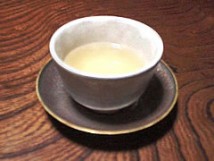
    Various hammered copperware pieces are naturally integrated into Ms. Yamashita's life. From vases, water pitchers, teapots, tea coasters, to braziers, the vastness of the hammered copperware world, from fine art to everyday tableware, is truly astonishing. "The water pitcher I'm using now was made in 1953. It's my first piece. Copperware gains more character the more you care for it. You develop an attachment to it because you take care of it every day." Tea poured from a copper teapot becomes smoother and its flavor is enhanced by the effects of metal ions. Hammered copperware, created with a magical technique, truly shows its value in everyday life.

    Even something placed in the midst of everyday life can fully exude its profound charm.

    Craftsman Profile

    Kaoru Yamashita

    Born in 1930 (Showa 5).
    He has been working in this field for 50 years, since 1949. He is eager to create unconventional designs that will surprise the users.

    Anecdotes

    Tools filled with the wisdom of our ancestors

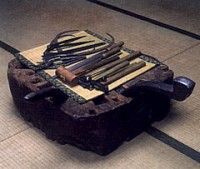
    Let's introduce some of the tools used in TSUBAME Tsuiki Doki (Beaten Copperware). First, there's the "torikuchi" (bird's mouth). The copper plate, hammered into shape with a wooden mallet, is hooked onto this fitting and hammered into shape with a metal hammer. Also known as an "ategane" (attegane), there are hundreds of different types used depending on the shape of the product. This torikuchi is inserted into a hole in a stand made of zelkova wood called an agariban.
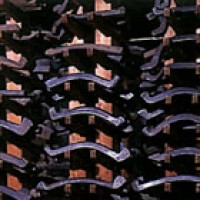
    Hammers come in various sizes and types depending on their intended use. Wooden mallets are used for hammering flat copper plates or shaping them for finishing. Metal hammers include "shaping hammers" for creating the body shape, "smoothing hammers" for creating hammer marks and smoothing the surface, "roughening hammers" for creating patterns on the surface, and other hammers used for metal engraving.
    In addition to those mentioned above, a wide variety of tools are needed to finish a single piece of hammered copperware. Needless to say, each and every tool embodies the wisdom of our predecessors.

    • The hammer's appearance also conveys a sense of accumulated history. The photo shows a "roughing hammer."

    • Sitting on this zelkova wood platform, he continues his work in silence.


overview

Craft item name TSUBAME Tsuiki Doki (Beaten Copperware)
Reading Swallows's Movement
Classification of crafts Metalwork
Main Products Tea sets, kitchenware, sake sets, stationery
Main manufacturing area Tsubame City
Designated date June 22, 1981

contact address

■ Production area association

Tsubame Copperware Crafts Association
959-1244
2-2-21 Chuo-dori, Tsubame City, Niigata Prefecture
Tamagawado Co., Ltd.
TEL: 0256-62-4857
FAX: 0256-64-5945

Features

"Tsuchioki" means to shape something by hammering it. A flat copper plate is repeatedly hammered to create a three-dimensional shape. This requires a high level of skill, even to hammer out the spout of objects like kettles.

How to make it

The copper vessel is hooked onto an iron tool called an "ategane" and hammered to shape it from a dish shape to a cylindrical shape, and then to a bag shape. As the copper hardens during this process, it is annealed in a furnace to soften it. These processes are repeated alternately until the shape is complete. After that, it is decorated with engraving or the surface is smoothed with a hammered pattern, and then colored by boiling it in a solution of verdigris and copper sulfate.

Please see here for information on traditional craftspeople.

Japanese traditional craftsman
top