ECHIGO SANJO Uchihamono (Forged Blades)

Niigata Prefecture

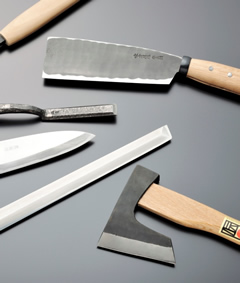
As a tool necessary for agriculture, they manufactured sickles and hoes since the Middle Ages. After starting to make Japanese nails as a side business for farmers during the off-season, they began to produce many types of forged bladed tools such as kitchen knives, planes, chisels, pruning shears, carving knives, and axes.
Furthermore, blacksmiths are also able to manufacture tools necessary for the production of forged blades, such as "yattoko" (iron chopsticks), demonstrating that the techniques and skills to consistently produce everything from the finished product to its tools and equipment have been passed down to the present day.

  • Technology/techniques/raw materials

    Technology/techniques

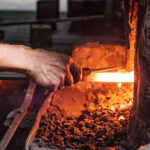
    1. Forming is carried out by free forging, which involves heating iron or iron and carbon steel in a furnace and then hammering and stretching or widening it.

    2. Blade steel is made by heating iron and carbon steel in a furnace and forge-welding them together by hammering. In this case, for chisels, carbon steel is wrapped around the blade from the tip to the neck and then forge-welded.

    3. The entire axe shall be assembled by simultaneously attaching the head, body, and blade tip.

    4. In the case of Japanese nails, a "shinogi" (ridge) should be attached.

    5. The "coloring" of the wooden shears shall be done by heating them in a furnace before hardening and rubbing them with a silk stick made of bundled silk cloth or a cloth stick made of equivalent material.

    6. For hardening kitchen knives, utility knives, planes, hatchets, and sickles, apply a "mud coating" and then rapidly cool them.

    7. Sharpening, grinding, and finishing must be done by hand.

     

    raw materials

    1. The materials to be used shall be iron or iron and carbon steel.

    2. The handle shall be made of wood.

overview

Craft item name ECHIGO SANJO Uchihamono (Forged Blades)
Reading Echigo Sanjo Uchihamono
Classification of crafts Metalwork
Main Products Kitchen knives, carving knives, planes, chisels, hatchets, axes, sickles, wood shears, pliers, Japanese nails
Main manufacturing area Sanjo City
Designated date April 28, 2009

contact address

■ Production area association

Echigo Sanjo Blacksmith Group
955-0072
11-53 Motomachi, Sanjo City, Niigata Prefecture
Inside the Sanjo Blacksmithing Dojo
TEL: 0256-34-8080
FAX: 0256-34-8081

https://kajidojo.com/blacksmith/

Features

Because they are made with shapes and materials specialized for each application, they are easy to handle, maintain their sharpness, and possess the durability to withstand long-term use.

How to make it

The manufacturing process involves a wide range of steps, including forging (forge welding), shaping (fire forging), sharpening, grinding, heat treatment, tempering, and distortion correction, and each step is done by hand.

top