OSAKA NANIWA Suzuki (Pewterware)

Osaka Prefecture

It is said that tinware was introduced to Japan about 1300 years ago by an envoy to the Sui Dynasty.
It is said that the origins of tin craftsmanship lie in the early Kamakura period, when Eisai traveled to Song Dynasty China and brought back tea caddy makers. A production center was established in Osaka during the mid-Edo period.

  • Technology/techniques/raw materials

    Technology/techniques

    1. Casting is done in one of the following ways:
    (1) For turned products, use stone molds, metal molds, or wooden molds.
    (2) For "forged objects," stone molds and stencils shall be used.

    2. Shaping and trimming shall be done in one of the following ways:
    (1) For turned wood, rough shaping is performed using a lathe, lathe plane and scraper, and then finishing shaping is performed using a lathe and finishing plane.
    (2) For "forged" items, rough cutting is performed using metal shears, a small blade, and a sledgehammer, and then finishing is done using a sledgehammer, scraper, and sledgehammer.

    3. When joining materials, the joining method shall be either "heat bonding" or "brazing" using solder.

    4. Polish the surface.

    5. When decorating, the method shall be "kusarashi," hammering, or lathe-turned patterning.

    6. When coloring, use natural lacquer.
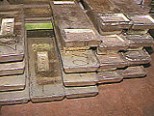
     

    raw materials

    The raw casting material shall be tin, and the purity of the tin shall be 97 parts per hundred or higher.


  • Work scene

    Making tinware can take anywhere from a day for simple pieces to about a month for more complex ones. Let's take a closer look at the tinware manufacturing process.

    Process 1: Raw materials

    The material is a metal called "tin." It is hardly mined in Japan and is imported from Malaysia, Thailand, Indonesia, China, and other countries. Tin ingots are sold in units of "1 cho," which is 35 to 45 kilograms in weight.

    Process 2: Casting Process

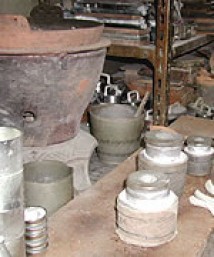
    Tin melts at approximately 230 degrees Celsius and can be easily melted even with natural gas. The tin ingot is melted in a pot, and the molten tin (called "yū") is poured with a ladle into a mold that is angled to facilitate flow. After a while, the inner basket is removed, the tin is cooled slightly with a brush dipped in water, and once it has solidified, it is removed from the mold. Even at this point, it is still quite hot. Then, any excess tin that has spilled out from the pouring spout is trimmed off. Molds come in various sizes depending on the type and shape of the product and are made from materials such as cement, clay, and metal.

    画像をクリックすると動画が再生されます

    Process 3: Cutting process

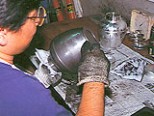
    For round pieces that have been cast, the process of shaping them by trimming them on a potter's wheel is similar to the process of carving a kokeshi doll. The potter's wheel process is the central step in the production of tinware. The cast surface is rough and hard, but when it is trimmed with a plane, the beautiful luster inherent to tin is brought out. For long and large pieces like vases, or pieces that cannot be cast in a single mold, the top and bottom parts are trimmed separately on the surface and inside, and then the top and bottom parts are joined together to finish the piece.
    We also do the polishing work after the lacquering process is complete. The curvature of the product and the thickness to be shaved are all determined by the intuition of an experienced craftsman. Different planes are used for removing the cast surface, shaping, and finishing. Traditional materials such as hackberry leaves and horsetail are also used to create a shine. For products where the color of the shine is important, the finish is achieved at this stage.

    画像をクリックすると動画が再生されます

    Process 4: Intermediate work

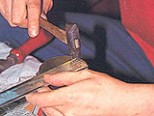
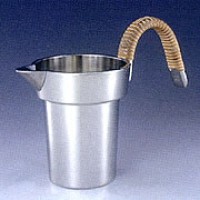
    We create accessory parts such as handles and spouts that cannot be made on a potter's wheel, and attach them to the main body. We also cut, bend, and hammer-texture the material here.

    Step 5: Patterning process

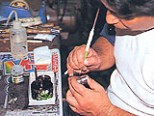
    Patterns (paintings) are added to the pottery that has been made on the potter's wheel. Lacquer or enamel ink is used. When this is immersed in nitric acid solution, the painted areas are masked, so only the other parts erode, creating a pearlescent finish. This is a delicate process where the degree of erosion varies depending on the season. After checking how well the painting stands out, the piece is washed with water, and then lacquer in black or vermilion is applied and wiped off. This process is repeated, causing the painted areas to shine, the pattern to stand out, and the piece to have a refined finish.

    Step 6: Finishing Process

    Once the lacquer dries, it is polished on a potter's wheel, and then handles and other details are attached to finish it.


  • Close-up

    The allure of tinware can be felt from its quiet radiance.

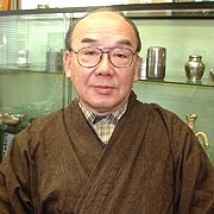
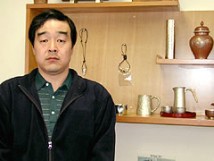
    Tatsumasa Imai, a traditional craftsman, grew up watching his father's tin workshop. From a young age, he felt a close connection to tin. He would put tin fragments he had collected into an empty pudding can and melt them on a stove. When they fell onto the cold floor, they would gradually harden. That was the first tin product Imai ever made: marbles.


    Even tin, with its rich history, was affected during wartime...

    The history of tinware is very old, with artifacts dating back to around 1500 BC unearthed in Egypt, and it even appears in the Romance of the Three Kingdoms in China. It was introduced to Japan 1300 years ago. It is said to have been brought by Japanese envoys to Tang China and Sui China, but one theory suggests that Zen master Eisai brought tin teapots (which were medicine jars at the time) from China along with tea. In the past, its use was limited to the upper class, but it became more common from the Edo period onward. In Osaka, tinware production was thriving until before the war, and there were many manufacturers, but many were forced out of business because they supplied tin as military supplies. Amidst this, a cooperative was established to preserve the techniques of tinware production, and skilled craftsmen were gathered to continue production. Mr. Imai's grandfather was one of those craftsmen.

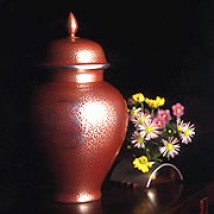
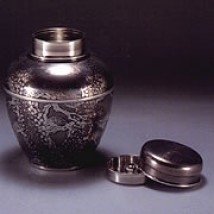
    A vermilion teapot adorned with intricate arabesque patterns.

    Tin tableware changes along with changes in lifestyle

    Traditional items are made in forms suited to the era in which they were created. However, as time passes, lifestyles change. "Even something as simple as a sake cup—in the days when people lived on trays, a flat shape that could be picked up from above was convenient. But nowadays, with people eating at tables, a long, vertical shape that can be grasped from the side is more practical. In this way, we must adapt to the times and meet the needs of the user. Just because something is a traditional craft doesn't mean it should remain stuck in its old form. Building upon new things that suit the times, and repeatedly connecting them, is how we pass on and inherit tradition."

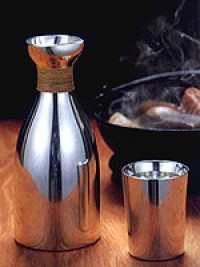
    A tasteful, smoked teapot

    The benefits of tinware

    Tin tableware, tea sets, and sake sets are said to enhance the flavor of what is placed inside, and have long been praised for their ability to neutralize toxins and prevent boils. Furthermore, because of their high airtightness, they are said to preserve the aroma of tea leaves for a long time when used in tea caddies. "If you try it yourself, you'll see that even if you immerse a tin tea caddy in water, no water gets inside. Also, because each piece is handmade with the body and lid carefully adjusted, other combinations won't fit together." The fact that they only fit together as a pair is like finding the perfect clam shell. "Tinware doesn't rust, so it's easy to maintain. Occasionally, you just wash away dirt like fingerprints with detergent, rinse with water, and wipe with a soft cloth." Surprisingly, it's easy to maintain its elegant luster.

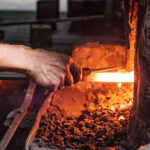
    • Inside the casting furnace, the tin emits a quiet light.

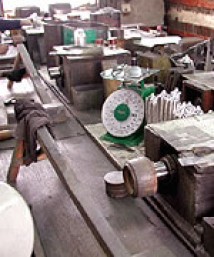
    • In the workshop, lined with pottery wheels, the distinctive sound of the wheels turning echoes throughout.

    New products that attract women's interest

    "I want to preserve traditional crafts in various forms. That's why, as one of the new items, I tried making a pendant top using traditional crafting techniques," says Imai. This is truly the idea of a young successor who will be a driving force for the future of the tinware industry. Many women stop to look at it, he says. It might be good to experience traditional industries in a more accessible way through items like this. "It's very encouraging for this industry when people don't just cling to tradition but explore new worlds. Old things are important as traditions, but we can't stay stagnant," says Sugimoto, a director of the Osaka Naniwa Tinware Association and chairman of the Traditional Craftsmen's Association.
    "We have skills that our predecessors have left us. For example, if it took our predecessors 10 years to create a skill, it only takes us 5 years to inherit it. That's why I want to spend the remaining 5 years working to leave something behind for the next generation."

    • Mr. Sugimoto, Chairman of the Traditional Craftsmen's Association

    • Mr. Imai contemplates the future of tinware. Behind him is a craft pendant.

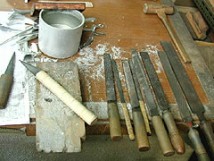
    • Files and knives for creating patterns, etc.

    Anecdotes

    A must-have for alcohol lovers!


overview

Craft item name OSAKA NANIWA Suzuki (Pewterware)
Reading Osakana niwa suzuki
Classification of crafts Metalwork
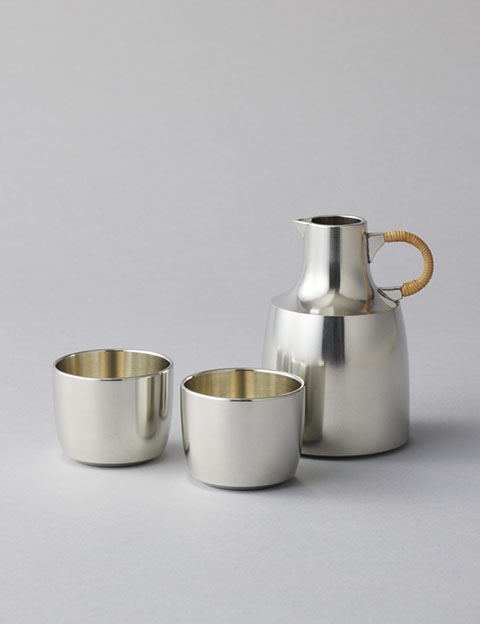
Main Products Buddhist and Shinto religious items, sake vessels, tea utensils, confectionery containers, flower vases
Main manufacturing area Osaka City, Matsubara City, Habikino City, Higashi-Osaka City
Designated date April 27, 1983

contact address

■ Production area association

Tinware Business Cooperative Association
546-0031
6-6-15 Tanabe, Higashisumiyoshi-ku, Osaka City, Osaka Prefecture
Osaka Tinware Co., Ltd.
TEL: 06-6628-6731
FAX: 06-6628-6735

Features

Tin is a very stable metal. It has a strong ionic effect and a water-purifying property, and because it does not impair the subtle flavors of sake, it is suitable for sake vessels. It is also suitable for vases, and because it is airtight, it has good preservation properties even in hot and humid places, making it suitable for tea caddies.

How to make it

Because tin is soft and difficult to machine, most of the process is done by hand. The process is broadly divided into casting and polishing. The rough-grained casting is mounted on a potter's wheel, the surface is shaved smooth with a special plane, the shape is refined, and then it is polished to a shine to create the finished product.

Please see here for information on traditional craftspeople.

Japanese traditional craftsman
top