TOSA Uchihamono (Forged Blades)

Kochi Prefecture

The Chōsokabe Land Survey Records, compiled in 1590 during a comprehensive land survey of Tosa Province, record that there were 399 blacksmiths. The true flourishing of TOSA Uchihamono (Forged Blades) began in the early Edo period with the Genna Reforms (1621) implemented by the Tosa Domain.
The domain's policies of securing forest resources and promoting the development of new rice fields led to an expansion of demand for agricultural and forestry tools, resulting in a significant improvement in both the production volume and quality of TOSA Uchihamono (Forged Blades) TOSA Uchihamono (Forged Blades). Although some mechanization was incorporated, the techniques and traditions of the Edo period have been passed down to the Heisei era.

  • Technology/techniques/raw materials

    Technology/techniques

    1. Forming shall be carried out by heating iron, carbon steel, or iron and carbon steel in a furnace and hammering and stretching it.

    2. The axe and the claws of the hawk shall be removed by the "claw removal" method.

    3. The saw should be made from a single piece of material, with the neck and tang constructed from the same material.

    4. For quenching sickles, knives, machetes, and sickle handles, apply a "mud coating" and then rapidly cool them.

    5. For single-edged machetes, a groove must be attached.

    6. "Removing distortion," "sharpening," "polishing," and "finishing" must be done by hand.
     

    raw materials

    1. The materials used shall be iron, carbon steel, or iron and carbon steel.

    2. The handle shall be made of wood.

  • Work scene

    The process of TOSA Uchihamono (Forged Blades) is divided into many steps. Here, we will introduce the main flow of the process.

    Step 1: Charcoal cutting

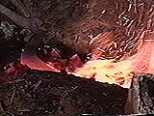
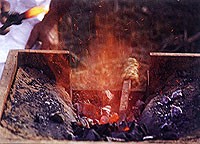
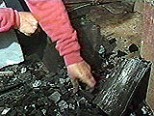
    To control the fire and blow air with bellows, cutting the charcoal to a uniform size is a crucial task. It is said that this requires such skill that it takes three years to master charcoal cutting.

    Process 2: Steel and Iron Making

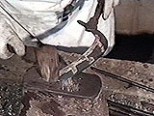
    A key characteristic of TOSA Uchihamono (Forged Blades) lies in the method of interlacing steel with iron. First, the steel that will form the blade edge is prepared. Then, an incision is made in the iron, the steel is sandwiched in between, and lightly hammered in. Skilled craftsmen do not take measurements, yet the pieces are perfectly formed. Boric acid is applied as a bonding agent and the piece is heated. This process is called "boiling."

    画像をクリックすると動画が再生されます

    Step 3: Forge welding

    This is the process of integrating iron and steel. Recently, many production areas have started using pre-formed steel reinforcement materials. The welded material is then "ground cut".

    画像をクリックすると動画が再生されます

    Process 4: Forging and Shaping

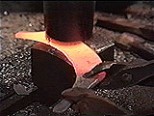
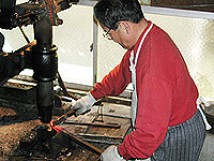
    The sickle shape is created using a belt hammer and by hand. The belt hammer, developed in the early Showa period, significantly increased production volume. Fine details are shaped with a hammer. This method of freely creating shapes is called free forging.

    Step 5: Rough grinding

    Before heat treatment, the blade is roughly ground. This is also called raw grinding.

    Step 6: Applying mud

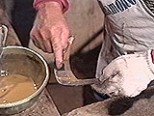
    To improve the hardening process, mud is applied to the sickle.

    Step 7: Hardening and tempering

    A crucial process that determines the hardness and toughness of a blade is "quenching." The temperature is determined by the color of the flame and the degree of burning. After heating to 770°C to 800°C, the blade hardens by rapidly cooling it with water. Blades need not only hardness but also toughness. This is where tempering comes in. The tempering temperature is approximately 170°C. The temperature is read by observing how the water beades off the blade.

    Step 8: Strain Removal

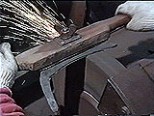
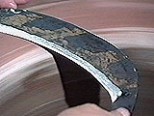
    This process removes any overall distortion caused by the hardening and tempering processes. The front and back surfaces are carefully hammered.

    Step 9: Sharpening and finishing

    The final step is sharpening the blade. The blade is carefully finished with sharpening, intermediate sharpening, and edge finishing. The Tosa-style thin sickle, with its superior sharpness, is now complete. While other production areas are increasingly specializing in different processes, TOSA Uchihamono (Forged Blades) with their integrated production process, have gained high praise and have been designated as a traditional craft.


  • Close-up

    The art of iron, fire, and water: the allure of traditional forging.

    Kochi Prefecture is one of the most humid, warm, and rainy regions in Japan, and has long been blessed with high-quality timber, which has been harvested in large quantities. Consequently, the production of forged tools for logging and other forestry work has been carried out since ancient times. Furthermore, sword-making techniques were introduced during the Kamakura period, and this tradition of ancient forging continues to this day.


    A man who relentlessly pursues sharpness, dedicating his life to his scythe.

    It is commonly said that "three years for cutting charcoal, five years for forging, and three years forging with bare hands" means that it takes eleven years to become a master craftsman of forged blades. Michinobu Yamasaki began his apprenticeship at the age of 10 and has dedicated 60 years of his life to manufacturing forestry sickles. We spoke with this stubborn man from Tosa.

    Tosa's forged blades, boasting a 400-year history and tradition, use "tamahagane," the same steel used for Japanese swords, for the blade.

    My rigorous training period

    "My father was a skilled blacksmith, but he was bad at getting ahead in life, so our family was poor. After I became his apprentice, I ate and slept with the craftsmen. It was tough, just like the world of sumo wrestling." He wasn't taught any of the processes like cutting charcoal or heat treatment. He had no choice but to learn everything by silently watching his master's techniques. "Back then, there was a blacksmith in every village, and you could hear the sound of hammers hammering, 'ton, ton, kan. Ton, ton, kan.'" The master and apprentice worked in perfect harmony, forging sickles, axes, hoes, and other bladed tools in pairs. "If the timing was even slightly off, a slap would come flying at you. There was absolutely no room for compromise. It was tough for a child."

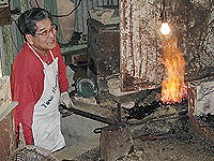
    He skillfully manipulates the bellows with his left hand to create airflow, while using his right hand to gauge the intensity of the charcoal fire.

    The development of the belt hammer machine changed the course of events.

    In the early Showa era, Sakamoto Seisakusho, also located in Kochi Prefecture, developed a belt hammer machine. The initial hammering process, which previously involved swinging a 4-kilogram hammer, was now done by machine. This allowed one person to produce 100 forestry sickles a day, whereas previously it took two people to finish about 42. "I was about 15 years old at the time, so I quickly grasped the knack of using the machine and was praised by my father. I became proud of myself and taught the older craftsmen how to use the machine." However, even with the hammer taking over the initial hammering, the subsequent processes remained exactly the same as before—a world of uncompromising craftsmanship.

    I've been using the belt hammer, which was developed in the early Showa era, for 60 years.

    Characteristics of TOSA Uchihamono (Forged Blades) (forestry sickles)

    "Nowadays, times are constantly changing, and even the heat treatment process uses boilers with set temperatures. But the color of the charcoal, the temperature of the flame, and the dimensions of the red-hot iron that I learned by feel since I was little, I can reproduce them perfectly even without a thermometer or ruler. I can't draw a blueprint if asked, but if asked to make something, I can make as many as I want with the same dimensions." The characteristic of TOSA Uchihamono (Forged Blades) forged blades is "free forging," where the red-hot iron is freely manipulated and shaped using a belt hammer. The more you sharpen Mr. Yamazaki's sickles, the better they become. They can be used for years as long as the blade is sharp. They have the true quality of something that is not disposable.

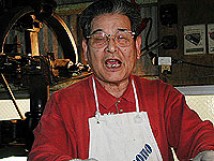
    Mr. Yamazaki, with a smile, says he finds immense joy in forging sickles in his traditional, private workshop.

    How to breathe new life into tradition while preserving it.

    With the decline of the forestry industry, the demand for forestry sickles has plummeted, and extremely cheap sickles imported from Asia line the shelves of home improvement stores throughout Japan, leaving the cutlery industry in dire straits. To overcome this situation, Mr. Yamazaki, together with his eldest daughter's husband, the third-generation successor, developed a grass-cutting sickle that retains the quality of TOSA Uchihamono (Forged Blades) while keeping costs down. Its sharpness has made it popular, and orders are pouring in from all over the country. I myself once bought a cheap sickle when I dabbled in natural farming. However, every sickle I used broke or bent after cutting grass two or three times and became useless. Moreover, if I tried to cut bamboo roots, the blade would chip immediately, causing me a lot of trouble. Amateur consumers won't be fooled forever. The times are changing, and people are demanding the real thing.

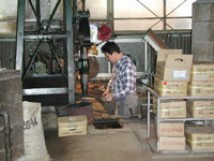
    Even with some modernization of equipment, TOSA Uchihamono (Forged Blades) are still meticulously crafted one by one.

    Craftsman Profile

    Michinobu Yamasaki

    Born in 1926, he began his apprenticeship with his father at the age of 10, honing his skills. He has dedicated 65 years to forging forestry sickles.

    Anecdotes

    Let's preserve "traditional forging techniques."

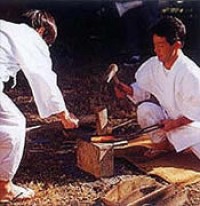
    Master and apprentice work together in pairs to forge blades. The number of skilled bladesmiths, once numbering over 1,000 in Kochi Prefecture, is steadily declining with time. The craftsmen are also aging, and training successors is the industry's biggest concern. Michinobu Yamazaki is determined to pass on the "traditional forging" technique, in which two people—the master (yokoza) and the apprentice (maeuchi)—work together to forge blades, to the second generation of craftsmen throughout the prefecture.
    They cut the charcoal just like in the old days, start a fire using bellows, and carefully hammer it in with large and small hammers. The young people were amazed at how hard the work was, using a 4-kilogram hammer, saying, "We never realized it was this hard work..." The second generation workers had difficulty even swinging the hammers straight down, but Mr. Yamazaki said, "We're finally getting the hang of it." Perhaps in the near future, we'll see the emergence of female forgesmiths?

    "You can feel the temperature of the fire with your skin." It took 11 years for a craftsman of traditional blacksmithing to become a full-fledged blacksmith.


overview

Craft item name TOSA Uchihamono (Forged Blades)
Reading Tosauchi wa mono
Classification of crafts Metalwork
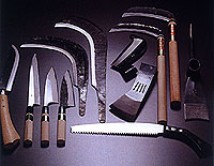
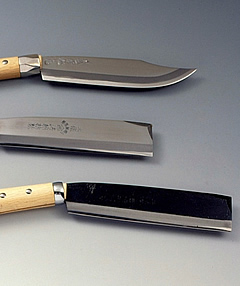
Main Products Axe, sledgehammer, saw, sickle, kitchen knife, machete, sickle with handle, hoe
Main manufacturing area Kochi City, Aki City, Nankoku City, Susaki City, Tosashimizu City, Kami City, and others.
Designated date May 6, 1998

contact address

■ Production area association

Kochi Prefecture Tosa Cutlery Association Cooperative
782-0034
2-2-27 Takaramachi, Tosayamada-cho, Kami City, Kochi Prefecture
Kami City Chamber of Commerce and Industry
TEL: 0887-53-4111
FAX: 0887-53-4113

http://tosahamono.com/

Features

TOSA Uchihamono (Forged Blades) received numerous orders for blades of varying shapes and weights from all over Japan, allowing them to manufacture simply from order forms specifying the actual size and shape. This is known as "Tosa's free forging." This can be inferred from the wide variety of products manufactured in Tosa, and because it enables small-batch, high-variety production, TOSA Uchihamono (Forged Blades) has continued to be made to this day.

How to make it

Steel or iron is heated in a furnace and shaped by hammering it. The blade of the shaped object is then sharpened to create the finished product. Axes and other tools, such as hacksaws, are made using a method called "nukibitsu," in which holes are cut into the iron material with a chisel.

top