AWA Washi (Papers)

Tokushima Prefecture

Records from the 9th century show that about 1300 years ago, a group of people called the Imbe clan, who served the imperial court, cultivated hemp and paper mulberry and flourished the production of paper and cloth. This marks the beginning of the history of AWA Washi (Papers).
Since then, the Imbe clan has continued to pass down its techniques by worshipping Amenohiwashi-no-Mikoto, the founder of the Imbe clan, as the god of papermaking, and this tradition continues to this day.

  • Technology/techniques/raw materials

    Technology/techniques

    1. Papermaking shall be carried out using the following techniques or methods:
    (1) Using the "flow-casting" method.
    (2) The mats used shall be made of bamboo or reeds.
    (3) The paste should be made from either Abelmoschus manihot or Hydrangea paniculata.

    2. Drying shall be done by "board drying" or "iron plate drying".
     

    raw materials

    The main ingredients shall be paper mulberry, mitsumata, or ganpi.

  • Work scene

    Step 1: Boiling

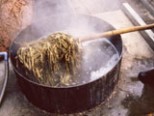
    Before boiling, the stored paper mulberry is soaked in running water overnight. This is to improve the penetration of the boiling agent and assist in the boiling process. Then, it is thoroughly washed in water to remove any remaining black bark or debris attached to the fibers.
    Next, the fibers are boiled in an alkaline solution. Traditionally, an alkaline solution (potassium carbonate) was extracted from wood ash and used as a boiling agent. Nowadays, lime (calcium hydroxide), soda ash (sodium carbonate), or caustic soda (sodium hydroxide) are used depending on the application.
    The amount of water needed should be at least 10 times the weight of the raw materials. Maintain high heat until it boils, then reduce the heat to a level that prevents it from boiling over. After about 30 minutes, the fibers will soften, so flip the ingredients over to ensure even cooking.

    Step 2: Dustpan

    When cooked, lye is produced. Originally, lye refers to the supernatant liquid obtained by mixing ash with water, but the term lye is used to refer to the entire boiled liquid. After boiling is complete, it is left to steam for 24 hours. Then it is soaked in running water to remove the lye. This removes the non-fibrous material that has dissolved in the alkaline solution. Next, dust is carefully removed. All of this is done by hand.
    Place a basket in water, add an appropriate amount of fiber, and remove any dust. This process removes any damaged, bud-like, unevenly burnt, or discolored parts.

    画像をクリックすると動画が再生されます

    Step 3: Thawing

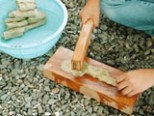
    The dusted raw materials are then beaten. Beating involves carefully pounding the fibers with a beating stick on a stone slab or hardwood board to separate the bundled fibers one by one. Nowadays, the beating process is also mechanized, and power mills are sometimes used.

    Step 4: Papermaking

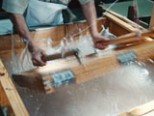
    When making washi paper using the nagashi-zuki method, there are three steps: "kake-nagashi," "toshō," and "tameshi-mizu." First, the paper is scooped shallowly, and the operator works quickly to ensure that the fibers are evenly distributed thinly across the translucent surface. The quick movements prevent dust and other impurities from settling on the surface. This step creates the surface of the paper and is called "kake-nagashi" or "hatsumizu."
    The next step in drawing water is called "adjusting the balance." The water is drawn in slightly deeper than the first time, and the skewer is moved to intertwine the fibers. This process of drawing water and shaking is repeated many times until the desired thickness is achieved. The elasticity of the bamboo suspended from the ceiling is used to reduce the weight of the water being drawn in, while the machine is shaken in a balanced manner. The method of movement varies depending on the type of paper being made and the region.
    Once the papermaking process is complete, the "su" (paper sieve) is removed from the "keta" (frame) and placed face down on a ruler on a paper base (shitoita) covered with paper or a blanket, ensuring no air gets trapped between the layers.

    Step 5: Pressing

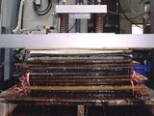
    The "paper bed," made by layering damp paper, is left overnight to allow the moisture to drain naturally. Then, to remove any remaining moisture, it is sandwiched between slightly larger boards and dewatered using a press that applies gravity.
    To avoid damaging the paper layers, the paper is compressed gently at first and gradually more strongly for about 6 hours. By extracting as much water as possible, a firm and resilient paper is created. The moisture content will be around 70%.

    Step 6: Drying

    After the pressing process is complete, the paper sheets are individually attached to drying boards and dried in the sun or using a steam dryer.
    When peeling wet paper from the paper bed, do so at a sharp angle, parallel to the paper bed surface. Place the peeled wet paper on the dryer and smooth it with a brush. When brushing, do not go against the direction of the fibers and apply even pressure.
    Depending on its intended use, the finished paper is coated with sizing, konjac, or persimmon tannin. It can also be dyed with chemical or natural dyes, or processed to create crumpled paper or crepe-like paper.

    画像をクリックすると動画が再生されます

  • Close-up

    AWA Washi (Papers) A beautiful harmony of traditional techniques and modernity.

    AWA Washi (Papers), with its unique texture, has been passed down for approximately 1300 years. The tradition of handmade washi is not only a source of nostalgia, but is also passed down to the next generation by continuously expressing the spirit of the present age.


    Legendary traditional craftsman, Minoru Fujimori

    Minoru Fujimori, who has now handed over both washi paper making and company management to his son, once said: "During the war, I was on board a cargo ship as a radio operator. Then the war ended. Tokyo and Osaka were both burnt to the ground. I didn't think I could easily find work in that situation, so I reluctantly took over the family business of making washi paper. At that time, we were making shoji paper, umbrellas, and so on, and as much as we made, it would sell immediately. It was a time when goods were scarce, so the fact that we could make and sell and see the volume of shipments increase gave me a strong sense of security and peace."
    "However, during the period of rapid economic growth in the 1950s, the washi paper makers in Yamakawa Town were pressured by Western-style paper from major manufacturers, and one after another they went out of business. It was sad, and naturally, our sense of crisis grew stronger. It was around that time that we were forced to change our way of thinking. We came to a new way of thinking about traditional washi paper: 'No matter how beautiful the paper we make, the paper itself is always a supporting player. Paper only gains value when it is used for something. You can't run a business unless you are conscious of the feelings of the people who use it.'" Fujimori also says, "I also felt like I was on the edge of a cliff, thinking that if I was going to ruin the family business here, then nothing else I did would work either."
    In the 1960s, Mr. Fujimori shifted his focus to hobbyist and artisanal washi paper, completely changing his planning and production in that direction. His invention of indigo-dyed washi paper and colored paper was also a strategy to seek new demand. In order to survive, he needed the ability to accurately perceive and respond to demand, to read the times, and the business sense to devise and produce profitable products without being bound by tradition, while still feeling the weight of tradition.
    Just because it's a long-standing tradition doesn't mean that a stubborn, unyielding craftsman's spirit alone would have led to the business's closure. With this strong conviction, Mr. Fujimori doesn't particularly like being called a craftsman. He has the confidence and pride of having adapted to changing times and successfully overcome crises for both his company and the tradition of AWA Washi (Papers).

    A challenge to new products

    That pioneering spirit of the previous generation continues to be passed down to the present day. AWA Washi (Papers) finds a harmony between traditional washi paper as a craft and new washi paper.
    For example, they also manufacture custom-made washi paper using traditional handmade papermaking methods. While retaining the texture of handmade washi, they also incorporate metal wire as a design element. This is a large-sized piece of washi paper for interior decoration, ordered by a restaurant in Osaka.
    AWA Washi (Papers) has successfully incorporated such new sensibilities and ideas, and is now thriving in the 21st century. We spoke with Sadako Ueda, a female traditional craftswoman who was seriously making custom-made interior washi paper with this new sensibility.

    New washi paper for interior decoration is also being produced.

    Mother and daughter, two generations of female traditional craftspeople

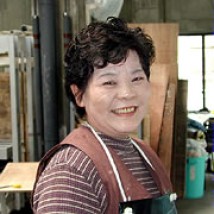
    Traditional craftswoman Sadako Ueda has been working with AWA Washi (Papers) for 21 years. "I've never felt any hardship at all. You always have to be creative and innovative, otherwise it won't work. I love making washi paper. I always enjoy the work," Ms. Ueda said with a bright smile. She is clearly a woman who loves making things from the start. Whether she is making traditional washi paper or inserting wire into the paper while consulting with the design team, she is full of enthusiasm. You can feel her determination to create something good.
    In fact, Ms. Ueda's daughter also entered the world of washi paper making, inspired by her mother's example. Mother and daughter find joy in being involved in this traditional industry nurtured in their local area, and they are challenging themselves to create new products. We look forward to seeing what new products AWA Washi (Papers) will produce in the future.

    Sadako Ueda, a traditional craftswoman with a lovely smile.

    "I've come all the way from Tokyo to study washi (Japanese paper)."

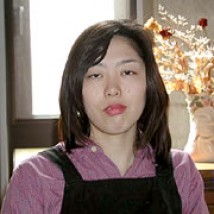
    Tamiko Kudo, who managed AWA Washi (Papers) Traditional Industry Hall, where papermaking demonstrations are also held, is a woman who loves AWA Washi (Papers) so much that she once came all the way to Yamakawa Town in Tokushima for a washi paper workshop and immediately asked, "Please give me a job."
    Of course, she has mastered all aspects of washi paper making. There are new types of artisans like her, and many artists and designers from both Japan and abroad visit, drawn by the unique texture of AWA Washi (Papers).

    Tamiko Kudo, a 21st-century craftswoman

    Anecdotes

    Here's a brief explanation of the raw materials used in washi paper, which is now rarely seen or heard of.

    1. Paper mulberry (Kozo)
    Paper mulberry is a deciduous shrub belonging to the mulberry family, growing to about 3 meters tall. It is easy to cultivate and can be harvested every year (an ecological plant). Because its fibers are thick and strong, it is the most widely used raw material for a wide range of applications, including shoji paper, mounting paper, art paper, and hosho paper. In the case of AWA Washi (Papers), the black bark cultivated in the area from Tokushima Prefecture to the border with Kochi Prefecture is used. Two types of paper mulberry are harvested in Tokushima. One type has coarse fibers and is suitable for making thick paper, while the other type has fine fibers and is suitable for making thin paper.
    Currently, due to a sharp decline in domestic production of paper mulberry in Japan, prices have skyrocketed, and as a result, paper mulberry from Thailand is increasingly being used.

    2. Mitsumata (Edgeworthia chrysantha)
    The term "mitsumata" is a common name today, but it is said to have been a dialect used in the Suruga and Izu regions in the past.
    Mitsumata is a papermaking material unique to Japan, but it is said that its use as a paper material began 300 to 500 years ago.
    Mitsumata is a deciduous shrub belonging to the Thymelaeaceae family, characterized by its three-branched structure. Mature trees can grow to over 2 meters tall, and the fruit can be harvested every three years after planting a sapling. The leaves are oval-shaped and grow in alternating directions. Flowers bud at the top of the tree from early autumn, and bloom sequentially from the outside inward around February or March of the following year. The flowers have four yellow petals, eight stamens, and one pistil per flower, and bear fruit around June.

    3. Ganpi (a type of rice cracker)
    Ganpi is a deciduous shrub belonging to the Thymelaeaceae family, and mature plants grow to 2 meters in height. Its fibers are fine, short, and lustrous, making it an excellent raw material. However, it grows slowly and is difficult to cultivate, so wild ganpi is harvested by stripping the fibers while they are still wet. The harvest season is from spring to summer when the water absorption is good. Ganpi was once used in large quantities as a raw material for mimeograph paper, but since the spread of photocopiers, its use has decreased dramatically. Currently, it is used for foil-beating paper for hammering gold and silver foil, and as underlay for sliding doors.

overview

Craft item name AWA Washi (Papers)
Reading Awawashi
Classification of crafts Japanese paper
Main Products Calligraphy paper, craft paper, wrapping paper
Main manufacturing area Yoshinogawa City, Naka Town (Naka District), Miyoshi City
Designated date December 15, 1976

contact address

■ Production area association

Awa Handmade Washi Paper Commercial and Industrial Cooperative Association
779-3401
141 Kawahigashi, Yamakawa-cho, Yoshinogawa City, Tokushima Prefecture
Inside AWA Washi (Papers) Traditional Industry Hall
TEL: 0883-42-2772
FAX: 0883-42-6085

■ Visits to production areas from overseas
image
AWA Washi (Papers)- Article about visiting the production area

Features

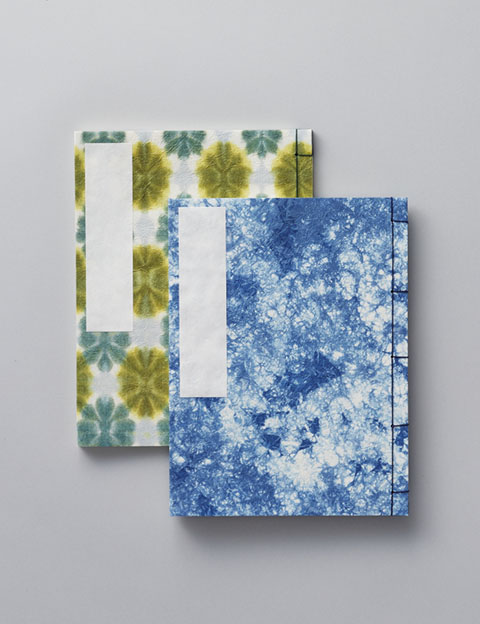
Awa indigo-dyed washi paper is a plant-dyed product that boasts the natural, unbleached color, gentle texture, supple softness, and surprising strength that only handmade paper can offer.

How to make it

The fibers are extracted from carefully selected raw materials—kozo, mitsumata, and ganpi—and then finished through papermaking and paper pasting. The most important part of the process is the manual papermaking, which is done using a bamboo or reed screen called a "nagashi-zuki" (flow-casting) method. Maintaining a consistent thickness and eliminating fiber unevenness requires considerable skill.

Please see here for information on traditional craftspeople.

Japanese traditional craftsman
top