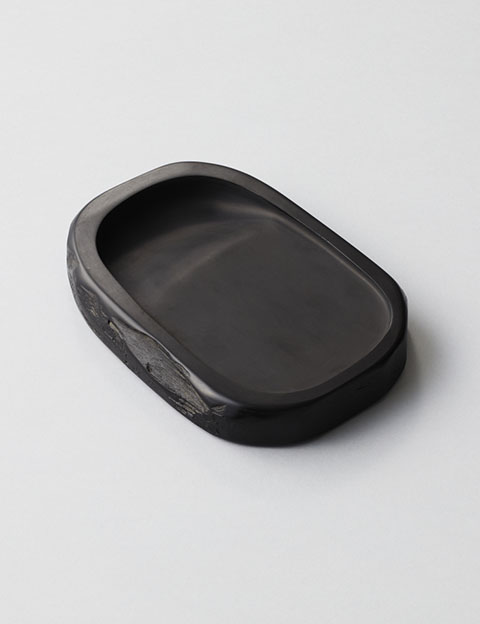
OGATSU Suzuri (Inkstones)

Miyagi Prefecture

The history of OGATSU Suzuri (Inkstones) is very old, and is said to date back to the early Muromachi period.
It is said that in the early Edo period, when Date Masamune came to Tojima, an island off the Oshika Peninsula, to hunt deer, the craftsman presented him with two inkstones, which greatly impressed him, and he was rewarded with a gift.
Furthermore, it is said that Date Tadamune, the second head of the Date family, was so impressed by the skillful craftsmanship that he employed the inkstone maker in the Date domain and designated the mountains where the raw materials for inkstones were sourced as "restricted mountains" (or "forbidden mountains"), prohibiting ordinary people from taking the stones.

  • Technology/techniques/raw materials

    Technology/techniques

    1. The stone used must be free from "stone defects," "cracks," or "fissures."

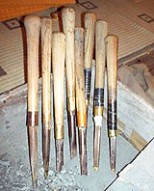
    2. For "edge setting," use "carving chisels" and "small round chisels."

    3. For "rough carving," use a "carving tool" to perform "carving by hand."

    4. After the "rough carving," the "finishing carving" is done by hand.

    5. When "decorative engraving" is performed, it must be done in the form of "hair engraving" or "relief engraving."

    6. For "finishing polishing," use a "whetstone."

    7. The finishing touches shall be one of the following:
    (1) For items requiring "lacquer wrapping," a "glossy finish" or "burnt finish" shall be applied after the "lacquer wrapping."
    (2) For items that do not require "lacquer wrapping", apply a "ink-lined finish".
     

    raw materials

    1. The stone material shall be Ogatsu stone.

    2 漆は、天然漆とすること。

  • Work scene

    The production of OGATSU Suzuri (Inkstones), which has been a thriving industry since ancient times, involved a division of labor: quarrying Ogatsu stone, cutting, sand grinding (smoothing the surface of the raw stone with a grinding keyboard), and carving. This time, we will introduce the process from carving to finishing the inkstone.

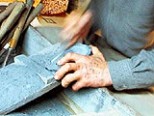
    Step 1: Edge setting

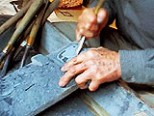
    We create the edges from a single stone. We rest the handle of the chisel on our shoulder, shifting our weight and concentrating all the strength in our bodies. It requires both the strong force to carve the stone and the skill to draw gentle curves.

    Step 2: Rough carving

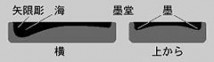
    Roughly carve the inkwell (the part where the ink is ground) and the sea (where the ground ink collects). Carve the approximate depth in one go.

    画像をクリックすると動画が再生されます

    Step 3: Sea carving

    One-third of the entire stone will be the sea area. At its deepest point, the sea is about two-thirds the thickness of the entire stone. The width and depth of this sea are determined by feeling the stone with one's hands as it is carved. The gentle slope from the inkwell to the sea determines the flow of the water and ground ink.

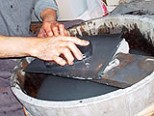
    工程4: 磨き

    The carved inkstone is polished in three stages: internal polishing, external polishing, and finishing polishing, using whetstones and waterproof sandpaper. Internal polishing is the most crucial part of the inkstone, where the ink is ground. It is polished carefully by hand, checking the feel as it goes.

    画像をクリックすると動画が再生されます

    Step 5: Flatten the bottom.

    Next, flatten the bottom. Even the finest inkstone, with its excellent ink grinding and smooth ink flow, is useless if the bottom isn't solid. The bottom, which supports the inkstone, should be leveled by applying even pressure across its entire surface. Polishing stone, like carving, requires considerable strength. Again, concentrate the strength of your entire body into your arms and use momentum to polish and smooth the bottom.

    工程6: 仕上げ

    There are three finishing methods: a glossy finish using lacquer, a baked finish, and a black ink finish using sumi ink. Each method produces a different kind of shine.


  • Close-up

    OGATSU Suzuri (Inkstones) Stationery that chronicles the history of Tohoku

    Calligraphy is both a record of history and an art form. One of its tools, the inkstone, has always been desired to be of high quality and, above all, easy to use. OGATSU Suzuri (Inkstones) utilize the natural properties of Ogatsu stone, and the carving techniques, meticulously designed to ensure the smooth flow of the ground ink, are condensed into each piece.


    The characters for "to look at stone" are read as "suzuri" (inkstone).

    Grinding ink involves grinding the fine ink particles on an inkstone while mixing them with water. "Not just any stone can be carved into an inkstone. As you can see from the character for 'inkstone,' you have to carefully examine the stone, and only a stone that meets the requirements for an inkstone will become one," says Mr. Chiba of OGATSU Suzuri (Inkstones) Production and Sales Cooperative. The requirements for a stone to become an inkstone are...

    - The ink should contain a balanced amount of abrasive particles that act like teeth when grinding the ink.
    (The teeth of a radish grater function like the teeth of a grater.)
    - Low water absorption rate, which allows the ground ink particles to dissolve in water.
    - It does not deteriorate due to chemical reactions or over long periods of time.
    - It has a beautiful natural pattern on the stone surface.

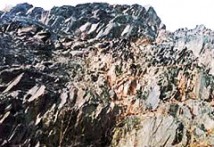
    The stone that possesses all of these conditions is Ogatsu stone, which originates from faults in the underground area of Ogatsu that are over 250 million years old.

    The ink-receiving pillar is what receives the ink. Unless the inkstone has well-balanced, evenly spaced grinding points, the ink cannot be ground or received properly. OGATSU Suzuri (Inkstones) in this balance.

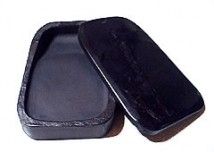
    A one-of-a-kind combination of inkstone and lid – a natural inkstone with a matching lid.

    Ogatsu stone, formed from solidified sediment at the bottom of an ancient river, is essentially a fault line dating back 250 million years. This means it can be split relatively cleanly in a certain direction. Inkstones with lids are made utilizing this property. The Ogatsu stone is cleanly split, one half is carved into the inkstone, and the other half is completed as the lid. The edges are left as they were when split, and when the two halves are joined together, they fit together perfectly. The combination of inkstone and lid, determined the moment the stone is split, is one of a kind in the world, a testament to the unique qualities of natural stone.

    A natural inkstone with a matching lid. The beautiful surface of the Ogatsu stone allows the natural cut edges to be preserved.

    The Ogatsu OGATSU Suzuri (Inkstones) a favorite of Lord Date Masamune, has an unexpected shape.

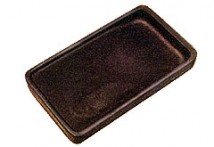
    What kind of inkstone do you imagine when you hear "the inkstone favored by Date Masamune, the lord of the Sendai domain"? Many people would probably picture something large and imposing, with magnificent carvings all around. Here at OGATSU Suzuri (Inkstones) Traditional Industry Hall, there is a replica OGATSU Suzuri (Inkstones) favored by Date Masamune, which is owned by the Sendai City Museum. However, you will be surprised at how simple and small its shape is. "A favorite item taken to the battlefield is small, functional, and elegant so that it is easy to carry," says Mr. Chiba of OGATSU Suzuri (Inkstones) Production and Sales Cooperative. That makes sense. Did Lord Masamune use this inkstone on the battlefield, writing letters amidst the flames of war?

    It is said that creating an inkstone identical to this simple one favored by Lord Masamune is an extremely difficult feat of craftsmanship. At first glance, it appears to be a small, square inkstone, but upon closer inspection, the edges are rounded without sharp corners. Furthermore, the ink-grinding area (inkwell) is raised, and the ground ink flows from both sides into the "sea" (where the ground ink collects). The flow of the ink is meticulously calculated, and the rounded edges and inkwell form smooth curves without the slightest deviation on either side. The finest craftsmanship is condensed within this small inkstone.

    • This inkstone, favored by Lord Date Masamune, embodies the finest technology, so refined that even current measurement techniques cannot match it.

    • The flow of the ground ink, the depth of the sea, and the beautifully rounded rim, the inkstone... There are so many remarkable features in this small, seemingly ordinary inkstone.

    Craftsman Profile

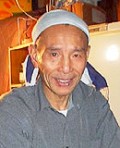
    Takahashi Shineo

    Born in 1932 (Showa 7).
    He became an inkstone craftsman at the age of 21.
    "Making a beautiful, rounded shape is definitely the most difficult part."

    Anecdotes

    The origin of the name of Otomeyama

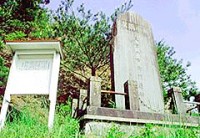
    The Otomeyama mountain, facing Ogatsu Bay, was once called "Otomeyama." It is said that when Lord Date Masamune, the founder of the domain, came to the area around Ogatsu to hunt deer, he presented two inkstones to the craftsman, who greatly praised him and bestowed rewards upon him. Furthermore, when the second lord, Lord Tadamune, also came hunting deer, he was so impressed by the craftsman's skill that he made the inkstone maker a retainer of the Date domain and designated the mountain producing inkstones as Otomeyama, prohibiting general mining. Currently, Otomeyama is privately owned.


    • This shows another side of Ogatsu stone besides inkstones. It might be used in more places around our daily lives than you think.

overview

Craft item name OGATSU Suzuri (Inkstones)
Reading Ogatsu Suzuri
Classification of crafts stationery
Main Products Natural stone inkstones, inkstones with natural lids, special inkstones
Main manufacturing area Sendai City, Ishinomaki City
Designated date May 22, 1985

contact address

■ Production area association

OGATSU Suzuri (Inkstones) Production and Sales Cooperative
〒986-1335
2-17 Shimoogatsu, Ogatsu-cho, Ishinomaki City, Miyagi Prefecture
TEL: 0225-57-2632
FAX: 0225-57-2632

https://www.ogatsu-suzuri.jp/

Features

The most important part of an inkstone is the ridges (hobo), which act like teeth when grinding ink. The characteristic of OGATSU Suzuri (Inkstones) is that the coarseness, fineness, hardness, and softness of these ridges are perfectly balanced. The color is black or dark indigo, with a rich luster and a smooth surface.

How to make it

OGATSU Suzuri (Inkstones) have been praised as superior inkstones since the Muromachi period, boasting a history and tradition of 600 years. They are meticulously carved using traditional, handcrafted methods, relying solely on the skill of the inkstone maker.

Please see here for information on traditional craftspeople.

Japanese traditional craftsman
top