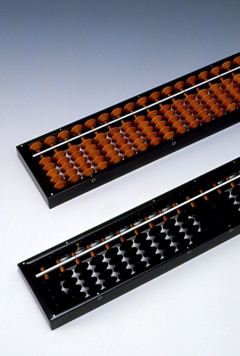
UNSHU Soroban (Abacus)

Shimane Prefecture

In the late Edo period, a carpenter from Nita Town in Shimane Prefecture, using an abacus made by a craftsman in Hiroshima as a model, created a magnificent abacus using oak, plum, and bamboo that could be found in the region as materials.
Later, when craftsmen in Yokota Town perfected a hand-operated lathe for shaping the beads, production increased dramatically, laying the foundation for the local industry. The high quality of the abacus led to the saying, "When you think of abacuses, think of Unshu."

  • Technology/techniques/raw materials

    Technology/techniques

    1. Drying shall be carried out by the following techniques or methods:
    (1) In the case of logs, they should be air-dried for at least six months in their raw state and for at least two weeks in their "rough log" state.
    (2) For frame materials, the raw timber must be air-dried for at least six months, and the cut timber must be air-dried for at least six months.


    2. The ball-making process shall be carried out using the following techniques or methods:
    (1) After the initial trimming, the finishing touches are done using a round lathe and a round plane.
    (2) Chamfering and cleaning the holes.
    (3) When using Onoore as a bead material, use the "red meat" and color it using red iron oxide, red lead, and "gira powder".


    3. In the construction of the shaft, the shaft material should be "skinned" while leaving the "outer layer" intact.


    4. The frame construction shall be carried out using the following techniques or methods:
    (1) The joints of the left and right frames shall be made using a round tenon or triangular tenon for the upper frame and a triangular tenon for the lower frame.
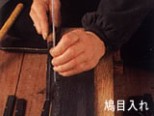
    (2) Add eyelets.
    (3) The top surface of the frame should be rounded.
    (4) The backing board of the frame shall be a "carved board," a "flat board," a "perforated board," or a "round bar," and the "carved board" shall be "chamfered."
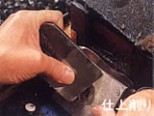
    (5) The frame shall be polished using horsetail and hackberry leaves or materials with equivalent properties, and then waxed using wood wax.


    5. Assembly shall be carried out using the following techniques or methods:
    (1) The shafts should be assembled with the "skin" facing upwards.
    (2) After tightening the frame, perform a stoppering.
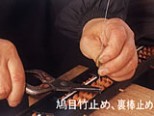
    (3) Use eyelet bamboo fasteners, back rod fasteners, and star-shaped eyelets.
     

    raw materials

    1. The lumber shall be made from wood such as oak, cypress, boxwood, plum, ebony, rosewood, or timber of equivalent quality.

    2. The main material shall be Madake or Moso bamboo, and shall be in a state of being sooty or equivalent.

    3. The frame material shall be made of ebony or a material of equivalent quality.

  • Work scene

    The production process for UNSHU Soroban (Abacus) is extremely complex, with almost all steps relying on manual labor. There are 187 steps in total, and each material has its own specific process. Here, we will briefly introduce the steps.
    The materials used in abacuses are,
    The beads are made from hippopotamus from Tochigi, Gunma, Saitama, and Iwate prefectures; chair from Kagoshima; boxwood from Kagoshima and Thailand; and ebony from Africa.
    The frame is made of processed bamboo and Japanese bamboo. The frame is made of ebony, striped ebony (from Southeast Asia), and specially reinforced wood.

    Process 0: Manufacturing process for the ball


    1. Log
    2. Drying
    3. Owari/horizonomi
    4. Aratama drying
    5. Rough ball cleaning
    6. Appetizers
    7. Mid-range hole sweep
    8. Finishing cuts
    9. Chamfering
    10. Dyeing
    11. Polishing
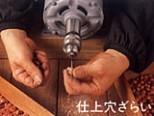
    12. Finishing hole cleaning
    13. Selection

    Process 0: Manufacturing process for the shaft (beam)


    1.Aratake
    2. Selection
    3. Slice into rounds
    4. Small cuts
    5.Cutting
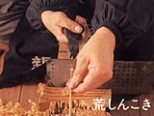
    6. Arashi Shinkoki
    7. Selection
    8. Peeling off the skin
    9. Finishing touches
    10. Finishing polish
    11. Cut to standard length
    12. Chamfering
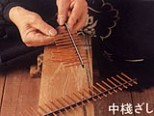
    13. Nakasanzashi

    Process 0: Manufacturing process for the frame.

    1. Log
    2. Drying
    3. Wood selection
    4. Selection
    5. Cut into small pieces and dry.
    6. Correcting the misalignment
    Next, the structure is divided into its individual components: the "middle frame," "upper and lower frames," "left and right frames," and "back panel."

    Step 0: "Nakasan"

    1. Drilling holes
    2. Sand both sides
    3. Cutting out the center groove
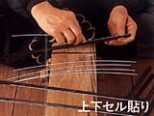
    4. Applying cells to the top and bottom.
    5. Cut to standard length.
    6. Finishing the top and bottom surfaces
    7. Finishing hole cleaning
    8. Double-sided finish

    Step 0: "Upper and Lower Frames"

    1. Drilling bearing holes
    2. Cut to a fixed length.
    3. Making mortise holes
    4. Groove carving on the back panel
    5. Triangular cutting
    6. Eyelet insertion
    7. Interior finish
    8. Finishing hole cleaning

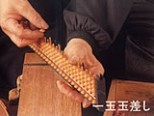
    Once all the components of the frame are assembled, a temporary frame is constructed. The beams are inserted using the "middle beam insertion" and "five-beam insertion" techniques, and then assembled into the temporary frame.

    The next step is
    1. Insert one ball into the ground.
    2. Insert the backing rod.
    3. Installing the lower frame
    4. Inserting the backing plate
    5. Frame closing
    6. Eyelet bamboo fasteners, backing rod fasteners
    7. Stopping thrust
    8. Intermediate polishing
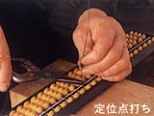
    9. Positioning point marking
    10. Finishing polish
    11. Final finishing
    12. Final Inspection
    13. Finished product


  • Close-up

    The best abacus in Japan is made in a town steeped in mythology.

    For approximately 160 years since 1832 (Tenpo 3), the tradition of UNSHU Soroban (Abacus) has been preserved here in Yokota by many hands.
    Yokota Town is Japan's leading abacus production center, manufacturing approximately 70% of the country's total production. High-quality materials such as birch, boxwood, ebony, and bamboo are always selected, and each exquisite abacus is carefully crafted by master artisans who carry on the tradition.


    The history of Yokota Town and the abacus

    Why did the abacus industry originate and develop here in Yokota town? Mr. Matsuura, chairman of the Unshu Abacus Cooperative Association, explained:
    "Yokota has long been a region where 'tatara' (an important ancient Japanese iron-making method that produces high-purity iron from iron sand and charcoal, with particularly excellent steel being called 'tamahagane,' an indispensable raw material for Japanese swords) flourished, and itinerant merchants have been coming and going since ancient times. The origin of UNSHU Soroban (Abacus) is said to be that people started making them after seeing the abacus that an itinerant merchant was carrying."
    Originally, it was a region with heavy snowfall, so there was a need for industries other than agriculture. Combined with the diligence of the local people, and the fact that it was a production area for plum trees, which were used to make abacus beads at the time, these factors played a role.
    "Furthermore, in the distribution of UNSHU Soroban (Abacus), local 'sashimi merchants' would carry abacuses along with seafood from the Sea of Japan, traveling as far as Kanto and Tohoku, and the abacuses prospered due to their high quality."

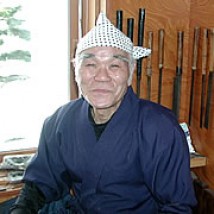
    Chozo Ishihara, the abacus craftsman with a wonderful smile.

    We asked a master craftsman with 48 years of experience making abacuses about the essence of the abacus.

    Chozo Ishihara, a man with a wonderful smile, is a master abacus maker born in 1930. Of course, he continues to make abacuses every day. We asked Mr. Ishihara about what inspired him to start this work.
    "Right after I graduated from school, I took a completely different job. Then my father passed away, and I had to take care of the family, so I apprenticed myself to an abacus maker who was a friend of my father's. I was 23 at the time, so it was a very late start to an apprenticeship as a craftsman." "Because of my age, my master said, 'You have to learn the job in a year. I won't look after you for more than a year.'"
    So, of course I was desperate. Looking back now, I think it was "tough love." I even bowed my head to senior apprentices who were much younger than me and asked them to teach me. My master was probably like that of everyone, but he was very quiet and never told me what to do or how to do it. From around 7 a.m. until it got dark at night, I worked diligently making abacuses. And of course, I didn't take a single day off for a whole year.
    "My master only looked at the results of the work and said whether it was good or bad. I don't think that kind of world exists anywhere anymore, do you? Apprentices have to quietly observe their master's work from the sidelines and steal the techniques. That's the only way to improve your own skills," Ishihara said, reflecting on his apprenticeship.
    "My skills improved considerably, and I was able to show my abacus to my master, and his 'That's good' made me so happy." Since then, Ishihara has diligently worked on making abacuses by himself for 48 years.

    Ishihara's favorite planes

    A craftsman's life depends on his tools.

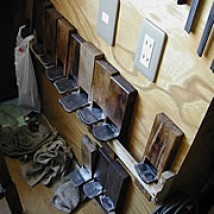
    In Mr. Ishihara's workplace, well-worn planes, drills, and chisels are neatly organized and stored. The manufacture of abacuses involves many steps, and moreover, it is not divided into specialized tasks; one person makes all the steps. Even today, most of these are handmade, and therefore the tools are very important.
    "Well, without tools, a craftsman is just an ordinary old man... I guess. This plane has been planing the wooden frames of abacuses for 48 years, just like me." Surprisingly, Mr. Ishihara uses the same planes and chisels he has since his apprenticeship. "The more you use a tool, the more it suits you, or rather, you start to feel a connection with it." "That's why, even if the blade of the plane breaks, I sharpen it myself to my preferred angle and sharpness. If I don't take care of it myself, it just doesn't feel right." Not only the planes, but also the hammer casually placed on the table and the chisels individually placed in the tool rack are almost all tools that he has been using for over 40 years. I felt as if I had seen not only the traditional techniques, but also the spirit that should never be forgotten.

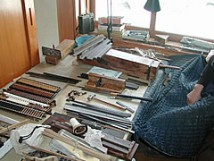
    A view of Mr. Ishihara's workshop.

    Craftsman Profile


    UNSHU Soroban (Abacus) Ishihara (Nagakumo), a traditional craftsman of Unshu abacus
    Born in 1930 (Showa 5). After graduating from Yokota Agricultural and Forestry School in Shimane Prefecture, he studied under Soichi Abe and dedicated himself to mastering abacus manufacturing techniques.
    He has been manufacturing abacuses at his home since 1952. He is a director of the Shimane Prefecture Traditional Craftsmen's Association. Since 1996, an abacus corridor has been located next to UNSHU Soroban (Abacus) Traditional Industry Hall, where craftsmen showcase their skills.

    Anecdotes

    About the origin and etymology of the abacus

    The abacus has long been considered a fundamental part of learning, along with reading and writing. Let's explore its origins and history.

    The origin of the abacus
    In a broad sense, the term includes abacuses made of clay and sand used in Mesopotamia around 400-300 BC, as well as groove abacuses from ancient Greece and Rome. However, it usually refers to those currently used in various parts of Asia, such as Japan, China, and Korea.
    In China, it is called (Suan-Pan), and in Korea, it is called (Chupan).
    There are several theories as to why "算盤" is read as "soroban," but the most natural and representative idea has been that it is a corrupted form of the Chinese pronunciation "suanpan." However, the theory that it originated from "走盤" (sōban) has recently gained traction.
    Besides "算盤" (abacus), the characters "十露盤" (tenroban) were also used in the past, but there are more than 50 other kanji characters used as phonetic equivalents.

    History of the abacus
    The oldest documented records appear in Chinese books from the Han dynasty (around the end of the 2nd century), but the version currently in use is thought to have existed before 1106 (during the Song dynasty). Its rapid spread occurred between the 14th and 16th centuries.

    The introduction of the abacus
    Although there were traditional Japanese methods of calculation before the abacus, its speed of calculation led to its flourishing alongside the development of commerce and transportation. It was likely introduced to Japan through traders and Buddhist monks who traveled to China, but the exact timing is unclear.
    Based on various records, it is believed that it was imported from China in the 1570s (during the time of Oda Nobunaga).

overview

Craft item name UNSHU Soroban (Abacus)
Reading Unshu Abacus
Classification of crafts stationery
Main Products Abacus
Main manufacturing area Okuizumo Town, Nita District
Designated date May 22, 1985

contact address

■ Production area association

Unshu Abacus Cooperative Association
699-1832
992-2 Yokota, Okuizumo-cho, Nita-gun, Shimane Prefecture
Inside UNSHU Soroban (Abacus) Traditional Industry Hall
TEL: 0854-52-0369
FAX: 0854-52-0369

https://okuizumo.org/jp/guide/detail/189/

Features

The most important part of an abacus is the beads. A good abacus has beads that move smoothly and produce a clear, high-pitched sound. In particular, the finishing of the holes in the beads and the core bamboo are done meticulously, so it becomes easier to use the longer you use it.

How to make it

The materials used for abacuses include woods such as birch, boxwood, ebony, and charcoal for the beads, charcoal and specially reinforced wood for the frame, and bamboo and processed bamboo for the shaft. All materials are carefully selected, thoroughly dried, and free from warping.

Please see here for information on traditional craftspeople.

Japanese traditional craftsman
top