KUMANO Fude (Brushes)

Hiroshima Prefecture

During the Edo period, many farmers who could not make a living solely from agriculture would go to the Kumano region of Kishu (present-day Wakayama Prefecture) or the Yoshino region of Yamato (present-day Nara Prefecture) to work during the off-season. When they returned home, they would purchase brushes and ink made in these regions and sell them as itinerant vendors. This is how the connection between Kumano and brushes was born.
It is said that Kumano brushes originated in the late Edo period when a resident of Kumano, who learned the art of brush making at the place of the official brush maker for the Asano family, the lords of the KUMANO Fude (Brushes) domain, returned to his village and taught the technique to the villagers.

  • Technology/techniques/raw materials

    Technology/techniques

    1. For burning and rubbing the hair, use the ashes of rice husks.

    2. For cutting 2. inches, use a "inch piece of wood" and scissors.

    3. The hair blending must be done by "kneading" (including cases where "kneading" is done after "basin mixing").

    4. Use hemp thread for tying the threads.


    raw materials

    1. The ear of the stalk shall be made of the hair of a goat, horse, deer, raccoon dog, weasel, or cat, or animal hair of equivalent material.

    2. The material of the shaft shall be bamboo or wood.

  • Work scene

    The town of Kumano, the nation's leading producer of brushes, is supported by the brush-making techniques that have been passed down unchanged among the people.
    Brush making is divided into stages such as the shank-making process and the shaft-making process, but each stage is performed entirely by hand by the respective craftsman. The precision and meticulousness of their work can only be described as divine.
    This time, we will explain the process step by step, divided into the stages of "shaping the ear of rice" and "shaping the stem."


    <Shaping the ear of rice>

    Step 1: Hair selection and hair arrangement

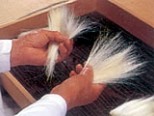
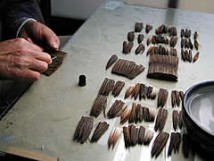
    Depending on the type of brush being made, the quality of the raw hair is selected from the necessary materials, and then sorted into usable and unused hairs. The hairs are then weighed and combined according to the specific brush being made.


    Step 2: Heat pressing and hair conditioning

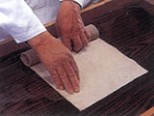
    The hair is sprinkled with ash from burnt rice husks, then ironed, and wrapped in deerskin before being rubbed. This process removes the oil from the hair, straightens it, and makes it easier to absorb ink.


    Step 3: Aligning the hair

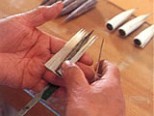
    After combing out the downy hairs, the hairs are piled up in small amounts to make them even.


    Step 4: Remove stray and rubbed hairs

    The ends of the hair are perfectly aligned, and using a small knife, any backcombed or tangled hairs are carefully removed, using the sense of touch in your fingertips. Only the best hairs are meticulously selected.


    Step 5: Cutting into threads

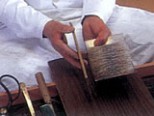
    The hairs from the tip to the bottom of the brush, known as the "life hairs," "throat," "belly," and "waist," are cut to their respective lengths.


    画像をクリックすると動画が再生されます


    Step 6: Mix

    Spread the cut hair thinly and mix it together while applying a thin layer of glue. Remove any remaining tangled hairs, and evenly layer the hairs of different lengths, mixing them repeatedly.


    画像をクリックすると動画が再生されます


    Step 7: Core setting

    The hair is placed in the core holder (spool) and adjusted to the specified thickness. Any unnecessary hairs are removed, and the hair is dried.


    Step 8: Wrapping the fabric

    To make the ear of grain look more beautiful, the outer hairs are spread thinly and wrapped around the dried core, then dried again.


    Step 9: Thread tightening

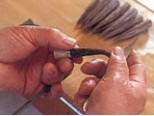
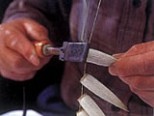
    Tie the base of the bristles with hemp thread, apply a branding iron, quickly heat-seal them, and bundle them together. This completes the tip of the bristles.


    <Building the core>

    Step 1: Choosing the axis

    On the sorting table, select a stalk that is the right thickness for the tip of the stalk.


    Step 2:

    It is heated over a fire, and the bends are straightened out using a wooden tool.


    Step 3: Cutting the shaft

    The shaft will be cut to the ordered length.


    Step 4: Applying the technique

    The barrel is fitted with a celluloid or wooden tip.


    Step 5: Lathe turning (chamfering)

    On the potter's wheel, you trim the wood to match the thickness of the shaft.


    Step 6: Shaft polishing

    After rough polishing with water using a polishing machine, the surface is polished using wax.


    Step 7: Attaching the thread

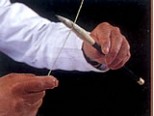
    Drill a hole in the tip to attach the thread, then use an awl to attach the thread.


    Step 8: Daruma processing

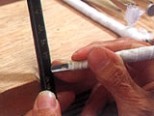
    First, the tip of the shaft to which the Daruma doll will be attached is beveled. Next, the split joint is placed on the lathe, the molten Daruma doll is placed inside, the length is determined with a measuring stick, and then it is shaped with a horseshoe and a scraper (small knife).


    Step 9: Attaching the Daruma doll

    Apply glue to the shaft, insert the Daruma doll, and the shaft is complete.

    Next, you'll need to align the tip of the blade with the stem.


    Step 10: Removal

    Apply adhesive to the shaft, insert the brush head, and secure it firmly.


    工程11: 仕上げ

    After thoroughly soaking the tip of the bristles with glue, wrap the thread around them and remove any excess glue while rotating the shaft. Once the shape of the bristles is set, let them dry and then put the cap on.


    Step 12: Engraving

    The inscription is carved into the shaft with a triangular chisel, and that area is then colored with pigment.


    工程13: 完成

    And that's how a single brush is completed.

  • Close-up

    Quiet traditional crafts and artisans in a quiet town

    Kumano Town is literally Japan's number one brush-making town, accounting for 80% of the nation's total brush production. Currently, there are approximately 1,500 brush-making artisans known as "brush masters." Among them, the "traditional craftsmen," who have dedicated themselves to brush making for 40 to 50 years, are masters of brush making who create custom-made brushes for calligraphers throughout the country.


    Quiet and rigorous training as a calligrapher

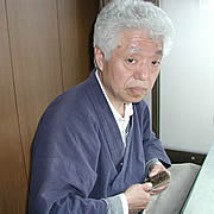
    We spoke with one of the traditional craftspeople, Toshiro Nakagawa. "Originally, Kumano Town is in a basin, so there isn't much land, and there aren't many jobs, so we just kept making brushes, and that's how it became the number one production area in Japan," Nakagawa began, speaking in a hesitant Hiroshima dialect. Coincidentally, his mother made brushes at home, so as soon as he graduated from school, he apprenticed himself to a "master" born in the Meiji era who lived nearby. The master would only teach the basics of the work, and then the apprentices would learn by watching and imitating. Every single day, Saturday and Sunday, they would start at 8 a.m. and simply make brushes. And after each step (there are about 70 steps in brush making), they would have their master check the quality of their work. "Every time, my master would tell me, 'That's no good.' So, to improve and move on to the next stage, I was desperate. Four of us apprenticed together at the time, but after a while, my master told one of us, 'Your hands are too weak, you're out.' In other words, he meant that with those hands, I couldn't make a living making brushes, so I should find a different job. That person never came back the next day. Looking back now, I think it was an act of love to tell me early on that I lacked talent. But I was always nervous while making brushes, trying not to get told that by my master."

    Toshiro Nakagawa, who has dedicated his life to brush making for 49 years, is celebrating his 49th year in the business.

    "It's going well, this should do."

    After completing four years of rigorous training, Nakagawa's next goal upon becoming independent was "to create brushes that would satisfy the user." For the next ten years or so, he focused solely on that. However, the brushes he was satisfied with were not praised by the calligraphers who would use them, and he spent many frustrating years of trial and error. Then one day, a wholesaler told him, "Nakagawa, that famous teacher said, 'It's coming along nicely, this should be good.'" "I was so happy. I truly felt that all my efforts in brush making had been worthwhile. Even now, it's as if I'm working just to hear those words," says Nakagawa.
    A brush crafted by a first-class artisan with love and determination is recognized and used by a first-class calligrapher, and that's how first-class calligraphy is created. ...That's how it works.

    "The hair these days is yaoi."

    Nakagawa continues, "The hair these days is too soft, so we can't keep up." In other words, the animal hair, which is the raw material and is mostly imported from China, has become softer, making it difficult to meet the orders of teachers who want brushes with more resilience. The cause is unclear, but it could be an environmental problem, such as a change in the feed that has altered the condition of the animal hair compared to the past, or an economic problem, such as not being able to wait for the animals to grow up. The cause is not clear, but in any case, there is less animal hair that meets the standards of top craftsmen. KUMANO Fude (Brushes) are also being affected by the import of cheap brushes from overseas. "But..." Nakagawa says, "I won't give up. In the end, it's a battle of skill. The ability to discern the best raw materials, the tradition of brush making in Kumano town, and love and skill for brushes. I will do my best." Nakagawa said this with a gentle gaze as he looked at the rapeseed flowers in his garden.

    Mr. Nakagawa's impressive skills in his home workshop.

    Craftsman Profile

    Toshiro Nakagawa

    Born on January 11, 1936.
    He has been involved in brush making since he was 16 years old, and this year marks his 49th year in the craft. In December 1981, he was certified as a traditional craftsman.

    Anecdotes

    The history of brush making

    The exact time when brush making began is unclear, but inscriptions believed to have been written with a brush have been found on oracle bone fragments from the Yin dynasty (circa 1600 BC to 1028 BC), suggesting that brushes already existed during that period. Furthermore, patterns believed to have been drawn with a brush have been found on painted pottery from the late Neolithic period. The oldest surviving brush in the world is the "Changsha brush," discovered at a site in the Chu state (?–223 BC) from the Warring States period of China. It consists of a slender bamboo shaft about 16 cm long, with the tip split, rabbit hair inserted and tied with thread, then hardened with lacquer. Another example is the "Juyan brush," discovered with wooden slips from the Han dynasty. This brush has a wooden shaft about 21 cm long, with one end split into four sections, and a 1.4 cm brush head inserted.

    In Japan, brushes are believed to have been made during the Taihō era (701-714), but the oldest existing brushes are 17 rolled brushes made from rabbit, deer, and raccoon hair, housed in the Shōsōin Treasure House.
    Records show that in 812, Kukai, a master calligrapher, commissioned the brush maker Sakana Kiyokawa to create four badger hair brushes (for regular, semi-cursive, cursive, and sutra copying) using Tang Dynasty brush-making techniques, and presented them to the Emperor. Around this time, brushes began to be made in various regions from Kanto to Kyushu. During the Edo period, high-quality brushes were actively produced as a side job for samurai retainers.

    The history of brush making in Kumano dates back about 170 years to the end of the Edo period. At that time, Kumano had little farmland, and agriculture alone was not enough to support the people. Many farmers would go away to work during the off-season. Their destinations were mainly the Kumano region of Kishu (Wakayama Prefecture) and the Yoshino region of Yamato (Nara Prefecture). After finishing their work away from home, they would stop in Nara to purchase brushes and ink, and then return to Kumano while selling them as itinerant merchants. This was the beginning of the connection between Kumano and brushes.
    Around that time, a young man named Jihei Inoue (Yasuke Inoue) was a brush maker for the Hiroshima domain, and it is said that Tametsugu Sasaki and Tsuneta Otomaru (Tsunetaro Otomaru) learned brush making in Arima, Settsu Province (Hyogo Prefecture), and returned to the village to spread the art of brush making to the local people. In Kumano, which had no significant industries at the time, brush making was adopted as a new industry, and through the efforts and passion of the villagers, it formed the foundation of a production area. The excellent techniques have been passed down continuously for 170 years to this day.

overview

Craft item name KUMANO Fude (Brushes)
Reading Bear's Brush
Classification of crafts stationery
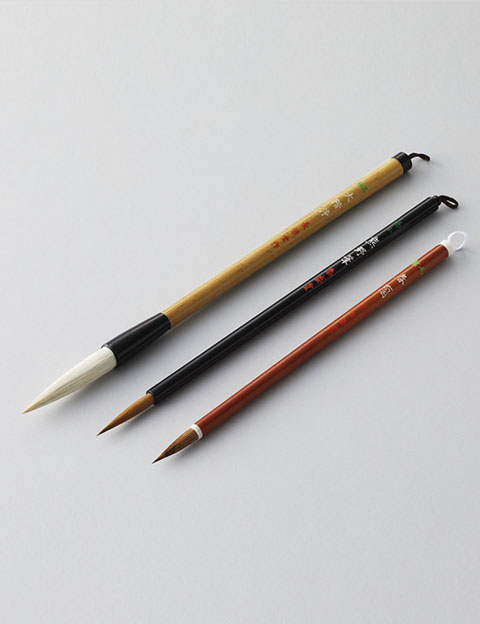
Main Products Calligraphy brushes, paintbrushes, makeup brushes
Main manufacturing area Kumano Town, Aki District
Designated date May 10, 1975

contact address

■ Production area association

KUMANO Fude (Brushes) Business Cooperative
731-4214
3-13-19 Nakamizo, Kumano-cho, Aki-gun, Hiroshima Prefecture
TEL: 082-854-0074
FAX: 082-854-6790

https://www.kumanofude.or.jp/

Features

We produce a wide range of brushes for schoolchildren, general use, and professional calligraphers, fulfilling the needs of those who practice calligraphy. We also create custom brushes to order.

How to make it

The process begins with selecting and combining the hairs. The hairs are rubbed in ash to remove the oil, cut to the required length, and thoroughly mixed to create the core. The remaining hairs are wrapped around the core like a garment, the base is tied with thread, and then it is burned to complete the brush head. The brush head is attached to the shaft, hardened with glue, and the brush's name is engraved to finish it. The brush head is made from the hairs of goats, horses, deer, raccoons, weasels, cats, etc. Hair selection is a crucial step that forms the basis of brush making; if the selection is wrong, a good brush cannot be made.

Please see here for information on traditional craftspeople.

Japanese traditional craftsman
top