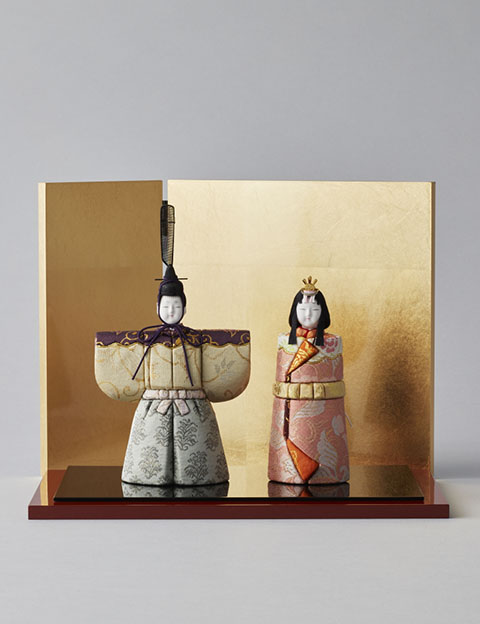
EDO Kimekomi Ningyo (Dolls)

Saitama Prefecture, Tokyo

It is said that the custom originated in the mid-Edo period at the Kamigamo Shrine in Kyoto, when Shinto priests used leftover pieces of willow wood from the willow boxes used in festivals to create small wooden dolls, carved grooves into them, and then stuffed leftover fabric from their own robes into the grooves to dress the dolls.
Initially, these dolls were made in Kamo and were therefore called "Kamo dolls," but they came to be known as "Kimekomi dolls" because the fabric for their costumes was tucked into cuts in wood, and they were introduced to Edo (present-day Tokyo).

  • Technology/techniques/raw materials

    Technology/techniques

    1. The preparation of the base material shall be carried out using the following techniques or methods:
    (1) The head shall be made in one of the following ways:
    (i) In the case of "paulownia wood paste heads," after "base coat," "raising," "intermediate coat," and "cutting," five or more "top coats" shall be applied.
    For unglazed pottery, after applying the undercoat and cutting, apply at least five coats of topcoat.
    (2) The torso shall be constructed by first "polishing the raw material," then "applying a base coat" and "carving lines." In this case, the "body filler" shall be made of "paulownia wood paste."
    (3) For making the hands and feet, after applying the base coat, intermediate coat and cutting, apply the top coat at least five times. In this case, the "nuki" (body parts) shall be made of paulownia wood paste.


    2. The dressing process involves applying glue to the grooves and then using an awl to create the "joint" or "overlapping" kimekomi (wood inlay) technique. In this case, the glue should be made of kanbai powder.


    3. Face painting involves using a fine brush to "paint in the eyes," "paint in the eyebrows," and "apply lipstick."


    4. Hair blowing should be done after "suga shaping". In this case, the hairstyle should be "updo", "parted hair", or "bald".
     

    raw materials

    1. The material used for "Kirito" (paulownia wood paste) shall be paulownia wood.

    2. The clay used for the "unglazed head" shall be white clay or a material of equivalent quality.

    3. The fabric used for dressing shall be silk, cotton, or of equivalent material.

    4. The thread used for the hair must be silk.

  • Work scene

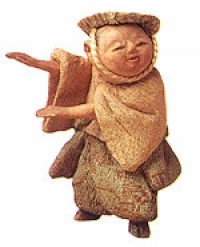
    Unlike dressed dolls, Kimekomi dolls have grooves carved into the body and fabric is inlaid into them to give the appearance of clothing. This technique does not detract from the beauty of the doll's body lines, giving it a luxurious feel and demonstrating superior craftsmanship. Also, while dressed dolls have glass eyes, Kimekomi dolls have hand-painted eyes. A distinctive feature is that the faces vary depending on the artist.

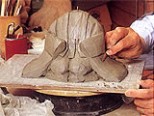
    Step 1: Creating the basic shape

    I create the basic shape of the doll's body using clay. In the case of Hina dolls, I sculpt the details of the costume, such as the seams, folds, and flow of the obi (sash), including the twelve-layered kimono and court attire, into the basic shape.

    Step 2: Kettle

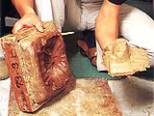
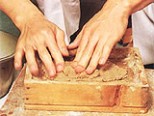
    The original model is placed inside a wooden frame, and molten sulfur is poured into the frame to create a mold of the doll. This mold is called a "cauldron," and two are made: the front half and the back half (or top and bottom) of the original model.

    Step 3: Preparing the base material

    The pot is coated with oil to make it easier to remove the body, and then filled with paulownia wood paste (paulownia wood powder mixed with wheat starch paste). At this time, the center of the body is made hollow and reinforced with paper to prevent the shape from collapsing. Next, the two pots are joined together and pressed firmly. The resulting body is called a "nuki," and it is thoroughly dried in a drying room. Any unevenness or cracks that have formed on the body are filled in with paulownia wood paste using a bamboo spatula and then neatly repaired with sandpaper.

    Step 4: Applying white pigment

    White pigment made from roasted seashell powder is mixed with animal glue, dissolved in hot water, and applied to the body. This tightens the body's texture and makes it easier to carve the lines.

    Step 5: Outline marking

    Next, grooves are created for inlaying (fitting) the fabric. This is called groove carving, and it is an important step that affects the quality of the finished product. The depth and width of the grooves will vary depending on the type and thickness of the fabric being inlaid, but they are carefully carved using a carving knife to achieve a consistent depth and width.

    Step 6: Wood carving

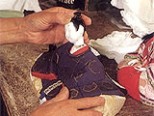
    After applying glue to the grooves, the fabric cut according to the pattern is firmly pressed into the wood using an awl or wood-making tool. It is especially important to press the curved parts tightly against the body to create the shape as in the original pattern, so that there is no sagging or small wrinkles.

    画像をクリックすると動画が再生されます

    Step 7: Making the head

    Oil is applied to the two separate molds, one for the face and the other for the back of the head, and then finer-grained paulownia wood paste is packed into them. Just like the body, the center is left hollow, and the thoroughly dried mold is sanded and repaired.

    Step 8: Applying white pigment to the head

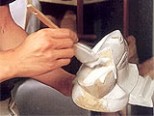
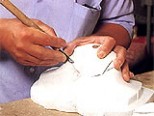
    First, the base coat is applied and allowed to dry. Next, raised white pigment is applied to create raised areas for the nose and mouth. After drying, the shape is refined by carving with a small knife. Next is the undercoat. A darker white pigment than the base coat is applied to the entire head, carefully shaping it and allowing it to dry. A damp cloth is used to wipe away any unevenness in the white pigment. Then, the raised areas are carved one by one to create subtle facial expressions. This is where the doll maker's skill comes into play. Next is the top coat. The top coat white pigment is strained and allowed to settle, and the supernatant is applied with a brush 7 to 10 times, carefully and quickly to avoid unevenness.

    Step 9: Drawing the face

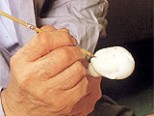
    The face is said to be the lifeblood of a doll. With all my attention focused on the tip of a fine brush, I paint in the eyes, lips, and other features. Painting the face is a crucial step that determines the quality of the doll.

    Step 10: Engraving

    We will now carve grooves for the areas where the hair will be implanted.

    Step 11: Hair blowing

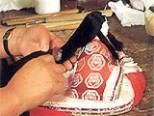
    The black-dyed silk threads are combed, the ends are trimmed, and then glued. The shorter hairs are then inserted into the grooves that have been carved using an awl.

    画像をクリックすると動画が再生されます

    Step 12: Installation

    After completing the wood inlay work on the body, carefully consider the orientation and angle when attaching the head, hands, and accessories.

    工程13: 仕上げ

    I straighten out any tangles in the hair, brush it to make it look neat, and then I check for any imperfections in the wood inlay work to finish it.


  • Close-up

    I want to have a once-in-a-lifetime encounter with my favorite Hina doll, EDO Kimekomi Ningyo (Dolls)

    In Iwatsuki, the town of dolls, countless adorable dolls continue to be created by the hands of many people. Hina dolls, May dolls, Ichimatsu dolls—these dolls embody the parents' hopes that their children will grow up healthy, strong, and beautiful. Even though the environment surrounding children may change dramatically, that sentiment remains the same, then and now.


    I want to decorate with dolls for my children and for myself.

    Iwatsuki in Musashi Province is renowned as a town of dolls. This area, which flourished as a castle town and post town, is said to have been settled by artisans who worked on the construction and repair of Nikko Toshogu Shrine, and who began making dolls. The area around Iwatsuki was originally a source of paulownia wood. The artisans discovered that the powder from this paulownia wood was suitable as a material for dolls, and that the local water was ideal for dissolving white pigment.
    Even today, around 300 people are involved in traditional doll making under the old-fashioned division of labor system. "Recently, young mothers in their 20s and 30s with boys seem to prefer adorable Kimekomi dolls to armor and helmets that evoke images of weapons. Also, many women in their 40s and older buy them for themselves. Small standing Hina dolls are popular regardless of the festival. Perhaps it's because they have more financial freedom and peace of mind," says traditional craftsman Juichi Arimatsu. His gentle and unpretentious way of speaking reveals a deep and kind character.

    Standing hina dolls enjoy enduring popularity regardless of the festival. "Many mothers buy them for themselves," says the artist, Juichi Arimatsu.

    Even today's kids are crazy about Kimekomi dolls.

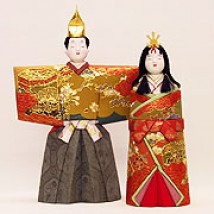
    With its delicately hand-painted, gentle face, dazzling silk costume adorned with exquisite color combinations, and graceful, upright posture, Kimekomi dolls are exquisitely crafted, beautiful, and luxurious works of art that will make even adults sigh in admiration.
    Meanwhile, children are also captivated by Kimekomi dolls, but for a different reason. Ms. Arimatsu once taught doll making to fourth and fifth graders as part of an experiential learning program at an elementary school. Every child's eyes lit up with excitement as they worked on cutting out the doll shapes. "These days, there's a lot of talk about classroom disruption and ADHD, but children are completely engrossed in using their hands and learning through physical activity. The teachers were surprised by this."

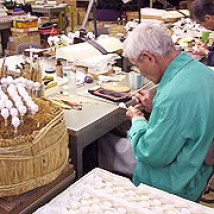
    In Iwatsuki, a well-established division of labor system is in place. Here, they are painting facial details. This is a job where concentration is essential.

    Skills as a craftsman, business acumen as a wholesaler

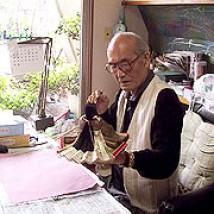
    Arimatsu had been helping his father, a doll maker, since he was in junior high school. By chance, he went to work for his master at the age of 15. After about three years of training, he began helping with the business management as well. When he was 20, his master passed away suddenly at the young age of 42. Unable to abandon the family he left behind, he temporarily stopped making dolls and devoted himself to the wholesale business. Later, he handed over the business to his master's son and finally became an independent doll maker.
    "The fact that I couldn't stick to just one path all the time actually broadened my perspective."
    In this age of widespread IT, Mr. Arimatsu is also making full use of his computer. He creates brochures, handling both photography and design himself, and uses them in sales, receiving rave reviews from wholesalers for their functionality and aesthetic appeal. He also launched his own website, though this one is primarily for educational purposes.
    "We'll make sure to stay within our purview as a manufacturer, while also making sure not to get in the way of the wholesalers."
    The attentiveness to various aspects and sense of balance I acquired during my time in management are proving invaluable here. Of course, I haven't forgotten the importance of looking ahead. In the future, the number of craftsmen will surely decrease. My son says he doesn't want to take over the business, and I have no intention of forcing him. That's precisely why the Kimekomi dolls I've made so far are an irreplaceable asset. I want to preserve them as a database so that they can be useful to future generations who want to make dolls.

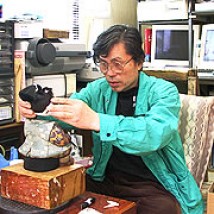
    Ms. Arimatsu is in the process of attaching the headpiece. "Choosing the costume is always a challenge. Every year, I visit the NISHIJIN Ori (Textiles) exhibition in Kyoto."

    There is a once-in-a-lifetime encounter between people and dolls.

    One day, Arimatsu received an email on his website from a woman he had never met. It was from a young mother who had purchased a Keiun Hina doll made by Arimatsu. —There were many works displayed in the shop, but my eyes were inevitably drawn to the Keiun Hina doll you made. I bought it for my child, but now the more I look at it, the more attached I become, and I feel so fulfilled that I came across this Hina doll. Thank you very much.
    It is a once-in-a-lifetime encounter. Perhaps this can be called a unique experience not only between people, but also between people and dolls. Dollmakers face each doll as if raising their own children, breathing life into them with their love and moving the hearts of those who see them. As long as there is a parent's love for their child, the art of doll making will never die out.

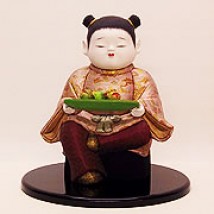
    • "Kichijōka" is one of the Gosho-style series. Its Chinese-style topknot is adorable. No matter which doll you look at, the exquisite patterns and color combinations of the costumes are breathtakingly beautiful.

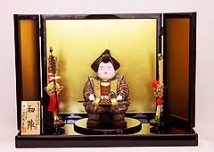
    • "First Battle" by Ms. Arimatsu. Her face is plump and cute, yet she also exudes a sense of dignity.

    Craftsman Profile

    Juichi Arimatsu

    Born in 1941.
    Currently, I'm researching how to use 3D software for doll making.
    On the other hand, he is a dedicated individual who continues to learn terracotta (sculpture) techniques.

    EDO Kimekomi Ningyo (Dolls) embody the delicate sensibilities of the Japanese people who cherish the four seasons.

    Through the four seasons, the natural world of the Japanese archipelago changes moment by moment. The sensitivity to perceive these subtle changes in life force is greatly reflected in the creation of Kimekomi dolls. Through the dolls of master craftsmen, adults and children alike can remember and cherish the sensitivity that is inherent in all Japanese people.


    Parental feelings entrusted to a doll

    In the spring of Yayoi, when the cold weather eases and peach blossoms begin to open, Hina dolls are displayed to pray for the healthy growth of girls. Carp streamers (koinobori) swim vigorously in the bright blue sky of May, and warrior dolls are displayed with the wish that their sons will grow up to be strong men. Though times may change, the parental love entrusted to dolls remains the same.
    In these times of declining birth rates, parents, with fewer children, seem to be able to pour more care and attention into each one, wanting to buy a special doll for their child. A generation ago, it was common for grandparents to give dolls for a child's first Hina Matsuri (Girls' Day), but now I hear that it's becoming more common for young fathers and mothers to choose the dolls themselves.

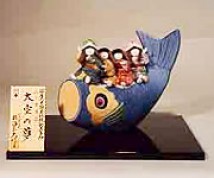
    "Dreams of the vast sky." You can almost hear the children's joyful shouts.

    "If you have an evil heart, you can't make dolls."

    Doll maker Toko Kakinuma entered this profession at the age of 15. He has always loved working with his hands, and he says he enjoyed learning the job and doesn't recall any particular difficulties.
    "I have a laid-back personality. Generally speaking, people who make dolls tend to be gentle and calm-hearted. If you have an evil heart, you can't make dolls, and even if you do, it will show on their faces." The lively movements and original designs are the true essence of the Kimekomi dolls made by Ms. Kakinuma. Kintaro throwing a bear, a boy cheering while being carried on his older brother's back, a boy sitting on a peach and gazing at you, a boy stretching his body as if competing to grow next to a bamboo shoot, mischievous boys straddling a carp streamer. Each doll, playing innocently in nature, is adorable, and just looking at them makes you involuntarily smile.

    Kakinuma's workspace. "The pace of the world seems to have picked up so quickly. Back in the day, I'd work whenever I felt like it."

    Kimekomi dolls that meet the needs of the new era

    As mothers' generations change, their preferences for dolls inevitably change as well. While continuing to create traditional dolls, Ms. Kakinuma also works on Kimekomi dolls that meet the needs of the new era. To do this, she travels around to experience traditional crafts in various regions and never forgets to be attentive to even the smallest details of everyday life.
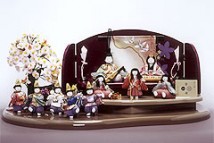
    Recently, a new and innovative set of Hina dolls was unveiled. It allows you to enjoy changing the dolls, background decorations, and base according to the season (the five seasonal festivals). This has been well-received across generations. For New Year's, the dolls celebrate the beginning of spring on a red felt mat adorned with kadomatsu (pine and bamboo decorations) and kagami mochi (rice cakes). In the background, the auspicious sunrise shines through the clouds. For the Peach Festival, there are the Emperor and Empress dolls, surrounded by children happily playing music and dancing. For the Boys' Festival, there is a feast for the boys, with carp streamers and irises in the background, of course. For the Tanabata Festival, children play innocently by the flowing Milky Way, as if celebrating the romance of Orihime and Hikoboshi. Around the time of the Mid-Autumn Festival, the dolls gather around dumplings and enjoy moon viewing. A rabbit sits beside them, and the plumes of pampas grass create an autumnal atmosphere.

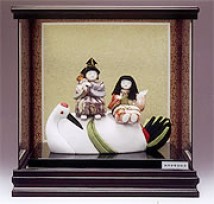
    • These are dolls of children made by Toko Kakinuma. His other works, featuring children riding animals, are all incredibly charming.

    • A new kind of Hina doll set, Yumeko Hina "Matsuri Yuu"

    Enjoy the changing seasons through Kimekomi dolls.

    The word "sekku" (seasonal festival) was originally written as "sekku" (節供). "Setsu" (節) represents the turning point of the seasons, and "ku" (供) means to offer food. In other words, sekku was a ceremony held at the change of seasons in which seasonal foods were offered to the myriad gods as a token of gratitude, and people also partook of the food and prayed for good health.
    Festivals and events are special occasions, and by fully enjoying them, vitality is regenerated, making everyday life from the next day onward full of energy. Yes, there was a sense of structure and balance in life.
    "But nowadays, annual events themselves, and the deep meanings they hold, are gradually being forgotten, and daily life has become bland. Through dolls, I want to convey to children the delicate sensibilities of the Japanese people that flow beneath traditional culture."
    The Kimekomi dolls created by Ms. Kakinuma possess a charming cuteness, yet they also hold a vibrant life force. They have a strong presence. Adults and children alike can decorate with Kimekomi dolls and enjoy the changing seasons together—isn't this kind of peace of mind and richness what is so desperately needed today?

    "Ikaruga Sacred Star." A work that evokes the atmosphere of ancient Asuka.

    Craftsman Profile

    Toko Kakinuma

    Born in 1920.
    They constantly incorporate new techniques and sensibilities, such as hand-painted patterns with raised relief, gold leaf application, and mother-of-pearl inlay.

    Anecdotes

    The birthplace of EDO Kimekomi Ningyo (Dolls) is Kamigamo Shrine in Kyoto.


    • Kamigamo Shrine. Actually, this is a common name; its official name is Kamo Wakeikazuchi Shrine.


overview

Craft item name EDO Kimekomi Ningyo (Dolls)
Reading Edokimekominingyo
Classification of crafts Dolls and Kokeshi dolls
Main Products Festival dolls, Kabuki dolls, folk dolls
Main manufacturing area Saitama City, Kasukabe City, Tokyo / Bunkyo Ward, Taito Ward, Sumida Ward, Kita Ward, Arakawa Ward, Itabashi Ward, Adachi Ward, Katsushika Ward, Edogawa Ward
Designated date February 6, 1978

contact address

■ Production area association

Tokyo Metropolitan Doll Manufacturers Cooperative Association
110-0016
2-1-3 Taito, Taito-ku, Tokyo
Century Building, 2nd Floor
TEL: 03-6284-3765
FAX: 03-6284-3652

http://www.hina-ko.jp/

IWATSUKI Ningyo (Dolls) Cooperative
339-0057
3-2-5 Honcho, Iwatsuki-ku, Saitama City, Saitama Prefecture
Watts East Building, 4th Floor
Inside the Iwatsuki Branch of the Saitama Chamber of Commerce and Industry
TEL: 048-757-8881
FAX: 048-757-8891

https://doll.or.jp/

Features

Kimekomi dolls are made by carving grooves into a mold made of paulownia wood paste (toso), which is made by hardening paulownia wood powder with soybean paste, and then stuffing (inserting) fabric into the grooves.

How to make it

It is said that the quality of a doll is determined by its face, making head-making the most skilled process. First, a mixture of paulownia wood powder and soybean paste is molded and dried to create the base. After this, multiple coats are applied, the eyes, nose, and mouth are cut out with a small knife, and then another coat is applied and polished to give the skin a sheen. Then, eyebrows and eyes are drawn with a fine brush, rouge is applied to the cheeks, and lipstick is added. Finally, the hair is attached and styled, completing the head.

Please see here for information on traditional craftspeople.

Japanese traditional craftsman
top