GIFU Chochin (Lanterns)

Gifu Prefecture

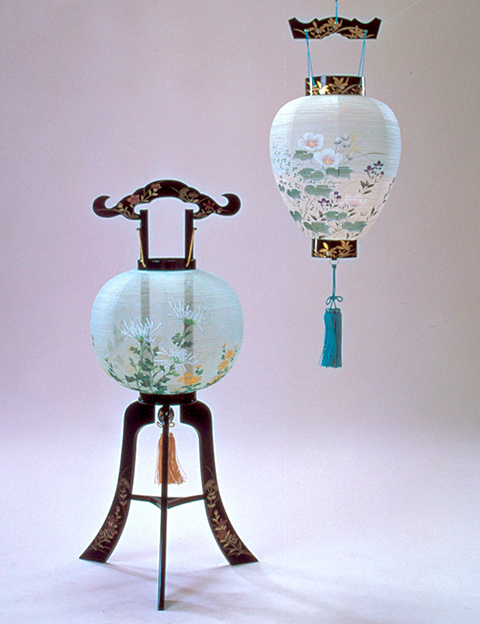
GIFU Chochin (Lanterns) are said to have originated in Gifu in the mid-18th century, and their production flourished due to the abundance of raw materials such as washi paper and bamboo nearby.
It is said that lanterns with the characteristics we see today became quite widespread in the first half of the 19th century. They are widely used for Obon (Buddhist festival) and for enjoying the summer heat.

  • Technology/techniques/raw materials

    Technology/techniques

    1. When processing the base paper and fabric, "sizing" and "base color application" shall be performed. However, "base color application" shall not be performed on white-backed paper.

    2. When decorating the paper or fabric, the method shall be either "printing" or painting. In this case, the painting shall be done by hand.

    3. The processing of the lantern shade shall be carried out by "mold assembly," "bamboo strip winding," "adhesion," "seam cutting," and "die cutting."

    4. When processing the wood, perform "gluing," "finishing," and "chamfering."
     

    raw materials

    1. The base paper shall be Japanese paper (washi), and the fabric shall be silk.

    2. The frame of the lantern shall be made of Madake bamboo or Hachiku bamboo.

    3. The wood used shall be cedar, cypress, magnolia, or a material of equivalent quality.

  • Work scene

    The manufacturing process for GIFU Chochin (Lanterns) can be broadly divided into four stages: decoration of washi paper (or silk), production of the lantern shade (hibukuro), processing of the wooden base (kiji), and finishing. There are two methods for decorating washi paper (or silk): one is to "print" a picture onto the paper using a stencil before pasting it on, and the other is to "paint" a picture by hand after pasting on plain paper (or silk).
    In GIFU Chochin (Lanterns), the process is divided among specialists: the decoration of the washi paper, or the creation of the picture paper, is done by "surikomishi" (paper stencil makers); the creation of the lantern shade is done by "harishi" (paper hangers); the painting is done by "eshi" (painters); the wooden base (rim, lantern stand, etc.) is made by "kijishi" (woodworkers); the painting is done by "nurishi" (painters); and the makie (gold lacquer) application is done by "makieshi" (gold lacquerers).

    Step 1: Dough preparation

    A solution made by adding alum to dissolved animal glue is applied to the washi paper. This not only gives the paper a sheen and stiffness, but also prevents the pigment from bleeding during the rubbing process. Furthermore, a thin base color is applied to the paper in a process called "ground color application."

    Step 2: Rubbing

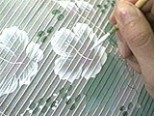
    After printing the design using a woodblock carved along its outline, stencils are layered on top to apply the colors. The designs are carved based on original drawings by Japanese painters. Because it's impossible to print adjacent delicate parts of the design in one go, and it wouldn't create a sense of depth otherwise, the design is printed in multiple stages. Depending on the design, the stencils may be layered nearly 100 times before the final print is complete. This is the work of the printmaker.

    画像をクリックすると動画が再生されます

    Step 3: Making the mouthpiece and hand plate

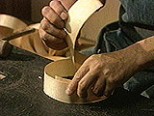
    Specialized craftsmen called woodworkers create the rings that attach to the top and bottom of the lanterns, the hanging boards for Gosho lanterns, and the legs for Ouchi andon lanterns. Unlike ordinary lanterns, GIFU Chochin (Lanterns) have a double-layered upper ring (kamiwa, the ring used at the top). This is made by gluing together thin planks of cypress or cedar that have been planed to slightly different thicknesses, and this double-layered structure hides the joint between the lantern shade and the upper ring when the lantern is finished.

    Step 4: Decoration

    The rim, handle, and legs are decorated using techniques such as raised decoration and maki-e (gold lacquer) work. This decoration is also done by specialized craftsmen.

    Step 5: Assembling the lantern and wrapping the bamboo strips

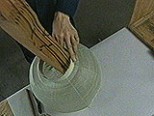
    The lantern's base is assembled to create the basic shape. Bamboo strips are wrapped around the grooves carved into this base to form the lantern's form. Wrapping these thin bamboo strips, which are only 0.6 to 0.7 mm thick, with even tension is a skilled task. If a strip runs out during the process, thread is used to connect the remaining strips. The thinner the strips and the more stitches there are in the wrapping, the higher the quality of the lantern.

    画像をクリックすると動画が再生されます

    Step 6: Application

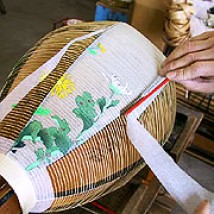
    Threads are attached to the bamboo strips to control the stretching of the lantern and prevent damage to the paper. The threads are carefully placed along the stretching mold, and glue is applied to the strips in the spaces between the threads, and washi paper is attached. The paper is attached at intervals of one ken (approximately 3.8 meters).

    Step 7: Cutting the seams

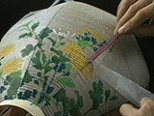
    Each time a sheet of paper is attached, the excess is quickly trimmed off with a razor blade, aligning it with the thread attached to the bamboo stick. At this point, the overlap between the sheets of paper (the glue margin) is only about 1 millimeter. The glue margin is kept to a minimum because if the overlap between the sheets of paper is too large, the light will become uneven.

    Step 8: Cutting out the lantern shape

    The lantern molds, which have been dried slowly over time, are removed one by one. The process of folding them is completed by carefully creating creases with a spatula.

    Step 9: Painting and finishing

    If the lantern is made from plain paper rather than pre-printed paper, the "painting" is done at this stage. Even when using pre-printed paper, touch-ups are made as needed. Finally, accessories such as the mouth ring, handle board, and tassels are attached to complete the lantern.


  • Close-up

    Exquisite beauty that has been continuously presented to the shogunate and the imperial family.

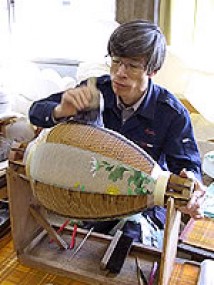
    GIFU Chochin (Lanterns) are said to have become famous during the Hōreki era (1751-1763) when Juzo, a lantern maker from Gifu, presented lanterns to the Tokugawa shogunate. GIFU Chochin (Lanterns) are made through a division of labor among several specialists, and this time we spoke with Akio Suzumura, a "harishi" (lantern hanger) who makes the main body of the lantern.


    Enter the world of GIFU Chochin (Lanterns) with a relaxed attitude.

    The Mino region became known for its lanterns due to the abundance of thin yet strong MINO Washi (Papers) and high-quality bamboo. After gaining recognition, the techniques were continuously improved, resulting in the exquisite and elegant GIFU Chochin (Lanterns) we see today. GIFU Chochin (Lanterns) have a history of being presented to the shogunate and the imperial family for over 200 years, from the Edo period through the Meiji, Taisho, and Showa eras. However, when Ms. Suzumura entered this world, she had no such expectations and found it quite relaxed. When she visited the company for a job search after graduating from junior high school, she saw the lantern manufacturing process and thought it would suit her, given her love of arts and crafts. "I didn't think about preserving tradition or its long history at all," she says. Nevertheless, after about three months, she had a good grasp of the work of a lantern maker and began to find the job interesting.

    Ms. Suzumura is pasting paper onto the lantern. She is pasting eight sheets of paper, leaving one space between each sheet.

    A parade of intricate tasks

    "It suited me," says Suzumura. The work of a lantern maker involves assembling a wooden mold, wrapping bamboo strips around it, pasting paper, drying it, and folding it, but as you can see immediately when you look at an actual lantern, it is extremely detailed work. The bamboo strips are made by specialized craftsmen, but they are only 0.6 to 0.7 millimeters thick. These strips are wound spirally along finely carved grooves in the wooden mold, but unlike wire, bamboo strips have knots and their thickness varies slightly. It is difficult to wind them with the same tension. The bamboo strips are about 4 meters long, but to make a lantern with a diameter of 1 shaku (approximately 30 cm), these strips must be joined together 20 to 25 times. This process of joining them by finely tying them with thread is time-consuming. After pasting the paper, the excess is cut off with a razor blade along the thread connecting the upper and lower stretching rings. The overlap between adjacent pieces of paper at this time is only 1 millimeter. The lanterns are so intricately made that you might think they're all made from a single sheet of paper. "It was really hard to learn," Suzumura says casually, but it's a time-consuming job where she can only make about five or six a day.

    Cut off the excess paper along the thread stretched along the wooden mold.

    GIFU Chochin (Lanterns) are the culmination of the skills of various specialists.

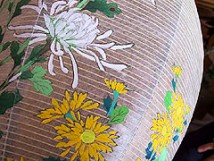
    The paper that Suzumura, the paperhanger, was pasting already had large white chrysanthemums and small yellow chrysanthemums drawn on it, but this was done by a specialist craftsman called a "surikomishi" who used stencils to print the image. If you look closely, you can see that each petal and each leaf is subtly printed differently. To layer multiple colors and to create a three-dimensional effect, the stencil is sometimes applied nearly 100 times. There is also a method of painting on lanterns made by pasting on plain paper afterwards, but this is the job of an "etsukeshi" (painting specialist). Several specialists are involved in the manufacturing process of GIFU Chochin (Lanterns). The rim, the handle of the Gosho lantern, and the base of the Andon lantern are made by a "kijishi" (woodworker), and the decoration of the woodwork is done by a "nurishi" (painting specialist) and a "makie" (gold lacquer specialist), and so on. "I think the charm of GIFU Chochin (Lanterns) is that everything made with care by each specialist comes together as one. Each one is of high quality."

    GIFU Chochin (Lanterns) are meticulously crafted, with only a 1mm margin of overlap between the paper sections—a testament to the skill of the artisans.

    The exquisite charm of autumn grasses

    Ms. Suzumura says she loves the delicate designs on GIFU Chochin (Lanterns). The designs on GIFU Chochin (Lanterns) used to depict flowers, birds, landscapes, and Gifu's cormorant fishing, when lanterns were used as lighting fixtures. Now that they are often used during Obon and for cooling off in the summer, autumn grasses are frequently depicted. Even though the designs change, their exquisite beauty remains the same. "I think we have a role to play in passing on the techniques that we have inherited from our predecessors. I want to pass them on," Ms. Suzumura said clearly, adding that she initially entered this world without thinking at all about tradition or its long history.

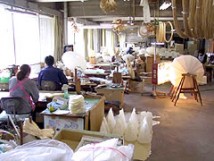
    Lanterns of various sizes are being made inside the factory.

    Craftsman Profile

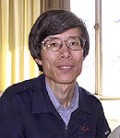
    Akio Suzumura

    Born in 1950 (Showa 25).
    After graduating from junior high school, I joined Ozeki Co., Ltd., a company that has been manufacturing GIFU Chochin (Lanterns) for over 100 years since the early Meiji period. For the past 30 years or so, I have worked as a lantern hanger, creating lanterns of all sizes.

    Anecdotes

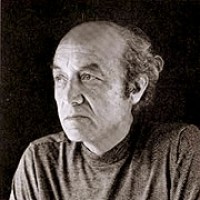
    "Akari" that captivated Isamu Noguchi


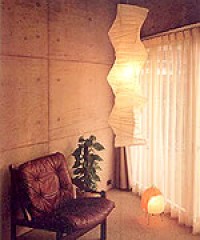
    • The "AKARI" series of floor lamps from Ozeki Co., Ltd., which has been consistently manufactured and sold since Isamu visited the factory in 1951.

    • Isamu Noguchi (1904-1988) had a Japanese father and an American mother.

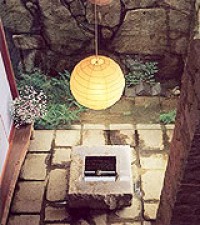
    • Pendant lights surprisingly blend well with both Japanese and Western-style spaces.


overview

Craft item name GIFU Chochin (Lanterns)
Reading Gifu lantern
Classification of crafts Other crafts
Main Products Lanterns, Ouchi lanterns
Main manufacturing area Gifu City, Yamagata City, Mizuho City, Ginan Town, Hashima District
Designated date April 5, 1995

contact address

■ Production area association

GIFU Chochin (Lanterns) Cooperative Association
500-8061
1-18 Oguma-cho, Gifu City, Gifu Prefecture
(Inside Ozeki Co., Ltd.)
TEL: 058-263-0111
FAX: 058-262-0058

http://www.gifu-chochin.or.jp/

Features

The shape is elegant, the craftsmanship is exquisite, and the lampshade is adorned with graceful and beautiful colored paintings. The bamboo frame is thin, the paper is extremely thin, and it is decorated with paintings of flowers and birds, landscapes, and figures. The shape is either spherical or oval.

How to make it

First, the lantern mold is assembled, and bamboo strips are wound spirally along the grooves carved into the mold. Next, glue is applied to the bamboo frame, and washi paper or silk is attached, with the excess parts being trimmed off. The lantern is then decorated by printing or drawing, and once it is dry, the mold is removed, the top and bottom rings are assembled, and any accessories are attached to complete the lantern.

Please see here for information on traditional craftspeople.

Japanese traditional craftsman
top